Apollo Hospital
 Fortis Hospital
 Artemis Hospital
 Max Hospital
 Columbia Asia Hospital
 Medanta Hospital


 Jaslok Hospital
 Lilavati Hospital


 Global Hospitals

 :
: Nasal Polyp Removal Surgery in India
Key Takeaways
- Parotidectomy is performed under general anaesthetic with an S‑shaped incision in front of the ear, removal of the swelling and part of the parotid gland, placement of a drain, and closure that aims to leave only a faint scar.
- Pre‑operative advice includes stopping smoking, managing blood pressure/heart/lung conditions, arranging a companion for post‑operative care, and bringing all current medications in their original packaging.
- After surgery most patients experience mild nausea for up to 24 hours, temporary clumsiness from anaesthesia, and discomfort on movement; drains are removed after 2–3 days and stitches or clips are typically taken out after 5–7 days, with normal bathing possible after about 10 days.
- Common postoperative complications are ear numbness (usually improves over 2–3 months but may persist slightly) and facial nerve weakness in about 1 in 10 patients, which typically recovers over 2–4 months; infection is uncommon and responds to antibiotics.
- Patients can usually return to work within 10 days and are advised to have follow‑up monitoring for possible recurrence, with pathology examination of the removed tissue and occasional need for further treatment such as radiotherapy.
What is it?
The parotid is a gland which makes saliva to wet the food in your mouth. It is shaped like a wedge and fits behind the back of your jawbone just in front of your ear. The saliva runs from the parotid gland along a tube which opens into your mouth near your back teeth.
The nerve to all your face muscles runs through the parotid gland and the nerve to the skin of your ear runs past the back of the parotid. If a swelling grows in the parotid gland, that part of the parotid has to be removed.
The Operation
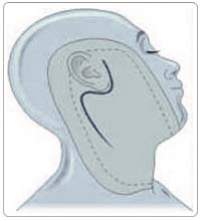 You will have a general anaesthetic, and will be asleep for the whole operation. An S-shaped cut is made down the skin crease in front of your ear, under your ear lobe, and down on to the side of your neck. The swelling together with some of the parotid gland is cut out.A small plastic tube is placedin the wound called a drain. this is connected to a small bottle and stops blood collecting under the skin. The skin is closed up. The wound is designed to heal leaving only a faint scar.
Any Alternatives
If you do nothing the problem in your parotid will slowly get worse. The bigger the swelling the more difficult it is to take out safely and the greater the risk of nerve damage. Sometimes the parotid problem needs extra treatment. The swelling needs to be taken out to find out if this is needed. Treating the swelling with x-rays or drugs on their own is not as good as an operation.
To get free no obligation Quote For Parotid Gland Removal - Parotidectomy Surgery in India :
Click HerePhone Numbers Reach Us-
India & International : +91-9860755000 / +91-9371136499
UK : +44-2081332571
Canada & USA : +1-4155992537
Before the operation
Stop smoking and try to get your weight down if you are overweight. If you know that you have problems with your blood pressure, your heart, or your lungs, ask your family doctor to check that these are under control. Check the hospital's advice about taking the pill or hormone replacement therapy (HRT). Check you have a relative or friend who can come with you to hospital, take you home, and look after you for the first week after the operation. Sort out any tablets, medicines, inhalers that you are using. Keep them in their original boxes and packets. Bring them to hospital with you.
On the ward, you may be checked for past illnesses and may have special tests, ready for the operation. Please tell the nurses of any allergies to tablets, medicines or dressings. You will have the operation explained to you and will be asked to fill in an operation consent form. Many hospitals now run special preadmission clinics, where you visit for an hour or two, a few weeks or so before the operation for these checks.
After - In Hospital
Some patients feel a bit sick for up to 24 hours after operation, but this passes off. You will be given some treatment for sickness if necessary. You may be given oxygen from a face mask for a few hours if you have had chest problems in the past. A general anaesthetic may make you slow, clumsy and forgetful for about 24 hours. Do not make important decisions during that time. There is usually some discomfort on moving rather than severe pain. You will be given injections or tablets to control this as required.
By the end of one week the wound should be virtually pain-free.Any drain tubes are removed after 2 or 3 days. The wound dressing may show some staining with old blood in the first 24 hours. The dressing will be removed and the wound will be sprayed with a cellulose varnish similar to nail varnish. There is no need for a dressing after this. The wound is held together with metal clips and does not need further attention. Some surgeons use a stitch deep inder the skin which cannot be seen, others use a glue for skin. There may be some purple bruising around the wound which spreads downwards by gravity and fades to a yellow colour after 2 to 3 days. It is not important.
There may be some swelling of the surrounding skin which also improves in 2 to 3 days. After 7 to 10 days, small crusts on the wound will fall off. The cellulose varnish will peel off and can be assisted with nail varnish remover. Any clips or stitches are reved after 5-7 days. You will be told when to come back to the ward for this. You can bathe, shower or shampoo normally after 10 days. The nurses will talk to you about your home arrangements so that a proper time for you to leave hospital can be arranged. Some hospitals arrange a check up about one month after you leave hospital. Others leave check-ups to the General Practitioner. The nurses will advise about sick notes, certificates etc.
After - At Home
You may feel rather tired for a week or so. You will gradually improve over the next 2 weeks. You can drive as soon as you leave hospital. You should be able to go back to work within 10 days.
Possible Complications
Most people have some numbness of the ear. This gets better over 2 to 3 months but may always be there slightly. Straight after the operation about 1 in 10 patients notices some weakness of the side of the mouth or some difficulty in closing the eye properly. This is caused by stretching or bruising of nerve fibres. Recovery takes an average of 2-4 months. Infection is an unusual problem and settles down with antibiotics in a week or two. Rarely there may be a little discharge of saliva through the wound for a week or two. This always gets better. Sometimes the skin over the temple sweats during a meal. This is rarely troublesome, but can be treated. The swelling in the parotid will be examined under a microscope to find out the exact type. Sometimes x-ray treatment is needed after the operation. The results and any further treatment will be discussed with you. Occasionally swellings come back on the operated side or even appear on the opposite side. You will be examined from time to time after the operation to check for this.
To get free no obligation Quote For Parotid Gland Removal - Parotidectomy Surgery in India :
Click HerePhone Numbers Reach Us-
India & International : +91-9860755000 / +91-9371136499
UK : +44-2081332571
Canada & USA : +1-4155992537
Some of the common countries from which patients travel to India for surgery are:
| USA | UK | Canada |
| Australia | New Zealand | Nigeria |
| Kenya | Ethiopia | Uganda |
| Tanzania | Zambia | Congo |
| Sri Lanka | Bangladesh | Pakistan |
| Afghanistan | Nepal | Uzbekistan |
Below are the downloadable links that will help you to plan your medical trip to India in a more organized and better way. Attached word and pdf files gives information that will help you to know India more and make your trip to India easy and memorable one.
| Click icon to Download Document | ||||||
| About India |  |  | Destinations in India | | | |
| Indian Embassy List | | | Medical Tourism FAQ | | | |
| Visa For India | | | ||||
Frequently Asked Questions
Related Articles:
- Septoplasty Surgery in India
- Stapedectomy Surgery in India
- Myringotomy Surgery in India
- Grommet Removal Surgery in India
Our objective is to empower patients with accurate, evidence-based, and patient-centric information, enabling them to make informed healthcare decisions with confidence. We combine reliable medical knowledge with personalized guidance and compassionate support, helping every patient choose the treatment that best serves their health and long-term well-being.
Quick Facts
Parotidectomy is the surgical removal of the parotid gland, typically performed to treat tumors or chronic infections.
Facial nerve weakness occurs in about 1 in 10 patients immediately after surgery due to nerve stretching or bruising, with recovery averaging 2 to 4 months.
Ear numbness is common and usually improves over 2 to 3 months, though slight permanent numbness may remain.
Saliva leakage or gustatory sweating may occur temporarily; recurrence monitoring is required postoperatively.
Last updated: May 2026