

Urosurgery and Reconstructive Urology in India for Patients from Somalia
Obstetric fistula is one of the most severe injuries in all of maternal health, and one of the most reliably fixable — a single, well-performed surgery restores what a difficult birth took away for the great majority of women who reach it.
A prolonged, obstructed labour without timely access to a caesarean section can leave a woman with an opening between the birth canal and the bladder, causing constant, uncontrollable leakage. It is a devastating injury, and it is also, in the great majority of cases, a genuinely correctable one through a single reconstructive surgery. For 24 years I have worked with women carrying this condition for far longer than medically necessary, simply because the surgery that fixes it was never within reach.
India performs fistula repair and reconstructive urology at real volume, with urogynaecologists and reconstructive urologists using vaginal, laparoscopic and open techniques matched to each case, achieving among the highest success rates recorded anywhere — at a fraction of the cost of the same care in the Gulf, Europe or the United States.
Healing Journeys of Somali Patients









Key Takeaways
- The guide identifies obstetric fistula as a major reconstructive urology concern for Somali women, linking its persistence to prolonged obstructed labour and limited access to timely caesarean delivery. It states that roughly 6 in 10 births in Somalia occur without a skilled birth attendant present.
- Fistula repair is presented as a highly successful reconstructive procedure at experienced centres, with approximately 85–95% first-attempt success and outcomes approaching complete success when a second repair is required.
- The page 2 chart gives an illustrative breakdown of reconstructive urology referrals from Somalia: 35% obstetric fistula, 25% urethral stricture, 20% congenital anomalies and 20% kidney stones/other conditions.
- The appropriate fistula repair technique depends on the size, location and previous repair history. Vaginal repair is generally preferred when suitable, while complex or recurrent cases may require abdominal or laparoscopic approaches.
- Reconstructive urology also covers urethral strictures, hypospadias and kidney stones, with treatment ranging from minor procedures and urethroplasty to keyhole stone surgery depending on the diagnosis.
- The guide recommends a dedicated fistula and reconstructive urology team. Patients should specifically ask how many fistula repairs the named surgeon performs each year rather than relying on general urology experience.
- Indicative all-in cost for reconstructive urology surgery in a reputable private Indian hospital is approximately US$2,000–US$5,000, with straightforward vaginal fistula repair generally toward the lower end and complex or recurrent cases toward the higher end.
- Somali patients should provide an honest delivery history and details of previous surgery or treatment before travel. This helps the specialist determine the appropriate reconstructive approach in advance.
- Important warning signs include no assessment of the fistula's exact size and location, only one surgical technique being offered, no catheter-care plan after surgery, and a quotation that keeps changing.
- The travel pathway includes routes through Nairobi, Addis Ababa, Dubai or Djibouti, medical-visa processing through the Indian mission in Addis Ababa or Nairobi, up to two medical attendants and a yellow-fever vaccination certificate where required.
Quick Facts
- Treatment
- Urosurgery and Reconstructive Urology
- Country
- India
- Patients
- Patients from Somalia
- Key Specialist
- Reconstructive Urologist / Urogynaecologist
- Main Condition
- Obstetric Fistula
- Other Conditions
- Urethral Stricture, Congenital Urological Conditions and Kidney Stones
- Primary Assessment
- Specialist Examination and Condition-Specific Evaluation
- Main Fistula Approaches
- Vaginal, Abdominal and Laparoscopic Repair
- Other Procedures
- Urethroplasty, Hypospadias Repair and Stone Treatment
- Indicative Cost
- US$2,000–US$5,000 All-In
- Important Check
- Dedicated Reconstructive Urology / Fistula Team
- Specialist Check
- Surgeon-Specific Fistula Repair Experience
- Success Rate
- 85–95% First-Attempt Fistula Repair at Experienced Centres
- Cost Check
- Written Quote Based on the Specific Case and Surgical Approach
- Pre-Travel Records
- Delivery History and Previous Treatment Details
- Travel Routes
- Nairobi, Addis Ababa, Dubai or Djibouti
- Visa
- Hospital Invitation and Medical Visa
- Attendants
- Up to Two Medical Attendants
- Post-Surgery Care
- Catheter Drainage and Follow-Up
- Follow-Up
- Ongoing Urology / Reconstructive Care
- Author
- Dr. Dheeraj Bojwani
- Experience
- 24+ Years
In Brief
For Somali patients considering reconstructive urology treatment in India, the guide recommends starting with a proper specialist assessment of the condition, previous treatment and, for fistula, the exact size and location of the opening before deciding on surgery. Patients should choose a dedicated reconstructive urology or fistula team capable of vaginal, abdominal and laparoscopic approaches where appropriate, confirm a clear catheter-care plan after repair and request a written quotation based on the specific procedure.
First, know why this injury is still common in Somalia specifically
Obstetric fistula has been virtually eliminated in countries where every woman in obstructed labour can reach a caesarean section within hours. It persists specifically where that access is unreliable — and in Somalia, roughly six in every ten births happen without a skilled birth attendant present at all. When labour becomes obstructed under these circumstances, the pressure of prolonged, unrelieved labour on the surrounding tissue can cause the injury directly. UNFPA identifies Somalia, alongside Yemen and Sudan, as among the countries in the region most affected by this condition today.
A devastating injury, and a genuinely fixable one
The consequences of fistula extend well beyond the physical: women affected often face social isolation and are, in some cases, abandoned by their families, on top of the physical burden of constant leakage. What matters most for anyone facing this diagnosis is the other half of the picture, which gets far less attention: at an experienced centre, first-attempt surgical repair succeeds in roughly 85 to 95% of cases, and outcomes approach total success once a second repair is performed in the small number of cases that need one. This is not an experimental or high-risk procedure. It is one of the more reliably successful operations in all of reconstructive surgery, performed at real scale in India for exactly this reason.
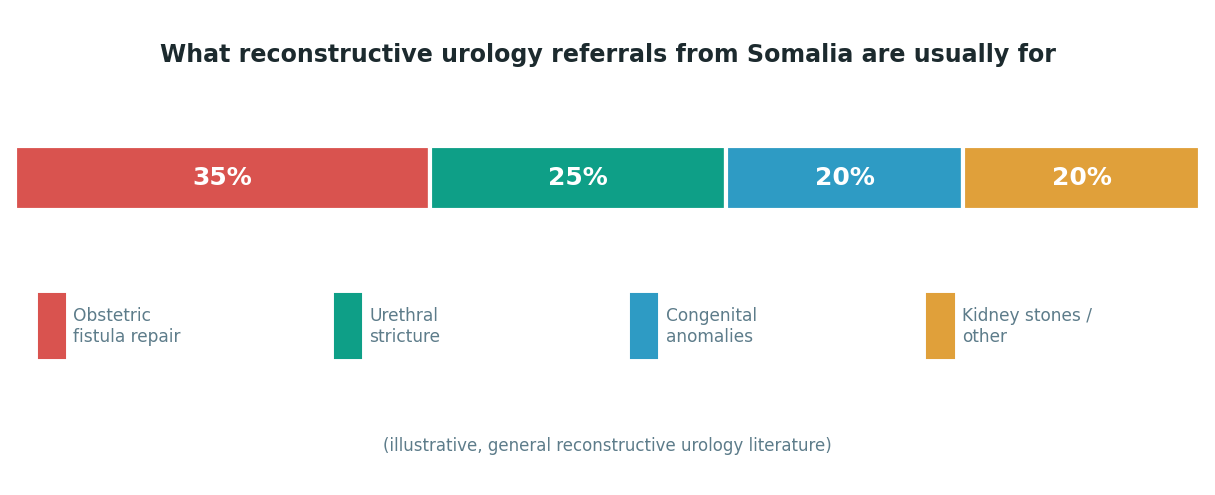
Illustrative breakdown of reconstructive urology referrals from Somalia, based on general reconstructive urology literature.
Why the surgical approach chosen actually matters
Fistula repair can be performed through the vaginal route, through the abdomen, or laparoscopically, and the right choice depends on the fistula's size, location and whether previous repair attempts have already been made. Vaginal repair generally means a shorter operation, a shorter hospital stay and lower cost, and is preferred wherever the fistula's location allows it; more complex or recurrent cases sometimes need an abdominal or laparoscopic approach with additional tissue reinforcement. A surgeon experienced across all three techniques, rather than one who only offers a single approach, is in a better position to match the technique to the case rather than the case to the technique they happen to know.
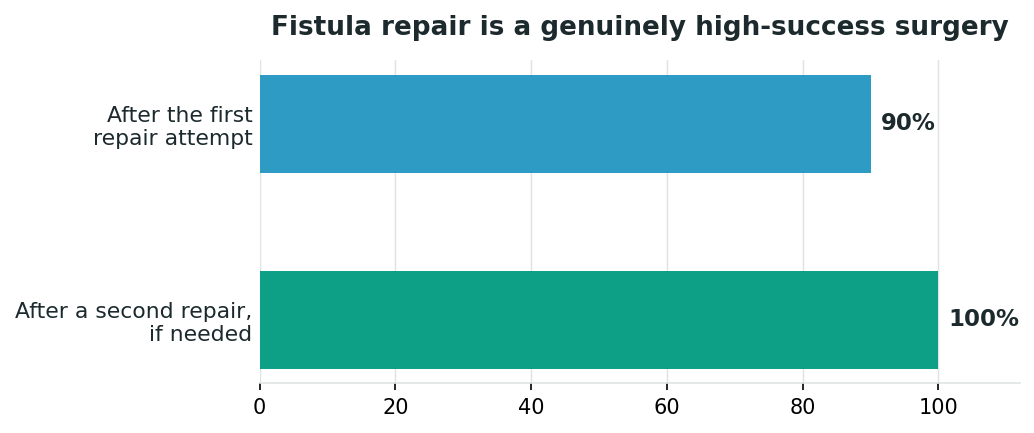
Published success rates for fistula repair surgery at experienced centres.
Know the warning signs, and do not wait them out
Continuous, uncontrollable leakage of urine beginning within days of a difficult, prolonged delivery, especially one involving labour that lasted a very long time or a stillbirth, is the hallmark sign of obstetric fistula and deserves a specialist evaluation, not an assumption that nothing can be done. Persistent leakage after any pelvic or gynaecological surgery, including a previous caesarean section, also warrants an assessment for a possible fistula, since not all cases follow childbirth directly. For urethral stricture, a urine stream that has become noticeably slower or more difficult over time, straining to urinate, or recurrent urinary infections are worth investigating. None of these conditions improve by waiting, and in the case of fistula specifically, the surgery that fixes it does not become harder to perform the longer someone waits, which makes there being no medical reason to delay seeking an evaluation once it becomes possible to do so.
Reconstructive urology covers more than fistula repair
This branch of surgery addresses a wide range of conditions beyond obstetric fistula. Urethral stricture, a narrowing that restricts urine flow, sometimes following an old injury or infection, is treated with reconstructive techniques ranging from a minor procedure to more involved urethroplasty for longer or recurrent strictures. Congenital conditions such as hypospadias, where the urinary opening does not form in the typical position in boys, are best corrected in early childhood with excellent long-term results. Kidney stones causing recurrent pain or blockage are treated with a range of techniques from shockwave therapy to keyhole surgery, chosen according to the stone's size and position. Each of these has its own evaluation and treatment pathway, and a proper diagnosis, not assumptions based on symptoms alone, determines which applies.
What it costs
In more than 24 years arranging this kind of care, the disputes I have seen were almost never about the price itself — they were about a diagnosis, or a cost, nobody had bothered to write down before the flight was booked. A quote should specify the surgical approach planned and whether it is a first attempt or a repair of a previous surgery, since recurrent cases are generally more complex.
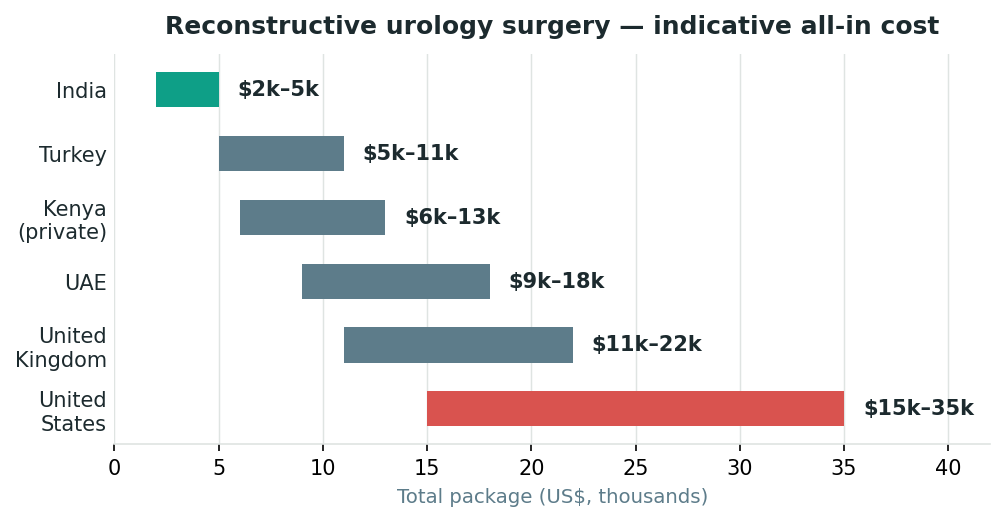
Indicative all-in cost for reconstructive urology surgery. India sits far below every common alternative.
Reconstructive urology surgery in a reputable private Indian hospital typically runs US$2,000 to US$5,000 all-in, with straightforward vaginal fistula repair toward the lower end and more complex or recurrent cases toward the top. Ask for the figure specific to your case and the surgical approach recommended.
Why a genuinely dedicated fistula and reconstructive urology team is what to look for
Fistula repair, in particular, is a procedure where outcomes are strongly linked to how often a specific surgeon performs it. Ask directly how many fistula repairs, not general gynaecological or urological cases, the named surgeon completes each year, and whether the hospital has a specific programme for this condition rather than treating it as an occasional case among many others. The same applies to congenital urological conditions in children: a paediatric urologist with focused experience in hypospadias or similar repairs achieves meaningfully better long-term results than a general urologist taking on the occasional paediatric case.
Four signals that should make you stop and walk away
No examination to confirm the fistula's exact size and location. This detail determines the surgical approach. A plan made without it is a plan made blind.
Only one surgical technique ever mentioned. Ask why vaginal, abdominal or laparoscopic repair specifically suits your case, not just that it is available.
No catheter care plan after surgery. Bladder rest and catheter drainage after repair is standard and important for healing. Its absence from the plan is a gap.
The price keeps moving. A verbal estimate that shifts each time you ask is not an estimate. Demand a fixed figure in writing.
The practical journey from Somalia — plan it before you fly
There is no direct flight between Somalia and India; patients route through Nairobi, Addis Ababa, Dubai or Djibouti. Because there is no full Indian mission inside Somalia, the medical visa is issued through the Embassy of India in Addis Ababa or the High Commission in Nairobi , against a written invitation letter from the treating hospital. Somali patients may bring up to two medical attendants on attendant visas. Since your route crosses yellow-fever territory, carry a valid yellow-fever vaccination certificate. Above every other instruction: send an honest account of your delivery history and any prior treatment already tried, not just a description of symptoms, so the surgical team can plan the right approach before you ever leave home. Complete discretion is standard practice throughout.
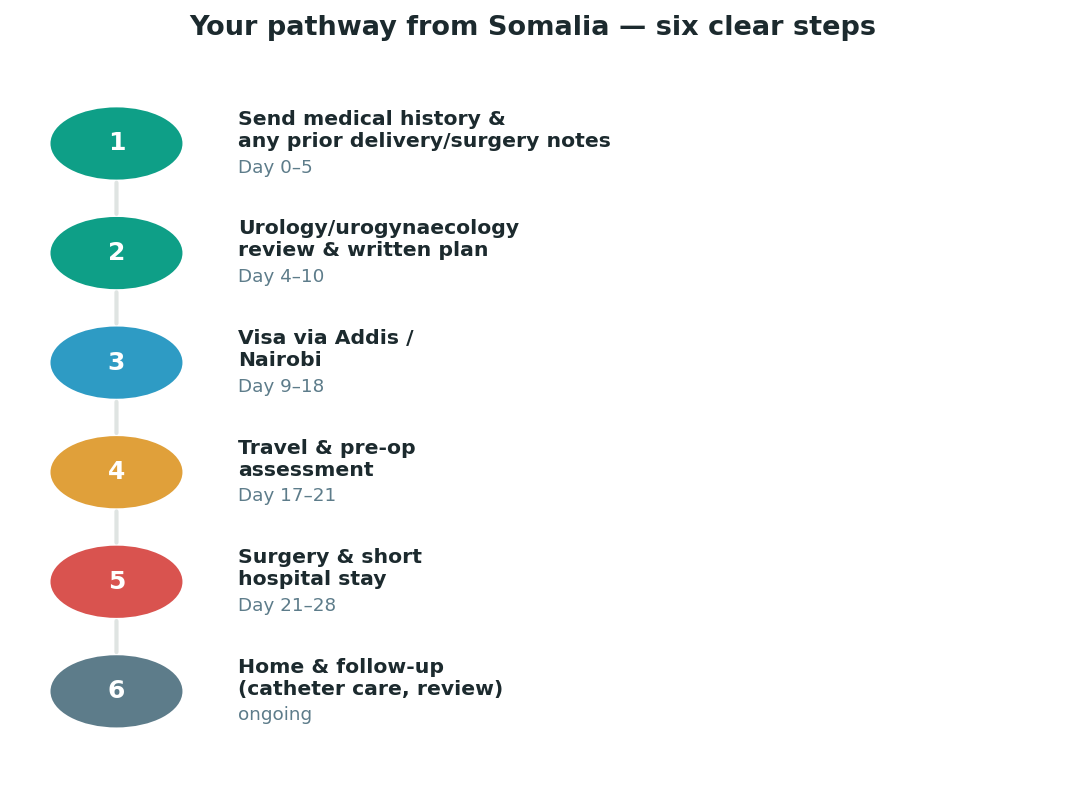
The complete route, start to finish — recovery typically includes a period of catheter drainage after discharge.
A difficult birth does not have to be a permanent sentence
Farhiya, a woman from rural Beletweyne, lived with fistula for a decade before reaching surgery that transformed her life within weeks. Her story is not unusual in its ending, only in how long it took to reach it. For every woman still waiting, that same ending is available far sooner than a decade away.
Sources & useful links
- 🌐 Indian medical visa (Somali nationals) — indianvisaonline.gov.in
- 🌐 Embassy of India, Addis Ababa — eoiaddisababa.gov.in
- 🌐 High Commission of India, Nairobi — hcinairobi.gov.in
- 🌐 Yellow-fever requirements — who.int/health-topics/yellow-fever
- 🌐 Hospital accreditation (India) — nabh.co · jointcommissioninternational.org
- 🌐 Verify a surgeon's registration — nmc.org.in
Do not decide alone, and do not decide blind
If you want your case reviewed properly and an honest written plan — including which surgical approach genuinely fits it — that is precisely the independent guidance I provide, without a single hospital's interest attached to my advice. Dr. Dheeraj Bojwani · Independent medical travel advisor
Frequently Asked Questions by Somali Patients about Urosurgery and Reconstructive Urology in India
What is the main reconstructive urology condition discussed for Somali patients?
The guide places particular emphasis on obstetric fistula, which can occur after prolonged obstructed labour and cause continuous, uncontrollable urine leakage.
How successful is fistula repair in India?
The guide states that experienced centres achieve approximately 85–95% success on the first repair attempt, with outcomes approaching complete success when a second repair is required.
What symptoms may indicate an obstetric fistula?
Continuous, uncontrollable urine leakage beginning shortly after a difficult or prolonged delivery, particularly after very prolonged labour or stillbirth, is identified as the hallmark warning sign.
Can fistula occur after a caesarean section or other pelvic surgery?
Yes. The guide notes that persistent urinary leakage after pelvic or gynaecological surgery, including a previous caesarean section, should also be evaluated for a possible fistula.
How is the appropriate fistula surgery selected?
The choice depends mainly on the size and location of the fistula and whether previous repair attempts have been performed. Vaginal repair is preferred where appropriate, while complex cases may need abdominal or laparoscopic surgery.
How much does reconstructive urology surgery cost in India for Somali patients?
The guide gives an indicative all-in range of US$2,000–US$5,000. Straightforward vaginal fistula repair is generally toward the lower end, while complex or recurrent cases may cost more.
Why should Somali patients choose a dedicated reconstructive urology team?
The guide recommends checking the surgeon's specific annual fistula-repair experience and whether the hospital has a dedicated programme rather than treating fistula as an occasional general urology or gynaecology case.
What should patients check about care after fistula surgery?
They should confirm that the treatment plan includes catheter drainage and bladder rest after surgery, as catheter care is important for healing.
What information should Somali patients provide before travelling to India?
Patients should provide an honest delivery history and details of any previous surgery or treatment. This allows the reconstructive team to plan the appropriate approach before travel.
What is the travel pathway from Somalia to India for reconstructive urology treatment?
The guide describes travel through Nairobi, Addis Ababa, Dubai or Djibouti, followed by medical-visa arrangements through the Indian mission, surgery and short hospital recovery. Up to two medical attendants may accompany the patient, and a yellow-fever vaccination certificate may be required depending on the route.
Page Summary
This guide explains the key considerations for Somali patients exploring urosurgery and reconstructive urology in India, with particular emphasis on obstetric fistula and its relationship to prolonged obstructed labour and limited access to skilled birth care. It covers fistula repair, urethral strictures, congenital urological conditions and kidney stones, explains how the fistula's size, location and previous repair history influence the surgical approach, and highlights the importance of a dedicated reconstructive team experienced in vaginal, abdominal and laparoscopic procedures. It also provides an indicative cost of US$2,000–US$5,000, identifies warning signs when selecting a provider, explains pre-travel information requirements, and outlines the six-step pathway from medical history and specialist review through visa, surgery, catheter care and long-term follow-up.
Citation Block
| Topic | Information |
|---|---|
| Topic Information | Urosurgery and Reconstructive Urology in India for Patients from Somalia |
| Treatment | Urosurgery and Reconstructive Urology |
| Intended Audience | Patients from Somalia |
| Key Specialist | Reconstructive Urologist / Urogynaecologist |
| Main Condition | Obstetric Fistula |
| Other Conditions | Urethral Stricture, Congenital Urological Conditions and Kidney Stones |
| Primary Assessment | Specialist Examination and Condition-Specific Evaluation |
| Main Fistula Approaches | Vaginal, Abdominal and Laparoscopic Repair |
| Indicative Cost | US$2,000–US$5,000 All-In |
| Fistula Success Rate | Approximately 85–95% at Experienced Centres on First Attempt |
| Important Specialist Check | Confirm the Named Surgeon's Fistula Repair Experience |
| Hospital Requirement | Dedicated Fistula and Reconstructive Urology Programme |
| Important Warning | No Examination to Confirm the Fistula's Exact Size and Location |
| Technique Warning | Only One Surgical Approach Offered Regardless of Findings |
| Post-Surgery Check | Confirm Catheter Drainage and Bladder-Rest Plan |
| Cost Check | Request a Fixed Written Quote Based on the Recommended Approach |
| Pre-Travel Records | Delivery History and Previous Surgery or Treatment Details |
| Travel Routes | Nairobi, Addis Ababa, Dubai or Djibouti |
| Visa Requirement | Hospital Invitation and Medical Visa |
| Patient Journey | Medical history → urology/urogynaecology review → visa → travel/pre-op assessment → surgery/recovery → catheter care and follow-up |
| Follow-Up | Catheter Care and Ongoing Reconstructive Urology Review |


Our Mission Statement
Our mission is to place patients at the centre of every healthcare decision by providing trustworthy, evidence-based, and unbiased medical information. We believe that informed patients make better decisions. Backed by personalised guidance from our experienced advisory team, we help patients understand their treatment options, compare them objectively, and confidently choose the path that best suits their medical needs and personal circumstances.
Patient Testimonials from Somalia




Ready to Take the First Step?
Share your Medical Reports with our Healthcare Managers Today and Get a FREE CONSULTATION, a Personalized Treatment Plan, and Complete Support from Arrival to Recovery.
Get Your Free ConsultationAreas We Serve
This resource has been thoughtfully prepared for patients from Somalia who are considering medical treatment in India. We also welcome patients from the wider region in the countries mentioned below-
We assist patients from:
- Ethiopia
- Djibouti
- Yemen
- Kenya
- Seychelles
- Somalia
- South Sudan
- Tanzania
- Uganda
- Zambia
- Zimbabwe
- Angola
- Cameroon
- Central African Republic
Many of the insights, treatment pathways, hospital recommendations, travel guidance, and patient support services described here are equally relevant and may be used as a reference when planning treatment in India.
From Somalia to India: Your Complete Patient Support Guide
- Best Brain Tumour Surgeons & Hospitals in India for Somali Patients
- Best Cancer Treatment Surgeons & Hospitals in India for Somali Patients
- Best Cardiac Surgeons & Hospitals in India for Somali Patients
- Best CyberKnife Teams & Centres in India for Somali Patients
- Best Heart Valve Replacement Surgeons & Hospitals in India for Somali Patients
- Best Hip Surgeons & Hospitals in India for Somali Patients
- Best Knee Surgeons & Hospitals in India for Somali Patients
- Best Neurosurgeons & Hospitals in India for Somali Patients
- Best Paediatric Cardiac Surgeons & Hospitals in India for Somali Patients
- Best Paediatric Neurosurgeons & Hospitals in India for Somali Patients
- Best Spine Surgeons & Hospitals in India for Somali Patients
- Bariatric Surgery in India for Patients from Somalia
- Brain Tumour Surgery in India for Patients from Somalia
- Cancer Treatment and Surgery in India for Patients from Somalia
- Cardiac Surgery in India for Patients from Somalia
- Cosmetic and Plastic Surgery in India for Patients from Somalia
- CyberKnife Treatment in India for Patients from Somalia
- Dental Surgery in India for Patients from Somalia