

CyberKnife Treatment in India for Patients from Somalia
Somalia does not own a single radiotherapy machine. The nearest advanced alternative, a robotic CyberKnife system in Kenya, is one machine explicitly expected to serve patients from Somalia, Ethiopia, Sudan, Tanzania and beyond. This guide is about what that machine actually does, and how to reach the same technology without competing for a single shared slot.
In 2023, Kenya installed East and Central Africa's first CyberKnife system — only the second in the entire continent. The manufacturer's own team said plainly, at launch, that they expected patients to travel there from Somalia, Ethiopia, Sudan, Tanzania and Nigeria, because nowhere closer offered this technology. That single sentence tells you almost everything about the scale of the gap: an entire region of hundreds of millions of people, sharing one machine. Before that machine existed at all, patients from this region who needed this kind of precision were sent further still, to Europe and to India. For 24 years I have guided exactly these referrals, and I write here as an independent adviser with no hospital's interest attached to my advice.
India has offered CyberKnife treatment for considerably longer than the region's newest installation, across multiple established centres with deep experience in exactly this technology — not a single machine serving several countries, but real capacity, at a fraction of what the same treatment costs in the West or the Gulf. For a Somali patient facing a tumour in a difficult location, that combination of depth of experience and genuine availability matters enormously.
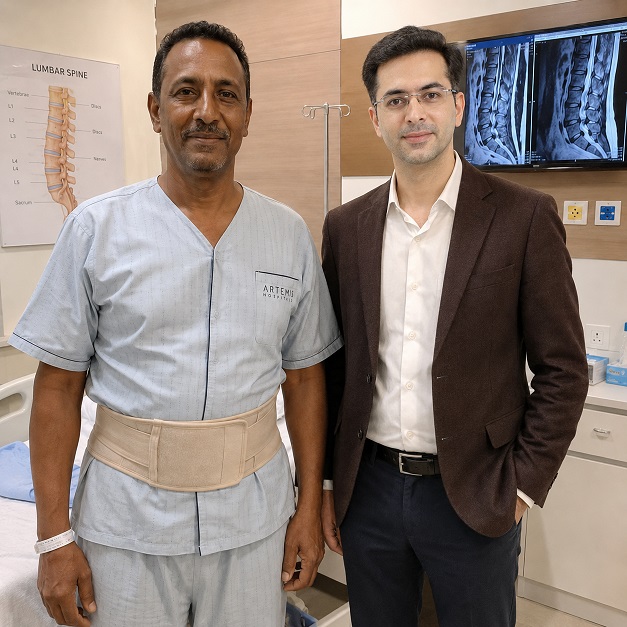
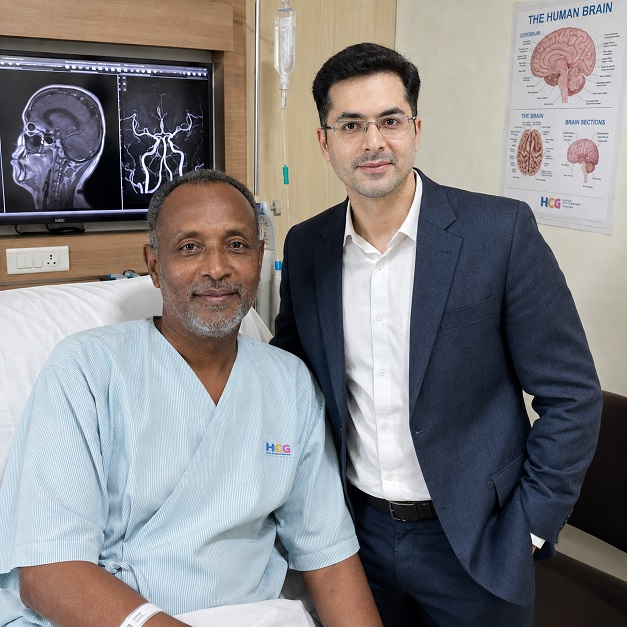
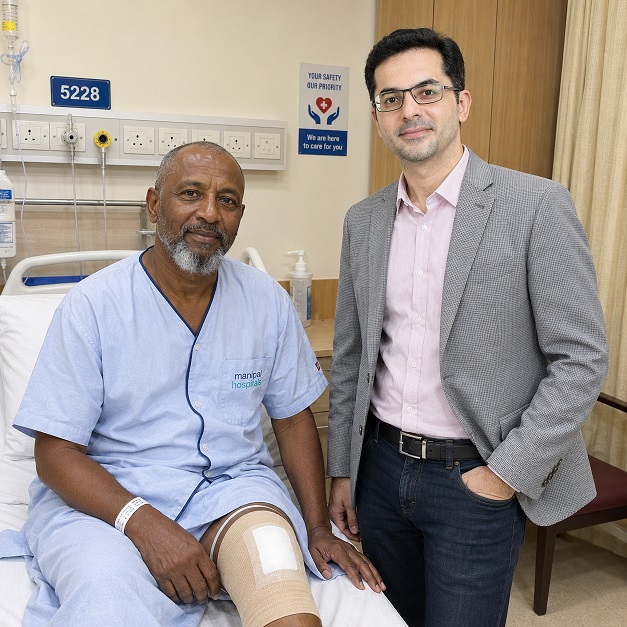
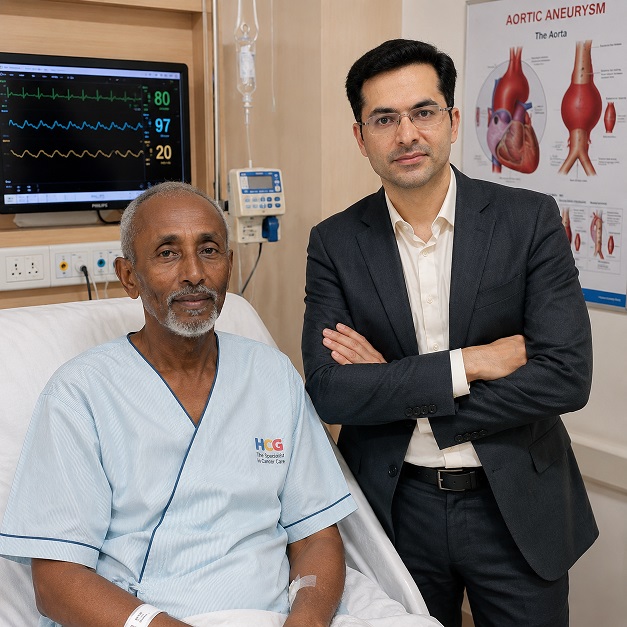
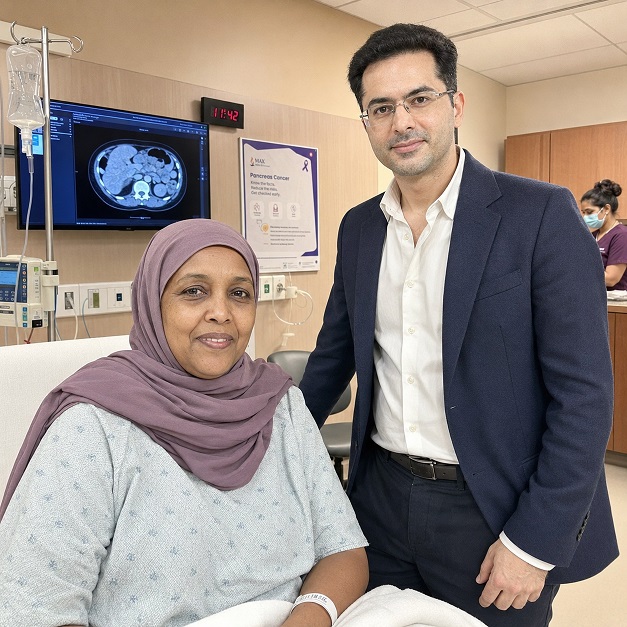
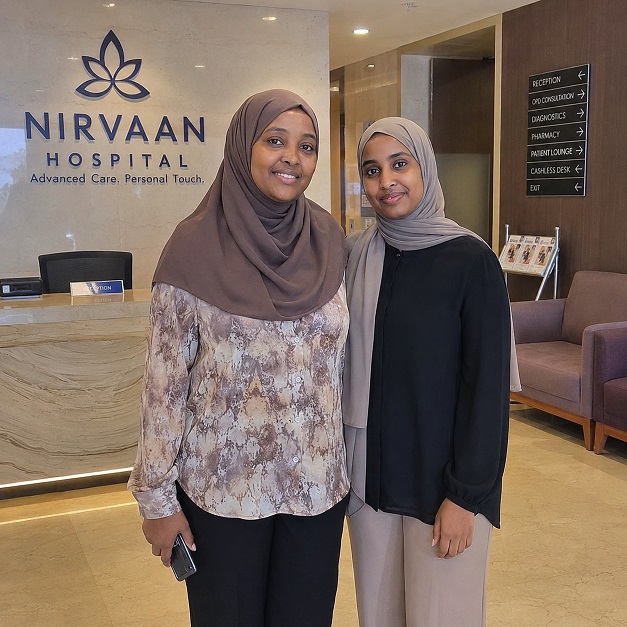
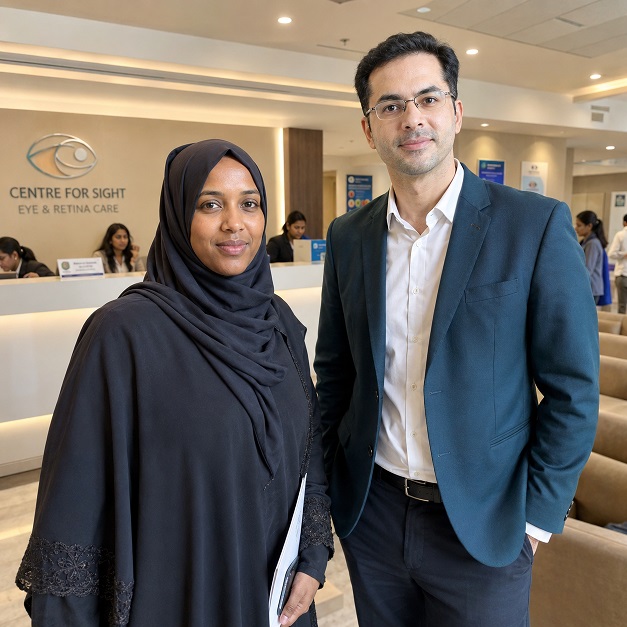
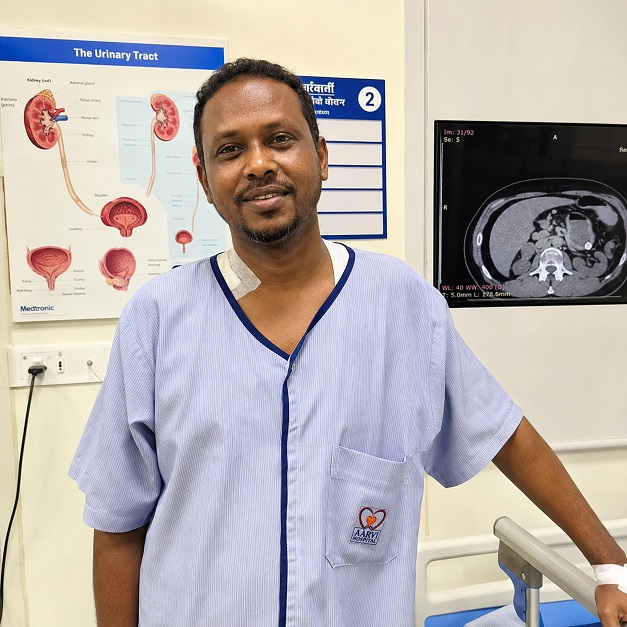
Healing Journeys of Somali Patients
Key Takeaways
- CyberKnife is not surgery and does not involve a knife. It uses a robotic arm to deliver highly targeted radiation with sub-millimetre accuracy, while real-time imaging adjusts for small movements, including breathing.
- For Somali patients, access is a major issue because the guide states that Somalia has no radiotherapy machine. The nearest advanced CyberKnife alternative described is Kenya’s single system, which is expected to serve patients from several countries in the region.
- One of CyberKnife’s main advantages for international patients is the short treatment course. The chart on page 2 compares approximately 1–5 CyberKnife sessions with 20–30 sessions for conventional radiotherapy.
- CyberKnife generally requires no incision or general anaesthesia, and most patients can leave the treatment centre on the same day after each session.
- The treatment is particularly useful for certain tumours in locations where conventional surgery may be risky, for patients who may not tolerate major surgery, and for selected recurrent tumours previously treated with radiation.
- The page 3 chart provides an illustrative CyberKnife case mix: brain tumours 28%, spine tumours 20%, lung cancer 18%, prostate cancer 16%, liver/pancreatic cancer 12%, and other lesions 6%.
- CyberKnife is not appropriate for every tumour. Tumour size, type and location determine eligibility, and the decision should be made by a radiation oncologist after reviewing the patient's actual scans and pathology.
- The guide stresses that the medical physics team matters as much as the CyberKnife machine. Patients should ask about the centre's experience, case volume for their particular tumour type, treatment planning and dose-verification process.
- A complete CyberKnife course in India is estimated at approximately US$3,500–US$8,000 all-in, covering planning, treatment sessions and follow-up imaging.
- The cost chart on page 4 compares India at US$3,500–US$8,000, Turkey at US$7,000–US$14,000, Kenya at US$8,000–US$16,000, UAE at US$12,000–US$24,000, United Kingdom at US$14,000–US$30,000, and United States at US$25,000–US$65,000.
Quick Facts
- Treatment
- CyberKnife Robotic Radiosurgery
- Country
- India
- Intended Audience
- Somali Patients
- Treatment Type
- Highly Targeted Robotic Radiation
- Surgery Required
- No
- Incision
- No
- General Anaesthesia
- No
- Typical CyberKnife Sessions
- 1–5
- Conventional Radiotherapy Sessions Compared
- 20–30
- Treatment Accuracy
- Sub-Millimetre
- Real-Time Imaging
- Yes
- Brain Tumours
- 28% illustrative case mix
- Spine Tumours
- 20%
- Lung Cancer
- 18%
In Brief
CyberKnife treatment in India offers Somali patients a non-invasive form of robotic radiosurgery that delivers highly targeted radiation without an incision or general anaesthesia. The guide highlights approximately 1–5 CyberKnife sessions compared with 20–30 sessions for conventional radiotherapy, which can significantly shorten the medical-travel period. Eligibility depends on tumour size, location and type and must be confirmed by a radiation oncologist. A complete CyberKnife course in India is estimated at approximately US$3,500–US$8,000 all-in.
What CyberKnife actually is, in plain terms
CyberKnife is not a knife at all. It is a robotic arm that delivers radiation with sub-millimetre accuracy, guided by real-time imaging that adjusts for the smallest movement, including a patient's own breathing. Because the targeting is this precise, the treatment can concentrate a high dose exactly on a tumour while sparing the healthy tissue around it — including tissue as delicate as the brainstem, spinal cord or optic nerves, where a wider margin of error would be genuinely dangerous. There is no incision, no general anaesthesia, and most patients walk in and out the same day for each session.
Why sessions matter so much when you are travelling from Somalia
This is where CyberKnife changes the practical arithmetic of medical travel entirely, not just the medicine. Conventional radiotherapy is delivered in small daily doses over many weeks, because it relies on lower precision and needs time between sessions for healthy tissue to recover. CyberKnife's precision allows a much higher dose per session, safely, which means the entire course is often finished in less than a week.
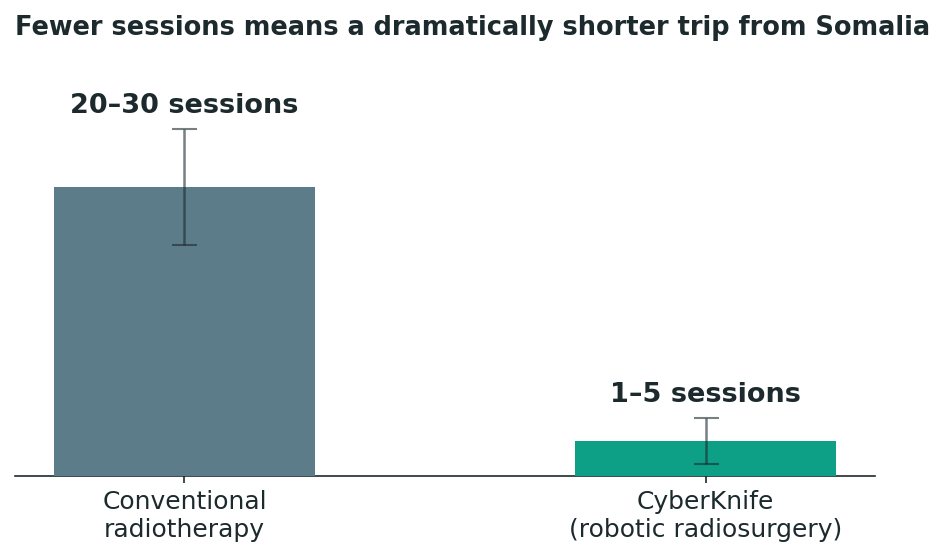
Fewer sessions means fewer days away from home, fewer flights, and a smaller total cost of travel.
What it can treat — and what it is especially good for
CyberKnife is used across a genuine range of tumours, though it is not a universal replacement for every treatment. It is particularly valuable for tumours in locations that make conventional surgery risky, for patients whose overall health makes a major operation unwise, and for tumours that have recurred in an area that already received radiation before, where conventional retreatment is often not possible.
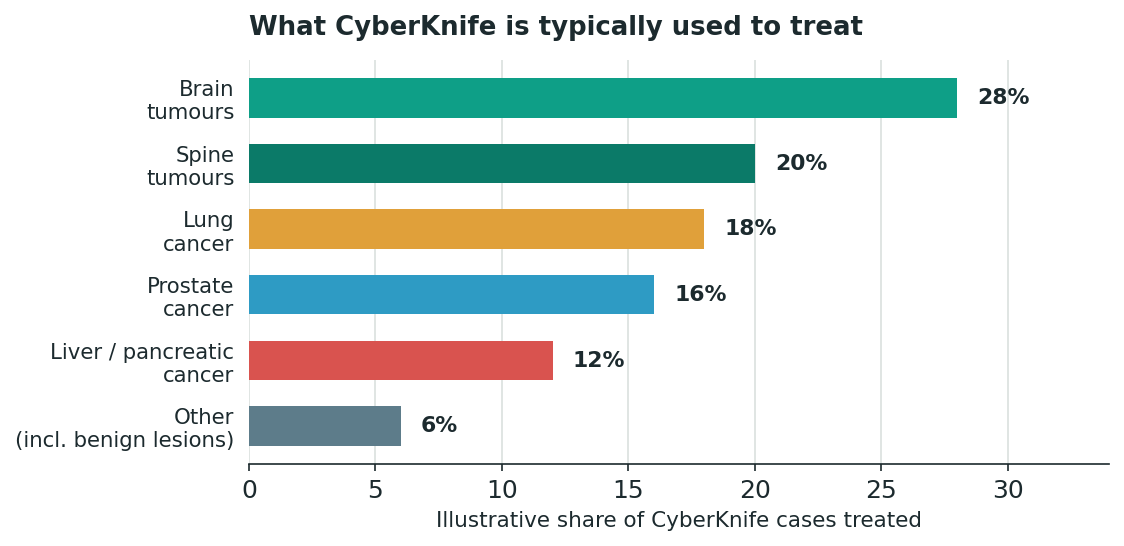
Illustrative case mix. A radiation oncologist confirms whether your specific tumour is a genuine candidate.
The Somali difference: the nearest option is one machine, shared by a region
Somalia has no radiotherapy capacity of any kind within its own borders. The nearest advanced alternative, Kenya's CyberKnife system, is genuinely excellent technology — but it is a single installation that its own operators openly expect to serve patients from at least five countries, Somalia among them by name. Even reaching that machine means competing for capacity built for one nation, now serving several.
India's centres have run this exact technology for longer, at greater scale, with teams who have treated far higher volumes of the specific tumour types common in patients referred from this region. That depth of experience, not just the existence of a machine, is what actually protects a patient's outcome.
Not every tumour is a candidate — and that is a genuine medical decision
A responsible team will not simply say yes to CyberKnife because a patient asks for it. Tumour size, location, and type all determine candidacy, and this decision should come from a radiation oncologist working with the wider team that reviewed your case, not from marketing material. If CyberKnife is not the right tool for your specific tumour, a good centre will say so plainly and explain the better alternative.
Choosing the centre: the physics team matters as much as the machine
CyberKnife treatment depends on meticulous planning by medical physicists as much as it depends on the machine itself — verifying that every dose calculation and every image-guided adjustment is exactly right before treatment begins. Ask how long the centre has operated its system, how many cases of your specific tumour type they have treated, and whether a dedicated medical physics team is genuinely part of daily practice, not a name on a brochure.
What it costs — a number you can actually plan around
Somalia has run on the US dollar for a generation, the shilling itself never meaningfully reissued since 1991, so it fits that Indian centres quote this care the same way — in dollars, not a currency that shifts by the week. A complete CyberKnife course in a reputable Indian centre typically runs US$3,500 to US$8,000 all-in, covering planning, all sessions and follow-up imaging. Set that beside the alternatives and the case makes itself.
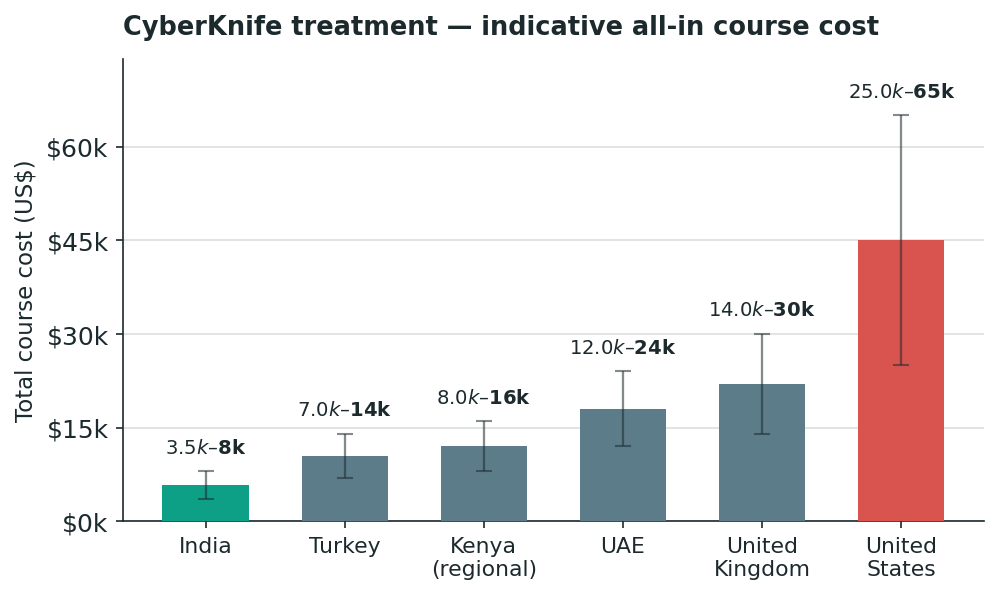
Indicative all-in cost for a complete CyberKnife course. India sits far below every common alternative.
One rule protects every Somali family who makes this journey: get the estimate in writing before a single flight is booked, and confirm it includes every planned session and follow-up scan, not just the first one. In more than 24 years arranging this kind of care, the disputes I have seen were almost never about the price itself — they were about a session count, or a follow-up scan, nobody had written down.
Four signals that should make you stop and walk away
- No radiation oncologist reviewed the scans — Candidacy for CyberKnife is a medical decision, not a booking form. Insist on real review first.
- No mention of the physics team — If nobody can describe the planning and verification process, ask more questions.
- Vague session count — A serious centre tells you the planned number of sessions before you travel, not after.
- The price keeps moving — A verbal estimate that shifts each time you ask is not an estimate. Demand a fixed figure in writing.
Straight answers
Is CyberKnife the same as surgery?
No. There is no incision and no general anaesthesia. It is a form of highly targeted radiation delivered by a robotic arm, not a physical removal of tissue.
Will it hurt?
The treatment itself is painless. Some patients notice mild tiredness or localised effects in the treated area afterward, but nothing comparable to surgical recovery.
How long will I need to stay in India?
Plan on roughly ten days to two weeks in total: time for a detailed planning scan, the treatment sessions themselves over several days, and a short recovery period before you are cleared to fly home.
What happens once I am home in Somalia?
You leave with a complete treatment record and a schedule for follow-up imaging. A properly run centre reviews your results remotely by phone or video — essential when specialist oncology follow-up inside Somalia remains extremely limited.
The practical journey from Somalia — plan it before you fly
The medicine is the easy part; the logistics are what genuinely trip families up. There is no direct flight between Somalia and India; patients route through Nairobi, Addis Ababa, Dubai or Djibouti. Because there is no full Indian mission inside Somalia, the medical visa is issued through the Embassy of India in Addis Ababa or the High Commission in Nairobi, against a written invitation letter from the treating centre. Somali patients may bring up to two medical attendants on attendant visas. Since your route crosses yellow-fever territory, carry a valid yellow-fever vaccination certificate. Above every other instruction: send your actual scans and pathology, not a written summary, so the team can confirm candidacy before you ever leave home.
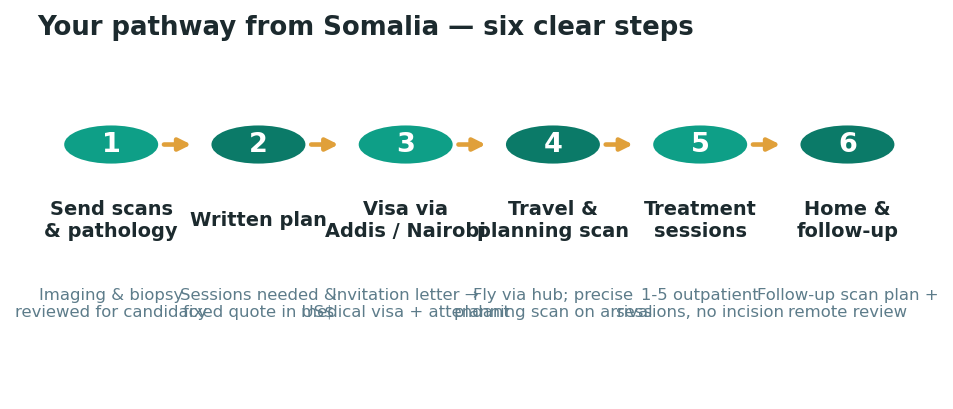
The complete route, start to finish — shorter than most treatments in this guide, thanks to the low session count.
The technology exists. The question is only how deliberately you reach it
A single shared machine a region away should never be the ceiling on what treatment is possible. India's depth of experience with this exact technology, reached with a clear plan rather than in a crisis, is what turns a difficult tumour into a treatable one.
Sources & Useful Links
- 🌐 Indian medical visa (Somali nationals): indianvisaonline.gov.in
- 🌐 Embassy of India, Addis Ababa: eoiaddisababa.gov.in
- 🌐 High Commission of India, Nairobi: hcinairobi.gov.in
- 🌐 Yellow-fever requirements: who.int/health-topics/yellow-fever
- 🌐 Hospital/centre accreditation (India): nabh.co · jointcommissioninternational.org
- 🌐 Verify a doctor's registration: nmc.org.in
Do not decide alone, and do not decide blind
If you want your scans reviewed properly and an honest written answer — including whether CyberKnife is genuinely the right tool for your tumour — that is precisely the independent guidance I provide, without a single hospital's interest attached to my advice.
Dr. Dheeraj Bojwani · Independent medical travel advisor
Frequently Asked Questions by Somali Patients about CyberKnife Treatment in India
Why do Somali patients travel to India for CyberKnife treatment?
Somalia has no domestic radiotherapy capacity, while India has established centres offering CyberKnife robotic radiosurgery. This gives Somali patients access to advanced precision radiation treatment.
How much does CyberKnife treatment cost in India for Somali patients?
A complete CyberKnife course in India typically costs around US$3,500–US$8,000 all-in. The guide states this covers planning, treatment sessions and follow-up imaging.
Which cancers can Somali patients receive CyberKnife treatment for in India?
CyberKnife may be considered for selected brain, spine, lung, prostate, liver and pancreatic tumours. A radiation oncologist must confirm suitability based on tumour type, size and location.
How many CyberKnife sessions will a Somali patient need in India?
CyberKnife usually requires approximately 1–5 treatment sessions, compared with 20–30 sessions for conventional radiotherapy in the guide. The exact number depends on the individual tumour.
How long should Somali patients stay in India for CyberKnife treatment?
Patients should generally plan approximately 10 days to two weeks in India. This allows time for treatment planning, CyberKnife sessions and a short recovery period before flying home.
What medical records should Somali patients send to India before travelling?
Patients should send their actual scans and pathology, not only written summaries. The Indian radiation oncology team can then assess whether CyberKnife is appropriate before travel.
Is CyberKnife in India an alternative to brain tumour surgery for Somali patients?
For selected tumours, CyberKnife may provide a non-invasive treatment option without an incision or general anaesthesia. However, it is not suitable for every brain tumour, so specialist review is essential.
Do Somali patients need hospital admission for CyberKnife treatment in India?
CyberKnife sessions are generally performed on an outpatient basis, and most patients can leave the centre the same day. Hospital admission is usually not required for each session.
How can Somali patients choose a CyberKnife centre in India?
Look for an experienced radiation oncology team and dedicated medical physics support. Patients should also ask about the centre's experience treating their specific tumour type.
What follow-up is needed after Somali patients return home?
Patients should return to Somalia with a complete treatment record and schedule for follow-up imaging. The treating centre can review results remotely by phone or video where appropriate.
Page Summary
This guide explains CyberKnife robotic radiosurgery in India for Somali patients, particularly in the context of Somalia having no domestic radiotherapy capacity. It describes CyberKnife as a robotic radiation system rather than conventional surgery, with no incision or general anaesthesia required, typically needing only 1–5 sessions compared with 20–30 for conventional radiotherapy. CyberKnife can be used for selected brain, spine, lung, prostate, liver and pancreatic tumours, but not every tumour is a genuine candidate — eligibility depends on tumour size, type and location and should be determined by a radiation oncologist. The experience of the centre's medical physics team is a major selection criterion. A complete CyberKnife course in India is estimated at approximately US$3,500–US$8,000 all-in, and Somali patients should send their actual scans and pathology before travelling to receive a written plan confirming candidacy, session count and cost.
Citation Block
| Topic | Information |
|---|---|
| Topic Information | Details |
| Procedure | CyberKnife Robotic Radiosurgery |
| Country | India |
| Intended Audience | Somali Patients |
| Conditions Covered | Brain Tumours, Spine Tumours, Lung Cancer, Prostate Cancer, Liver/Pancreatic Cancer and Other Selected Lesions |
| Procedure Type | Non-Invasive, Highly Targeted Robotic Radiation |
| Typical Sessions | Approximately 1–5 Sessions |
| Typical Stay | Approximately 10 Days to 2 Weeks in India |
| Hospital Stay | Usually Outpatient for Each Treatment Session |
| Anaesthesia | No General Anaesthesia |
| Recovery | Usually Short; Some Patients May Experience Mild Tiredness or Localised Effects |
| Average Treatment Cost | US$3,500–US$8,000 All-In |
| Cost Includes | Planning, All Treatment Sessions and Follow-Up Imaging |
| Eligibility | Depends on Tumour Size, Location and Type |


Our Mission Statement
Our mission is to place patients at the centre of every healthcare decision by providing trustworthy, evidence-based, and unbiased medical information. We believe that informed patients make better decisions. Backed by personalised guidance from our experienced advisory team, we help patients understand their treatment options, compare them objectively, and confidently choose the path that best suits their medical needs and personal circumstances.
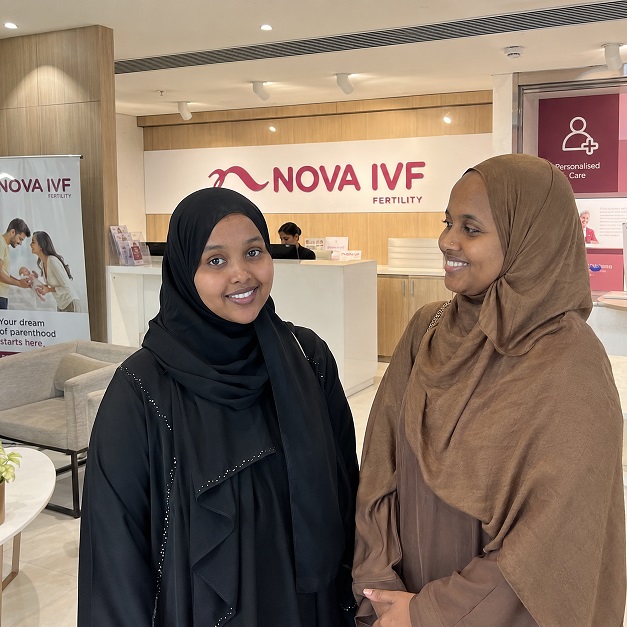
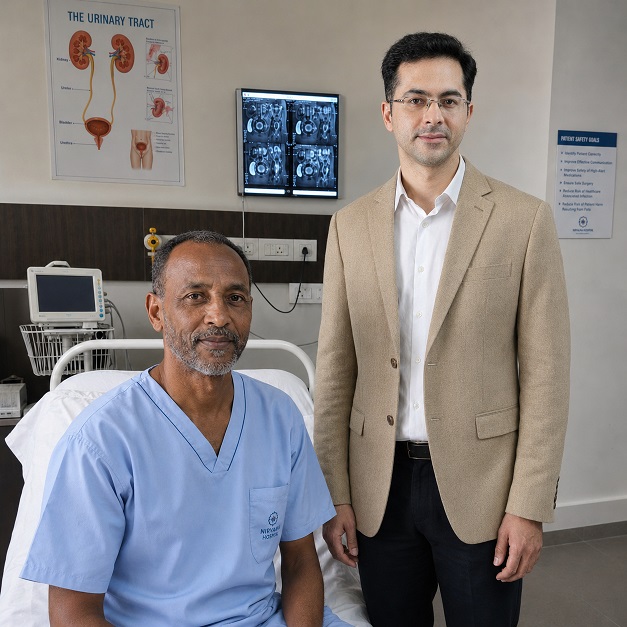
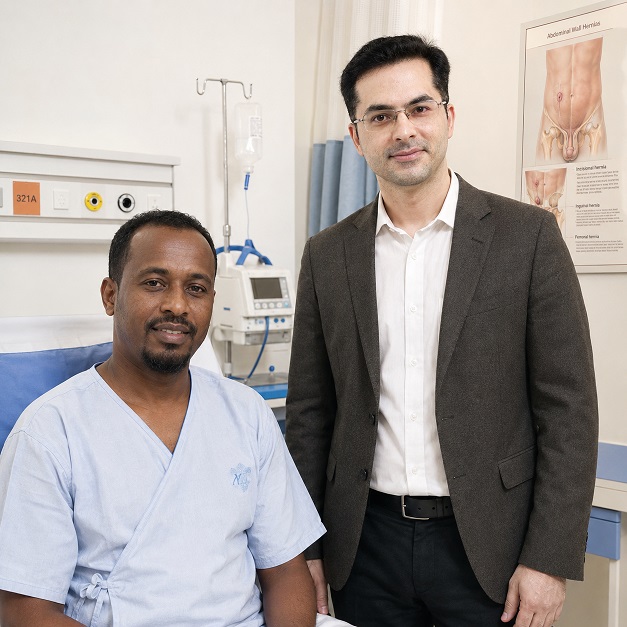
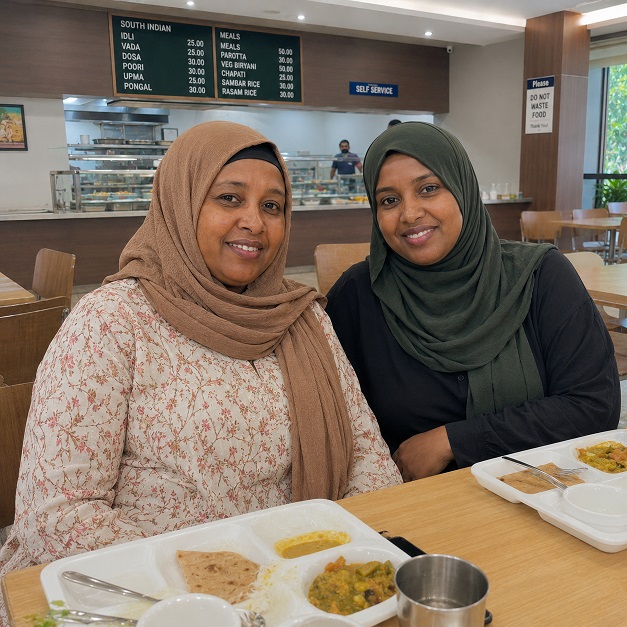
Patient Testimonials from Somalia
Ready to Take the First Step?
Share your Medical Reports with our Healthcare Managers Today and Get a FREE CONSULTATION, a Personalized Treatment Plan, and Complete Support from Arrival to Recovery.
Get Your Free ConsultationAreas We Serve
This resource has been thoughtfully prepared for patients from Somalia who are considering medical treatment in India. We also welcome patients from the wider region in the countries mentioned below-
We assist patients from:
- Ethiopia
- Djibouti
- Yemen
- Kenya
- Seychelles
- Somalia
- South Sudan
- Tanzania
- Uganda
- Zambia
- Zimbabwe
- Angola
- Cameroon
- Central African Republic
Many of the insights, treatment pathways, hospital recommendations, travel guidance, and patient support services described here are equally relevant and may be used as a reference when planning treatment in India.
From Somalia to India: Your Complete Patient Support Guide
- Best Brain Tumour Surgeons & Hospitals in India for Somali Patients
- Best Cancer Treatment Surgeons & Hospitals in India for Somali Patients
- Best Cardiac Surgeons & Hospitals in India for Somali Patients
- Best CyberKnife Teams & Centres in India for Somali Patients
- Best Heart Valve Replacement Surgeons & Hospitals in India for Somali Patients
- Best Hip Surgeons & Hospitals in India for Somali Patients
- Best Knee Surgeons & Hospitals in India for Somali Patients
- Best Neurosurgeons & Hospitals in India for Somali Patients
- Best Paediatric Cardiac Surgeons & Hospitals in India for Somali Patients
- Best Paediatric Neurosurgeons & Hospitals in India for Somali Patients
- Best Spine Surgeons & Hospitals in India for Somali Patients
- Bariatric Surgery in India for Patients from Somalia
- Brain Tumour Surgery in India for Patients from Somalia
- Cancer Treatment and Surgery in India for Patients from Somalia
- Cardiac Surgery in India for Patients from Somalia
- Cosmetic and Plastic Surgery in India for Patients from Somalia
- CyberKnife Treatment in India for Patients from Somalia
- Dental Surgery in India for Patients from Somalia