

Selecting the Best Knee Surgeons & Hospitals in India — A Somali Patient's Guide
Deciding to have your knee replaced in India is the easy part. Deciding who actually does it, and where, is the decision that determines whether you walk out of this pain-free for twenty years or spend the next two fighting complications. This guide is about that second decision.
Every year, more Somali patients decide that a knee replacement in India is the right choice — and nearly all of them stop thinking too soon after making that decision. They compare countries, glance at a price, and book with the first clinic that answers quickly. That is backwards. The country matters far less than the two specific choices inside it: which surgeon holds the instruments, and which hospital stands behind them if anything goes wrong. For 24 years I have watched good outcomes and poor ones come from patients who made this second decision carelessly, even after making the first one wisely. I write here as an independent adviser with no hospital's interest attached to my advice.
Healing Journeys of Somali Patients
Key Takeaways
- For Somali patients considering knee replacement in India, the guide recommends treating the surgeon and hospital as two separate decisions. The chart on page 2 gives a useful starting balance of 55% surgeon and 45% hospital.
- A major Somalia-specific concern is that knee damage may be post-traumatic rather than simple age-related arthritis. Old fractures, blast injuries and road-traffic injuries can leave complex joint damage that requires a surgeon experienced with previously injured or operated knees.
- The guide also highlights Somalia’s TB burden and recommends a pre-operative infection and TB work-up before knee replacement. Blood tests and imaging should be used to exclude infection before proceeding with surgery.
- Patients should look for a surgeon with a named fellowship in joint replacement or arthroplasty. The qualification pathway shown on page 4 is MBBS → MS/DNB Orthopaedics → Fellowship in Joint Replacement/Arthroplasty.
- Annual knee-replacement volume is given the highest importance in the page 4 ranking at 10/10. The guide describes 300 or more knee replacements per year as a meaningful benchmark for an individual surgeon.
- The page 3 chart presents illustrative good-outcome rates of 85% for fewer than 50 cases/year, 90% for 50–150, 94% for 150–300 and 97% for 300+ cases/year.
- Other surgeon-selection factors include experience with complex post-traumatic knees, transparent complication and revision rates, willingness to accept a second opinion and clear communication.
Quick Facts
- Specialty
- Orthopaedics / Knee Replacement
- Country
- India
- Intended Audience
- Somali Patients
- Core Principle
- Choose the surgeon and hospital separately.
- Surgeon/Hospital Weighting
- 55% / 45%
- Somalia-Specific Concern
- Post-traumatic knee damage
- Important Infection Concern
- Knee TB should be ruled out before replacement.
- Annual Volume Benchmark
- 300+ knee replacements/year
- Annual Case Volume Importance
- 10/10
- Joint-Replacement Fellowship
- 9/10
- NABH/JCI Accreditation
- 9/10
- Post-Traumatic Knee Experience
- 8/10
- Pre-Operative Infection/TB Work-Up
- 8/10
- Named Implant Brand & System
- 8/10
In Brief
Somali patients choosing knee replacement in India should evaluate the surgeon and hospital separately, with a suggested 55% surgeon and 45% hospital weighting. Important factors include annual knee-replacement volume, joint-replacement fellowship training, experience with post-traumatic knees, pre-operative TB/infection screening, implant transparency and physiotherapy from day one. The guide estimates knee replacement at approximately US$4,200–US$7,000 all-in.
First, should you travel at all?
Somalia's general hospitals in Mogadishu and Hargeisa can manage fractures, basic trauma care and emergency orthopaedic needs. What they cannot yet offer, at meaningful scale, is elective joint replacement — the implants, the specialised operating theatres, and above all the volume of cases that builds real surgical judgement. If your knee has reached the point where daily pain, night pain or a shrinking walking distance define your life, travelling for a properly performed replacement is not an extravagance. It is the only realistic route to a normal knee.
The one clinical fact that should shape your whole search
A large share of knee damage referred from Somalia is not simple age-related wear. It is post- traumatic — old fractures, blast and road-traffic injuries that healed badly and wore the joint out decades early — and Somalia's high tuberculosis burden means TB of the knee is a genuine possibility that must be ruled out before any replacement is planned. This changes what you should look for. You do not just need a surgeon who replaces knees. You need one genuinely comfortable with complex, previously injured joints, at a hospital willing to test for infection before assuming straightforward arthritis.
Two decisions, not one
Patients consistently under-weigh the hospital and over-weigh the surgeon, or the reverse, when both deserve deliberate, separate attention. A brilliant surgeon inside a hospital with poor infection control is not a safe choice. A superb hospital with an inexperienced surgeon operating inside it is not one either. As a rough guide, weigh the surgeon slightly more heavily — but never treat the hospital as an afterthought.
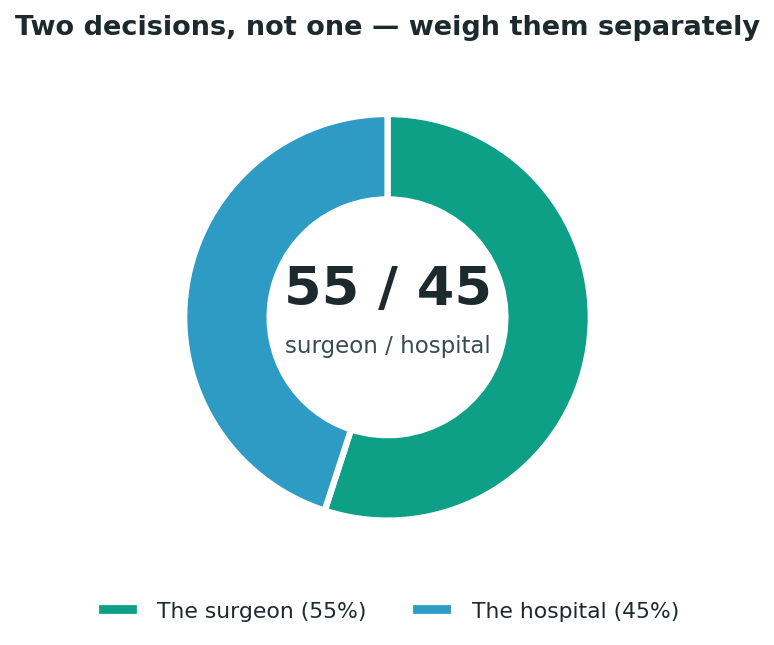
A useful starting balance. Adjust it, but never let either side reach zero.
Part One: Choosing the Surgeon
1. A named fellowship in joint replacement. A general orthopaedic qualification is the foundation, not the finish line. Ask for the specific fellowship and where it was completed.
2. Genuine annual volume. Ask how many knee replacements this specific surgeon performs each year, not the hospital as a whole. Three hundred or more a year is a meaningful benchmark.
3. Comfort with complex, post-traumatic knees. Given how common this is among Somali patients, ask directly how many previously injured or operated knees they have handled, not just routine arthritis.
4. A real pre-operative infection work-up. A surgeon who orders bloodwork and imaging to exclude TB before committing to surgery is protecting you from a serious, avoidable complication.
5. Transparent complication and revision rates. Every surgeon has some. One who shares real numbers is more trustworthy than one who claims none.
6. Comfort with a second opinion. A confident surgeon welcomes another specialist reviewing your scans. Reluctance here is itself useful information.
7. Clear, direct communication. You should be able to ask a difficult question and receive a plain, honest answer, not a reassuring deflection.
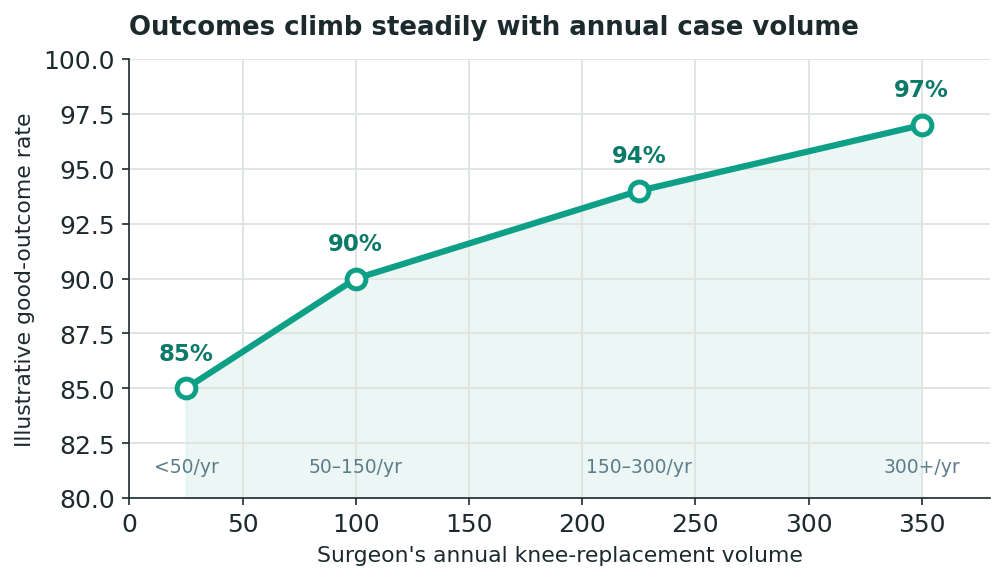
Volume is not vanity. It is the clearest predictor of a safe result available to you.
Part Two: Choosing the Hospital
8. NABH accreditation in India, or international JCI accreditation. These are independently verified standards of safety and process, not formalities.
9. A dedicated joint-replacement unit. A hospital that treats this as a core specialty, not one service among dozens, invests accordingly.
10. Named implant brand and system. Insist on knowing the exact manufacturer and model before surgery, not after. This record matters if any future issue arises.
11. On-site physiotherapy from the first day. Early, supervised movement is what actually determines your long-term result, not the surgery alone.
12. Genuine international patient support. A hospital used to patients from Somalia will have interpreters and realistic guidance on visa and logistics.
13. Infection control track record. Ask directly about surgical site infection rates. A confident hospital will share them.
14. Remote follow-up after you fly home. Confirm, in writing, how your recovery will be monitored once you are back in Somalia.
| Stage | Qualification | What it confirms |
|---|---|---|
| 1 | MBBS | Basic medical degree, the foundation for every doctor. |
| 2 | MS / DNB (Orthopaedics) | Specialist postgraduate training in orthopaedic surgery. |
| 3 | Fellowship in Joint Replacement / Arthroplasty | Focused, advanced training specifically in knee and hip replacement. |
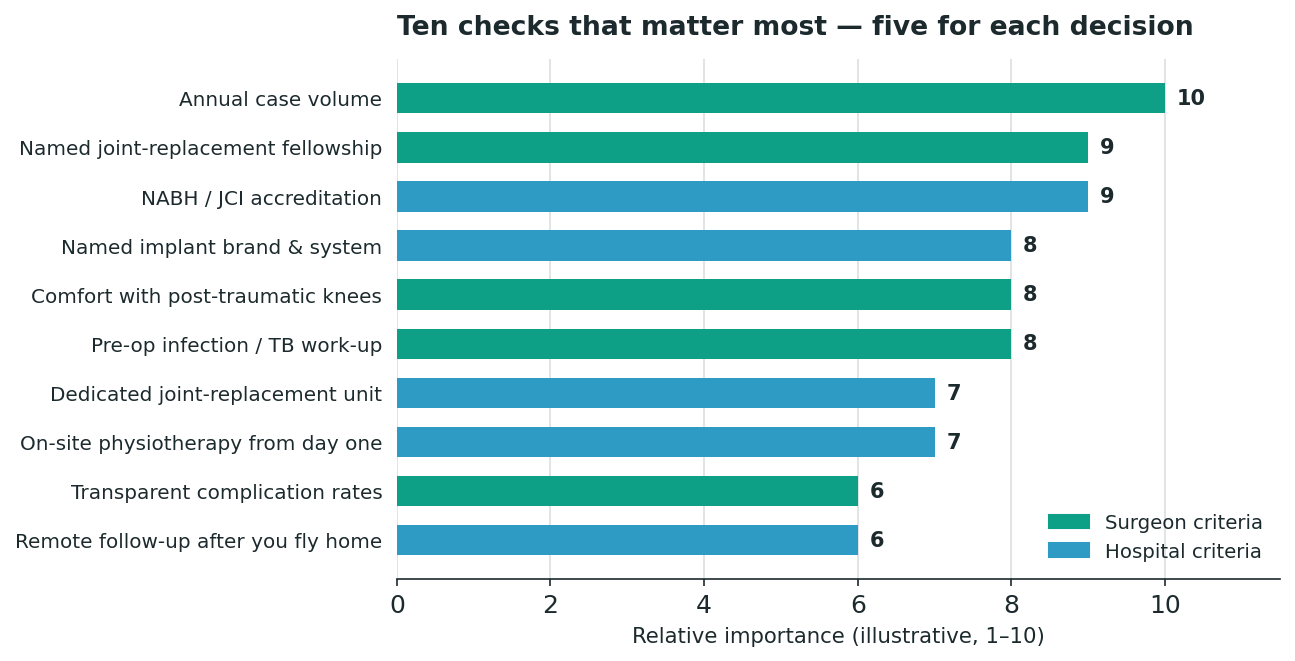
The ten criteria that matter most, ranked by how much weight each should carry in your decision.
Cost and value are not the same conversation
Somalia has run on the US dollar for a generation, the shilling itself never meaningfully reissued since 1991, so Indian hospitals quoting in dollars is a genuine convenience, not a complication. A well- chosen surgeon and hospital combination for knee replacement typically costs US$4,200 to US$7,000 all-in. The cheapest quote is rarely the best value; the criteria above are what actually protect the money you are spending, not the number on the invoice alone. In more than 24 years arranging this kind of care, the patients who chose on price alone were the ones most likely to call me again, later, with a problem.
What a Somali patient should weigh in particular
Beyond the universal criteria above, a few things matter specifically for you. Confirm the surgeon has genuine experience with knees damaged by old trauma, not just degenerative wear, since this is disproportionately common in Somali referrals. Insist on TB and infection screening as a standard part of the work-up, not an optional extra. Because funds are often gathered from relatives abroad, get every cost element in writing before travel, so contributions are made against a real number. And send your actual X-rays, not a written description, so the surgeon can plan the real operation before you ever leave home.
The practical journey from Somalia
There is no direct flight between Somalia and India; patients route through Nairobi, Addis Ababa, Dubai or Djibouti. Because there is no full Indian mission inside Somalia, the medical visa is issued through the Embassy of India in Addis Ababa or the High Commission in Nairobi, against a written invitation letter from your chosen hospital. Somali patients may bring up to two medical attendants on attendant visas. Since your route crosses yellow-fever territory, carry a valid yellow-fever vaccination certificate.
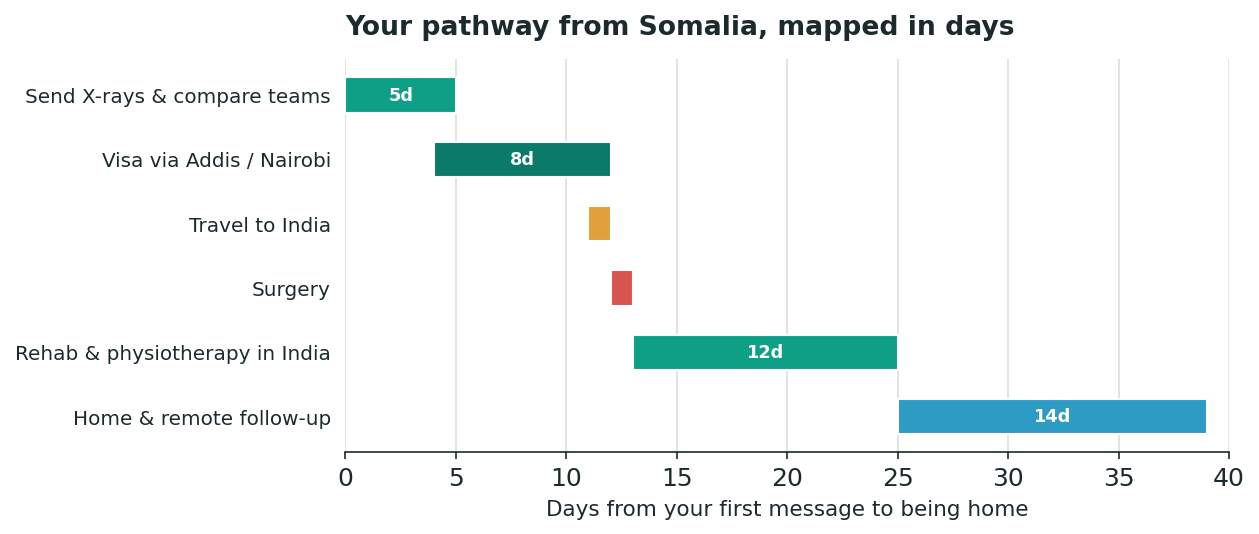
Mapped in days, not just steps — most of the early ones happen before you ever leave Somalia.
Four signals that should make you pause
- No named surgeon — If a clinic cannot tell you exactly who will operate before you travel, treat that as a serious warning.
- No infection screening mentioned — Given Somalia's TB burden, skipping this step is a genuine safety risk, not a shortcut.
- Implant brand undisclosed — If nobody will name the exact implant before surgery, ask why, and consider looking elsewhere.
- Pressure to decide immediately — A reputable team gives you time to compare. Urgency is a sales tactic, not a medical one.
Straight answers
Should I choose the surgeon first, or the hospital first?
Start with the surgeon, since their skill and judgement matter most, but never finalise a booking until you have separately verified the hospital meets every criterion above.
Is a bigger, more famous hospital always the safer choice?
Not automatically. A smaller unit with a genuinely high-volume, fellowship-trained joint-replacement surgeon can outperform a large general hospital where knee replacement is only one service among many.
Can I speak to the surgeon before I travel?
Yes, and you should insist on it. A video or phone consultation reviewing your actual X-rays before booking flights is a reasonable, standard request that any serious team will accommodate.
What if the surgeon and hospital give different quotes later?
This should not happen if you have a written estimate. If it does, treat it as a serious signal and ask for a full, itemised explanation before proceeding.
The right choice, made once, protects everything that follows
A knee replacement should be a decision you make once, carefully, not a gamble you correct twice. Take the time these ten questions require. The country got you this far; the surgeon and the hospital decide the rest.
Sources & Useful Links
- 🌐 Indian medical visa (Somali nationals): indianvisaonline.gov.in
- 🌐 Embassy of India, Addis Ababa: eoiaddisababa.gov.in
- 🌐 High Commission of India, Nairobi: hcinairobi.gov.in
- 🌐 Yellow-fever requirements: who.int/health-topics/yellow-fever
- 🌐 Hospital accreditation (India): nabh.co · jointcommissioninternational.org
- 🌐 Verify a surgeon's registration: nmc.org.in
Do not choose alone, and do not choose blind
If you want help verifying a surgeon's qualifications, comparing hospital options, and getting a written, itemised quote before you travel, that is precisely the independent guidance I provide, without a single hospital's interest attached to my advice.
Dr. Dheeraj Bojwani · Independent medical travel advisor
Frequently Asked Questions by Somalis about Knee Surgeons & Hospitals in India
How should Somali patients choose the best knee surgeon in India?
Choose a surgeon with a joint-replacement fellowship, high annual knee-replacement volume and experience with complex post-traumatic knees. The guide suggests weighing the surgeon at 55% of the decision.
Why is post-traumatic knee experience important for Somali patients?
The guide notes that many Somali referrals involve old fractures, blast injuries and road-traffic injuries, rather than only age-related arthritis. These cases may require more complex surgical planning.
Should Somali patients be screened for knee TB before replacement?
Yes. The guide specifically recommends a pre-operative infection and TB work-up before knee replacement because Somalia has a high tuberculosis burden.
How much does knee replacement in India cost for Somali patients?
The guide estimates approximately US$4,200–US$7,000 all-in for knee replacement. Patients should obtain every cost component in writing before travelling.
Does a knee surgeon’s annual surgery volume matter?
Yes. The guide identifies 300+ knee replacements per year as a meaningful benchmark and ranks annual case volume at 10/10 in importance.
What hospital facilities should Somali patients look for?
Look for NABH/JCI accreditation, a dedicated joint-replacement unit and physiotherapy from the first day. Infection-control performance should also be checked.
Should patients know which knee implant will be used?
Yes. Patients should ask for the exact implant manufacturer and model before surgery. The guide considers implant transparency an important hospital-selection criterion.
What should Somali patients send before travelling to India?
Patients should send their actual knee X-rays rather than only written descriptions. This allows the surgeon to review and plan the case before travel.
How long should patients plan for rehabilitation in India?
The page 5 journey chart shows approximately 12 days for rehabilitation and physiotherapy in India. Actual recovery time depends on the knee condition and surgical complexity.
What are the warning signs when choosing a knee surgery provider?
The guide highlights four red flags: no named surgeon, no infection screening, implant brand undisclosed and pressure to decide immediately.
Page Summary
This guide explains how Somali patients should select knee surgeons and hospitals in India. Its central message is that choosing India is only the first decision—the individual surgeon and hospital ultimately determine the quality and safety of knee replacement care. The guide gives particular attention to post-traumatic knee damage and possible knee TB. Somali patients may present with knees damaged by old fractures, blast injuries or road-traffic injuries, making complex knee experience and infection screening especially important.
Citation Block
| Topic | Information |
|---|---|
| Topic Information | Details |
| Procedure | Knee Replacement Surgery |
| Country | India |
| Intended Audience | Somali Patients |
| Conditions Covered | Post-Traumatic Knee Damage, Old Fracture-Related Joint Damage, Degenerative Knee Disease and Suspected Knee TB Requiring Exclusion |
| Procedures | Knee Replacement, Pre-Operative Infection/TB Screening, Implant-Based Joint Replacement and Postoperative Physiotherapy |
| Typical Stay | Approximately 12 Days for Rehabilitation and Physiotherapy in India as Shown in the Journey Chart |
| Hospital Stay | Not Specifically Stated in the Guide |
| Recovery | Depends on Knee Damage, Surgical Complexity and Rehabilitation Progress |
| Average Treatment Cost | US$4,200–US$7,000 All-In |
| Key Surgeon Criterion | Annual Knee-Replacement Volume |
| Annual Volume Benchmark | 300+ Knee Replacements Per Year |
| Key Somalia-Specific Consideration | Post-Traumatic Knee Expertise and Pre-Operative TB/Infection Screening |
| Surgeon/Hospital Weighting | 55% Surgeon / 45% Hospital |

Our Mission Statement
Our mission is to place patients at the centre of every healthcare decision by providing trustworthy, evidence-based, and unbiased medical information. We believe that informed patients make better decisions. Backed by personalised guidance from our experienced advisory team, we help patients understand their treatment options, compare them objectively, and confidently choose the path that best suits their medical needs and personal circumstances.
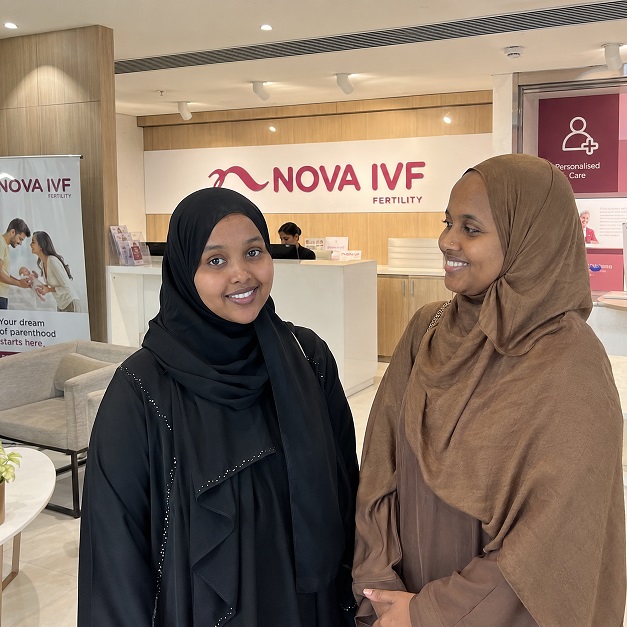
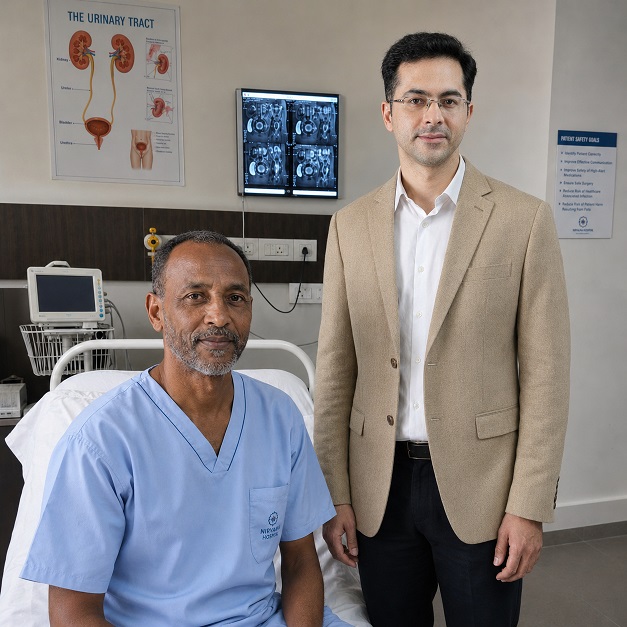
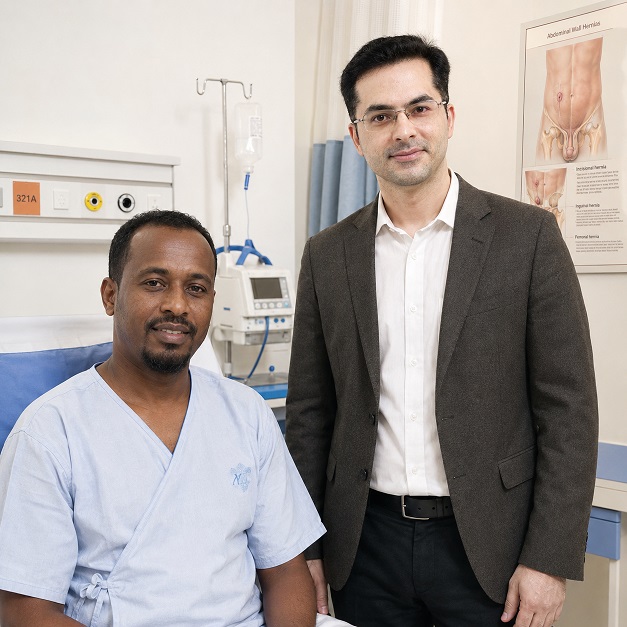
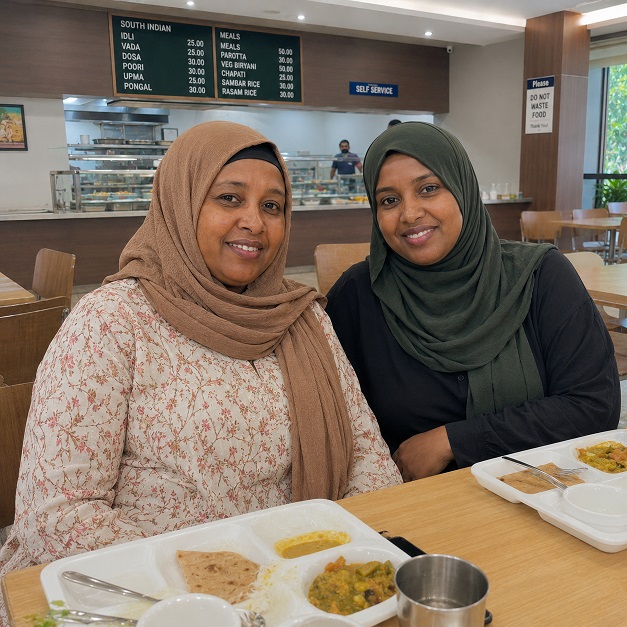
Patient Testimonials from Somalia
Ready to Take the First Step?
Share your Medical Reports with our Healthcare Managers Today and Get a FREE CONSULTATION, a Personalized Treatment Plan, and Complete Support from Arrival to Recovery.
Get Your Free ConsultationAreas We Serve
This resource has been thoughtfully prepared for patients from Somalia who are considering medical treatment in India. We also welcome patients from the wider region in the countries mentioned below-
We assist patients from:
- Ethiopia
- Djibouti
- Yemen
- Kenya
- Seychelles
- Somalia
- South Sudan
- Tanzania
- Uganda
- Zambia
- Zimbabwe
- Angola
- Cameroon
- Central African Republic
Many of the insights, treatment pathways, hospital recommendations, travel guidance, and patient support services described here are equally relevant and may be used as a reference when planning treatment in India.
From Somalia to India: Your Complete Patient Support Guide
- Best Brain Tumour Surgeons & Hospitals in India for Somali Patients
- Best Cancer Treatment Surgeons & Hospitals in India for Somali Patients
- Best Cardiac Surgeons & Hospitals in India for Somali Patients
- Best CyberKnife Teams & Centres in India for Somali Patients
- Best Heart Valve Replacement Surgeons & Hospitals in India for Somali Patients
- Best Hip Surgeons & Hospitals in India for Somali Patients
- Best Knee Surgeons & Hospitals in India for Somali Patients
- Best Neurosurgeons & Hospitals in India for Somali Patients
- Best Paediatric Cardiac Surgeons & Hospitals in India for Somali Patients
- Best Paediatric Neurosurgeons & Hospitals in India for Somali Patients
- Best Spine Surgeons & Hospitals in India for Somali Patients
- Bariatric Surgery in India for Patients from Somalia
- Brain Tumour Surgery in India for Patients from Somalia
- Cancer Treatment and Surgery in India for Patients from Somalia
- Cardiac Surgery in India for Patients from Somalia
- Cosmetic and Plastic Surgery in India for Patients from Somalia
- CyberKnife Treatment in India for Patients from Somalia
- Dental Surgery in India for Patients from Somalia