

Shoulder Surgery in India for Patients from Somalia
A shoulder that has been giving trouble for a year is a very different repair from one seen in the first month — and in Somalia, a year's delay is often simply what getting to the right surgeon takes.
Pain reaching overhead. A shoulder that gives way when lifting a child or hauling in a net. A dull ache at night that never fully settles. These are the everyday complaints behind two very different kinds of shoulder damage, and for 24 years I have helped patients from across the Horn of Africa work out which one they actually have before anyone talks about an operation.
India is where that distinction gets made properly. Its leading orthopaedic centres perform shoulder arthroscopy, rotator cuff repair and both anatomic and reverse shoulder replacement in high volume, with fellowship-trained shoulder surgeons and the imaging to tell a repairable tear from one that has already gone too far — at a fraction of the cost of the same evaluation in the Gulf, Europe or the United States.
Healing Journeys of Somali Patients









Key Takeaways
- The guide highlights two important patterns among Somali shoulder patients: traumatic shoulder injuries and chronic overuse. A Mogadishu study found the shoulder and humerus accounted for nearly one-quarter of extremity war-trauma injury sites.
- Occupational research cited in the guide found approximately 65% of manual net-fishing workers reported chronic shoulder pain, reflecting the effect of repeated overhead work.
- The page 2 chart provides an illustrative breakdown of referrals: 30% post-traumatic, 35% rotator cuff/overuse, 25% degenerative and 10% neglected fracture/other.
- Delayed diagnosis can change the treatment. A rotator cuff tear left for a year or more may retract and develop muscle wasting and fatty changes, potentially making conventional repair more difficult and sometimes leading to reconstruction or reverse shoulder replacement.
- The guide stresses that not every shoulder problem requires surgery. Physiotherapy, activity modification and targeted injections may help many partial rotator cuff tears and early osteoarthritis.
- Appropriate surgery depends on the underlying damage. Arthroscopy is commonly used for rotator cuff repair and recurrent instability, while anatomic shoulder replacement is suited to arthritis with an intact rotator cuff. Reverse replacement is used for advanced cuff damage combined with arthritis.
- The guide recommends a fellowship-trained shoulder surgeon and dedicated shoulder-and-elbow unit, particularly for complex replacement, revision and neglected trauma cases.
- Indicative all-in shoulder surgery cost in a reputable private Indian hospital is approximately US$5,000–US$12,000, with straightforward arthroscopic repair generally toward the lower end and reverse or complex revision replacement toward the higher end.
- Patients should send their actual MRI or X-ray films, rather than only a written summary, so the surgeon can determine whether repair, reconstruction or replacement is appropriate before travel.
- Somali patients can generally plan the journey through Nairobi, Addis Ababa, Dubai or Djibouti. The guide also mentions medical-visa processing through the Indian mission in Addis Ababa or Nairobi, up to two medical attendants and yellow-fever vaccination documentation where required.
Quick Facts
- Treatment
- Shoulder Surgery
- Country
- India
- Patients
- Patients from Somalia
- Key Specialist
- Fellowship-Trained Shoulder Surgeon
- Main Conditions
- Rotator Cuff Tears, Shoulder Arthritis and Traumatic Injuries
- Other Conditions
- Recurrent Dislocation and Neglected Fracture Damage
- Primary Assessment
- MRI/X-Ray and Clinical Review
- Main Procedures
- Arthroscopy, Rotator Cuff Repair and Shoulder Replacement
- Replacement Options
- Anatomic and Reverse Shoulder Replacement
- Indicative Cost
- US$5,000–US$12,000 All-In
- Important Check
- Dedicated Shoulder and Elbow Unit
- Specialist Check
- Surgeon-Specific Procedure Experience
- Non-Surgical Options
- Physiotherapy, Activity Modification and Targeted Injections
- Cost Check
- Written Quote Based on Actual Imaging
- Pre-Travel Records
- Actual MRI or X-Ray Films
- Travel Routes
- Nairobi, Addis Ababa, Dubai or Djibouti
- Visa
- Hospital Invitation and Medical Visa
- Attendants
- Up to Two Medical Attendants
- Follow-Up
- Procedure-Specific Physiotherapy and Recovery
- Author
- Dr. Dheeraj Bojwani
- Experience
- 24+ Years
In Brief
For Somali patients considering shoulder surgery in India, the guide recommends starting with a proper review of the actual MRI or X-ray and the history of symptoms or injury, because delayed diagnosis can change a repairable rotator cuff tear into a more complex reconstruction or replacement problem. Patients should choose a fellowship-trained shoulder surgeon with experience in the specific procedure, confirm access to procedure-specific physiotherapy, and obtain a written quotation based on the actual imaging. The guide also stresses that conservative treatment should be considered where appropriate before surgery.
First, know why Somalia's shoulder referrals look different
Two very different patients walk into this evaluation, and mixing them up leads to the wrong operation. One is a young man in his twenties, injured suddenly and violently. The other is a fisherman, herder or labourer whose shoulder has worn down slowly over years of overhead, repetitive work. Both are common in Somalia in a way they simply are not in most countries researching shoulder surgery, and both change what "the right operation" actually means.
The Somali difference: trauma and overuse, both at unusually high rates
A retrospective study of 333 extremity gunshot and blast casualties at a major Mogadishu trauma hospital found the shoulder and humerus together accounted for close to a quarter of all injured sites, in a population with a mean age under 30. Comminuted fractures, joint-surface damage and soft-tissue loss from these injuries frequently heal poorly without specialist fixation, leaving chronic instability, stiffness or early arthritis years later. Set alongside this, Somalia has one of mainland Africa's longest coastlines, and occupational research on manual net-fishing consistently finds shoulder pain in roughly two-thirds of workers, driven by the repeated overhead pulling and throwing the work demands — a well-documented mechanism for rotator cuff tears wherever it occurs. A shoulder clinic built around one of these patterns, without genuine capability in the other, will manage a meaningful share of Somali referrals badly.
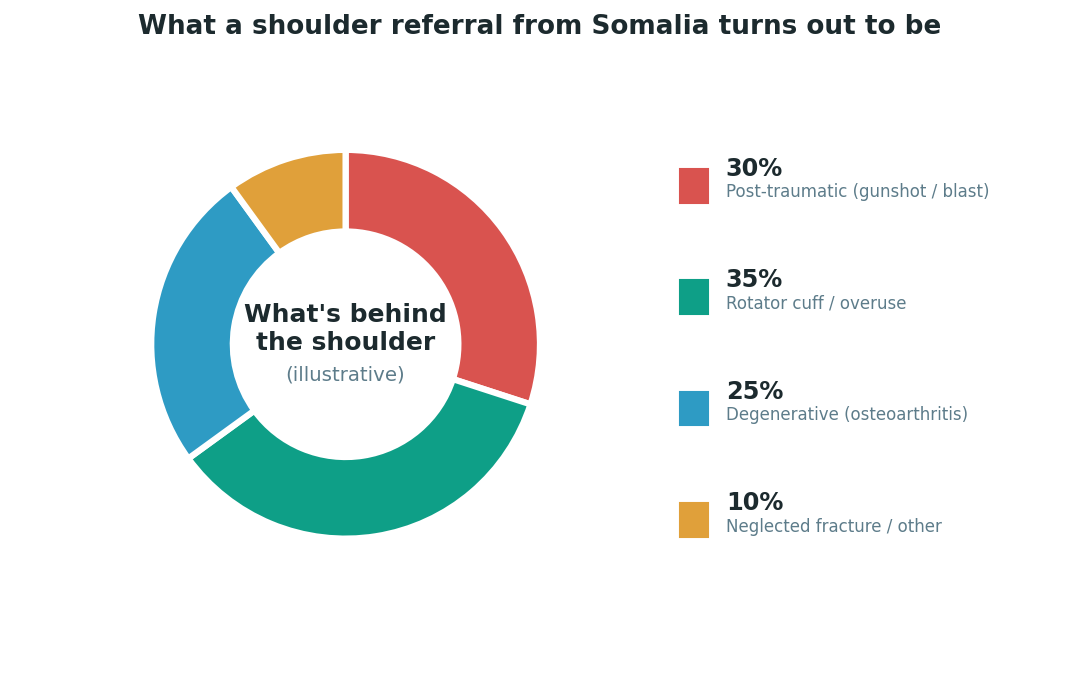
Illustrative breakdown of shoulder referrals from Somalia, by underlying cause.
Why the delay changes the operation on the table
A rotator cuff tear repaired within a couple of months of starting is usually a straightforward arthroscopic fix with a good, durable outcome. A tear left for a year or more behaves differently: the torn tendon retracts, the muscle behind it begins to waste and fill with fat, and beyond a certain point the tissue is simply no longer strong enough to repair conventionally. At that stage the realistic options narrow to more complex reconstructive techniques or, in the most advanced cases, a reverse shoulder replacement instead of a repair. None of this reflects poorly on the patient. It reflects how far a torn shoulder is from the nearest surgeon able to actually fix it, and how long the wait for a diagnosis takes once a scan is even possible.
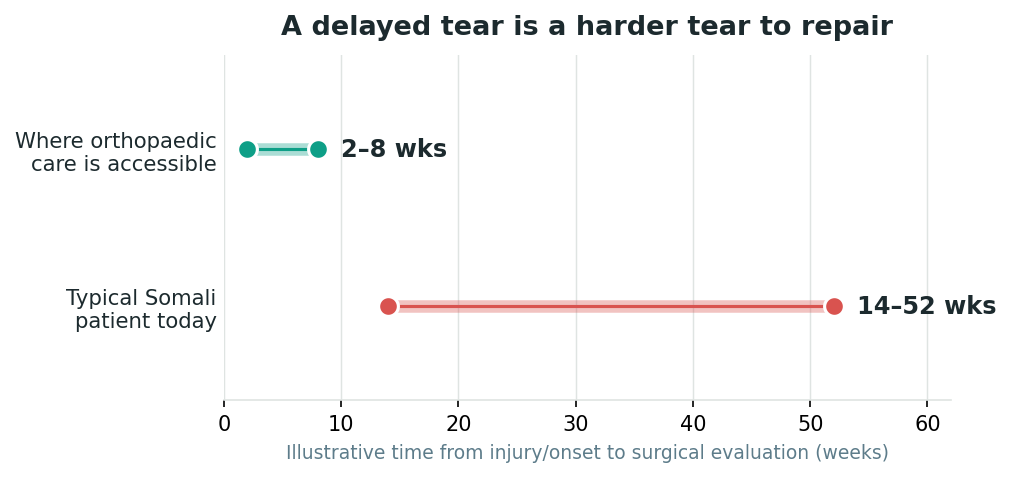
Illustrative time from injury or symptom onset to surgical evaluation: where orthopaedic care is accessible, versus a typical Somali patient today.
Know the warning signs, and do not wait them out
Weakness lifting the arm overhead, a shoulder that catches, clicks or gives way without warning, night pain that disrupts sleep, or a visible deformity and inability to move the arm after a fall or blow are all signs that deserve imaging, not painkillers alone. For anyone with a healed gunshot or shrapnel wound near the shoulder, new or worsening stiffness months or years later is also worth investigating, since scar tissue and old fracture fragments can go on to restrict the joint long after the original wound has closed. Because orthopaedic specialists and MRI access remain concentrated in a handful of Somali cities, many patients live with a slowly worsening shoulder for months before anyone confirms what is actually torn or damaged — time that, as the chart above shows, can be the difference between a repair and a replacement.
Not every shoulder needs an operation
A meaningful share of shoulder pain, including many partial rotator cuff tears and most early osteoarthritis, responds well to physiotherapy, activity modification and targeted injections, without ever needing surgery. Surgery is reserved for full-thickness tears that have not improved with a genuine course of conservative treatment, for tears causing significant weakness or affecting the dominant arm of someone whose livelihood depends on it, for recurrent traumatic dislocation, and for advanced arthritis or fracture damage that physiotherapy cannot address. Where Somali patients lose ground is not in needing more operations than anyone else — it is in a diagnosis, and therefore any treatment at all, arriving so late that the non-surgical window has already closed.
Matching the operation to the damage, not the other way round
Arthroscopic keyhole surgery, done through a few small incisions with a camera, is the standard approach for most rotator cuff repairs and for stabilising a recurrently dislocating shoulder, and it generally means a faster, less painful recovery than open surgery. Anatomic total shoulder replacement suits an arthritic joint where the rotator cuff itself is still intact and functioning. Reverse total shoulder replacement, which deliberately swaps the position of the ball and socket, is specifically designed for the pattern seen after a badly damaged or long-neglected rotator cuff combined with arthritis — precisely the combination war trauma and years of unaddressed tearing can produce. Ask which of these is actually being proposed, and why, before agreeing to any date.
Why a genuinely fellowship-trained shoulder surgeon is the real safeguard
Shoulder surgery is a subspecialty within orthopaedics, and the difference in outcome between a generalist who occasionally operates on shoulders and a surgeon who does little else is well documented, particularly for reverse replacement and revision cases. Ask specifically how many shoulder arthroscopies and replacements the named surgeon performs each year, whether the hospital has a dedicated shoulder and elbow unit rather than a general orthopaedics list, and whether physiotherapy for the specific procedure is available on site before discharge. For neglected war-related injuries especially, a surgeon experienced in revision and reconstructive shoulder work, not just first- time repairs, is the detail that most affects whether the operation actually restores useful function.
What it costs
In more than 24 years arranging this kind of care, the disputes I have seen were almost never about the price itself — they were about a diagnosis, or a cost, nobody had bothered to write down before the flight was booked.
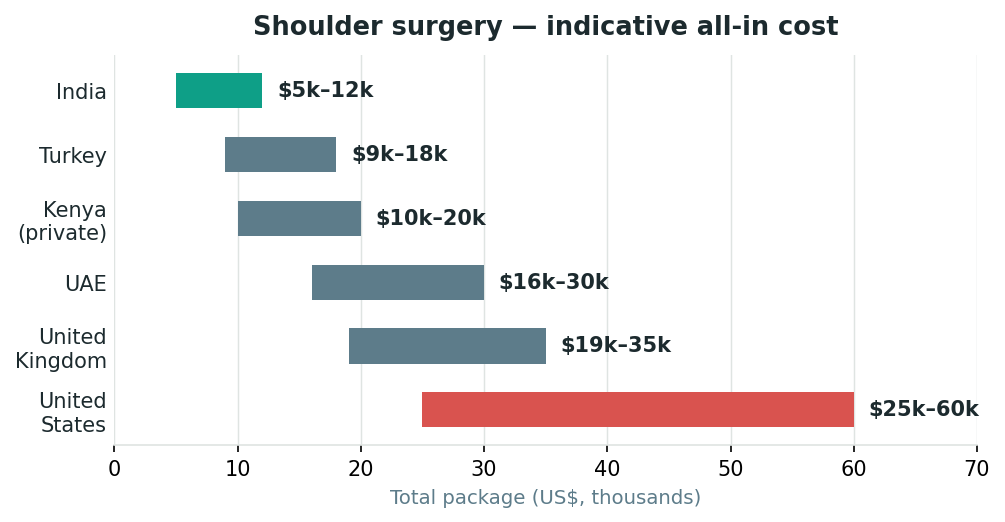
Indicative all-in cost for shoulder surgery, from arthroscopic repair to full replacement. India sits far below every common alternative.
A surgical shoulder case in a reputable private Indian hospital typically runs US$5,000 to US$12,000 all-in, with straightforward arthroscopic rotator cuff repair toward the lower end and reverse or complex revision shoulder replacement toward the top. Ask for the figure specific to your actual imaging and the operation being proposed, in writing, before a flight is booked.
Four signals that should make you stop and walk away
Surgery quoted without a conservative-treatment history. If nobody asks how long the shoulder has hurt or what physiotherapy has already been tried, the plan is incomplete.
No mention of MRI or arthroscopic assessment. An X-ray alone cannot show a rotator cuff tear. Confirming the actual extent of soft-tissue damage should come first.
One surgery type offered regardless of findings. Repair, reconstruction and replacement solve different problems. Ask why this specific operation fits your imaging.
The price keeps moving. A verbal estimate that shifts each time you ask is not an estimate. Demand a fixed figure in writing.
The practical journey from Somalia — plan it before you fly
There is no direct flight between Somalia and India; patients route through Nairobi, Addis Ababa, Dubai or Djibouti. Because there is no full Indian mission inside Somalia, the medical visa is issued through the Embassy of India in Addis Ababa or the High Commission in Nairobi , against a written invitation letter from the treating hospital. Somali patients may bring up to two medical attendants on attendant visas. Since your route crosses yellow-fever territory, carry a valid yellow-fever vaccination certificate . Above every other instruction: send your actual MRI or X-ray films, not a written summary, so the surgical team can begin planning the right procedure before you ever leave home.
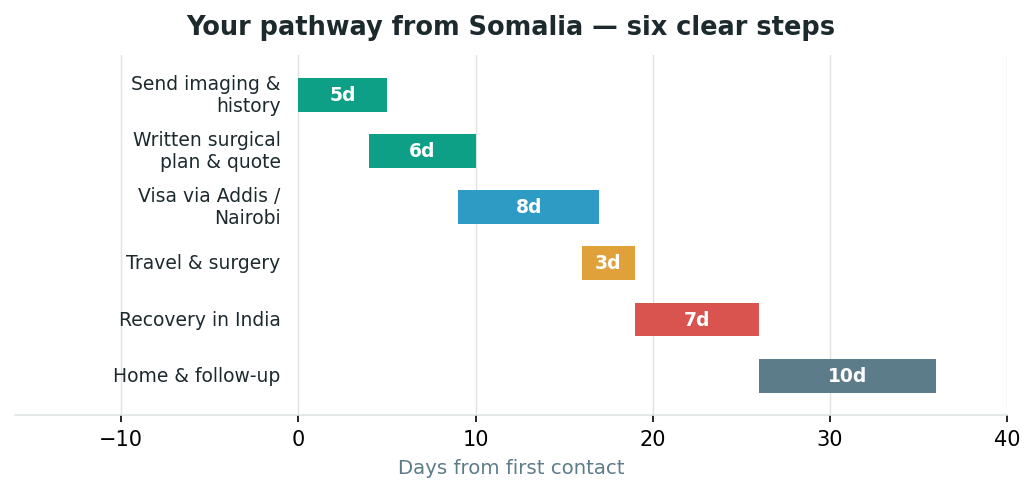
The complete route, start to finish — most of it arranged before you ever leave Somalia.
A working shoulder is a working life
For a fisherman, a herder, a mother carrying water, or anyone whose living depends on their arms, a shoulder that cannot lift overhead is not a minor complaint. Matched to the right operation early enough, both traumatic and overuse shoulder damage respond, more often than not, with a genuine return to the work and life the injury interrupted.
Sources & useful links
- 🌐 Indian medical visa (Somali nationals) — indianvisaonline.gov.in
- 🌐 Embassy of India, Addis Ababa — eoiaddisababa.gov.in
- 🌐 High Commission of India, Nairobi — hcinairobi.gov.in
- 🌐 Yellow-fever requirements — who.int/health-topics/yellow-fever
- 🌐 Hospital accreditation (India) — nabh.co · jointcommissioninternational.org
- 🌐 Verify a surgeon's registration — nmc.org.in
Do not decide alone, and do not decide blind
If you want your imaging reviewed properly and an honest written plan — including whether repair, reconstruction or replacement genuinely fits your shoulder — that is precisely the independent guidance I provide, without a single hospital's interest attached to my advice. Dr. Dheeraj Bojwani · Independent medical travel advisor
Frequently Asked Questions by Somali Patients about Shoulder Surgery in India
Why may Somali patients seek shoulder surgery in India?
The guide highlights limited access to specialised shoulder care and MRI services in Somalia. India offers high-volume shoulder surgery centres with specialised surgeons and imaging facilities.
What are the main shoulder problems discussed for Somali patients?
The guide focuses on traumatic injuries, rotator cuff tears, overuse-related damage, arthritis, recurrent instability and neglected fractures.
Does every shoulder problem require surgery?
No. Many partial rotator cuff tears and early cases of osteoarthritis may improve with physiotherapy, activity modification or targeted injections.
Why is early treatment important for a rotator cuff tear?
A delayed tear may cause tendon retraction, muscle wasting and fatty changes. This can make a conventional repair more difficult and may eventually require reconstruction or replacement.
What is the difference between anatomic and reverse shoulder replacement?
Anatomic replacement is generally suited to an arthritic shoulder with a functioning rotator cuff. Reverse replacement is designed for advanced cuff damage combined with arthritis.
How much does shoulder surgery cost in India for Somali patients?
The guide gives an indicative all-in range of US$5,000–US$12,000, depending on the procedure and complexity.
Why should Somali patients choose a fellowship-trained shoulder surgeon?
Shoulder surgery is a specialised area of orthopaedics. The guide recommends checking the surgeon's annual volume of shoulder arthroscopies and replacements, especially for complex or revision cases.
What should patients check before agreeing to surgery?
They should confirm that the surgeon has reviewed the MRI or appropriate imaging, that conservative treatment has been considered, and that the proposed operation matches the actual shoulder damage.
What medical records should Somali patients send before travelling?
The guide specifically recommends sending actual MRI or X-ray films rather than only a written summary, allowing the surgical team to plan the appropriate procedure before travel.
What is the travel pathway from Somalia to India for shoulder surgery?
The guide describes routes through Nairobi, Addis Ababa, Dubai or Djibouti, followed by medical-visa arrangements, travel and surgery, recovery in India and home follow-up. Yellow-fever vaccination documentation may also be required depending on the route.
Page Summary
This guide explains the key considerations for Somali patients exploring shoulder surgery in India, focusing on traumatic injuries, chronic overuse and delayed diagnosis. It covers rotator cuff tears, recurrent shoulder instability, arthritis, neglected fracture damage and the different roles of arthroscopic repair, anatomic shoulder replacement and reverse shoulder replacement. The guide also explains why early assessment matters, when non-surgical treatment may still be appropriate, the importance of a fellowship-trained shoulder surgeon and dedicated shoulder unit, indicative costs of US$5,000–US$12,000, warning signs when selecting a provider, pre-travel MRI or X-ray requirements, visa and travel planning, and the six-step pathway from imaging review through surgery, recovery and follow-up.
Citation Block
| Topic | Information |
|---|---|
| Topic Information | Shoulder Surgery in India for Patients from Somalia |
| Treatment | Shoulder Surgery |
| Intended Audience | Patients from Somalia |
| Key Specialist | Fellowship-Trained Shoulder Surgeon |
| Main Conditions | Rotator Cuff Tears, Arthritis and Traumatic Shoulder Injuries |
| Main Procedures | Shoulder Arthroscopy, Rotator Cuff Repair and Shoulder Replacement |
| Replacement Options | Anatomic and Reverse Shoulder Replacement |
| Primary Assessment | MRI/X-Ray and Clinical Review |
| Non-Surgical Options | Physiotherapy, Activity Modification and Targeted Injections |
| Indicative Cost | US$5,000–US$12,000 All-In |
| Important Specialist Check | Confirm Surgeon Experience With the Specific Shoulder Procedure |
| Hospital Requirement | Dedicated Shoulder and Elbow Unit |
| Important Warning | Surgery Proposed Without Reviewing Conservative Treatment History |
| Imaging Warning | X-Ray Alone Used to Assess a Suspected Rotator Cuff Tear |
| Procedure Warning | Same Surgery Offered Regardless of Imaging Findings |
| Cost Check | Request a Fixed Written Quote Based on Actual Imaging |
| Pre-Travel Records | Actual MRI or X-Ray Films |
| Travel Routes | Nairobi, Addis Ababa, Dubai or Djibouti |
| Visa Requirement | Hospital Invitation and Medical Visa |
| Patient Journey | Imaging/history → surgical plan → visa → travel/surgery → recovery → home follow-up |
| Follow-Up | Procedure-Specific Physiotherapy and Recovery |


Our Mission Statement
Our mission is to place patients at the centre of every healthcare decision by providing trustworthy, evidence-based, and unbiased medical information. We believe that informed patients make better decisions. Backed by personalised guidance from our experienced advisory team, we help patients understand their treatment options, compare them objectively, and confidently choose the path that best suits their medical needs and personal circumstances.
Patient Testimonials from Somalia




Ready to Take the First Step?
Share your Medical Reports with our Healthcare Managers Today and Get a FREE CONSULTATION, a Personalized Treatment Plan, and Complete Support from Arrival to Recovery.
Get Your Free ConsultationAreas We Serve
This resource has been thoughtfully prepared for patients from Somalia who are considering medical treatment in India. We also welcome patients from the wider region in the countries mentioned below-
We assist patients from:
- Ethiopia
- Djibouti
- Yemen
- Kenya
- Seychelles
- Somalia
- South Sudan
- Tanzania
- Uganda
- Zambia
- Zimbabwe
- Angola
- Cameroon
- Central African Republic
Many of the insights, treatment pathways, hospital recommendations, travel guidance, and patient support services described here are equally relevant and may be used as a reference when planning treatment in India.
From Somalia to India: Your Complete Patient Support Guide
- Best Brain Tumour Surgeons & Hospitals in India for Somali Patients
- Best Cancer Treatment Surgeons & Hospitals in India for Somali Patients
- Best Cardiac Surgeons & Hospitals in India for Somali Patients
- Best CyberKnife Teams & Centres in India for Somali Patients
- Best Heart Valve Replacement Surgeons & Hospitals in India for Somali Patients
- Best Hip Surgeons & Hospitals in India for Somali Patients
- Best Knee Surgeons & Hospitals in India for Somali Patients
- Best Neurosurgeons & Hospitals in India for Somali Patients
- Best Paediatric Cardiac Surgeons & Hospitals in India for Somali Patients
- Best Paediatric Neurosurgeons & Hospitals in India for Somali Patients
- Best Spine Surgeons & Hospitals in India for Somali Patients
- Bariatric Surgery in India for Patients from Somalia
- Brain Tumour Surgery in India for Patients from Somalia
- Cancer Treatment and Surgery in India for Patients from Somalia
- Cardiac Surgery in India for Patients from Somalia
- Cosmetic and Plastic Surgery in India for Patients from Somalia
- CyberKnife Treatment in India for Patients from Somalia
- Dental Surgery in India for Patients from Somalia