

Selecting the Best Prostate Cancer Treatment Surgeons & Hospitals in India — A Somali Patient's Guide
The most important test in this entire guide is not performed in an operating theatre. It is a simple blood test, and in Somalia's own hospital data, one in six men who never had it went into surgery not knowing cancer was already there.
Every year, more Somali men decide that prostate treatment in India is the right choice — and nearly all of them stop thinking too soon after making that decision. They compare countries, glance at a price, and book with the first clinic that answers quickly. That is backwards, and for the prostate it carries a specific, well-documented danger, because in Somalia's own hospital data, a striking share of men treated for what was assumed to be simple benign enlargement turned out to have cancer discovered only after the fact. The country matters far less than the two specific choices inside it: which surgeon insists on the right tests first, and which hospital stands behind them if anything goes wrong. For 24 years I have watched good outcomes and poor ones come from patients who made this second decision carelessly, even after making the first one wisely. I write here as an independent adviser with no hospital's interest attached to my advice.
Healing Journeys of Somali Patients









Key Takeaways
- Before agreeing to prostate surgery in India, Somali patients should confirm that a PSA blood test and proper work-up have been completed. The PDF highlights this as the most important safeguard because urinary symptoms caused by benign prostate enlargement can resemble those associated with prostate cancer.
- The guide notes that a Somali study found prostate cancer in close to one in six men who underwent surgery for presumed benign prostatic hyperplasia (BPH), despite having no cancer diagnosis before surgery. This makes proper evaluation before a procedure particularly important.
- Patients should choose a surgeon who discusses active surveillance when appropriate, rather than automatically recommending immediate treatment. Early, low-grade prostate cancers may sometimes be monitored rather than treated immediately.
- The surgeon should also discuss the three major outcomes together: cancer control, urinary continence and sexual function.
- Relevant uro-oncology fellowship training, genuine annual prostate procedure volume, transparent complication rates and willingness to support a second opinion are highlighted as important surgeon-selection criteria.
- The hospital should have a genuine uro-oncology team, appropriate pathology capability, infection-control standards and relevant technology such as nerve-sparing or robotic techniques where appropriate. NABH accreditation, or international JCI accreditation, should also be checked.
- International patients should confirm that the hospital provides interpreters, realistic travel guidance and arrangements for remote PSA follow-up after returning to Somalia.
- The PDF gives an indicative overall prostate-treatment cost range of US$2,500–US$8,000, depending on whether the treatment involves BPH surgery or cancer treatment. It recommends obtaining a written and itemised quotation before travelling.
- Somali patients should send actual PSA results and imaging to the Indian hospital before travelling. The guide also highlights medical-visa arrangements, yellow-fever certification and available travel routes.
Quick Facts
- Treatment
- Prostate Cancer Treatment / BPH Surgery
- Country
- India
- Patients
- Somali Patients
- First Important Test
- PSA Blood Test
- Additional Evaluation
- Proper Prostate Work-Up and Biopsy Where Appropriate
- Key Clinical Concern
- BPH Symptoms Can Overlap With Prostate Cancer
- Surgeon Specialty
- Urology / Uro-Oncology
- Surgeon Qualification
- Fellowship in Uro-Oncology Preferred
- Surgeon Assessment
- Annual Prostate Procedure Volume
- Outcome Discussion
- Cancer Control, Urinary Continence and Sexual Function
- Complication Reporting
- Transparent Surgeon-Specific Rates
- Second Opinion
- Should Be Welcomed
- Hospital Team
- Genuine Uro-Oncology Team
- Pathology
- Accurate Pathology Capability for Staging
- Technology
- Nerve-Sparing or Robotic Technique Where Appropriate
- Accreditation
- NABH or International JCI
- International Support
- Interpreters and Medical-Travel Assistance
- Follow-Up
- Remote PSA Monitoring After Returning to Somalia
- Indicative Cost
- US$2,500–US$8,000
- Cost Planning
- Obtain a Written, Itemised Quote
- Medical Visa
- Through the Relevant Indian Mission
- Travel Routes
- Nairobi, Addis Ababa, Dubai or Djibouti
- Vaccination
- Valid Yellow-Fever Certificate
- Medical Records
- PSA Results and Actual Imaging Should Be Shared Before Travel
In Brief
For Somali patients considering prostate treatment in India, the first priority should be proper diagnosis before surgery. A PSA test and appropriate work-up can help distinguish benign prostate enlargement from possible prostate cancer. Once the diagnosis is understood, patients should separately assess the surgeon and hospital, focusing on uro-oncology experience, procedure volume, pathology, multidisciplinary care, accreditation, complication transparency and long-term follow-up.
First, should you travel at all?
Somalia has no national prostate cancer screening programme, no cancer registry, and PSA blood testing exists only through private urban laboratories, paid out of pocket. This leaves a large share of men proceeding to surgery for urinary symptoms without ever having the one test that could have told a different story. If you have been told you need prostate surgery, or even if you simply have urinary symptoms, travelling for a genuinely thorough evaluation is not an extravagance. It is the only realistic route to knowing, with confidence, what you are actually treating.
The one clinical fact that should shape your whole search
The first published study of its kind from Somalia looked back at hundreds of men who had surgery for benign prostatic hyperplasia, the common non-cancerous enlargement that causes urinary symptoms. None had been diagnosed with cancer beforehand. Yet when the removed tissue was examined afterward, close to one in six had prostate cancer growing inside the very tissue that had just been treated as "just BPH." This changes what you should look for. You do not just need a surgeon willing to operate. You need one who insists on a PSA test and proper work- up before any procedure, not one who assumes.
Why a PSA test should come before any prostate surgery
This is worth understanding on its own, because it is the single most protective step in this entire guide. Benign prostatic hyperplasia and prostate cancer can feel identical to a patient: both cause slow urination, frequent night-time trips to the bathroom, a sense of incomplete emptying. Only a blood test, and where appropriate a biopsy, actually tells them apart. A surgeon who schedules an operation for urinary symptoms without this basic step has skipped the single most important safeguard available to you, regardless of how confident or reassuring they sound in person. The test itself costs little and takes minutes; the information it provides can change the entire course of your treatment.
Two decisions, not one
Patients consistently under-weigh the hospital and over-weigh the surgeon, or the reverse, when both deserve deliberate, separate attention. Prostate care depends on a genuine uro-oncology team and real pathology capability for accurate staging, alongside the surgeon's own judgement. As a rough guide, weigh the surgeon slightly more heavily — but never treat the hospital as an afterthought.
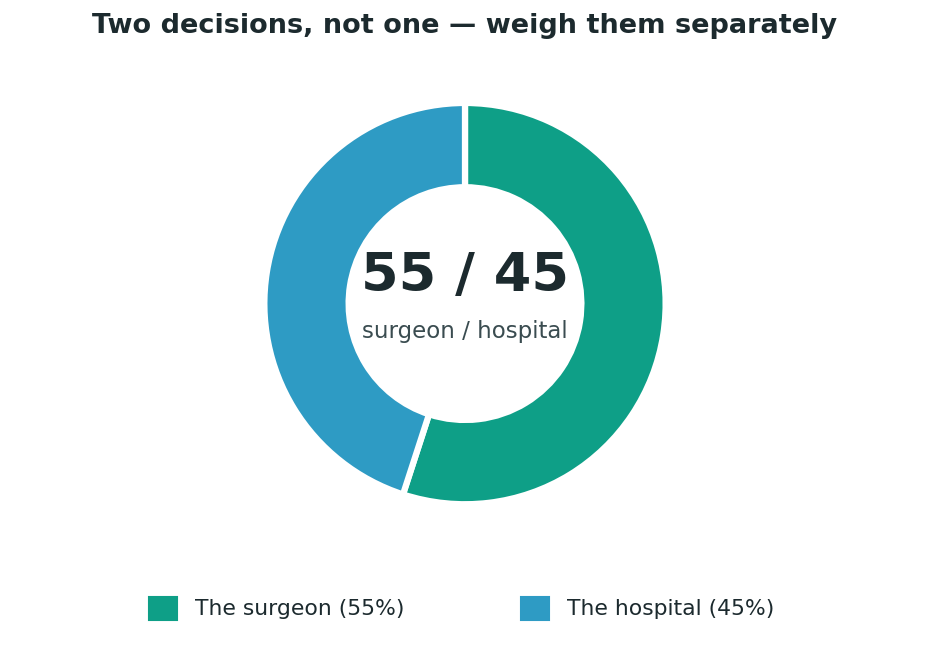
A useful starting balance. Adjust it, but never let either side reach zero.
Part One: Choosing the Surgeon
1. Insists on a PSA test before any BPH surgery. This single question, asked before you agree to anything, is the most revealing test of a surgeon's honesty you have available.
2. Discusses active surveillance as a genuine option. Many early, low-grade findings are appropriately managed with monitoring rather than immediate treatment; a surgeon who never mentions this may be over-treating.
3. Discusses the trifecta honestly. Cancer control, urinary continence and sexual function should all be discussed together, not just the cancer outcome alone. 4. Named fellowship or experience in uro-oncology. Ask for the specific qualification and where it was completed, not a general urology background alone.
5. Genuine annual volume. Ask how many prostate procedures this specific surgeon performs each year, not urology in general.
6. Transparent complication rates. Every surgeon has some. One who shares real numbers is more trustworthy than one who claims none. 7. Comfort with a second opinion. A confident surgeon welcomes another specialist reviewing your results. Reluctance here is itself useful information.
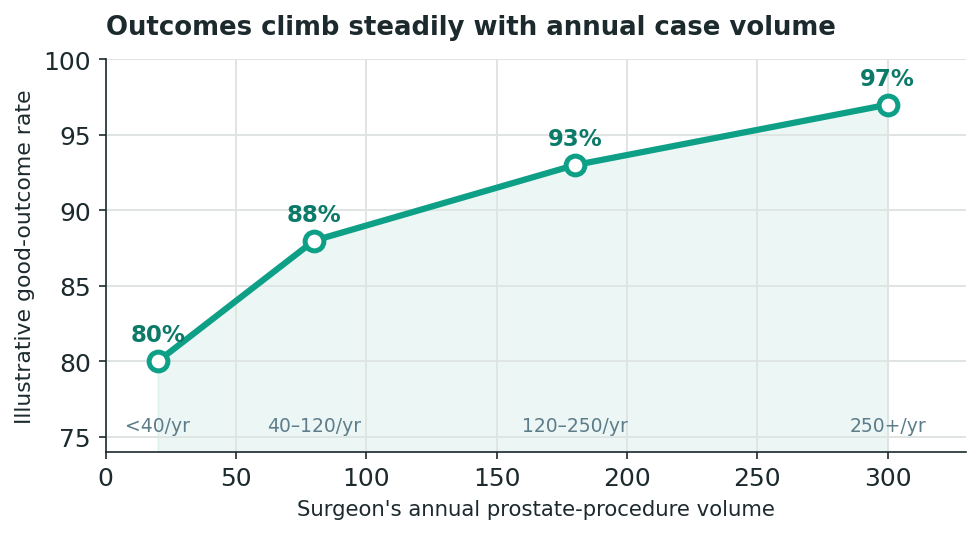
Volume is not vanity. It is the clearest predictor of a safe result available to you.
Why active surveillance is not doing nothing
This runs against instinct for many patients, but it deserves to be understood clearly before your first consultation. In Somalia's own hospital data, most of the men found to have incidental cancer during BPH surgery were not rushed into further treatment. The majority were managed with active surveillance, meaning regular monitoring rather than immediate intervention, reflecting the international evidence that many early, low-grade prostate cancers grow slowly enough that watching carefully is the wiser first step. A finding of cancer is not automatically a call to aggressive treatment, and a team that treats it that way without discussing alternatives may not be serving your genuine interests. Ask specifically what monitoring schedule would apply to your case if surveillance is chosen, so you understand what the alternative actually looks like in practice.
Part Two: Choosing the Hospital
8. A genuine uro-oncology team, not a solo surgeon. Ask whether cases confirmed or suspected to involve cancer are reviewed by a wider team, not decided alone.
9. NABH accreditation in India, or international JCI accreditation. These are independently verified standards of safety and process, not formalities. 10. Genuine pathology capability for accurate staging. Precise grading of any cancer found directly shapes the right treatment plan.
11. Nerve-sparing or robotic technique where appropriate. Ask whether this is genuinely available and how often it is used for cases like yours.
12. Genuine international patient support. A hospital used to patients from Somalia will have interpreters and realistic guidance on visa and logistics. 13. Infection control track record. Ask directly about surgical site infection rates. A confident hospital will share them.
14. Remote PSA follow-up after you fly home. Confirm, in writing, how your ongoing monitoring will be coordinated once you are back in Somalia.
| Stage | Qualification | What it confirms |
|---|---|---|
| 1 | MBBS | Basic medical degree, the foundation for every doctor. |
| 2 | MS / MCh Urology | Specialist postgraduate training in general urology. |
| 3 | Fellowship in Uro-oncology | Focused, advanced training specifically in prostate and urological cancer. |
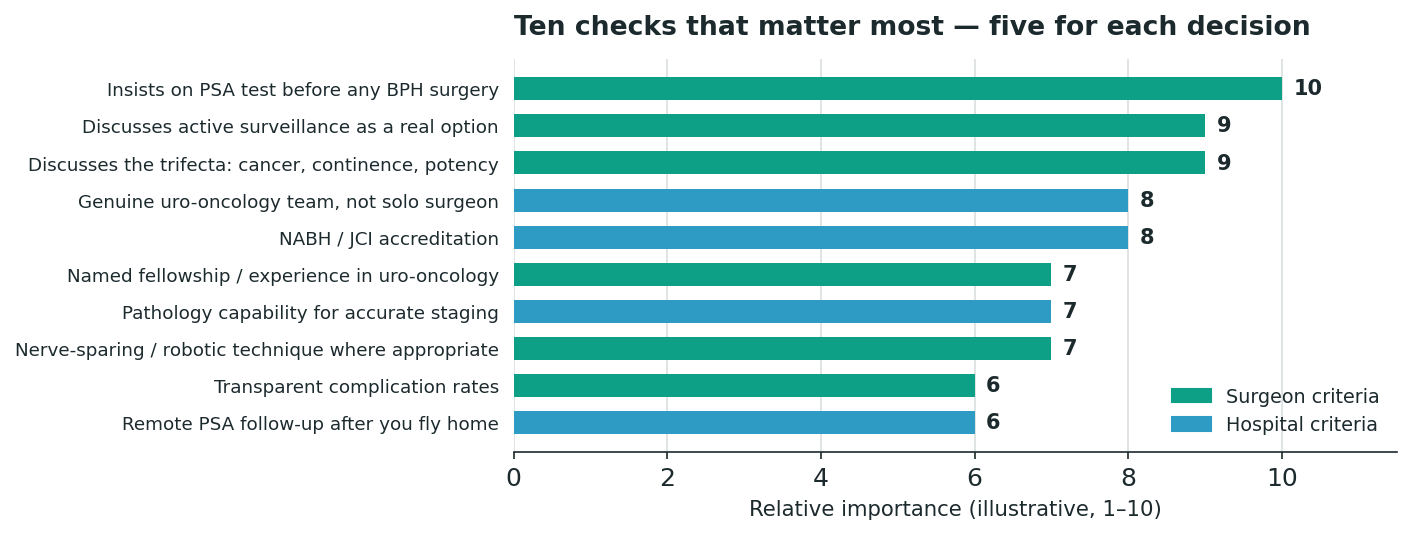
The ten criteria that matter most, ranked by how much weight each should carry in your decision.
Cost and value are not the same conversation
Somalia has run on the US dollar for a generation, the shilling itself never meaningfully reissued since 1991, so Indian hospitals quoting in dollars is a genuine convenience, not a complication. A well- chosen surgeon and hospital combination for prostate treatment typically costs US$2,500 to US$8,000 all-in, with the range reflecting whether the case is BPH surgery or cancer treatment. The cheapest quote is rarely the best value; the criteria above, not the invoice, are what actually protect you. In more than 24 years arranging this kind of care, the patients who chose on price alone were the ones most likely to call me again, later, with a problem.
What a Somali patient should weigh in particular
Beyond the criteria above, insist on a PSA test before agreeing to any surgery date, regardless of how routine the procedure is described. Ask specifically whether active surveillance was genuinely considered if a cancer is found. Because funds are often gathered from relatives abroad, get every cost element in writing before travel. And send your actual PSA results and any imaging, not a written description, so the team can plan properly before you ever leave home.
The practical journey from Somalia
There is no direct flight between Somalia and India; patients route through Nairobi, Addis Ababa, Dubai or Djibouti. Because there is no full Indian mission inside Somalia, the medical visa is issued through the Embassy of India in Addis Ababa or the High Commission in Nairobi , against a written invitation letter from your chosen hospital. Somali patients may bring up to two medical attendants on attendant visas. Since your route crosses yellow-fever territory, carry a valid yellow-fever vaccination certificate.
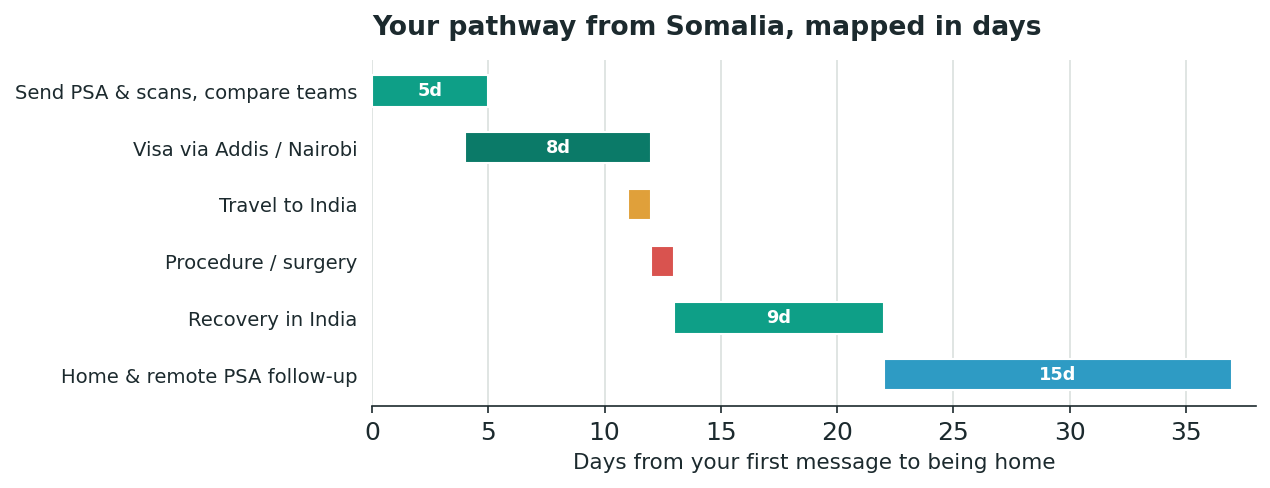
Mapped in days, not just steps — most of the early ones happen before you ever leave Somalia.
Four signals that should make you pause
No PSA test before surgery. Surgery scheduled without a PSA blood test first has skipped the most basic safeguard.
Only one outcome discussed. If continence and sexual function are never mentioned alongside cancer control, ask why.
Surgery pushed over surveillance. For low-risk findings, a team that never mentions monitoring may be over-treating.
Pressure to decide immediately. A reputable team gives you time to compare. Urgency is a sales tactic, not a medical one.
The test that takes minutes can change everything that follows
The right choice, made once and made with the right test done first, protects everything that follows. Take the time these ten questions require. The country got you this far; the surgeon and the hospital decide the rest.
Sources & useful links
- 🌐 Indian medical visa (Somali nationals) — indianvisaonline.gov.in
- 🌐 Embassy of India, Addis Ababa — eoiaddisababa.gov.in
- 🌐 High Commission of India, Nairobi — hcinairobi.gov.in
- 🌐 Yellow-fever requirements — who.int/health-topics/yellow-fever
- 🌐 Hospital accreditation (India) — nabh.co · jointcommissioninternational.org
- 🌐 Verify a surgeon's registration — nmc.org.in
Do not choose alone, and do not choose blind
If you want help verifying a surgeon's qualifications, confirming a PSA test and proper work-up before any surgery date, and getting a written, itemised quote before you travel, that is precisely the independent guidance I provide, without a single hospital's interest attached to my advice.
Dr. Dheeraj Bojwani · Independent medical travel advisor
Frequently Asked Questions by Somalis about Prostate Cancer Treatment Surgeons & Hospitals in India
Should Somali patients have a PSA test before prostate surgery in India?
Yes. The PDF identifies PSA testing before prostate surgery as the most important safeguard. It can help identify patients who may need further evaluation for prostate cancer before a BPH procedure.
Can BPH symptoms actually be caused by prostate cancer?
Yes. Urinary symptoms can occur with both BPH and prostate cancer. The guide highlights Somali hospital data in which close to one in six men undergoing surgery for presumed BPH were found to have prostate cancer in the removed tissue.
Should active surveillance be discussed for prostate cancer?
Yes, when clinically appropriate. Some early, low-grade prostate cancers may be monitored rather than treated immediately, so patients should ask what surveillance would involve in their particular case.
What should Somali patients ask about a prostate surgeon's experience?
Patients should ask about specific uro-oncology training, annual prostate procedure volume and complication rates. The guide recommends asking about the number of prostate procedures performed by the individual surgeon rather than general urology volume.
Should a surgeon discuss urinary and sexual function?
Yes. The guide recommends discussing the three major outcomes together: cancer control, urinary continence and sexual function.
What should Somali patients check about the hospital?
Patients should check for a genuine uro-oncology team, pathology capability, infection-control standards, appropriate technology and international-patient support. NABH or JCI accreditation should also be verified.
What is the indicative cost of prostate treatment in India?
The PDF gives an indicative range of US$2,500–US$8,000, depending on whether the case involves BPH surgery or cancer treatment. Patients should obtain a written, itemised quotation before travelling.
Can Somali patients receive follow-up after returning home?
Yes. The guide specifically recommends confirming how PSA monitoring will be coordinated remotely after the patient returns to Somalia.
What should Somali patients send to the Indian hospital before travelling?
Patients should send their actual PSA results and imaging rather than only describing the results in writing. This allows the medical team to assess the case more appropriately before travel.
What travel requirements are highlighted for Somali patients?
The guide states that Somali patients generally travel through Nairobi, Addis Ababa, Dubai or Djibouti. It also highlights medical-visa arrangements through the relevant Indian mission and the need to carry a valid yellow-fever vaccination certificate.
Page Summary
This guide helps Somali patients choose prostate cancer treatment surgeons and hospitals in India. It highlights the importance of PSA testing and proper evaluation before prostate surgery. Patients should assess surgeon experience, uro-oncology training, procedure volume, complication rates and treatment alternatives. Hospital selection should consider pathology, accreditation, infection control and multidisciplinary care. The guide also covers indicative treatment costs, medical-visa requirements and travel planning. Finally, it emphasizes arranging PSA follow-up after returning to Somalia.
Citation Block
| Topic | Information |
|---|---|
| Topic | Selecting the Best Prostate Cancer Treatment Surgeons & Hospitals in India for Somali Patients |
| Treatment | Prostate Cancer Treatment / BPH Surgery |
| Country | India |
| Intended Audience | Somali Patients |
| First Important Test | PSA Blood Test |
| Clinical Work-Up | Proper Evaluation and Biopsy Where Appropriate |
| Surgeon Selection | Uro-Oncology Experience and Fellowship |
| Team Assessment | Annual Prostate Procedure Volume |
| Outcome Assessment | Cancer Control, Urinary Continence and Sexual Function |
| Complication Transparency | Surgeon-Specific Complication Rates |
| Hospital Selection | Genuine Uro-Oncology Team |
| Pathology | Accurate Pathology Capability |
| Technology | Nerve-Sparing or Robotic Technique Where Appropriate |
| Accreditation | NABH or JCI |
| International Support | Interpreters and Medical-Travel Guidance |
| Follow-Up | Remote PSA Monitoring After Returning to Somalia |
| Indicative Cost | US$2,500–US$8,000 |
| Medical Visa | Relevant Indian Mission |
| Travel Routes | Nairobi, Addis Ababa, Dubai or Djibouti |
| Vaccination | Yellow-Fever Certificate |
| Medical Records | PSA Results and Actual Imaging |
| Author | Dr. Dheeraj Bojwani |
| Experience | 24+ Years of Experience |


Our Mission Statement
Our mission is to place patients at the centre of every healthcare decision by providing trustworthy, evidence-based, and unbiased medical information. We believe that informed patients make better decisions. Backed by personalised guidance from our experienced advisory team, we help patients understand their treatment options, compare them objectively, and confidently choose the path that best suits their medical needs and personal circumstances.
Patient Testimonials from Somalia




Ready to Take the First Step?
Share your Medical Reports with our Healthcare Managers Today and Get a FREE CONSULTATION, a Personalized Treatment Plan, and Complete Support from Arrival to Recovery.
Get Your Free ConsultationAreas We Serve
This resource has been thoughtfully prepared for patients from Somalia who are considering medical treatment in India. We also welcome patients from the wider region in the countries mentioned below-
We assist patients from:
- Ethiopia
- Djibouti
- Yemen
- Kenya
- Seychelles
- Somalia
- South Sudan
- Tanzania
- Uganda
- Zambia
- Zimbabwe
- Angola
- Cameroon
- Central African Republic
Many of the insights, treatment pathways, hospital recommendations, travel guidance, and patient support services described here are equally relevant and may be used as a reference when planning treatment in India.
From Somalia to India: Your Complete Patient Support Guide
- Best Brain Tumour Surgeons & Hospitals in India for Somali Patients
- Best Cancer Treatment Surgeons & Hospitals in India for Somali Patients
- Best Cardiac Surgeons & Hospitals in India for Somali Patients
- Best CyberKnife Teams & Centres in India for Somali Patients
- Best Heart Valve Replacement Surgeons & Hospitals in India for Somali Patients
- Best Hip Surgeons & Hospitals in India for Somali Patients
- Best Knee Surgeons & Hospitals in India for Somali Patients
- Best Neurosurgeons & Hospitals in India for Somali Patients
- Best Paediatric Cardiac Surgeons & Hospitals in India for Somali Patients
- Best Paediatric Neurosurgeons & Hospitals in India for Somali Patients
- Best Spine Surgeons & Hospitals in India for Somali Patients
- Bariatric Surgery in India for Patients from Somalia
- Brain Tumour Surgery in India for Patients from Somalia
- Cancer Treatment and Surgery in India for Patients from Somalia
- Cardiac Surgery in India for Patients from Somalia
- Cosmetic and Plastic Surgery in India for Patients from Somalia
- CyberKnife Treatment in India for Patients from Somalia
- Dental Surgery in India for Patients from Somalia