

Scoliosis Correction Surgery in India for Patients from Somalia
A curve that could have been braced at 20° is too often first found at 70° or 80° — not because the family waited, but because there was nowhere nearby to catch it earlier.
A child's shoulder sits a little higher than the other. A shirt hangs unevenly. A mother notices it while braiding her daughter's hair, or a teacher notices it during assembly — and only much later does anyone connect it to the spine underneath. For 24 years I have watched families in exactly this position work out, often too late, that what looked like posture was actually a curve that had been growing quietly for years.
India matters here for a specific reason: it is one of the few places within reach of Somalia with genuinely high-volume paediatric spinal deformity units — surgeons who correct dozens of curves a year, not one or two, with the intraoperative nerve monitoring and dedicated paediatric anaesthesia that this surgery demands. That combination of volume and infrastructure is what actually determines whether a severe curve can be corrected safely, and it is rarely available closer to home.
Healing Journeys of Somali Patients









Key Takeaways
- The guide highlights the absence of a national school-based scoliosis screening programme in Somalia, which can contribute to curves being detected later and at a more severe stage.
- Somalia's scoliosis picture also includes neuromuscular causes such as polio and cerebral palsy. The guide notes 39 confirmed paralytic cVDPV2 cases through March 2024 and explains how childhood paralysis can contribute to progressive spinal curvature.
- The page 2 chart gives an illustrative breakdown of scoliosis referrals: 60% idiopathic adolescent, 22% neuromuscular, 6% congenital and 12% post-infective/other.
- Early detection can significantly change treatment. A curve around 20–25° may often be managed with observation or bracing, whereas curves reaching 60–90° are more likely to require technically demanding surgery and may already affect lung capacity.
- The page 3 illustration compares an illustrative 20–25° first-diagnosis range where school screening exists with 55–95° for a typical Somali patient today, highlighting the potential effect of delayed detection.
- Not every scoliosis curve requires surgery. Mild curves in growing children may be observed, while moderate curves may be treated with a rigid brace. Surgery is generally reserved for severe, progressive or breathing-affecting curves.
- For children and teenagers requiring surgery, the guide strongly recommends a dedicated paediatric spine team, intraoperative neuromonitoring, experienced paediatric anaesthesia and a surgeon who regularly performs paediatric scoliosis correction.
- Indicative all-in cost for surgical scoliosis correction in a reputable private Indian hospital is approximately US$9,000–US$14,000. The final price depends on the number of vertebral levels fused and the need for ICU-level monitoring.
- Neuromuscular curves, particularly in non-ambulatory children, may require longer fusion and more complex recovery than straightforward adolescent idiopathic scoliosis. The quotation should therefore be based on the child's actual imaging.
- Somali families should send the child's actual X-rays before travel. For neuromuscular scoliosis, mobility level and any seating or feeding difficulties should also be communicated because they can affect surgical planning and recovery.
- The page 5 pathway shows an indicative sequence of 5 days for imaging/history, 8 days for surgical planning and quotation, 10 days for visa, 3 days for travel/surgery, 12 days for recovery in India and 14 days for home follow-up planning.
Quick Facts
- Treatment
- Scoliosis Correction Surgery
- Country
- India
- Patients
- Patients from Somalia
- Key Specialist
- Paediatric Spine Surgeon
- Main Conditions
- Adolescent Idiopathic and Neuromuscular Scoliosis
- Other Causes
- Polio-Related, Cerebral Palsy and Congenital Scoliosis
- Primary Assessment
- Spine X-Rays and Clinical Evaluation
- Non-Surgical Options
- Observation and Bracing
- Surgical Option
- Spinal Deformity Correction and Fusion
- Indicative Cost
- US$9,000–US$14,000 All-In
- Important Check
- Dedicated Paediatric Spine Unit
- Safety Requirement
- Intraoperative Neuromonitoring
- Anaesthesia Requirement
- Experienced Paediatric Anaesthesia Team
- Cost Check
- Written Quote Based on Actual Imaging
- Pre-Travel Records
- Actual X-Rays, Medical History and Mobility Details
- Travel Routes
- Nairobi, Addis Ababa, Dubai or Djibouti
- Visa
- Hospital Invitation and Medical Visa
- Attendants
- Up to Two Medical Attendants
- Follow-Up
- Recovery, Spine Monitoring and Long-Term Follow-Up
- Author
- Dr. Dheeraj Bojwani
- Experience
- 24+ Years
In Brief
For Somali families considering scoliosis treatment in India, the guide recommends sending the child's actual X-rays and medical history for specialist review before travelling, because early assessment may determine whether observation or bracing is still possible instead of surgery. If correction is required, families should choose a dedicated paediatric spine team with intraoperative neuromonitoring, paediatric anaesthesia and specific experience in scoliosis surgery. A diagnosis-specific written quotation should clearly reflect the child's curve, number of levels requiring fusion and expected monitoring or recovery needs.
First, know why Somalia's scoliosis picture looks different
Idiopathic scoliosis — the ordinary curve that appears during a growth spurt for no identifiable reason — is the most common type worldwide, and Somalia is no exception. But two things change the picture once a Somali family is actually sitting in front of a surgeon: what is causing the curve, and how large it has already grown by the time anyone gets a look at it.
The Somali difference: polio has not finished with this generation
Most countries researching scoliosis surgery today are decades removed from active polio transmission. Somalia is not. A wild poliovirus outbreak paralysed 189 children across 46 districts in 2013, and vaccine-derived poliovirus has continued circulating since 2017, with 39 confirmed paralytic cases documented through March 2024 — driven by chronically low routine immunisation coverage in insecure areas. Paralytic polio in early childhood is a well-established cause of progressive neuromuscular scoliosis as the spine grows around unbalanced muscles over the following decade. Alongside cerebral palsy, it makes neuromuscular scoliosis a real and current diagnosis for Somali patients in a way it simply is not for most families researching this surgery from elsewhere.
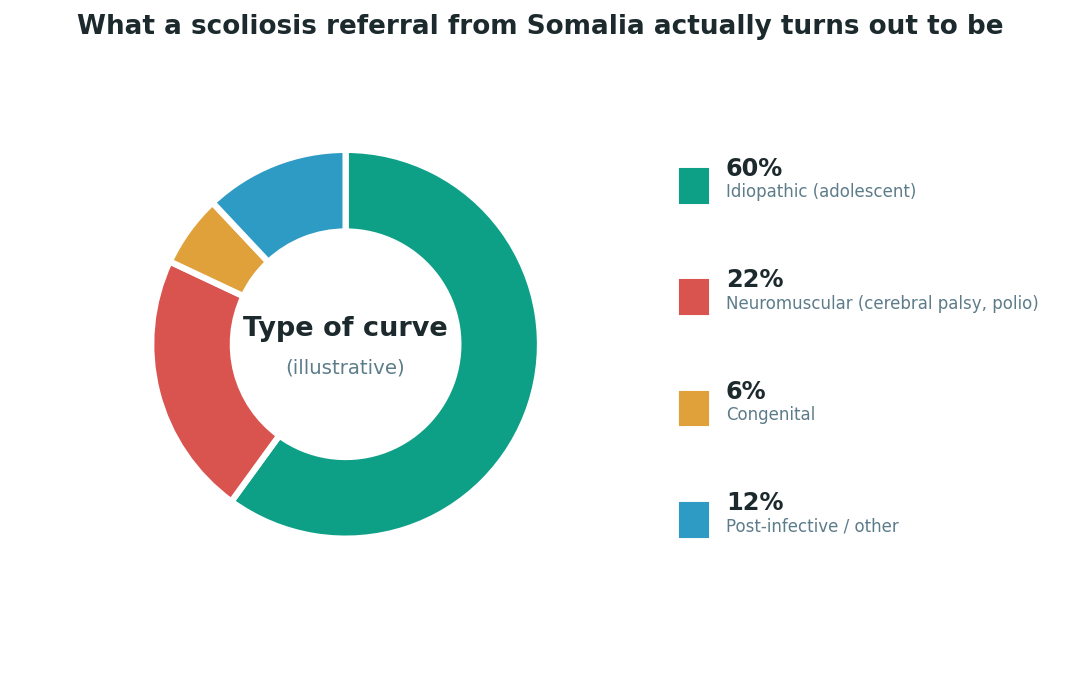
Illustrative breakdown of scoliosis referrals from Somalia, by underlying cause.
Why curves found late are harder curves to fix
A curve caught at 20–25 degrees, the kind picked up by a school nurse doing the forward-bend test, is often managed with nothing more than a brace and periodic review. A curve that nobody measures until it reaches 60, 80 or even 90 degrees is a different problem entirely: it usually needs surgery, the operation is longer and technically harder, and in the most severe cases it can already be affecting lung capacity. Somalia has no national school-based scoliosis screening programme, and published research across low- and middle-income settings without one has repeatedly found the same pattern — curves discovered later, and larger, than they need to be. None of this is a family's fault. It reflects an absence of infrastructure that has nothing to do with how closely a child was watched at home.
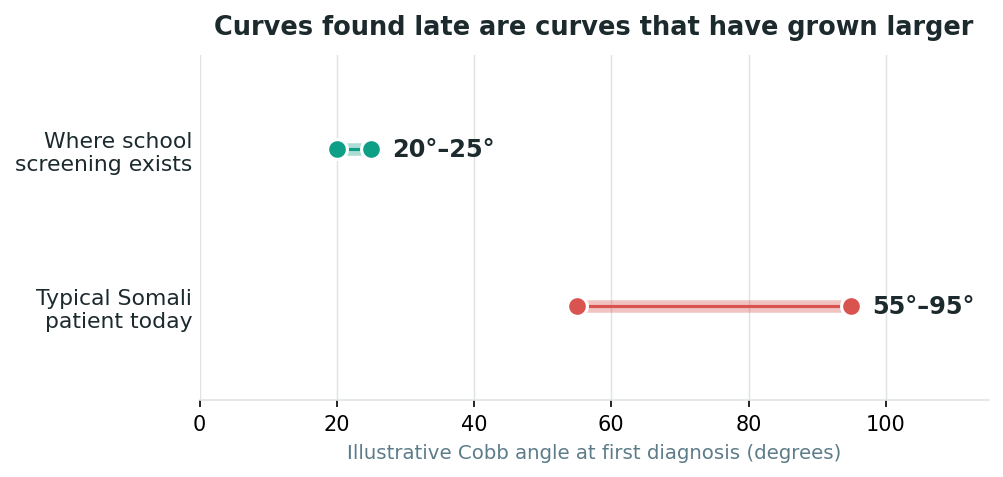
Illustrative Cobb angle at first diagnosis: where school screening exists, versus a typical Somali patient today.
Know the warning signs, and do not wait them out
A shoulder blade that sits higher on one side, a waistline that looks uneven, a rib hump that appears when a child bends forward to touch their toes, or clothes that never seem to hang straight are the classic early signs of scoliosis — and they deserve an X-ray, not patience. In a child with cerebral palsy or a history of paralytic illness, a spine that seems to be tilting the whole body to one side while sitting is worth the same attention. Because there is no routine screening to catch these signs early inside Somalia, families are often the first and only line of detection, and a curve flagged at home while it is still small is the single best predictor of a simple, non-surgical outcome.
Not every curve needs an operation
It bears saying plainly: surgery is not the answer for most scoliosis. A mild idiopathic curve under roughly 25 degrees in a child who still has growing to do is usually simply observed with repeat X-rays every four to six months. A moderate curve, once it passes about 25 degrees and there is meaningful growth remaining, is often managed with a rigid brace worn most of the day, which cannot straighten the spine but can reliably stop a curve from progressing further while the child grows. Surgery is reserved for curves that are already severe at diagnosis, curves that keep progressing despite bracing, or curves affecting breathing. Where Somali patients lose out is not in needing more surgery than anyone else — it is in reaching a clinic too late for the brace to still be a realistic option.
Why a genuinely paediatric spine team is the real safeguard
Spinal deformity correction in a child or teenager is not the same operation as adult back surgery, and it should not be planned by a general orthopaedic surgeon working outside a dedicated paediatric spine unit. The things that actually change outcomes are intraoperative neuromonitoring throughout the correction, so the surgical team knows immediately if a nerve is under stress; a paediatric anaesthesia team experienced in the long operating times these cases take; and a surgeon who does this specific operation often enough that its rare but serious complications are genuinely familiar territory, not something read about once in training. Somalia's own surgical workforce data make the case for travelling rather than waiting: the country has only around 1.2 surgical specialists per 100,000 people nationally, and a dedicated assessment of paediatric anaesthesia capacity in Somaliland found deficits of 99% in anaesthesiologist density and 83% in both operating-room and ventilator density against
WHO benchmarks. A procedure this demanding on anaesthesia and monitoring is, realistically, not one that can be done safely inside the country today.
What it costs
Scoliosis correction is priced in India the way most surgical travel packages are — as a single figure covering diagnosis, the operation itself, implants, hospital stay and initial recovery. In more than 24 years arranging this kind of care, the disputes I have seen were almost never about the price itself; they were about a diagnosis, or a cost, nobody had bothered to write down before the flight was booked.
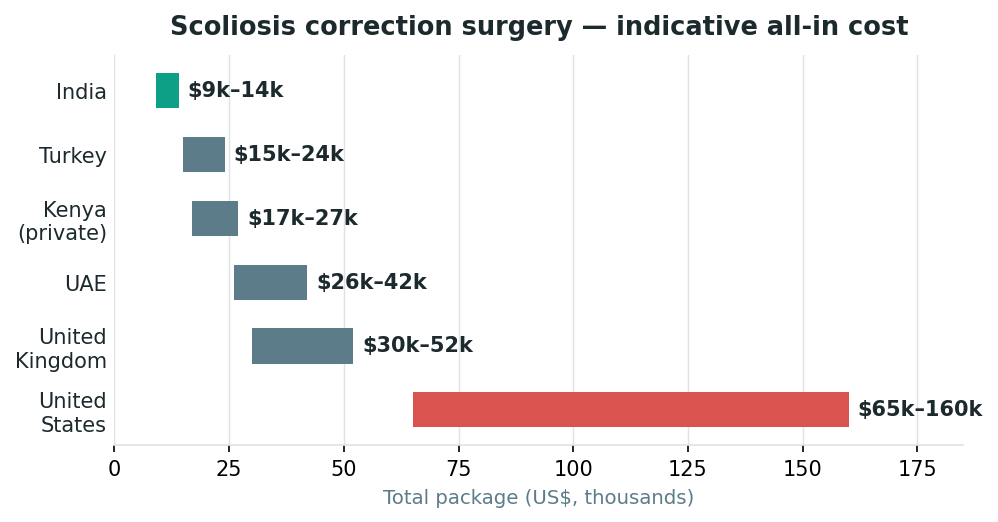
Indicative all-in cost for a surgical scoliosis correction case. India sits far below every common alternative.
A surgical scoliosis correction case in a reputable private Indian hospital typically runs US$9,000 to US$14,000 all-in, though the final figure depends heavily on how many vertebral levels need fusing and how many days of ICU-level monitoring the curve's severity requires. A neuromuscular curve in a non-ambulatory child, for instance, often needs a longer fusion down to the pelvis and a longer recovery than a straightforward adolescent idiopathic curve, and a fair quote should say so explicitly rather than pricing "scoliosis surgery" as one generic line item. Ask for that detail in writing, specific to your child's actual imaging, before a flight is booked.
Four signals that should make you stop and walk away
Surgery quoted without a bracing conversation. If nobody discusses whether observation or a brace could still work, and jumps straight to an operating date, ask why.
No mention of neuromonitoring. Nerve monitoring throughout the correction is standard practice for this operation. Its absence from the plan is a real gap, not a detail.
A general orthopaedic surgeon, not a paediatric spine specialist. Ask specifically how many paediatric scoliosis corrections the named surgeon performs each year.
The price keeps moving. A verbal estimate that shifts each time you ask is not an estimate. Demand a fixed figure in writing, tied to your child's actual imaging.
The practical journey from Somalia — plan it before you fly
There is no direct flight between Somalia and India; patients route through Nairobi, Addis Ababa, Dubai or Djibouti. Because there is no full Indian mission inside Somalia, the medical visa is issued through the Embassy of India in Addis Ababa or the High Commission in Nairobi , against a written invitation letter from the treating hospital. Somali patients may bring up to two medical attendants on attendant visas. Since your route crosses yellow-fever territory, carry a valid yellow-fever vaccination certificate . Above every other instruction: send your child's actual X-rays, not a written summary, so the surgical team can begin planning the correction before you ever leave home. For a neuromuscular curve, it also helps to send a short note on the child's mobility level and any seating or feeding difficulties, since these details shape both the surgical plan and the length of recovery the hospital should budget for.
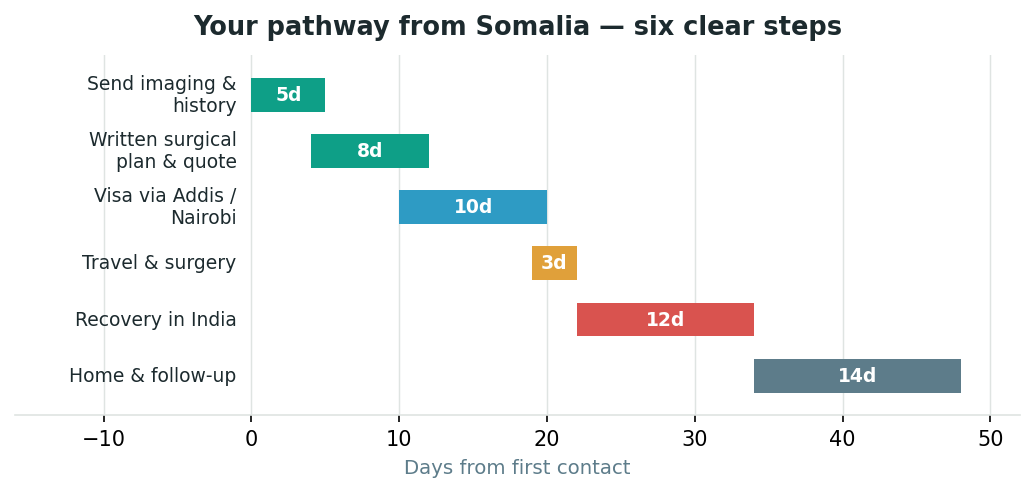
The complete route, start to finish — most of it arranged before you ever leave Somalia.
A straighter spine is not the only goal — a spine that stays corrected is
Scoliosis surgery is not cosmetic, whatever it may look like from the outside. Left to progress, a severe curve can compress the chest and eventually the lungs. Caught and corrected properly — by a team built for exactly this operation — the outcomes for both idiopathic and neuromuscular curves are, more often than not, excellent and lasting.
Sources & useful links
- 🌐 Indian medical visa (Somali nationals) — indianvisaonline.gov.in
- 🌐 Embassy of India, Addis Ababa — eoiaddisababa.gov.in
- 🌐 High Commission of India, Nairobi — hcinairobi.gov.in
- 🌐 Yellow-fever requirements — who.int/health-topics/yellow-fever
- 🌐 Hospital accreditation (India) — nabh.co · jointcommissioninternational.org
- 🌐 Verify a surgeon's registration — nmc.org.in
Do not decide alone, and do not decide blind
If you want your child's imaging reviewed properly and an honest written plan — including whether bracing could still be an option — that is precisely the independent guidance I provide, without a single hospital's interest attached to my advice. Dr. Dheeraj Bojwani · Independent medical travel advisor
Frequently Asked Questions by Somali Patients about Scoliosis Correction Surgery in India
Does every Somali child with scoliosis need surgery?
No. The guide explains that mild curves may be observed and moderate curves may be managed with bracing. Surgery is generally considered for severe, progressive or breathing-affecting curves.
When may a scoliosis curve be treated with a brace?
A moderate curve above roughly 25° in a child who still has significant growth remaining may often be managed with a rigid brace to help prevent further progression.
Why may Somali children be diagnosed with more severe scoliosis?
The guide notes that Somalia has no national school-based scoliosis screening programme, so curves may not be detected until they have become substantially larger.
Why is polio relevant to scoliosis treatment for Somali patients?
The guide explains that childhood paralytic polio can cause progressive neuromuscular scoliosis as the spine grows around unbalanced muscles. This makes assessment of the underlying cause particularly important.
What signs should Somali parents look for?
Important signs include one shoulder blade being higher, an uneven waistline, a rib hump when bending forward, clothes hanging unevenly or the body appearing to tilt to one side.
How much does scoliosis surgery cost in India for Somali patients?
The guide gives an indicative all-in cost of approximately US$9,000–US$14,000. The final cost depends on the number of vertebral levels requiring fusion and the child's monitoring and recovery needs.
Why is a paediatric spine specialist important?
Paediatric scoliosis correction is different from routine adult spine surgery. The guide recommends a dedicated paediatric spine team with specific scoliosis experience, neuromonitoring and paediatric anaesthesia support.
What should families check before choosing a scoliosis surgeon?
They should ask how many paediatric scoliosis corrections the named surgeon performs each year, confirm intraoperative neuromonitoring and ensure the team discusses non-surgical options where appropriate.
What should Somali families send before travelling to India?
They should send the child's actual X-rays rather than only a written summary. For neuromuscular scoliosis, mobility level and seating or feeding difficulties should also be shared.
How long should families plan for the treatment journey in India?
The guide's illustrative pathway includes pre-travel assessment and planning, visa processing, travel and surgery, approximately 12 days of recovery in India and subsequent home follow-up. The actual duration depends on the child's condition and surgical complexity.
Page Summary
This guide explains the key considerations for Somali patients and families exploring scoliosis evaluation and correction surgery in India, focusing on the absence of national school-based screening in Somalia and the resulting risk of curves being detected at a more advanced stage. It covers adolescent idiopathic, neuromuscular, congenital and post-infective scoliosis, including the relevance of polio and cerebral palsy, explains when observation or bracing may still be appropriate, and identifies when surgery may be required for severe, progressive or breathing-affecting curves. It also discusses dedicated paediatric spine expertise, neuromonitoring, paediatric anaesthesia, indicative surgical costs of US$9,000–US$14,000, warning signs when selecting a centre, pre-travel X-rays and medical information, visa and travel planning, and the six-stage pathway from remote assessment through surgery, recovery and home follow-up.
Citation Block
| Topic | Information |
|---|---|
| Topic Information | Scoliosis Correction Surgery in India for Patients from Somalia |
| Treatment | Scoliosis Correction Surgery |
| Intended Audience | Patients from Somalia |
| Key Specialist | Paediatric Spine Surgeon |
| Main Conditions | Adolescent Idiopathic and Neuromuscular Scoliosis |
| Other Causes | Polio-Related, Cerebral Palsy and Congenital Scoliosis |
| Primary Assessment | Spine X-Rays and Clinical Evaluation |
| Non-Surgical Options | Observation and Rigid Bracing |
| Surgical Option | Spinal Deformity Correction and Fusion |
| Indicative Cost | US$9,000–US$14,000 All-In |
| Important Specialist Check | Confirm Specific Paediatric Scoliosis Experience |
| Safety Requirement | Intraoperative Neuromonitoring |
| Anaesthesia Requirement | Experienced Paediatric Anaesthesia Team |
| Important Warning | Surgery Proposed Without Discussing Whether Observation or Bracing Could Still Work |
| Specialist Warning | General Orthopaedic Surgeon Used Instead of a Paediatric Spine Specialist |
| Cost Check | Request a Fixed Quote Based on the Child's Actual Imaging |
| Pre-Travel Records | Actual X-Rays, Medical History and Mobility Details |
| Travel Routes | Nairobi, Addis Ababa, Dubai or Djibouti |
| Visa Requirement | Hospital Invitation and Medical Visa |
| Patient Journey | X-rays/history → surgical review → written plan and quote → visa → travel/surgery → recovery and home follow-up |
| Follow-Up | Recovery, Spine Monitoring and Long-Term Follow-Up |


Our Mission Statement
Our mission is to place patients at the centre of every healthcare decision by providing trustworthy, evidence-based, and unbiased medical information. We believe that informed patients make better decisions. Backed by personalised guidance from our experienced advisory team, we help patients understand their treatment options, compare them objectively, and confidently choose the path that best suits their medical needs and personal circumstances.
Patient Testimonials from Somalia




Ready to Take the First Step?
Share your Medical Reports with our Healthcare Managers Today and Get a FREE CONSULTATION, a Personalized Treatment Plan, and Complete Support from Arrival to Recovery.
Get Your Free ConsultationAreas We Serve
This resource has been thoughtfully prepared for patients from Somalia who are considering medical treatment in India. We also welcome patients from the wider region in the countries mentioned below-
We assist patients from:
- Ethiopia
- Djibouti
- Yemen
- Kenya
- Seychelles
- Somalia
- South Sudan
- Tanzania
- Uganda
- Zambia
- Zimbabwe
- Angola
- Cameroon
- Central African Republic
Many of the insights, treatment pathways, hospital recommendations, travel guidance, and patient support services described here are equally relevant and may be used as a reference when planning treatment in India.
From Somalia to India: Your Complete Patient Support Guide
- Best Brain Tumour Surgeons & Hospitals in India for Somali Patients
- Best Cancer Treatment Surgeons & Hospitals in India for Somali Patients
- Best Cardiac Surgeons & Hospitals in India for Somali Patients
- Best CyberKnife Teams & Centres in India for Somali Patients
- Best Heart Valve Replacement Surgeons & Hospitals in India for Somali Patients
- Best Hip Surgeons & Hospitals in India for Somali Patients
- Best Knee Surgeons & Hospitals in India for Somali Patients
- Best Neurosurgeons & Hospitals in India for Somali Patients
- Best Paediatric Cardiac Surgeons & Hospitals in India for Somali Patients
- Best Paediatric Neurosurgeons & Hospitals in India for Somali Patients
- Best Spine Surgeons & Hospitals in India for Somali Patients
- Bariatric Surgery in India for Patients from Somalia
- Brain Tumour Surgery in India for Patients from Somalia
- Cancer Treatment and Surgery in India for Patients from Somalia
- Cardiac Surgery in India for Patients from Somalia
- Cosmetic and Plastic Surgery in India for Patients from Somalia
- CyberKnife Treatment in India for Patients from Somalia
- Dental Surgery in India for Patients from Somalia