

Selecting the Best Scoliosis Correction Surgeons and Hospitals in India — A Somali Patient's Guide
In scoliosis surgery, the spinal cord itself is at stake — and the hospital's own safety systems matter almost as much as the surgeon's hands. This guide sets out how to verify both before committing to travel.
Few decisions in this guide series carry the weight of this one: in spinal deformity surgery, the surgeon works within millimetres of the spinal cord, and the published risk of neurological injury runs from roughly 0.5% up to 3% depending on curve severity. In 24 years of guiding patients through treatment decisions, I have learned this is one category where the hospital's own safety systems — not just the surgeon's individual skill — genuinely change the odds. This guide sets out, plainly, how a Somali patient should verify a spine surgeon and hospital before committing to travel, and to surgery.
Healing Journeys of Somali Patients









Key Takeaways
- The guide explains that scoliosis correction is performed very close to the spinal cord, with published neurological injury risk of roughly 0.5%–3% depending on curve severity. This makes both the surgeon's deformity expertise and the hospital's safety systems important when selecting treatment.
- Before choosing surgery, patients should establish whether their case requires bracing, observation or surgical correction. The assessment should be based on actual standing X-rays, with the curve size, pattern and skeletal maturity considered by a genuine spine deformity specialist.
- For surgeon selection, the guide prioritises a named, fellowship-trained spine deformity surgeon, documented scoliosis-correction volume during the previous 12 months and an honest bracing-versus-surgery recommendation.
- The page 2 graphic gives 53% weighting to the spine surgeon and 47% to the hospital. The page 3 ranking places fellowship-trained deformity surgery first, followed by routine intraoperative neuromonitoring, recent scoliosis case volume and honest assessment of bracing versus surgery.
- Hospital checks should include routine intraoperative neuromonitoring, paediatric-specific anaesthesia and ICU capability, pre-operative MRI, traceable rod/implant systems and structured postoperative bracing and physiotherapy. NABH or JCI accreditation should also be verified.
- The guide warns that quotations may exclude neuromonitoring charges, extended bracing or costs associated with a second surgery. Somali patients should request a complete written estimate and maintain a 15–20% financial margin.
- For Somali patients, the guide recommends sending standing spine X-rays and MRI scans to each centre. It also highlights visa applications through Nairobi or Addis Ababa, connecting flights from Mogadishu and the need for a clear months-long bracing and physiotherapy follow-up plan after returning home.
Quick Facts
- Author
- Dr. Dheeraj Bojwani
- Experience
- 24+ Years
- Treatment
- Scoliosis Correction / Spinal Deformity Surgery
- Patients
- Somali Patients
- First Assessment
- Standing spine X-rays and curve assessment
- Key Specialist
- Spine Deformity Surgeon
- Decision Weighting
- Surgeon 53% / Hospital 47%
- Training Check
- Fellowship in spine deformity correction
- Case Volume
- Scoliosis corrections in last 12 months
- Treatment Choice
- Bracing vs surgery
- Safety Check
- Routine intraoperative neuromonitoring
- Paediatric Support
- Paediatric anaesthesia and ICU
- Imaging
- Pre-operative MRI
- Implant Check
- Traceable rod/implant system
- Recovery
- Bracing and physiotherapy
- Hospital Check
- NABH/JCI accreditation
- Cost Check
- Written itemised estimate
- Budget
- 15–20% margin
- Medical Records
- X-rays and MRI
- Visa
- Medical visa through relevant Indian mission
- Travel
- Connecting flights from Mogadishu
- Communication
- Somali- or Arabic-speaking coordinator
- Follow-Up
- Long-term bracing and physiotherapy plan
- Key Warning
- No routine neuromonitoring
- Decision Principle
- Choose proven deformity expertise backed by strong neurological safety systems.
This is not a case against travelling for scoliosis correction. India remains a genuine option for Somali patients because it combines fellowship-trained deformity surgeons with the neuromonitoring and paediatric-anaesthesia infrastructure this surgery specifically requires — provided both are confirmed in advance, not assumed.
In Brief
For Somali patients considering scoliosis correction in India, the key decision is to verify a fellowship-trained deformity surgeon alongside a hospital that routinely provides neuromonitoring and paediatric surgical support. Patients should confirm the need for surgery from actual imaging, understand the bracing option, obtain complete costs and establish long-term physiotherapy and follow-up before travelling.
First, Establish What Your Case Actually Needs
Before comparing surgeons or hospitals, get clarity on what your case requires — bracing and observation, or surgical correction, and how the curve's size and your skeletal maturity shape the approach. This should come from a genuine spine specialist reviewing your actual standing X-rays, not a general estimate from a description alone. If earlier care has not addressed the curve adequately, this is not a reason for alarm — it is the starting point for a fresh assessment of what remains possible.
Two Decisions, Not One
Choosing well depends on two things: the surgeon's own fellowship-level training in spinal deformity, and the hospital's own safety infrastructure — above all, whether neuromonitoring is used routinely during surgery. Unlike most topics in this series, the two run close to even: a skilled surgeon operating without
neuromonitoring carries real risk, and a well-equipped hospital without the right surgeon carries its own.
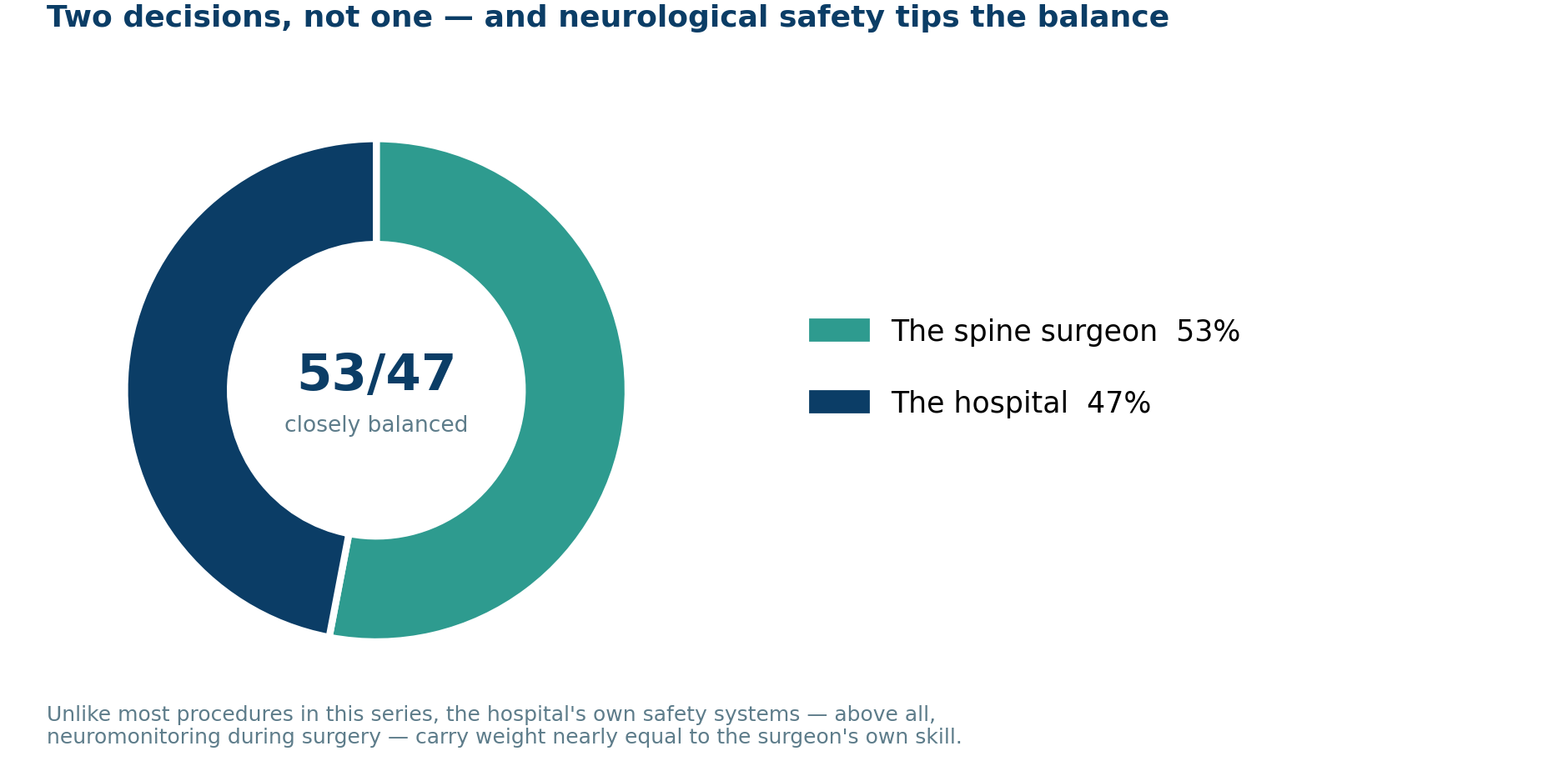
Neurological safety during surgery brings the hospital's own systems almost level with the surgeon's individual skill.
Part One: Verifying the Surgeon
These three points matter more than a hospital's overall reputation or general marketing claims.
1. A named, fellowship-trained spine deformity surgeon — not a general orthopaedic surgeon who occasionally performs spinal fusion.
2. Documented case volume in scoliosis correction specifically, in the last 12 months — general spine-surgery volume does not indicate deformity-specific experience.
3. An honest bracing-versus-surgery assessment, with the Cobb angle and curve pattern explained clearly for your case, rather than defaulting to surgery when observation may still be appropriate.
| Stage | What it means |
|---|---|
| MBBS | Basic medical degree — the entry point, not evidence of spine-specific surgical skill on its own. |
| MS / DNB (Orthopaedics or Neurosurgery) | The base surgical qualification — around three years of foundational training. |
| Fellowship in Spine Deformity Correction | Additional focused training in scoliosis and complex spinal deformity — the credential that actually confirms the specialist skill this guide is asking you to verify. |
Ask for this exact credential chain — a general orthopaedic qualification alone does not confirm spine-deformity-specific training.
Part Two: Verifying the Hospital
Once the surgeon is confirmed, the hospital's own systems shape how safely the correction and recovery unfold.
4. Intraoperative neuromonitoring (IONM) used routinely — the clearest safety marker in this category; studies link its routine use to the fall in neurological complication rates from roughly 3–4% in past decades to under 2% today, and no genuine deformity programme will hesitate to confirm it is standard, not an add-on.
5. Paediatric-specific anaesthesia and ICU capability, since much scoliosis correction involves adolescent patients.
6. A pre-operative MRI protocol to rule out an underlying intraspinal cause before surgery is planned.
7. The rod or implant system disclosed and traceable, since this affects cost and long-term durability.
8. A structured post-operative bracing and physiotherapy plan, covering months of recovery, not just the surgery itself.
9. NABH accreditation in India, or JCI internationally.
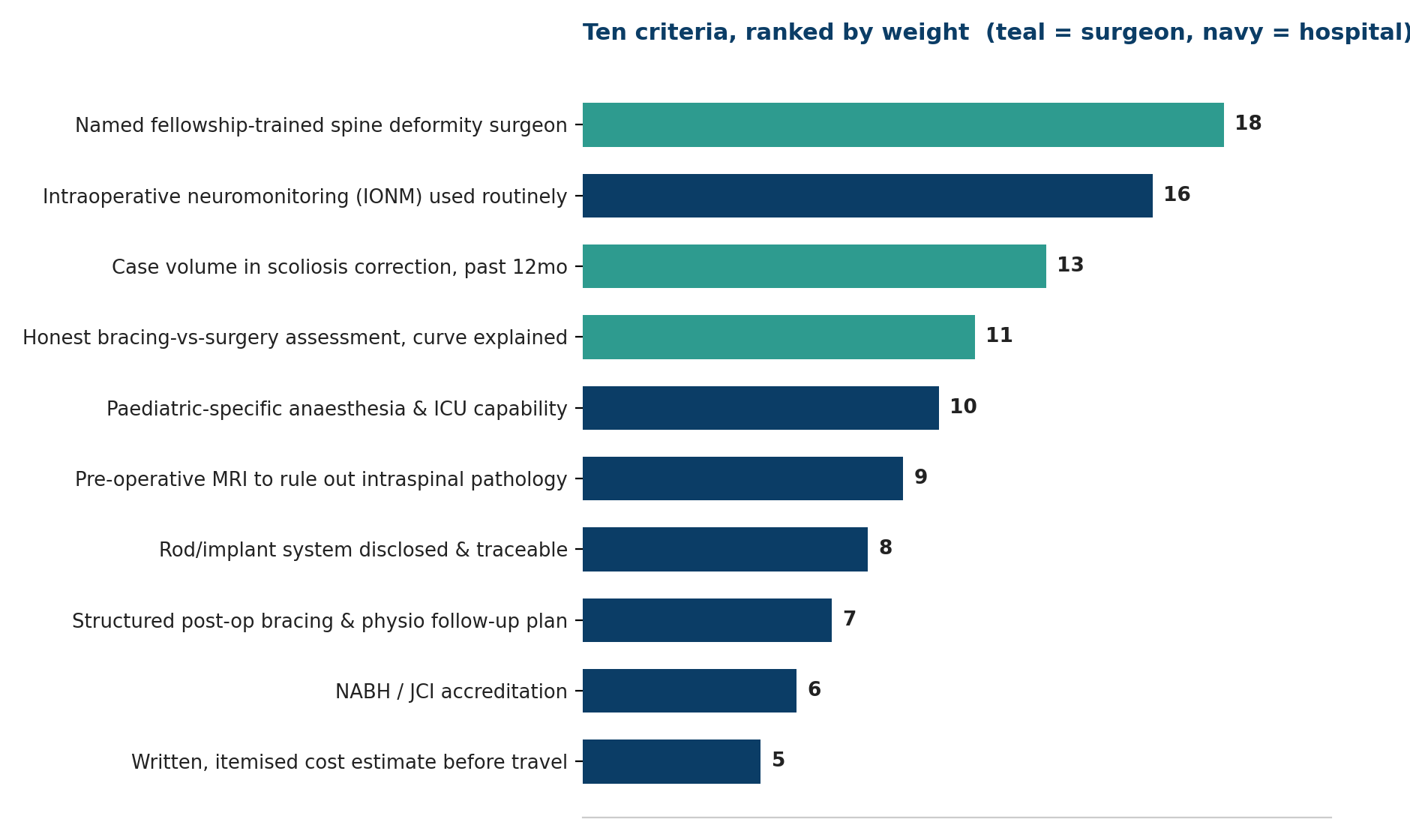
All ten criteria ranked by relative weight — neuromonitoring sits second only to the surgeon's own training.
| Verification check | Genuine deformity programme | General, unverified provider |
|---|---|---|
| Named fellowship-trained deformity surgeon | Yes | No |
| Neuromonitoring used routinely | Yes | No |
| Honest bracing-vs-surgery assessment | Yes | Partly |
| Paediatric anaesthesia & ICU available | Yes | No |
| Written, itemised cost estimate | Yes | Partly |
A simple check to run against any centre you are considering, before booking anything.
What the quote doesn't always show: In 24 years of reviewing these estimates, I have found disputes almost never concern the headline number — they concern what it silently left out: the neuromonitoring team billed as a separate line, or a bracing period priced as though it ends at discharge. Get every line item in writing, including what happens if a second surgery is ever needed, before paying any deposit.
What a Somali Patient Should Weigh in Particular
Send standing spine X-rays and any MRI, not just a description, to every centre being compared — a real assessment depends on the actual images, not a summary paragraph.
Currency and budget. Somalia is heavily dollarised — hospital-scale payments are quoted and settled in US dollars, not the shilling (roughly 570 SOS/US$1 in mid-2026). Budget with a 15–20% margin above the written estimate.
Visa timing. India has no resident mission in Mogadishu, so Somali passport holders apply through the Indian High Commission in Nairobi or the Embassy of India in Addis Ababa, with a no-objection letter from the Somali embassy there. Up to two attendants can be included on the same application.
No direct flight. Ethiopian Airlines via Addis Ababa is the most frequent route from Mogadishu; flydubai, Emirates, and Qatar Airways offer alternatives via Dubai or Doha.
A Somali- or Arabic-speaking coordinator, and a clear plan for who manages the months of bracing and physiotherapy follow-up once home — scoliosis correction capacity within Somalia itself remains extremely limited, so confirm the hospital's remote follow-up process before travel, not after.
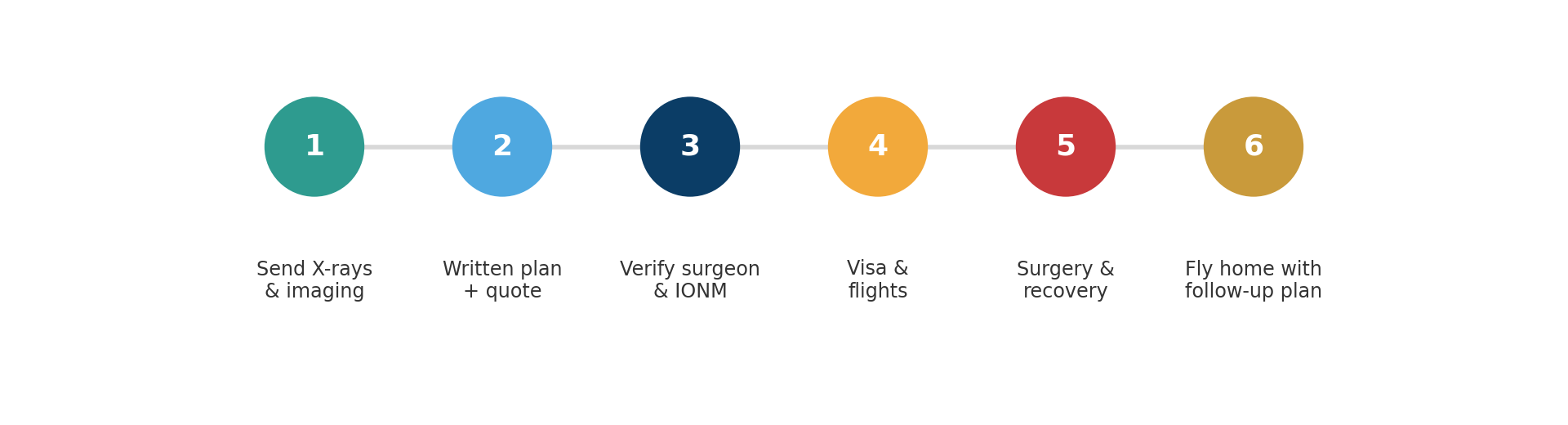
The practical sequence once you have chosen and verified your surgeon and hospital.
Four Signals That Should Make You Pause
1. No clear confirmation of fellowship-level spine deformity training.
2. No mention of intraoperative neuromonitoring as standard practice.
3. Treatment proposed without reviewing your actual imaging.
4. Pressure to pay the full balance before a written surgical plan exists.
Questions Worth Asking Directly
| Ask the surgeon | Ask the hospital |
|---|---|
| Are you fellowship-trained in spinal deformity? | Is neuromonitoring standard for every case, or extra? |
| How many scoliosis corrections have you done this year? | Do you have paediatric-specific anaesthesia and ICU? |
| Is bracing still an option for my case? | What does the bracing and follow-up plan involve? |
A Closing Word
Scoliosis correction operates within millimetres of the spinal cord, which is exactly why the hospital's own safety systems matter nearly as much as the surgeon performing it. A named, fellowship-trained deformity surgeon, backed by a hospital that uses neuromonitoring as standard and not an upsell, is the baseline worth insisting on before any deposit is paid — and no genuine programme will hesitate to confirm this clearly. If you can share your X-rays or a quote already received, I am glad to review it honestly, including telling you if a proposed surgeon or hospital does not look like the right match.
Sources
- 🌐 National Medical Commission of India — verify any surgeon's registration — nmc.org.in
- 🌐 National Accreditation Board for Hospitals & Healthcare Providers (NABH) — nabh.co
- 🌐 High Commission of India, Nairobi — visa services for Somali nationals — hcinairobi.gov.in
- 🌐 Embassy of India, Addis Ababa — medical visa requirements — indianembassy.gov.et
- 🌐 Scoliosis Research Society — intraoperative neuromonitoring literature — srs.org
Frequently Asked Questions by Somalis about Scoliosis Correction Surgeons and Hospitals in India
What should be assessed before scoliosis surgery?
The guide recommends reviewing standing spine X-rays, curve size and pattern, skeletal maturity and whether bracing or observation remains appropriate.
What type of surgeon should Somali patients choose?
Look for a fellowship-trained spine deformity surgeon with documented scoliosis-correction experience.
How important is neuromonitoring?
It is a major hospital safety criterion. The guide recommends routine intraoperative neuromonitoring, not a service added only when requested.
Why is pre-operative MRI important?
MRI can help identify an underlying intraspinal cause before surgical correction is planned.
What paediatric facilities should be checked?
For adolescent patients, verify paediatric-specific anaesthesia and ICU capability.
Should bracing always be avoided if surgery is being considered?
No. The guide recommends an honest bracing-versus-surgery assessment based on the patient's curve and maturity.
What should the cost quotation include?
It should cover the complete procedure and recovery, including neuromonitoring, bracing and potential additional surgery where applicable.
What records should Somali patients send?
Send standing spine X-rays and MRI scans, rather than only describing the curve.
What follow-up is needed after surgery?
The guide recommends a structured plan covering months of bracing and physiotherapy, including arrangements after returning to Somalia.
What are the main warning signs?
Be cautious if there is no fellowship-level deformity training, no routine neuromonitoring, no review of actual imaging or pressure to pay the full balance before a written surgical plan.
Page Summary
This five-page guide focuses on fellowship-trained scoliosis expertise and hospital neurological safety systems. Page 1 explains why both factors matter, while page 2 gives 53% weighting to the surgeon and 47% to the hospital. The page 3 ranking places deformity fellowship training, neuromonitoring, recent scoliosis volume and honest bracing-versus-surgery assessment highest. Pages 3–4 also cover paediatric support, MRI, implants, postoperative rehabilitation, costs, Somali visa and travel planning, follow-up and warning signs.
Citation Block
| Topic | Information |
|---|---|
| Topic | Scoliosis Correction Surgeons & Hospitals in India for Somali Patients |
| Treatment | Scoliosis Correction / Spinal Deformity Surgery |
| Patients | Somali Patients |
| First Assessment | Standing X-rays and curve assessment |
| Key Specialist | Spine Deformity Surgeon |
| Decision Weighting | Surgeon 53% / Hospital 47% |
| Specialist Training | Fellowship in spine deformity correction |
| Case Volume | Scoliosis correction in last 12 months |
| Treatment Choice | Bracing vs surgery |
| Neurological Safety | Routine intraoperative neuromonitoring |
| Paediatric Support | Paediatric anaesthesia and ICU |
| Pre-op Imaging | MRI to assess intraspinal pathology |
| Implant Check | Traceable rod/implant system |
| Recovery Plan | Bracing and physiotherapy |
| Hospital Check | NABH / JCI accreditation |
| Cost Check | Written itemised estimate |
| Cost Risk | Monitoring, bracing or second surgery may add costs |
| Budget | 15–20% margin |
| Medical Records | X-rays and MRI |
| Visa Planning | Nairobi or Addis Ababa |
| Travel | Connecting flights from Mogadishu |
| Communication | Somali- or Arabic-speaking coordinator |
| Home Follow-Up | Months of bracing and physiotherapy |
| Warning Signs | No deformity training or routine neuromonitoring |
| Payment Warning | Full balance requested before written plan |
| Key Decision | Verify deformity expertise and neurological safety infrastructure |


Our Mission Statement
Our mission is to place patients at the centre of every healthcare decision by providing trustworthy, evidence-based, and unbiased medical information. We believe that informed patients make better decisions. Backed by personalised guidance from our experienced advisory team, we help patients understand their treatment options, compare them objectively, and confidently choose the path that best suits their medical needs and personal circumstances.
Patient Testimonials from Somalia




Ready to Take the First Step?
Share your Medical Reports with our Healthcare Managers Today and Get a FREE CONSULTATION, a Personalized Treatment Plan, and Complete Support from Arrival to Recovery.
Get Your Free ConsultationAreas We Serve
This resource has been thoughtfully prepared for patients from Somalia who are considering medical treatment in India. We also welcome patients from the wider region in the countries mentioned below-
We assist patients from:
- Ethiopia
- Djibouti
- Yemen
- Kenya
- Seychelles
- Somalia
- South Sudan
- Tanzania
- Uganda
- Zambia
- Zimbabwe
- Angola
- Cameroon
- Central African Republic
Many of the insights, treatment pathways, hospital recommendations, travel guidance, and patient support services described here are equally relevant and may be used as a reference when planning treatment in India.
From Somalia to India: Your Complete Patient Support Guide
- Best Brain Tumour Surgeons & Hospitals in India for Somali Patients
- Best Cancer Treatment Surgeons & Hospitals in India for Somali Patients
- Best Cardiac Surgeons & Hospitals in India for Somali Patients
- Best CyberKnife Teams & Centres in India for Somali Patients
- Best Heart Valve Replacement Surgeons & Hospitals in India for Somali Patients
- Best Hip Surgeons & Hospitals in India for Somali Patients
- Best Knee Surgeons & Hospitals in India for Somali Patients
- Best Neurosurgeons & Hospitals in India for Somali Patients
- Best Paediatric Cardiac Surgeons & Hospitals in India for Somali Patients
- Best Paediatric Neurosurgeons & Hospitals in India for Somali Patients
- Best Spine Surgeons & Hospitals in India for Somali Patients
- Bariatric Surgery in India for Patients from Somalia
- Brain Tumour Surgery in India for Patients from Somalia
- Cancer Treatment and Surgery in India for Patients from Somalia
- Cardiac Surgery in India for Patients from Somalia
- Cosmetic and Plastic Surgery in India for Patients from Somalia
- CyberKnife Treatment in India for Patients from Somalia
- Dental Surgery in India for Patients from Somalia