

Robotic Cancer Surgery in India for Patients from Somalia
Across the entire African continent, only two countries have established robotic surgery programmes at all — which means the question for most Somali patients was never "open or robotic," it was whether minimally invasive surgery of any kind was on offer.
A cancer operation can be done through a single large incision, through several small ones with a camera and long instruments, or through the same small incisions guided by a robotic surgical system giving the surgeon a magnified 3D view and a steadier, more precise hand than either alternative. For 24 years I have watched this choice matter more than most patients realise — not for whether the cancer is removed, but for how much of the patient's life the operation costs them afterward.
India has built genuine depth in robotic oncology: da Vinci systems in dozens of leading hospitals, surgeons with thousands of robotic cases behind them, and multidisciplinary teams that combine robotic surgery with the chemotherapy and radiotherapy covered elsewhere in this series — at a fraction of the cost of the same operation in the Gulf, Europe or the United States.
Healing Journeys of Somali Patients









Key Takeaways
- The guide highlights a major technology gap in Africa, stating that only 2 of 54 African countries have established robotic surgery programmes, identified as Egypt and South Africa.
- Basic minimally invasive surgery is also limited across East, Central and Southern Africa, with the guide citing 0.5%–1.6% laparoscopic surgery utilisation in hospitals studied.
- Robotic surgery may offer important recovery advantages for selected cancers, including less pain, shorter hospitalisation and faster return to normal activities compared with equivalent open surgery.
- The page 2 illustration shows an indicative breakdown of cancer surgery referred from Somalia: 85% open surgery, 14% laparoscopic surgery and 1% robotic-assisted surgery. The guide clearly identifies this as an illustrative regional comparison, not a Somalia-specific measured outcome.
- Robotic surgery has its strongest established applications in prostate cancer, while colorectal, gynaecological, gastric and selected head and neck cancers may also be suitable when the tumour location and patient characteristics support the approach.
- The page 3 comparison illustrates a potential difference in recovery, showing 7 versus 2 days of hospital stay and 8 versus 3 weeks to return to normal activity for open versus robotic-assisted surgery. These are general literature comparisons, not Somalia-specific outcomes.
- Robotic surgery is not automatically the best option for every cancer. Very large tumours, tumours involving major blood vessels or cases where cancer clearance could be compromised may be better treated with open surgery.
- The guide stresses that complete cancer removal with clear margins must take priority over a smaller incision. A surgeon should be able to explain why robotic surgery is appropriate for the patient's specific tumour and stage.
- Surgeon experience is particularly important. Patients should ask for the named surgeon's number of robotic cancer cases for their specific tumour type, rather than relying on the hospital's total robotic surgery numbers.
- The indicative all-in cost for robotic cancer surgery in a reputable private Indian hospital is approximately US$5,000–US$14,000, depending on the cancer type and complexity.
- Somali patients should send their actual imaging and biopsy results, not only a written summary, before travelling. The guide's six-step pathway covers medical review, surgical planning, visa, travel and robotic surgery, shorter recovery and home follow-up.
Quick Facts
- Treatment
- Robotic Cancer Surgery
- Country
- India
- Patients
- Patients from Somalia
- Key Specialist
- Robotic Cancer Surgeon
- Main Applications
- Prostate, Colorectal, Gynaecological, Gastric and Selected Head and Neck Cancers
- Primary Assessment
- Imaging, Biopsy and Tumour Review
- Main Benefit
- Minimally Invasive Surgery and Potentially Faster Recovery
- Important Eligibility Factor
- Tumour Type, Stage and Location
- Indicative Cost
- US$5,000–US$14,000 All-In
- Important Check
- Surgeon's Specific Robotic Cancer Experience
- Cancer Priority
- Complete Tumour Removal With Clear Margins
- Surgical Backup
- Confirm Plan if Open Surgery Becomes Safer
- Cost Check
- Request a Fixed Diagnosis-Specific Written Quote
- Pre-Travel Records
- Actual Imaging and Biopsy Results
- Travel Routes
- Nairobi, Addis Ababa, Dubai or Djibouti
- Visa
- Hospital Invitation and Medical Visa
- Attendants
- Up to Two Medical Attendants
- Recovery
- Typically Shorter Than Equivalent Open Surgery
- Follow-Up
- Home and Post-Surgical Follow-Up
- Author
- Dr. Dheeraj Bojwani
- Experience
- 24+ Years
In Brief
For Somali patients considering robotic cancer surgery in India, the guide recommends first confirming whether the patient's tumour type and stage are genuinely suitable for a robotic approach, rather than choosing robotic surgery simply because the technology is available. The named surgeon's experience with the specific cancer should be checked, and the treatment plan should explain how cancer clearance will be maintained if an open approach becomes safer during surgery. Patients should send actual imaging and biopsy results before travel and obtain a fixed written quotation covering the diagnosis, operation, hospital stay and initial recovery.
First, know how large the gap actually is
It helps to be precise about what is missing, because it is more than just robotics. A continent-wide review found that robotic surgery programmes exist in a meaningful way in only two African countries: Egypt and South Africa. Everywhere else, including the entire Horn of Africa, the technology is essentially absent. But the gap runs deeper than robotics alone — even basic laparoscopic surgery, the older and far less expensive minimally invasive technique that robotic systems build on, remains rare across the wider East, Central and Southern African region, used in well under 2% of procedures at the hospitals studied. For most Somali cancer patients, the real starting point is not "robotic versus laparoscopic." It is "open surgery versus anything less invasive at all."
The Somali difference: a technology gap that costs recovery time, not just outcomes
The case for minimally invasive and robotic surgery is not only about cancer control, though outcomes are generally equal to or better than open surgery for the cancers it suits. It is also about what a large open incision costs a patient afterward: more pain, a longer hospital stay, a slower and more restricted return to lifting, walking and working. Robotic systems cost well over a million dollars to install and add several thousand dollars to each procedure, a cost structure that is simply unworkable for public health budgets across the region, regardless of clinical need. For a Somali patient whose household depends on daily physical labour, the weeks-long difference in recovery between an open operation and a robotic one is not a comfort question. It is often the difference between returning to work in three weeks or in three months.
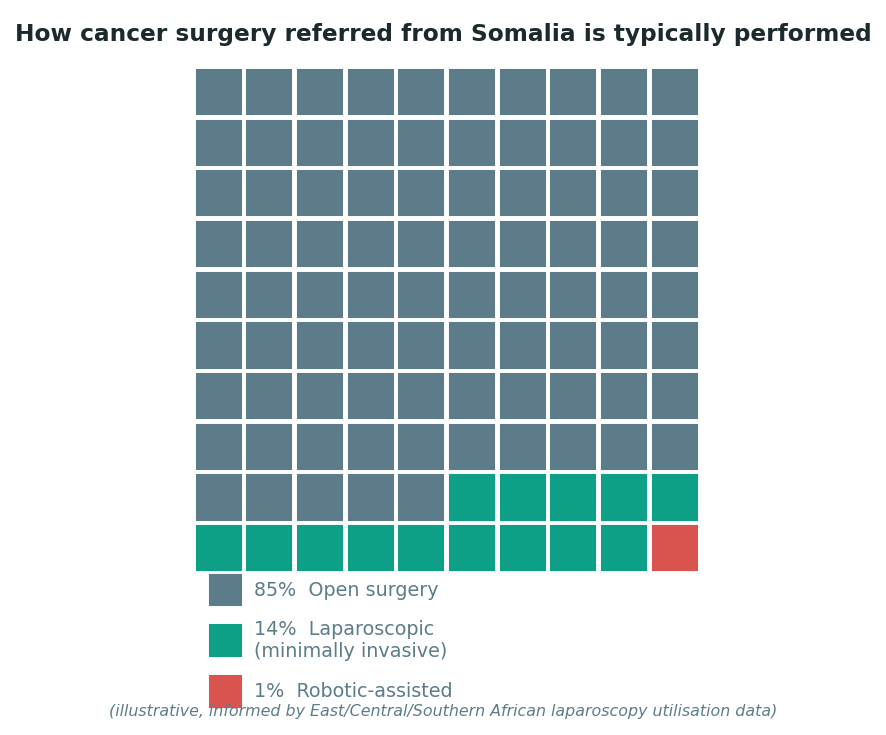
Illustrative breakdown of how cancer surgery referred from Somalia is typically performed, informed by published data on minimally invasive surgery utilisation in the wider region.
Which cancers robotic surgery actually suits
Robotic technique is not a universal upgrade for every operation; it has proven itself specifically in cancers where precision in a confined space matters most. Prostate cancer surgery is the most established application worldwide, with robotic technique now the standard of care in many countries because of its advantages for preserving continence and sexual function. Colorectal, gynaecological, gastric and select head and neck cancers are increasingly treated robotically as well, particularly where the tumour sits in a location that is difficult to reach with a large open incision without extensive surrounding tissue disruption. It is not automatically the right choice for every tumour or every patient, and a genuinely expert surgeon will say so.
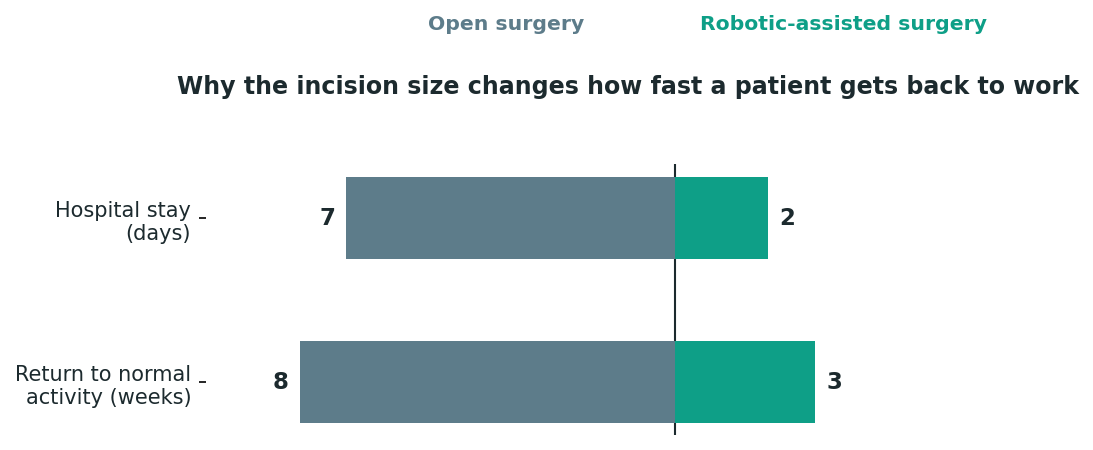
Illustrative comparison, open versus robotic-assisted surgery: general surgical literature, not a Somalia-specific measured outcome. Individual recovery varies by procedure and patient.
Know what to ask before assuming either option is right
Rather than warning signs in the usual sense, this is a topic where the right questions matter more than symptoms. Ask whether your specific tumour type and stage is one where robotic surgery has an established track record, or whether it is being offered simply because the equipment exists. Ask what the plan would be if, once the surgeon can see the tumour directly, an open approach turns out to be safer — a good team plans for this possibility rather than being locked into one technique regardless of what they find. And ask about your own fitness for a longer robotic procedure under anaesthesia, since robotic surgery can sometimes take longer in the operating theatre even as it shortens the recovery afterward, which matters for patients with significant heart or lung conditions.
Not every cancer needs the robot, and an honest surgeon says so
Some tumours are more safely and just as effectively removed through open surgery, particularly very large tumours, those involving major blood vessels, or cases where a robotic approach would compromise the completeness of cancer removal to preserve a smaller incision. The oncological outcome — whether all the cancer is removed with clear margins — always takes priority over the surgical approach used to achieve it. A surgeon offering robotic surgery for every case regardless of tumour characteristics is not necessarily doing a patient a favour; ask specifically why a robotic approach suits your particular tumour, not just that it is available.
What it costs
In more than 24 years arranging this kind of care, the disputes I have seen were almost never about the price itself — they were about a diagnosis, or a cost, nobody had bothered to write down before the flight was booked. Robotic surgery typically costs somewhat more than the equivalent open or laparoscopic operation at the same hospital, and a fair quote should say so explicitly rather than folding it into one number.
Why the surgeon's console time matters as much as the machine
Owning a da Vinci system does not automatically make a hospital a good choice for robotic cancer surgery; the surgeon operating it does. Robotic technique has a genuine learning curve, and outcomes measurably improve as an individual surgeon's case count grows, particularly for complex cancer operations rather than simpler benign procedures. Ask directly how many robotic cancer cases, specifically for your tumour type, the named surgeon has performed, not the hospital's total robotic case count across every specialty. A surgeon early in their robotic learning curve operating on a straightforward gallbladder case is a very different proposition from the same surgeon attempting a complex cancer resection.
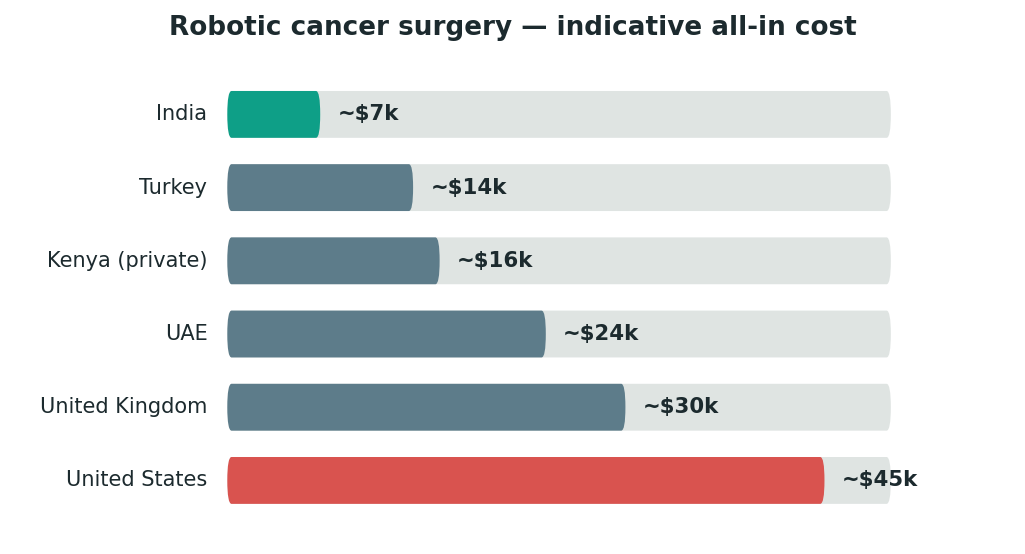
Indicative all-in cost for robotic cancer surgery. India sits far below every common alternative.
A robotic cancer surgery case in a reputable private Indian hospital typically runs US$5,000 to US$14,000 all-in, covering diagnosis, the operation, hospital stay and initial recovery; the exact figure depends heavily on the cancer type and complexity. Ask for the figure specific to your actual staging and diagnosis before committing to anything.
Four signals that should make you stop and walk away
Robotic surgery proposed without explaining why. Ask specifically why this approach suits your tumour, not just that the hospital owns the equipment.
No named surgeon with robotic-specific experience. Operating a robotic system is a distinct skill from open surgery. Ask how many robotic cases the named surgeon has performed.
Cancer clearance not discussed as the priority. The completeness of cancer removal should always come first. Be wary of a plan that emphasises the technology over the outcome.
The price keeps moving. A verbal estimate that shifts each time you ask is not an estimate. Demand a fixed figure in writing.
The practical journey from Somalia — plan it before you fly
There is no direct flight between Somalia and India; patients route through Nairobi, Addis Ababa, Dubai or Djibouti. Because there is no full Indian mission inside Somalia, the medical visa is issued through the Embassy of India in Addis Ababa or the High Commission in Nairobi , against a written invitation letter from the treating hospital. Somali patients may bring up to two medical attendants on attendant visas. Since your route crosses yellow-fever territory, carry a valid yellow-fever vaccination certificate. Above every other instruction: send your actual imaging and biopsy results, not a written summary, so the surgical team can confirm whether a robotic approach genuinely suits your case before you ever leave home.
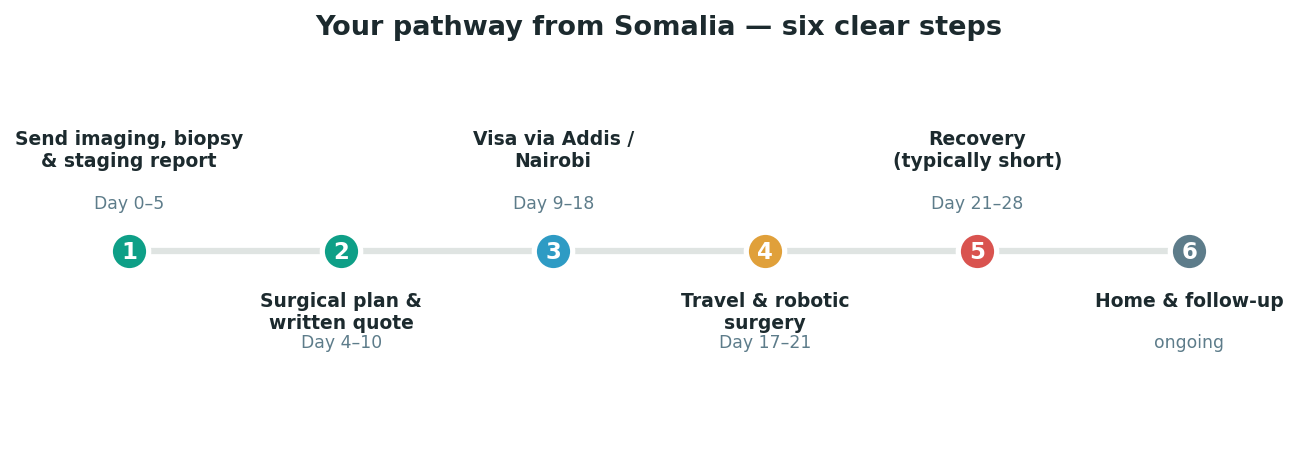
The complete route, start to finish — recovery from robotic surgery is typically shorter than from an equivalent open operation.
The smaller incision is not the point — the life after it is
A robotic operation is not a more advanced way to remove a cancer than open surgery when open surgery is what a particular tumour needs. What it offers, for the cancers it genuinely suits, is a faster path back to the work, the walking and the ordinary life that a large open incision can otherwise take months to return.
Sources & useful links
- 🌐 Indian medical visa (Somali nationals) — indianvisaonline.gov.in
- 🌐 Embassy of India, Addis Ababa — eoiaddisababa.gov.in
- 🌐 High Commission of India, Nairobi — hcinairobi.gov.in
- 🌐 Yellow-fever requirements — who.int/health-topics/yellow-fever
- 🌐 Hospital accreditation (India) — nabh.co · jointcommissioninternational.org
- 🌐 Verify a surgeon's registration — nmc.org.in
Do not decide alone, and do not decide blind
If you want your imaging reviewed properly and an honest written plan — including whether robotic surgery genuinely fits your case — that is precisely the independent guidance I provide, without a single hospital's interest attached to my advice. Dr. Dheeraj Bojwani · Independent medical travel advisor
Frequently Asked Questions by Somali Patients about Robotic Cancer Surgery in India
Why may Somali patients consider robotic cancer surgery in India?
The guide highlights the limited availability of robotic and minimally invasive surgery in Africa. India has established robotic oncology programmes with experienced multidisciplinary teams.
Which cancers can be treated with robotic surgery?
The guide identifies prostate cancer as the most established application, with colorectal, gynaecological, gastric and selected head and neck cancers also potentially suitable.
Is robotic surgery suitable for every cancer patient?
No. The guide explains that tumour size, location, stage and involvement of major blood vessels can make open surgery safer or more effective.
Does robotic surgery provide better cancer removal than open surgery?
Not necessarily. The guide emphasises that complete cancer removal with clear margins is always the priority. Robotic surgery should only be selected when it can achieve the required cancer outcome safely.
What are the recovery benefits of robotic cancer surgery?
The guide describes potential benefits including less pain, shorter hospitalisation and faster return to normal activities. Its page 3 illustration compares 7 versus 2 hospital days and 8 versus 3 weeks for normal activity.
How much does robotic cancer surgery cost in India for Somali patients?
The guide gives an indicative all-in range of US$5,000–US$14,000, depending on the cancer type, stage and complexity of surgery.
How important is the surgeon's robotic experience?
It is very important. Patients should ask how many robotic cancer operations the named surgeon has performed for their specific tumour type, rather than relying on the hospital's overall robotic case count.
What should Somali patients ask if an open operation may become necessary?
They should ask whether the surgical team has a clear plan to convert to open surgery if this becomes safer or necessary for complete cancer removal.
What medical records should Somali patients send before travelling?
The guide recommends sending actual imaging and biopsy results, rather than only a written medical summary, so the surgical team can determine whether robotic surgery genuinely suits the case.
What is the treatment journey from Somalia to India?
The guide outlines the pathway as imaging/biopsy → surgical plan and written quote → visa → travel and robotic surgery → typically shorter recovery → home and follow-up care. Somali patients should also plan their route through Nairobi, Addis Ababa, Dubai or Djibouti and carry a yellow-fever vaccination certificate where required.
Page Summary
This guide explains the key considerations for Somali patients exploring robotic cancer surgery in India, focusing on the limited availability of robotic and even basic minimally invasive surgery across Africa. It covers suitable cancers such as prostate, colorectal, gynaecological, gastric and selected head and neck cancers, potential recovery advantages over open surgery, situations where open surgery may be safer, the importance of tumour clearance and surgeon-specific robotic experience, indicative costs of US$5,000–US$14,000, warning signs when selecting a provider, pre-travel imaging and biopsy requirements, visa and travel planning, and the six-step pathway from case review through robotic surgery, recovery and follow-up. The page 3 chart also illustrates shorter hospital stay and return to normal activity with robotic-assisted surgery compared with open surgery, while noting that these are general literature comparisons rather than Somalia-specific outcomes.
Citation Block
| Topic | Information |
|---|---|
| Topic Information | Robotic Cancer Surgery in India for Patients from Somalia |
| Treatment | Robotic Cancer Surgery |
| Intended Audience | Patients from Somalia |
| Key Specialist | Robotic Cancer Surgeon |
| Main Applications | Prostate, Colorectal, Gynaecological, Gastric and Selected Head and Neck Cancers |
| Primary Assessment | Imaging, Biopsy and Tumour Review |
| Main Benefit | Minimally Invasive Surgery and Potentially Faster Recovery |
| Important Eligibility Factor | Tumour Type, Stage and Location |
| Indicative Cost | US$5,000–US$14,000 All-In |
| Important Specialist Check | Confirm the Named Surgeon's Robotic Experience for the Specific Cancer |
| Cancer Priority | Complete Tumour Removal With Clear Margins |
| Surgical Backup | Confirm the Plan if Open Surgery Becomes Safer |
| Pre-Travel Records | Actual Imaging and Biopsy Results |
| Important Warning | Robotic Surgery Proposed Without Explaining Why It Suits the Tumour |
| Experience Warning | No Named Surgeon With Robotic-Specific Cancer Experience |
| Cost Check | Request a Fixed Diagnosis-Specific Written Quote |
| Travel Routes | Nairobi, Addis Ababa, Dubai or Djibouti |
| Visa Requirement | Hospital Invitation and Medical Visa |
| Patient Journey | Imaging/biopsy → surgical plan → visa → travel/robotic surgery → recovery → home follow-up |
| Recovery | Typically Shorter Than Equivalent Open Surgery |
| Follow-Up | Home and Post-Surgical Follow-Up |


Our Mission Statement
Our mission is to place patients at the centre of every healthcare decision by providing trustworthy, evidence-based, and unbiased medical information. We believe that informed patients make better decisions. Backed by personalised guidance from our experienced advisory team, we help patients understand their treatment options, compare them objectively, and confidently choose the path that best suits their medical needs and personal circumstances.
Patient Testimonials from Somalia




Ready to Take the First Step?
Share your Medical Reports with our Healthcare Managers Today and Get a FREE CONSULTATION, a Personalized Treatment Plan, and Complete Support from Arrival to Recovery.
Get Your Free ConsultationAreas We Serve
This resource has been thoughtfully prepared for patients from Somalia who are considering medical treatment in India. We also welcome patients from the wider region in the countries mentioned below-
We assist patients from:
- Ethiopia
- Djibouti
- Yemen
- Kenya
- Seychelles
- Somalia
- South Sudan
- Tanzania
- Uganda
- Zambia
- Zimbabwe
- Angola
- Cameroon
- Central African Republic
Many of the insights, treatment pathways, hospital recommendations, travel guidance, and patient support services described here are equally relevant and may be used as a reference when planning treatment in India.
From Somalia to India: Your Complete Patient Support Guide
- Best Brain Tumour Surgeons & Hospitals in India for Somali Patients
- Best Cancer Treatment Surgeons & Hospitals in India for Somali Patients
- Best Cardiac Surgeons & Hospitals in India for Somali Patients
- Best CyberKnife Teams & Centres in India for Somali Patients
- Best Heart Valve Replacement Surgeons & Hospitals in India for Somali Patients
- Best Hip Surgeons & Hospitals in India for Somali Patients
- Best Knee Surgeons & Hospitals in India for Somali Patients
- Best Neurosurgeons & Hospitals in India for Somali Patients
- Best Paediatric Cardiac Surgeons & Hospitals in India for Somali Patients
- Best Paediatric Neurosurgeons & Hospitals in India for Somali Patients
- Best Spine Surgeons & Hospitals in India for Somali Patients
- Bariatric Surgery in India for Patients from Somalia
- Brain Tumour Surgery in India for Patients from Somalia
- Cancer Treatment and Surgery in India for Patients from Somalia
- Cardiac Surgery in India for Patients from Somalia
- Cosmetic and Plastic Surgery in India for Patients from Somalia
- CyberKnife Treatment in India for Patients from Somalia
- Dental Surgery in India for Patients from Somalia