

Radiotherapy and Modern Cancer Treatments in India for Patients from Somalia
Somali women have one of the highest cervical cancer rates in the world — and cervical cancer is, more than almost any other cancer, a disease that surgery alone cannot cure once it has grown beyond its earliest stage.
Surgery removes what a surgeon can see and reach. Radiotherapy, precisely targeted and delivered over weeks, treats the microscopic disease surgery cannot, and for several of the most common cancers affecting Somali patients, it is not an optional extra but the difference between a treatment plan that can cure and one that cannot. For 24 years I have watched how often this distinction gets lost when radiotherapy simply is not available to offer in the first place.
India runs some of the highest-volume radiotherapy programmes anywhere, combining external beam techniques like IMRT, IGRT and VMAT with brachytherapy, immunotherapy and targeted drug therapy in fully integrated cancer centres — at a fraction of the cost of the same care in the Gulf, Europe or the United States.
Healing Journeys of Somali Patients









Key Takeaways
- The guide highlights a major treatment-access gap for Somali cancer patients: Somalia has no radiotherapy machines, despite radiotherapy being an essential part of treatment for several common cancers.
- Cervical cancer is a particular concern. The guide cites approximately 24 cervical cancer cases per 100,000 Somali women annually, while a Mogadishu study found that only 14.3% of women had ever undergone cervical cancer screening and 5.5% had received HPV vaccination.
- For locally advanced cervical cancer, the guide identifies chemoradiation as the standard curative approach: external-beam pelvic radiotherapy combined with weekly chemotherapy, followed by brachytherapy.
- The page 2 illustration shows the cancers most dependent on radiotherapy in the guide: cervical cancer 35%, breast cancer 25%, head and neck cancer 20% and other solid tumours 20%.
- The guide explains that radiotherapy is not simply an additional treatment after surgery. For some cancers, particularly locally advanced cervical cancer, radiotherapy can be essential to achieving the intended treatment outcome.
- Modern radiation techniques such as IMRT, IGRT and VMAT can shape and accurately deliver radiation while reducing unnecessary exposure to surrounding healthy tissues. IGRT uses imaging before treatment sessions to confirm the target position.
- Brachytherapy is particularly important for cervical cancer. It delivers radiation directly inside the cervix, allowing a dose that external radiation alone may not safely achieve.
- The page 3 comparison illustrates the potential difference in outcomes for locally advanced cervical cancer: 5-year survival is shown as 30% without full chemoradiation access versus 65% with full chemoradiation, while lasting local control is shown as 35% versus 75%. These are explicitly presented as illustrative figures from general oncology literature, not Somalia-specific measured outcomes.
- A full chemoradiation course for locally advanced cervical cancer at a reputable private Indian hospital is approximately US$5,000–US$8,500 all-in, including external-beam radiotherapy, weekly chemotherapy and brachytherapy.
- Somali patients should send their actual biopsy and staging imaging rather than a written summary before travelling. The guide's six-step pathway covers imaging and biopsy review, tumour-board planning, visa, travel and treatment, a daily chemoradiation course over several weeks, and long-term follow-up.
Quick Facts
- Treatment
- Radiotherapy and Modern Cancer Treatment
- Country
- India
- Patients
- Patients from Somalia
- Key Specialist
- Radiation Oncologist
- Main Condition
- Locally Advanced Cervical Cancer
- Other Conditions
- Breast, Head and Neck and Other Solid Tumours
- Primary Assessment
- Biopsy and Staging Imaging
- Main Radiotherapy Techniques
- IMRT, IGRT and VMAT
- Additional Treatment
- Chemotherapy and Brachytherapy Where Indicated
- Indicative Cost
- US$5,000–US$8,500 All-In
- Important Check
- Dedicated Radiation Oncology Department
- Team Requirement
- Multidisciplinary Cancer Team
- Cervical Cancer Check
- Confirm Brachytherapy Availability
- Cost Check
- Session-by-Session Written Quotation
- Pre-Travel Records
- Actual Biopsy and Staging Imaging
- Travel Routes
- Nairobi, Addis Ababa, Dubai or Djibouti
- Visa
- Hospital Invitation and Medical Visa
- Attendants
- Up to Two Medical Attendants
- Treatment Duration
- Daily Sessions Over Several Weeks
- Follow-Up
- Home and Long-Term Oncology Follow-Up
- Author
- Dr. Dheeraj Bojwani
- Experience
- 24+ Years
In Brief
For Somali patients considering radiotherapy and modern cancer treatment in India, the guide recommends beginning with a proper review of the actual biopsy and staging imaging so that the radiation oncology team can determine the appropriate treatment combination. This is especially important for locally advanced cervical cancer, where the guide identifies external-beam radiotherapy, weekly chemotherapy and brachytherapy as the standard treatment pathway. Patients should confirm that radiotherapy, chemotherapy and surgery are coordinated by a multidisciplinary team, verify the centre's IMRT/IGRT capability and obtain a written quotation specifying the number of sessions and whether chemotherapy and brachytherapy are included.
First, know why this gap matters so much for Somali patients specifically
Cervical cancer is not a rare diagnosis in Somalia; it is one of the more common cancers affecting Somali women, with an estimated 24 cases annually per 100,000, placing it among the highest rates recorded anywhere in the world. A study of women in Mogadishu found only 14.3% had ever undergone cervical cancer screening, and just 5.5% had received the HPV vaccine that prevents most cases in the first place. Screening this low means most cervical cancers are found only once they cause symptoms — bleeding, pain, discharge — by which point many have already grown beyond the stage where surgery alone can cure them.
The Somali difference: the cancer most in need of radiotherapy, in a country with none
Locally advanced cervical cancer's standard, internationally recognised curative treatment is chemoradiation: external beam radiotherapy to the pelvis combined with weekly chemotherapy, followed by brachytherapy — radioactive sources placed directly inside the cervix for a period of days, delivering a dose to the tumour that external treatment alone cannot safely achieve. There is no surgical substitute for this combination once a cervical cancer has grown beyond its earliest stage; attempting surgery alone on locally advanced disease does not achieve the same cure rates and can make later radiotherapy more difficult to deliver safely. Somalia has no radiotherapy machines of any kind. For the disease with arguably the strongest, most specific need for this technology among Somali cancer patients, it is currently not available in the country at all.
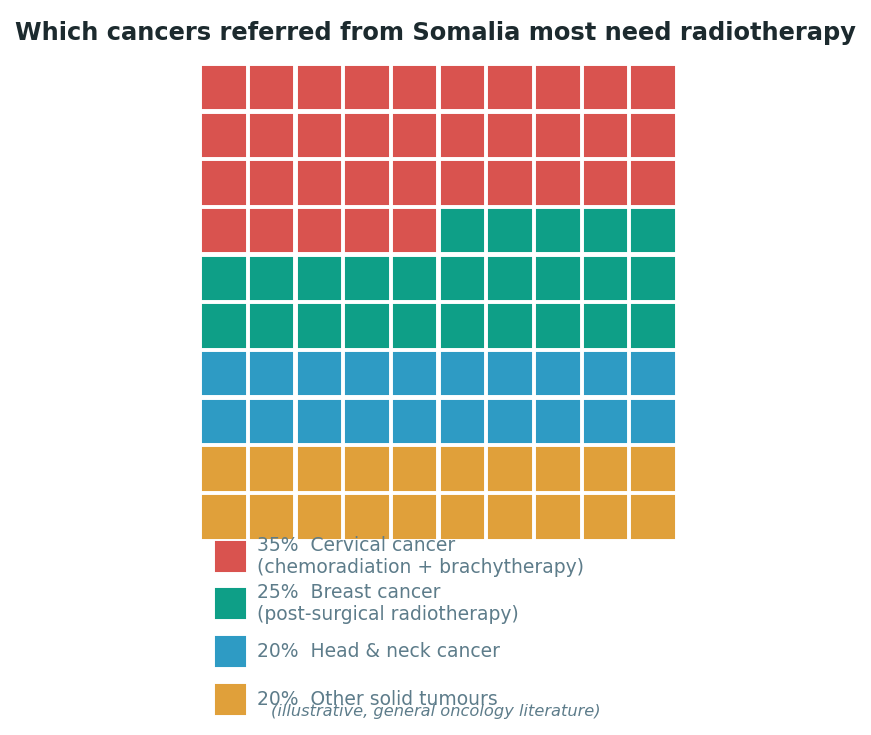
Illustrative breakdown of cancer types most dependent on radiotherapy for cure, based on general oncology literature.
Why "no radiotherapy" does not mean "no hope"
This is the point worth stating plainly: a locally advanced cervical, breast or head and neck cancer without access to radiotherapy is not automatically incurable — it is a cancer whose best treatment option has not yet been reached. The difference chemoradiation makes to outcomes in locally advanced cervical cancer specifically is large and well documented in the oncology literature, which is exactly why international guidelines treat it as the standard of care rather than one option among several.
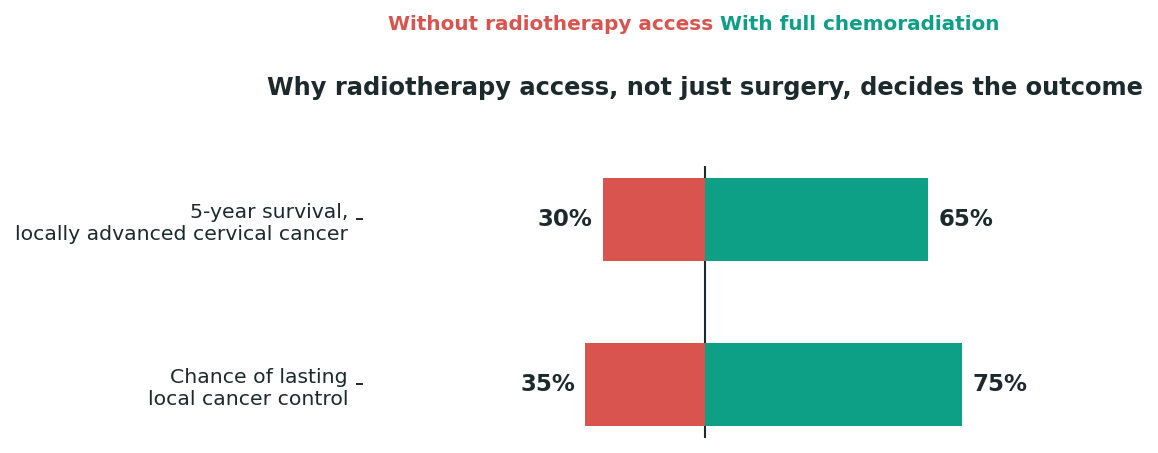
Illustrative outcomes for locally advanced cervical cancer: with full access to chemoradiation and brachytherapy, versus without. General oncology literature, not a Somalia-specific measured outcome.
Know the warning signs, and do not wait them out
Bleeding between periods, after menopause, or after intercourse, unusual vaginal discharge, and pelvic pain are the classic warning signs of cervical cancer and deserve an examination, not assumption. A breast lump, a persistent mouth ulcer or sore that will not heal, a hoarse voice lasting more than a few weeks, or a lump in the neck are worth the same attention for the other cancers most often needing radiotherapy. Because Somalia's screening rates are so low, many of these signs are the first indication anyone has had of a problem at all, which makes acting on them promptly, rather than waiting to see if they resolve, especially important. Where cervical cancer specifically is concerned, HPV vaccination for daughters and younger female relatives remains one of the most effective preventive tools available anywhere, entirely independent of what treatment is or is not accessible later.
Modern treatment is more than radiotherapy alone
Radiotherapy today is not the blunt instrument of decades past. IMRT and VMAT shape the radiation dose precisely around a tumour, sparing much more of the surrounding healthy tissue and organs than older techniques could. IGRT uses imaging taken immediately before each daily session to confirm the target has not shifted, improving accuracy over a treatment course that can run five to seven weeks. Beyond radiotherapy, targeted drug therapies attack specific molecular features of a tumour rather than all fast-dividing cells indiscriminately, and immunotherapy helps the patient's own immune system recognise and attack cancer cells, both now standard options for specific cancer types and stages. None of these are exotic or experimental; they are routine tools at a well-equipped cancer centre, simply not yet available closer to home.
What it costs
In more than 24 years arranging this kind of care, the disputes I have seen were almost never about the price itself — they were about a diagnosis, or a cost, nobody had bothered to write down before the flight was booked. A radiotherapy course is priced by the number of sessions and any chemotherapy or brachytherapy given alongside it, so ask for a plan that specifies exactly what is included.
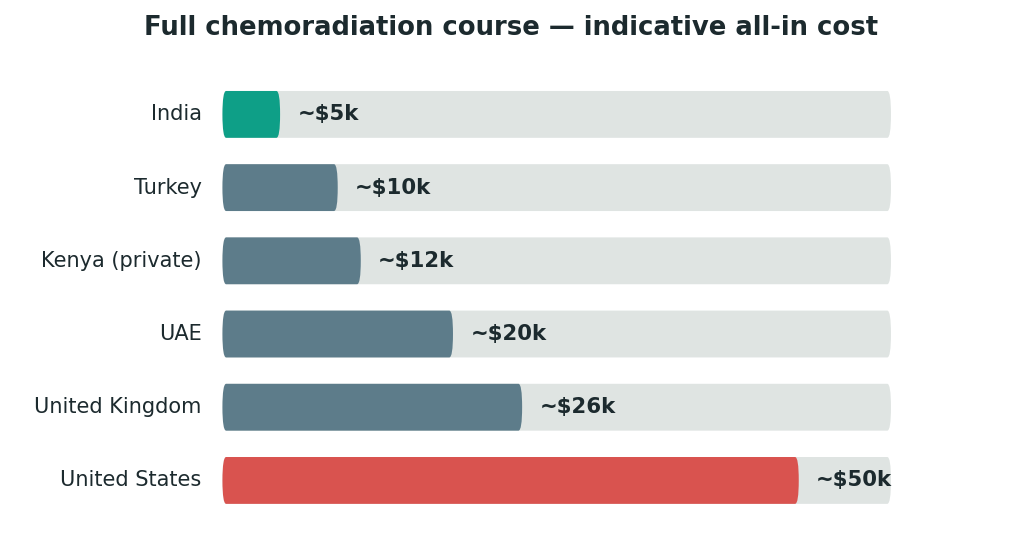
Indicative all-in cost for a full chemoradiation course, including external beam radiotherapy and brachytherapy. India sits far below every common alternative.
A full chemoradiation course for locally advanced cervical cancer in a reputable private Indian hospital, combining external beam radiotherapy, weekly chemotherapy and brachytherapy, typically runs US$5,000 to US$8,500 all-in. Earlier-stage disease treated with surgery alone, or radiotherapy for other cancer types, may cost less or more depending on the number of sessions required. Ask for the figure specific to your actual staging before committing to anything.
Why a genuine radiation oncology department is what to look for
Not every hospital claiming cancer care has its own radiotherapy department; some refer patients elsewhere for this part of treatment, which can fragment care and add delay at exactly the point when consistency matters most. Ask specifically whether radiotherapy, chemotherapy and any surgery are delivered under one roof by a coordinated multidisciplinary team, what radiotherapy technology the centre uses (IMRT and IGRT are now considered standard, older techniques less so), and how many cervical cancer or equivalent cases the radiation oncology team treats each year. A daily treatment course run over five to seven weeks depends on consistent, well-calibrated equipment and an experienced team far more than most single-operation surgeries do.
Four signals that should make you stop and walk away
Surgery proposed alone for locally advanced disease. If imaging shows disease beyond the earliest stage and only surgery is offered, ask directly why chemoradiation is not part of the plan.
No mention of brachytherapy for cervical cancer. External radiotherapy alone is not equivalent to the combination with brachytherapy. Its absence from a locally advanced plan is a real gap.
No tumour board or radiation oncologist involved. Deciding whether and how radiotherapy fits your case should involve a radiation oncologist directly, not a surgeon's opinion alone.
The price keeps moving. A verbal estimate that shifts each time you ask is not an estimate. Demand a session-by-session quote in writing.
The practical journey from Somalia — plan it before you fly
There is no direct flight between Somalia and India; patients route through Nairobi, Addis Ababa, Dubai or Djibouti. Because there is no full Indian mission inside Somalia, the medical visa is issued through the Embassy of India in Addis Ababa or the High Commission in Nairobi , against a written invitation letter from the treating hospital. Somali patients may bring up to two medical attendants on attendant visas, and because a radiotherapy course runs daily over several weeks, plan for an extended stay rather than a short trip. Since your route crosses yellow-fever territory, carry a valid yellow-fever vaccination certificate . Above every other instruction: send your actual biopsy and staging imaging, not a written summary, so the radiation oncology team can confirm the right treatment plan before you ever leave home.
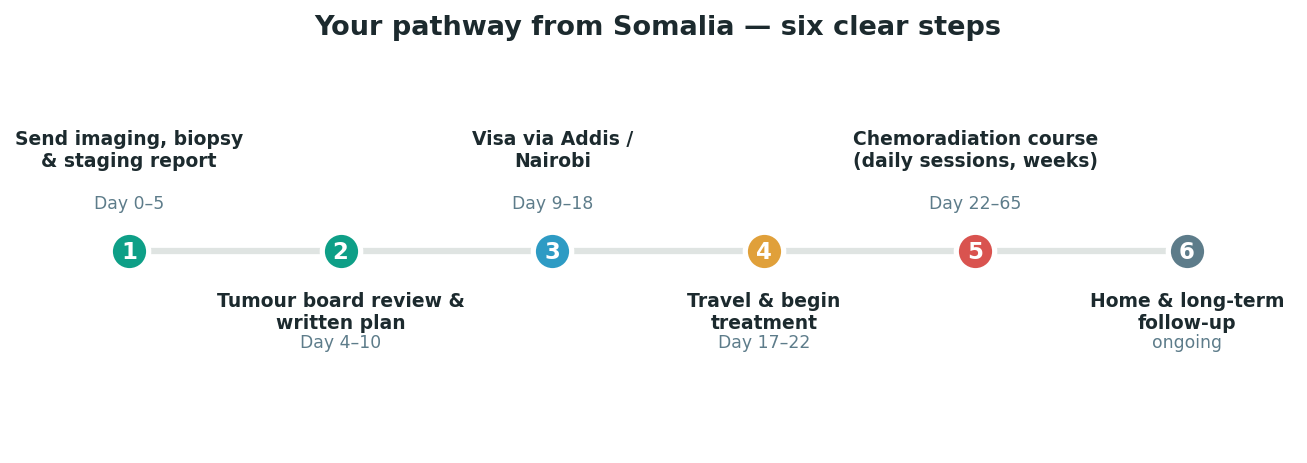
The complete route, start to finish — a full course of daily radiotherapy sessions runs several weeks.
A screening gap and a treatment gap, both genuinely closeable
Somalia's cervical cancer burden is high enough, and its screening rates low enough, that this disease will keep being diagnosed at a stage that needs radiotherapy for years to come. Closing that specific treatment gap, one patient at a time, is not a small thing — it is the difference between a cancer treated with everything modern medicine has to offer, and one treated with only part of it.
Sources & useful links
- 🌐 Indian medical visa (Somali nationals) — indianvisaonline.gov.in
- 🌐 Embassy of India, Addis Ababa — eoiaddisababa.gov.in
- 🌐 High Commission of India, Nairobi — hcinairobi.gov.in
- 🌐 Yellow-fever requirements — who.int/health-topics/yellow-fever
- 🌐 Hospital accreditation (India) — nabh.co · jointcommissioninternational.org
- 🌐 Verify a surgeon's registration — nmc.org.in
Do not decide alone, and do not decide blind
If you want your imaging and biopsy reviewed properly and an honest written plan — including whether radiotherapy genuinely belongs in it — that is precisely the independent guidance I provide, without a single hospital's interest attached to my advice. Dr. Dheeraj Bojwani · Independent medical travel advisor
Frequently Asked Questions by Somali Patients about Radiotherapy and Modern Cancer Treatments in India
Why is radiotherapy particularly important for Somali cancer patients?
The guide states that Somalia has no radiotherapy machines, despite radiotherapy being essential for several cancers. Patients requiring this treatment therefore need access to an appropriately equipped centre outside the country.
Why is cervical cancer a major concern for Somali women?
The guide cites approximately 24 cases per 100,000 Somali women annually and notes that only 14.3% of women in a Mogadishu study had ever undergone cervical cancer screening.
What is the standard treatment for locally advanced cervical cancer?
The guide describes external-beam pelvic radiotherapy with weekly chemotherapy, followed by brachytherapy as the internationally recognised curative treatment approach.
Why is brachytherapy important for cervical cancer?
Brachytherapy places radioactive sources directly inside the cervix, allowing a concentrated tumour dose that external radiotherapy alone may not safely deliver.
What modern radiotherapy techniques are available in India?
The guide discusses IMRT, IGRT and VMAT, which allow radiation to be shaped and delivered more accurately while helping spare surrounding healthy tissue.
How much does cervical cancer chemoradiation cost in India for Somali patients?
The guide gives an indicative all-in range of US$5,000–US$8,500, including external-beam radiotherapy, weekly chemotherapy and brachytherapy for locally advanced cervical cancer.
Should surgery always be performed for locally advanced cervical cancer?
The guide warns against assuming that surgery alone is sufficient once cervical cancer has progressed beyond its earliest stage. Patients should ask why chemoradiation and brachytherapy are or are not included in the treatment plan.
What should Somali patients check when selecting a radiotherapy centre?
They should confirm a dedicated radiation oncology department, multidisciplinary cancer team, modern radiotherapy technology and appropriate brachytherapy facilities for cervical cancer.
What records should Somali patients send before travelling to India?
They should send the actual biopsy results and staging imaging, rather than only a written medical summary. This allows the radiation oncology team to develop an appropriate treatment plan before travel.
How long should Somali patients plan to stay in India for radiotherapy?
Radiotherapy may require daily sessions over five to seven weeks, depending on the cancer and treatment plan. Patients should therefore plan an extended stay and arrange visa and accommodation requirements in advance.
Page Summary
This guide explains the key considerations for Somali patients seeking radiotherapy and modern cancer treatment in India, with particular emphasis on cervical cancer and the absence of radiotherapy facilities in Somalia. It covers the country's cervical cancer burden and low screening rates, the role of chemoradiation and brachytherapy in locally advanced cervical cancer, modern techniques such as IMRT, IGRT and VMAT, other cancers that may require radiotherapy, warning signs when selecting a cancer centre, indicative chemoradiation costs of US$5,000–US$8,500, multidisciplinary treatment requirements, pre-travel biopsy and staging records, visa and travel planning, and the six-step treatment pathway shown on page 5 from tumour-board review through several weeks of daily treatment and long-term follow-up.
Citation Block
| Topic | Information |
|---|---|
| Topic Information | Radiotherapy and Modern Cancer Treatments in India for Patients from Somalia |
| Treatment | Radiotherapy and Modern Cancer Treatment |
| Intended Audience | Patients from Somalia |
| Key Specialist | Radiation Oncologist |
| Main Condition | Locally Advanced Cervical Cancer |
| Other Conditions | Breast, Head and Neck and Other Solid Tumours |
| Primary Assessment | Biopsy and Staging Imaging |
| Main Techniques | IMRT, IGRT and VMAT |
| Additional Treatment | Chemotherapy and Brachytherapy Where Indicated |
| Indicative Cost | US$5,000–US$8,500 All-In |
| Important Check | Dedicated Radiation Oncology Department |
| Team Requirement | Multidisciplinary Cancer Team |
| Cervical Cancer Requirement | Confirm Brachytherapy Availability |
| Treatment Duration | Daily Sessions Over Five to Seven Weeks Where Required |
| Pre-Travel Records | Actual Biopsy and Staging Imaging |
| Important Warning | Surgery Alone Proposed for Locally Advanced Cervical Cancer Without Explanation |
| Radiotherapy Warning | No Brachytherapy Included in an Appropriate Cervical Cancer Plan |
| Cost Check | Request a Session-by-Session Written Quotation |
| Travel Routes | Nairobi, Addis Ababa, Dubai or Djibouti |
| Visa Requirement | Hospital Invitation and Medical Visa |
| Patient Journey | Imaging/biopsy → tumour-board review → visa → travel/begin treatment → chemoradiation → long-term follow-up |
| Follow-Up | Home and Long-Term Oncology Follow-Up |


Our Mission Statement
Our mission is to place patients at the centre of every healthcare decision by providing trustworthy, evidence-based, and unbiased medical information. We believe that informed patients make better decisions. Backed by personalised guidance from our experienced advisory team, we help patients understand their treatment options, compare them objectively, and confidently choose the path that best suits their medical needs and personal circumstances.
Patient Testimonials from Somalia




Ready to Take the First Step?
Share your Medical Reports with our Healthcare Managers Today and Get a FREE CONSULTATION, a Personalized Treatment Plan, and Complete Support from Arrival to Recovery.
Get Your Free ConsultationAreas We Serve
This resource has been thoughtfully prepared for patients from Somalia who are considering medical treatment in India. We also welcome patients from the wider region in the countries mentioned below-
We assist patients from:
- Ethiopia
- Djibouti
- Yemen
- Kenya
- Seychelles
- Somalia
- South Sudan
- Tanzania
- Uganda
- Zambia
- Zimbabwe
- Angola
- Cameroon
- Central African Republic
Many of the insights, treatment pathways, hospital recommendations, travel guidance, and patient support services described here are equally relevant and may be used as a reference when planning treatment in India.
From Somalia to India: Your Complete Patient Support Guide
- Best Brain Tumour Surgeons & Hospitals in India for Somali Patients
- Best Cancer Treatment Surgeons & Hospitals in India for Somali Patients
- Best Cardiac Surgeons & Hospitals in India for Somali Patients
- Best CyberKnife Teams & Centres in India for Somali Patients
- Best Heart Valve Replacement Surgeons & Hospitals in India for Somali Patients
- Best Hip Surgeons & Hospitals in India for Somali Patients
- Best Knee Surgeons & Hospitals in India for Somali Patients
- Best Neurosurgeons & Hospitals in India for Somali Patients
- Best Paediatric Cardiac Surgeons & Hospitals in India for Somali Patients
- Best Paediatric Neurosurgeons & Hospitals in India for Somali Patients
- Best Spine Surgeons & Hospitals in India for Somali Patients
- Bariatric Surgery in India for Patients from Somalia
- Brain Tumour Surgery in India for Patients from Somalia
- Cancer Treatment and Surgery in India for Patients from Somalia
- Cardiac Surgery in India for Patients from Somalia
- Cosmetic and Plastic Surgery in India for Patients from Somalia
- CyberKnife Treatment in India for Patients from Somalia
- Dental Surgery in India for Patients from Somalia