

Proton Therapy in India for Patients from Somalia
Of the world's 136 proton therapy centres, not one operates anywhere in Sub-Saharan Africa — in a region projected to soon carry the world's largest burden of childhood cancer.
Conventional radiotherapy uses X-ray beams that pass all the way through the body, depositing radiation in healthy tissue on both sides of the tumour. Proton therapy uses charged particles that stop precisely at the tumour and release almost none of their energy beyond it. For an adult, that difference matters. For a child, whose developing brain, bones and organs are still growing around the treatment area, it can matter enormously. For 24 years I have watched families search for this specific technology only to find it does not exist anywhere near them.
India runs the region's most established proton therapy programme at Apollo Proton Cancer Centre in Chennai — the first in South Asia and the Middle East, already treating patients referred from across Africa, with genuinely no waiting list for international patients and the same pencil beam scanning technology used at leading centres worldwide, at a fraction of the cost of the same treatment in the Gulf, Europe or the United States.
Healing Journeys of Somali Patients









Key Takeaways
- The guide highlights that Sub-Saharan Africa currently has no operational proton therapy centre, creating a major access gap for Somali patients who may require this specialised radiation technology.
- India is presented as an accessible regional option, with the guide identifying Apollo Proton Cancer Centre in Chennai as the established proton therapy programme discussed for international patients.
- Proton therapy differs from conventional X-ray radiotherapy because protons release most of their energy at a controlled depth, known as the Bragg peak, potentially reducing radiation exposure to nearby healthy tissues.
- The guide places particular emphasis on children with tumours near the brain, spine or other developing organs, where reducing unnecessary radiation exposure may help limit long-term effects involving growth, hormones and secondary cancers.
- The page 2 illustration identifies the childhood tumour groups where proton therapy may offer the clearest advantage: brain and spinal cord tumours 40%, sarcomas near the spine or pelvis 25%, head and neck tumours 20%, and eye tumours 15%.
- Proton therapy is not automatically better for every cancer. The guide says the clearest benefits are seen for selected childhood tumours, certain sarcomas, base-of-skull tumours and selected adult cancers close to critical structures.
- The page 3 comparison illustrates the potential reduction in radiation exposure to surrounding healthy tissue and long-term growth/hormonal risks, while clearly noting that these figures are illustrative comparisons from general radiation-oncology literature, not Somalia-specific outcomes.
- A full proton therapy course at a leading Indian centre is given as approximately US$21,000–US$50,000 all-in, with cost depending heavily on the number of treatment fractions. Longer courses of around 25–33 fractions may fall toward the higher end.
- For children, the centre should have a dedicated paediatric proton programme, paediatric anaesthesia expertise where daily anaesthesia is required, and a paediatric oncologist involved with the radiation oncology team.
- Somali patients should send actual imaging, biopsy results and staging information, rather than only a written summary, so the oncology team can determine whether proton therapy is genuinely appropriate before travel. For children, weight, previous anaesthesia history and developmental concerns should also be provided.
Quick Facts
- Treatment
- Proton Therapy
- Country
- India
- Patients
- Patients from Somalia
- Key Specialist
- Radiation Oncologist / Proton Therapy Specialist
- Main Applications
- Selected Brain, Spinal, Sarcoma, Head and Neck and Eye Tumours
- Primary Assessment
- Imaging, Biopsy and Staging Review
- Main Benefit
- Reduced Radiation Exposure to Nearby Healthy Tissue
- Important Eligibility Factor
- Tumour Location and Nearby Critical Structures
- Paediatric Requirement
- Dedicated Paediatric Proton Programme
- Indicative Cost
- US$21,000–US$50,000 All-In
- Important Check
- Confirm Why Proton Therapy Is Appropriate
- Treatment Duration
- Depends on Number of Fractions
- Pre-Travel Records
- Actual Imaging, Biopsy Results and Staging Information
- Child-Specific Records
- Weight, Anaesthesia History and Developmental Concerns
- Travel Routes
- Nairobi, Addis Ababa, Dubai or Djibouti
- Visa
- Hospital Invitation and Medical Visa
- Attendants
- Up to Two Medical Attendants
- Follow-Up
- Home and Long-Term Oncology Follow-Up
- Author
- Dr. Dheeraj Bojwani
- Experience
- 24+ Years
In Brief
For Somali patients considering proton therapy in India, the guide recommends beginning with a specialist review of the actual imaging, biopsy and staging information to establish whether proton therapy offers a meaningful advantage over conventional radiotherapy. It is particularly relevant for selected tumours near critical structures and for children whose developing tissues may benefit from reduced radiation exposure. Before travelling, patients should confirm the number of fractions, obtain a diagnosis-specific written quotation, verify multidisciplinary oncology involvement and, for children, ensure that paediatric oncology and anaesthesia support are routinely available.
First, know how genuinely rare this technology still is
Proton therapy is not simply a more expensive version of ordinary radiotherapy; it depends on a cyclotron or synchrotron, machinery so large and costly that most operational centres run to well over a hundred million dollars to build. Of 136 proton therapy centres operating worldwide, every one sits in the northern hemisphere except two still under construction, in Argentina and Australia. A centre in Egypt remains in the planning stages. For the whole of Sub-Saharan Africa today, proton therapy is simply not available at all.
The Somali difference: the region with the greatest need has none of the region's centres
This gap lands hardest on exactly the patients who could benefit most from it. Childhood cancer mortality in Africa runs at approximately 80%, compared with roughly 20% in the United States and Canada — and Africa is projected to carry the world's largest burden of paediatric cancer within the next five years as its child population continues to grow. Proton therapy was specifically developed for situations like these: tumours in children whose surrounding brain, spine or organs are still developing, where sparing healthy tissue from unnecessary radiation is not a comfort but a direct reduction in lifelong complications like impaired growth, hormonal deficiency and secondary cancers decades later. The country and region facing this crisis most acutely currently has no access to the technology built to address it.
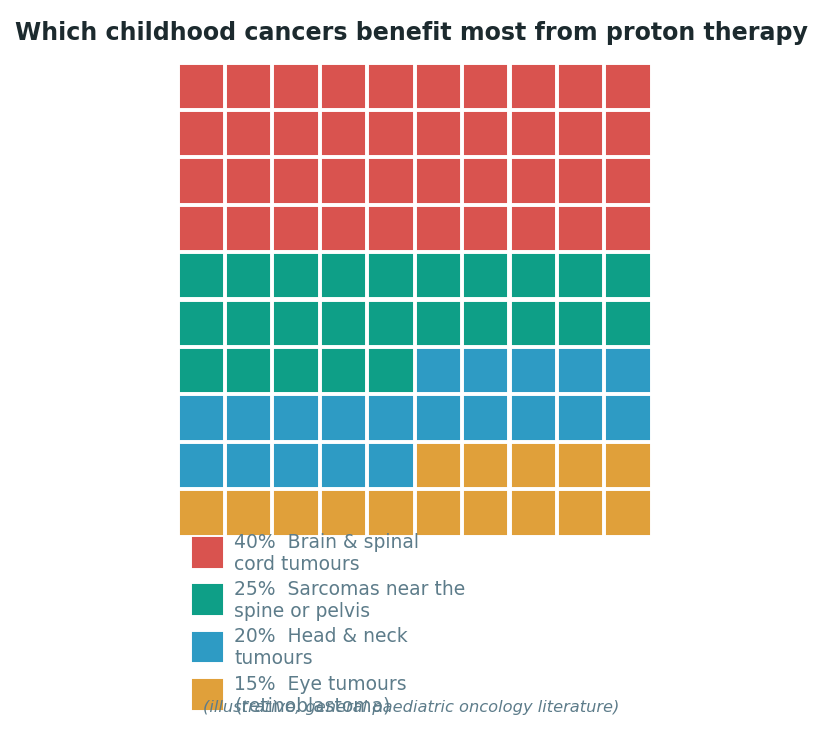
Illustrative breakdown of childhood cancers where proton therapy offers the clearest advantage, based on general paediatric oncology literature.
Why the physics, not just the marketing, matters here
Ordinary X-ray radiotherapy deposits its dose along the entire path the beam travels through the body, entering and exiting through healthy tissue on both sides of a tumour. Protons behave differently: they release most of their energy at a specific, controllable depth — the "Bragg peak" — and almost nothing beyond it. For a tumour near the brainstem, spinal cord or a growing child's skeleton, this difference can mean the surrounding tissue receives a small fraction of the radiation dose it would with conventional treatment, without compromising the dose delivered to the tumour itself.
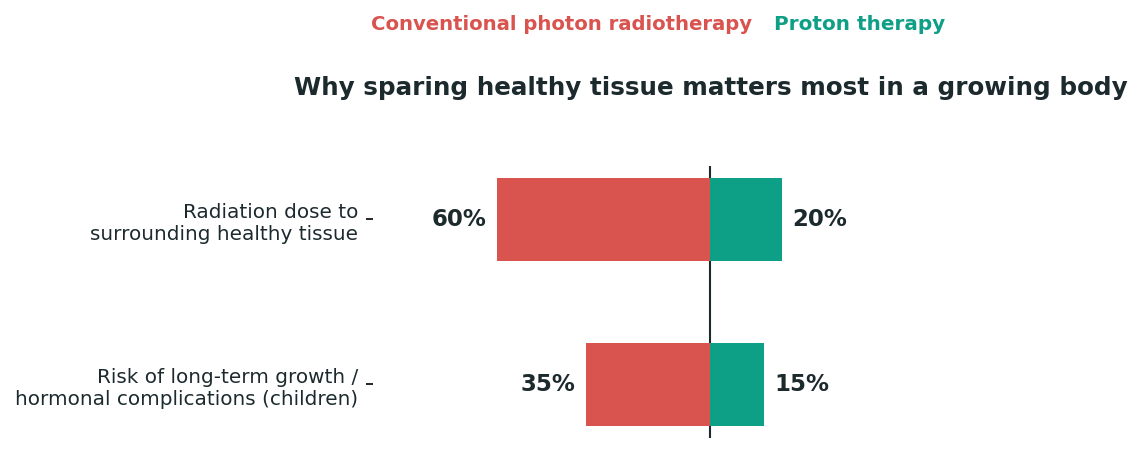
Illustrative comparison, conventional photon radiotherapy versus proton therapy: general radiation oncology literature, not a Somalia- specific measured outcome.
Know the warning signs, and do not wait them out
In children specifically, persistent headaches that worsen in the morning or wake a child from sleep, new vision or balance problems, unexplained back pain with weakness in the legs, a growing lump near the spine or pelvis, or a change noticed in a child's eye during photographs are all signs that deserve imaging, not patience. Because these symptoms can develop gradually, they are sometimes attributed to growing pains, clumsiness or ordinary childhood complaints for longer than they should be. None of these signs mean cancer in most cases, but persistence, or any of them appearing together, is exactly the pattern that justifies asking for a scan rather than waiting to see if things improve.
Not every tumour needs proton therapy
This is a technology for specific situations, not a universal upgrade over standard radiotherapy. It offers the clearest benefit for tumours near critical structures in children, certain sarcomas, base-of-skull tumours, and select adult cancers where sparing a nearby organ meaningfully changes long-term side effects. For many adult cancers, particularly where there is no critical structure immediately adjacent to the tumour, well-delivered conventional IMRT or IGRT radiotherapy achieves comparable cancer control at a fraction of the cost and complexity. An honest oncology team explains specifically why proton therapy suits your case, rather than presenting it as automatically superior for every diagnosis.
What it costs
In more than 24 years arranging this kind of care, the disputes I have seen were almost never about the price itself — they were about a diagnosis, or a cost, nobody had bothered to write down before the flight was booked. Proton therapy is priced by the number of fractions (treatment sessions) required, which varies significantly by tumour type and size.
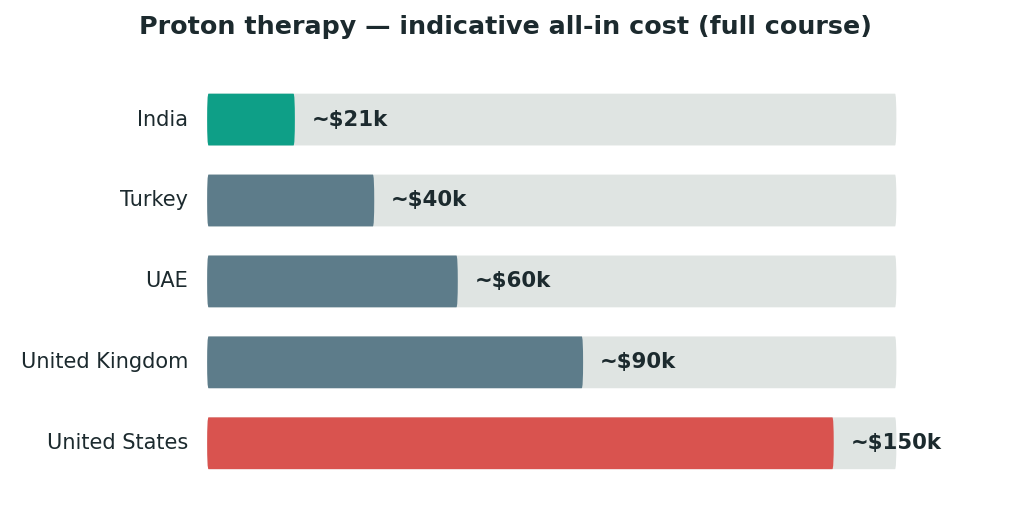
Indicative all-in cost for a full proton therapy course. India sits far below every common alternative.
A full proton therapy course at a leading Indian centre typically runs US$21,000 to US$50,000 all-in for international patients, depending heavily on the number of fractions needed; shorter courses of a handful of sessions sit toward the lower end, while extended 25 to 33-fraction courses for larger or more complex tumours sit toward the top. For comparison, the same course in the United States typically runs $150,000 to $250,000. Ask for the figure specific to your actual staging and the number of fractions your case requires.
Why a genuine paediatric proton programme is what to look for
Delivering proton therapy to a young child is a distinct undertaking from treating an adult. Younger children often need daily anaesthesia to lie completely still for each session, which means the centre needs paediatric anaesthesia expertise built into its daily workflow, not arranged as an exception. Ask specifically whether the centre treats children routinely as part of a dedicated paediatric proton programme, how sessions under anaesthesia are scheduled and monitored, and whether a paediatric oncologist is part of the standing team reviewing the treatment plan alongside the radiation oncologist. A centre with genuine paediatric experience handles these logistics as routine; one without it may treat a child's case as a rare exception, with everything that implies for planning and safety.
Four signals that should make you stop and walk away
Proton therapy proposed without explaining why. Ask specifically what nearby critical structure this approach is protecting, not just that the technology is available.
No multidisciplinary tumour board involved. The decision between proton and conventional radiotherapy should involve radiation oncology, not be presented as a default upgrade.
No clear fraction count given upfront. Cost and duration both scale directly with the number of sessions. A quote without this detail is incomplete.
The price keeps moving. A verbal estimate that shifts each time you ask is not an estimate. Demand a fraction-specific quote in writing.
The practical journey from Somalia — plan it before you fly
There is no direct flight between Somalia and India; patients route through Nairobi, Addis Ababa, Dubai or Djibouti. Because there is no full Indian mission inside Somalia, the medical visa is issued through the Embassy of India in Addis Ababa or the High Commission in Nairobi , against a written invitation letter from the treating hospital. Somali patients may bring up to two medical attendants on attendant visas, and because a proton therapy course runs daily over several weeks, plan for an extended stay. Since your route crosses yellow-fever territory, carry a valid yellow-fever vaccination certificate. Above every other instruction: send your actual imaging and biopsy results, not a written summary, so the radiation oncology team can confirm whether proton therapy is genuinely the right technology for your case before you ever leave home. For a child's case specifically, note their weight, any prior anaesthesia history, and any developmental concerns, since these details shape how the daily sessions will be planned.
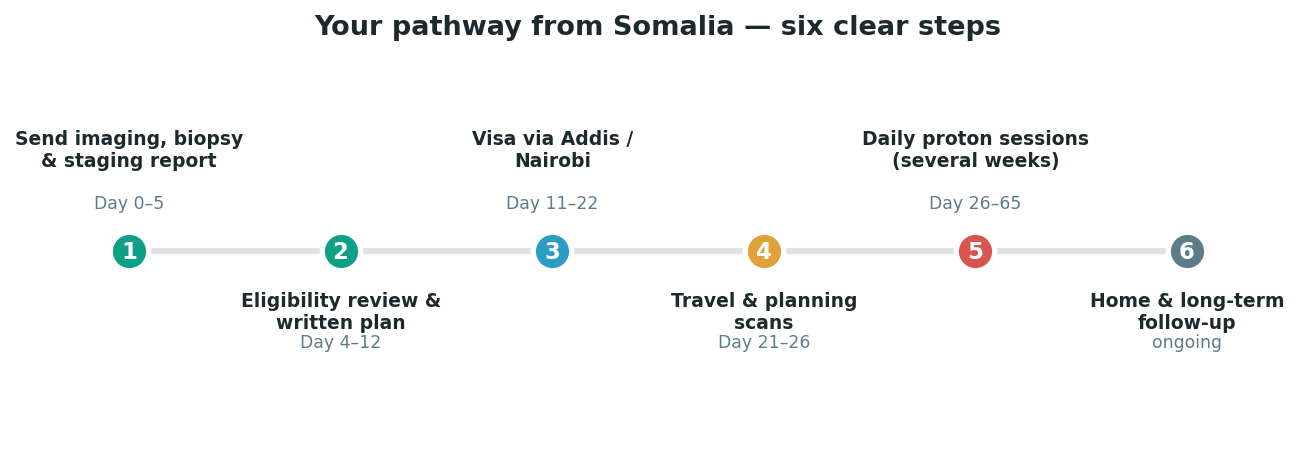
The complete route, start to finish — a proton therapy course runs daily sessions over several weeks.
Built for exactly the patients who cannot currently reach it
Proton therapy was developed, in large part, for children with tumours near the structures that govern growth and development — precisely the patients a region with Africa's paediatric cancer burden has in greatest number, and precisely the technology it currently has none of. Closing that specific gap, one child at a time, is what this guide exists to help with.
Sources & useful links
- 🌐 Indian medical visa (Somali nationals) — indianvisaonline.gov.in
- 🌐 Embassy of India, Addis Ababa — eoiaddisababa.gov.in
- 🌐 High Commission of India, Nairobi — hcinairobi.gov.in
- 🌐 Yellow-fever requirements — who.int/health-topics/yellow-fever
- 🌐 Hospital accreditation (India) — nabh.co · jointcommissioninternational.org
- 🌐 Verify a surgeon's registration — nmc.org.in
Do not decide alone, and do not decide blind
If you want your imaging reviewed properly and an honest written plan — including whether proton therapy genuinely fits your case — that is precisely the independent guidance I provide, without a single hospital's interest attached to my advice. Dr. Dheeraj Bojwani · Independent medical travel advisor
Frequently Asked Questions by Somali Patients about Proton Therapy in India
Is proton therapy available in Somalia?
The guide states that there are no operational proton therapy centres anywhere in Sub-Saharan Africa, making overseas treatment necessary for Somali patients seeking this technology.
Why may proton therapy be useful for children with cancer?
Protons can deposit most of their energy at a controlled depth, potentially reducing radiation exposure to developing brain, spinal structures, bones and other healthy tissues near the tumour.
Which cancers may benefit most from proton therapy?
The guide highlights selected brain and spinal tumours, sarcomas near the spine or pelvis, head and neck tumours, eye tumours, base-of-skull tumours and selected adult cancers near critical structures.
Does every cancer patient need proton therapy?
No. The guide specifically states that proton therapy is not a universal replacement for conventional radiotherapy. The oncology team should explain why it offers a meaningful advantage for the individual tumour.
How much does proton therapy cost in India for Somali patients?
The guide gives an indicative full-course range of US$21,000–US$50,000 all-in. The final cost depends substantially on the number of treatment fractions required.
Why is the number of fractions important?
Treatment cost and duration depend on the number of daily sessions. The guide notes that shorter courses may cost less, while 25–33-fraction courses for larger or more complex tumours may approach the higher end of the quoted range.
What should Somali patients check before choosing a proton therapy centre?
They should confirm why proton therapy is appropriate, multidisciplinary tumour-board involvement, the exact fraction count and a written fraction-specific quotation.
What additional support is important for children receiving proton therapy?
Children may require daily anaesthesia to remain still during treatment. The guide recommends a centre with routine paediatric proton experience, paediatric anaesthesia expertise and paediatric oncology involvement.
What medical records should Somali patients send before travelling?
Patients should send their actual imaging, biopsy results and staging information, rather than only a written summary. For children, weight, previous anaesthesia history and developmental concerns should also be included.
How long should Somali patients plan to stay in India for proton therapy?
Because proton therapy may involve daily sessions over several weeks, patients should plan for an extended stay. The guide also recommends arranging the medical visa and travel plans before departure and carrying a yellow-fever vaccination certificate where required by the route.
Page Summary
This guide explains the key considerations for Somali patients exploring proton therapy in India, focusing on the absence of operational proton therapy centres in Sub-Saharan Africa and the potential role of India as an accessible treatment destination. It explains how proton therapy differs from conventional radiotherapy, highlights selected childhood and adult cancers that may benefit from improved healthy-tissue sparing, discusses warning signs when choosing a proton centre, gives an indicative full-course cost of US$21,000–US$50,000, and explains the importance of fraction count, multidisciplinary review and paediatric expertise. The six-step pathway covers sending imaging and biopsy results, eligibility review, visa and travel planning, daily proton sessions over several weeks, and long-term follow-up.
Citation Block
| Topic | Information |
|---|---|
| Topic Information | Proton Therapy in India for Patients from Somalia |
| Treatment | Proton Therapy |
| Intended Audience | Patients from Somalia |
| Key Specialist | Radiation Oncologist / Proton Therapy Specialist |
| Main Applications | Selected Brain, Spinal, Sarcoma, Head and Neck and Eye Tumours |
| Primary Assessment | Actual Imaging, Biopsy and Staging Review |
| Main Treatment Advantage | Reduced Radiation Exposure to Nearby Healthy Tissue |
| Important Eligibility Factor | Tumour Location and Proximity to Critical Structures |
| Paediatric Requirement | Dedicated Paediatric Proton Programme |
| Indicative Cost | US$21,000–US$50,000 All-In |
| Fraction Check | Confirm the Exact Number of Treatment Sessions |
| Multidisciplinary Check | Radiation Oncology and Relevant Oncology Specialists Should Review the Case |
| Pre-Travel Records | Actual Imaging, Biopsy Results and Staging Information |
| Child-Specific Records | Weight, Previous Anaesthesia History and Developmental Concerns |
| Important Warning | Proton Therapy Proposed Without Explaining Its Specific Benefit |
| Cost Check | Request a Fraction-Specific Written Quotation |
| Travel Routes | Nairobi, Addis Ababa, Dubai or Djibouti |
| Visa Requirement | Hospital Invitation and Medical Visa |
| Treatment Duration | Daily Sessions Over Several Weeks for Longer Courses |
| Patient Journey | Imaging/biopsy → eligibility review → visa → travel/planning → daily proton sessions → long-term follow-up |
| Follow-Up | Home and Long-Term Oncology Follow-Up |


Our Mission Statement
Our mission is to place patients at the centre of every healthcare decision by providing trustworthy, evidence-based, and unbiased medical information. We believe that informed patients make better decisions. Backed by personalised guidance from our experienced advisory team, we help patients understand their treatment options, compare them objectively, and confidently choose the path that best suits their medical needs and personal circumstances.
Patient Testimonials from Somalia




Ready to Take the First Step?
Share your Medical Reports with our Healthcare Managers Today and Get a FREE CONSULTATION, a Personalized Treatment Plan, and Complete Support from Arrival to Recovery.
Get Your Free ConsultationAreas We Serve
This resource has been thoughtfully prepared for patients from Somalia who are considering medical treatment in India. We also welcome patients from the wider region in the countries mentioned below-
We assist patients from:
- Ethiopia
- Djibouti
- Yemen
- Kenya
- Seychelles
- Somalia
- South Sudan
- Tanzania
- Uganda
- Zambia
- Zimbabwe
- Angola
- Cameroon
- Central African Republic
Many of the insights, treatment pathways, hospital recommendations, travel guidance, and patient support services described here are equally relevant and may be used as a reference when planning treatment in India.
From Somalia to India: Your Complete Patient Support Guide
- Best Brain Tumour Surgeons & Hospitals in India for Somali Patients
- Best Cancer Treatment Surgeons & Hospitals in India for Somali Patients
- Best Cardiac Surgeons & Hospitals in India for Somali Patients
- Best CyberKnife Teams & Centres in India for Somali Patients
- Best Heart Valve Replacement Surgeons & Hospitals in India for Somali Patients
- Best Hip Surgeons & Hospitals in India for Somali Patients
- Best Knee Surgeons & Hospitals in India for Somali Patients
- Best Neurosurgeons & Hospitals in India for Somali Patients
- Best Paediatric Cardiac Surgeons & Hospitals in India for Somali Patients
- Best Paediatric Neurosurgeons & Hospitals in India for Somali Patients
- Best Spine Surgeons & Hospitals in India for Somali Patients
- Bariatric Surgery in India for Patients from Somalia
- Brain Tumour Surgery in India for Patients from Somalia
- Cancer Treatment and Surgery in India for Patients from Somalia
- Cardiac Surgery in India for Patients from Somalia
- Cosmetic and Plastic Surgery in India for Patients from Somalia
- CyberKnife Treatment in India for Patients from Somalia
- Dental Surgery in India for Patients from Somalia