

Plastic and Reconstructive Surgery in India for Patients from Somalia
A burn heals in weeks. The tight, restrictive scar it leaves behind, especially in a growing child, can take away the use of a hand or a joint for years afterward — unless a second, deliberate surgery releases it.
Plastic and reconstructive surgery is not, for most of the patients I work with, about appearance. It is about restoring a hand that can grip again after a burn, a mouth that can close and feed properly after a cleft, a limb that can move through its full range after an old injury healed the wrong way. For 24 years I have watched how much difference this branch of surgery makes for patients who have been living, sometimes for years, with a problem everyone assumed was simply permanent.
India performs reconstructive surgery at real scale, with plastic surgeons experienced specifically in burn contracture release, cleft repair and complex soft-tissue reconstruction, working alongside physiotherapy teams for the recovery that follows — at a fraction of the cost of the same care in the Gulf, Europe or the United States.
Healing Journeys of Somali Patients









Key Takeaways
- The guide highlights burn scar contractures as a major reason for reconstructive surgery, particularly in children. It states that approximately 38–54% of burns may leave a scar contracture by hospital discharge.
- The first published Somali paediatric burn study cited in the guide found that 75.7% of paediatric burns were caused by hot-water scalds, with open flame and hot oil accounting for most of the remainder.
- Burn contractures can become progressively more restrictive as a child grows, particularly around the neck, shoulders, hands and elbows. Early evaluation may prevent a relatively straightforward problem from becoming a complex reconstruction.
- The page 2 referral chart gives an illustrative breakdown of reconstructive referrals from Somalia: burn scar contracture release 40%, cleft lip/palate 25%, traumatic soft-tissue reconstruction 20% and other congenital/reconstructive conditions 15%.
- Not every burn scar requires surgery. Surgical release is mainly considered when a scar crosses a joint and restricts movement, causes ongoing pain or repeatedly breaks down. Less restrictive scars may be managed with moisturising, pressure garments or silicone sheeting.
- Cleft lip and palate require their own treatment timeline. The guide notes that international guidance generally recommends lip repair within the first year and palate repair by around 18 months, although later repair can still provide meaningful functional benefit.
- Reconstructive surgery is different from cosmetic plastic surgery. Families should specifically ask about the surgeon's experience with contracture releases, cleft repairs or the relevant reconstructive procedure, rather than relying on general cosmetic-surgery experience.
- Rehabilitation is an essential part of treatment. The guide stresses the importance of stretching, splinting and physiotherapy after contracture release, because scar tissue can tighten again without structured follow-up.
- Indicative all-in cost in a reputable private Indian hospital is approximately US$1,500–US$6,000, with straightforward cleft repair or minor contracture release toward the lower end and complex multi-stage reconstruction toward the higher end.
- Somali families should send clear photographs from multiple angles, medical history and previous treatment details before travelling. For an old burn in a child, the guide specifically recommends providing the child's age at the time of the original injury.
Quick Facts
- Treatment
- Plastic and Reconstructive Surgery
- Country
- India
- Patients
- Patients and Families from Somalia
- Key Specialist
- Reconstructive Plastic Surgeon
- Main Condition
- Burn Scar Contracture
- Other Conditions
- Cleft Lip/Palate and Traumatic Soft-Tissue Injuries
- Primary Assessment
- Clinical Examination and Photographs
- Main Surgical Options
- Contracture Release, Cleft Repair and Soft-Tissue Reconstruction
- Indicative Cost
- US$1,500–US$6,000 All-In
- Important Check
- Specific Reconstructive Surgery Experience
- Rehabilitation
- Physiotherapy, Stretching and Splinting
- Cost Check
- Written Quote With Expected Number of Procedures
- Pre-Travel Records
- Photographs, Medical History and Previous Treatment Details
- Travel Routes
- Nairobi, Addis Ababa, Dubai or Djibouti
- Visa
- Hospital Invitation and Medical Visa
- Attendants
- Up to Two Medical Attendants
- Follow-Up
- Scar, Growth and Functional Rehabilitation
- Author
- Dr. Dheeraj Bojwani
- Experience
- 24+ Years
In Brief
For Somali patients and families considering reconstructive surgery in India, the guide recommends early specialist assessment with clear photographs and previous treatment records, particularly for burn scars that restrict movement or cleft conditions requiring functional repair. The choice of surgeon should focus on specific reconstructive experience rather than general cosmetic practice, with attention to physiotherapy, stretching and splinting after surgery. Families should also obtain a written diagnosis-specific quotation that explains the planned procedure and whether reconstruction may require more than one operation before travelling to India.
First, know why burns are such a common reason families reach out
The first published epidemiological study of paediatric burn admissions in Somalia found that three- quarters of cases were scalds from hot water, with open flame and hot oil accounting for most of the rest, and an average of around 16% of total body surface affected. This pattern is not unique to Somalia; it reflects the same cooking arrangements, open flames and close quarters found across much of the world where kitchens are not childproofed by design. What makes the aftermath different is what happens next: whether a burn heals as flat, supple skin, or as a tight band of scar tissue that pulls a joint out of its normal range as the child grows.
The Somali difference: the burn heals, but the scar keeps working against the child
Burn scar contractures, where healing scar tissue tightens and restricts movement at a nearby joint, develop in roughly 38 to 54% of burns by the time of hospital discharge, and children are specifically more likely to develop them than adults, particularly across the neck, shoulders, hands and elbows. A contracture across a joint does not stay static as a child grows; the surrounding scar cannot stretch the way normal skin does, so the restriction can worsen over years even after the original burn has fully healed. Where reconstructive surgical capacity is limited, this frequently means a child who survived a burn without complication in the acute phase goes on to lose meaningful use of a hand, an arm or a neck simply because nobody was able to release the tightening scar while it was still a straightforward procedure.
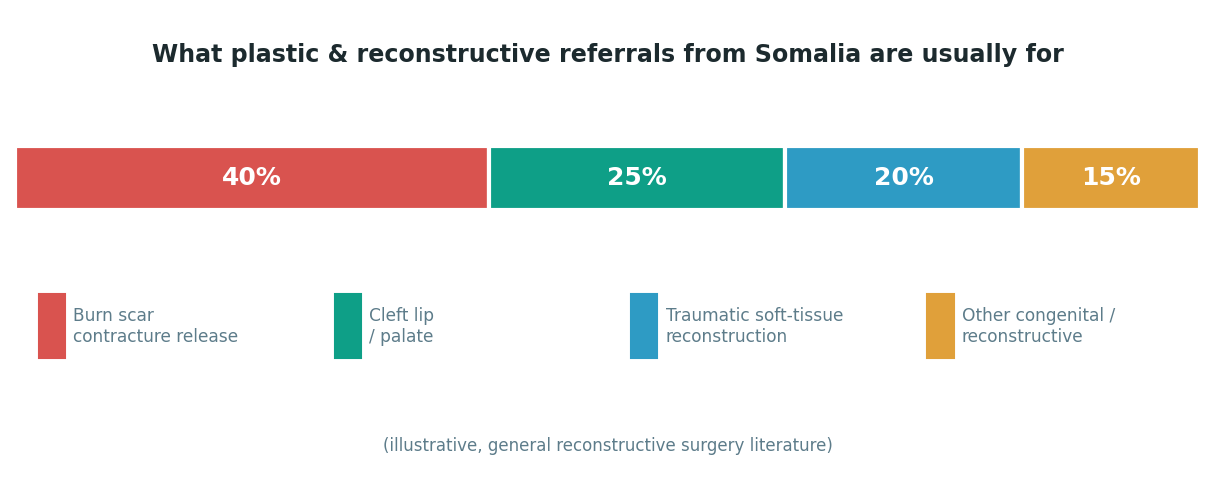
Illustrative breakdown of plastic and reconstructive surgery referrals from Somalia, based on general reconstructive surgery literature.
Why scald burns specifically deserve this much attention
Scalds tend to be deceptively unremarkable in the moment: no flame, no explosion, often just a pot or kettle of hot water. But because they usually involve a child's hand reaching, or a spill across the chest or thighs while being carried, they concentrate damage precisely in the areas most prone to disabling contractures — the hands, the neck, the areas around major joints. A scald treated correctly in the acute phase, and then monitored for early signs of tightening scar as it heals, gives a child the best chance of never needing a second surgery at all.
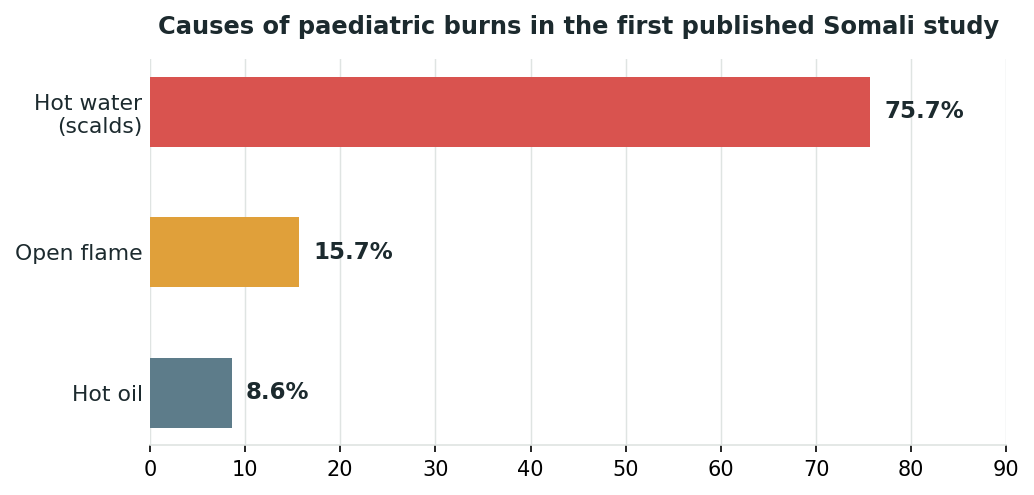
Findings from the first published epidemiological study of in-patient paediatric burn cases in Somalia.
Know the warning signs, and do not wait them out
A healed burn where the skin looks noticeably tighter or shinier than the surrounding area, especially across a joint like the neck, elbow, wrist or the back of the knee, deserves attention before the tightening progresses further. So does a joint that cannot fully straighten or bend the way its opposite, unburned side can, a scar that keeps cracking or breaking down with ordinary use, and any burn scar in a young child, since growth itself can steadily worsen a contracture that seemed stable at first. For cleft lip or palate specifically, feeding difficulty, frequent ear infections, or delayed or unclear speech in an unrepaired case are all reasons to seek an evaluation regardless of the child's current age — repair still meaningfully helps function even when done later than the ideal window.
Not every scar needs surgery, and cleft repair is its own story
Most burn scars, even visually striking ones, do not restrict movement and do not need surgical release; they need time, moisturising and, where available, pressure garments or silicone sheeting to soften as they mature. Surgery is specifically for scars crossing a joint that measurably limit its range of motion, or scars causing ongoing pain or recurrent breakdown. Cleft lip and palate, a separate but related category of reconstructive need, follows its own timeline entirely: international guidelines recommend lip repair within the first year of life and palate repair by around 18 months, and a global backlog of untreated cases, concentrated in lower-income regions, means many children and even adults are still awaiting a first repair that could have been completed in infancy.
What it costs
In more than 24 years arranging this kind of care, the disputes I have seen were almost never about the price itself — they were about a diagnosis, or a cost, nobody had bothered to write down before the flight was booked. A quote should specify exactly which procedure is planned and how many stages it may require, since complex reconstruction sometimes needs more than one operation.
Why a genuine reconstructive plastic surgery team is what to look for
Reconstructive surgery is a distinct discipline from cosmetic plastic surgery, even though the two sometimes share a surgeon. Ask specifically how many contracture releases or cleft repairs, not cosmetic procedures generally, the named surgeon performs each year, and whether a dedicated hand or paediatric physiotherapist is part of the standing team for post-surgical rehabilitation. The surgery itself is often the easier half of a good outcome; the structured stretching, splinting and follow-up that prevents the scar from simply re-tightening is what actually determines whether the improvement lasts.
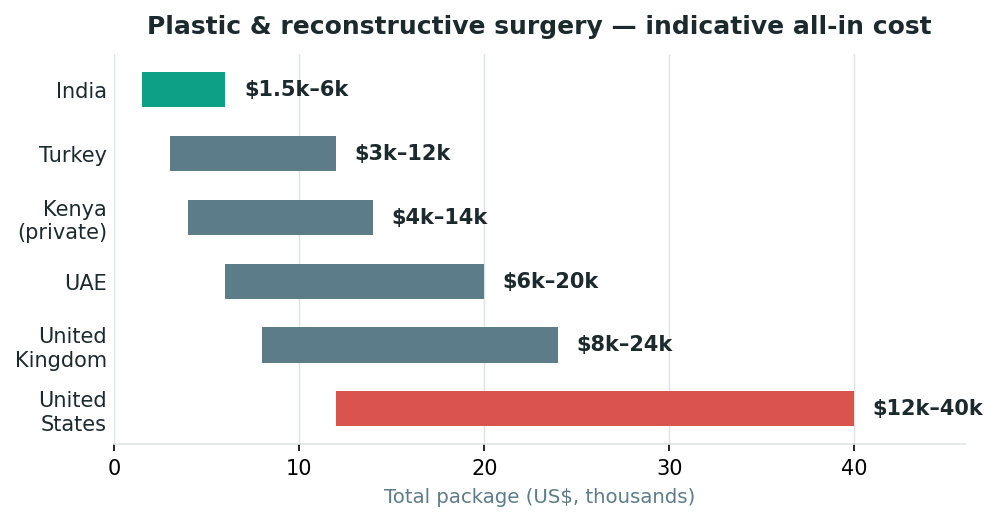
Indicative all-in cost for plastic and reconstructive surgery. India sits far below every common alternative.
Plastic and reconstructive surgery in a reputable private Indian hospital typically runs US$1,500 to US$6,000 all-in, with straightforward cleft lip repair or minor contracture release toward the lower end and complex, multi-stage reconstruction toward the top. Ask for the figure specific to your case and how many procedures it is expected to involve.
Four signals that should make you stop and walk away
No physiotherapy or splinting plan after contracture release. Surgery alone can be undone by scar re-tightening without a structured stretching and splinting programme afterward.
Cleft repair timing not discussed relative to your child's age. Lip and palate repair follow different, age-specific windows. Ask whether the plan reflects your child's actual age and needs.
No mention of how many procedures may be needed. Complex reconstruction is often staged. A single-procedure quote for a multi-stage case is incomplete.
The price keeps moving. A verbal estimate that shifts each time you ask is not an estimate. Demand a fixed figure in writing.
The practical journey from Somalia — plan it before you fly
There is no direct flight between Somalia and India; patients route through Nairobi, Addis Ababa, Dubai or Djibouti. Because there is no full Indian mission inside Somalia, the medical visa is issued through the Embassy of India in Addis Ababa or the High Commission in Nairobi , against a written invitation letter from the treating hospital. Somali patients may bring up to two medical attendants on attendant visas. Since your route crosses yellow-fever territory, carry a valid yellow-fever vaccination certificate . Above every other instruction: send clear photographs of the affected area from multiple angles and, for an old burn, the child's age at the time of the original injury, not just a description, so the reconstructive team can begin planning before you ever leave home.
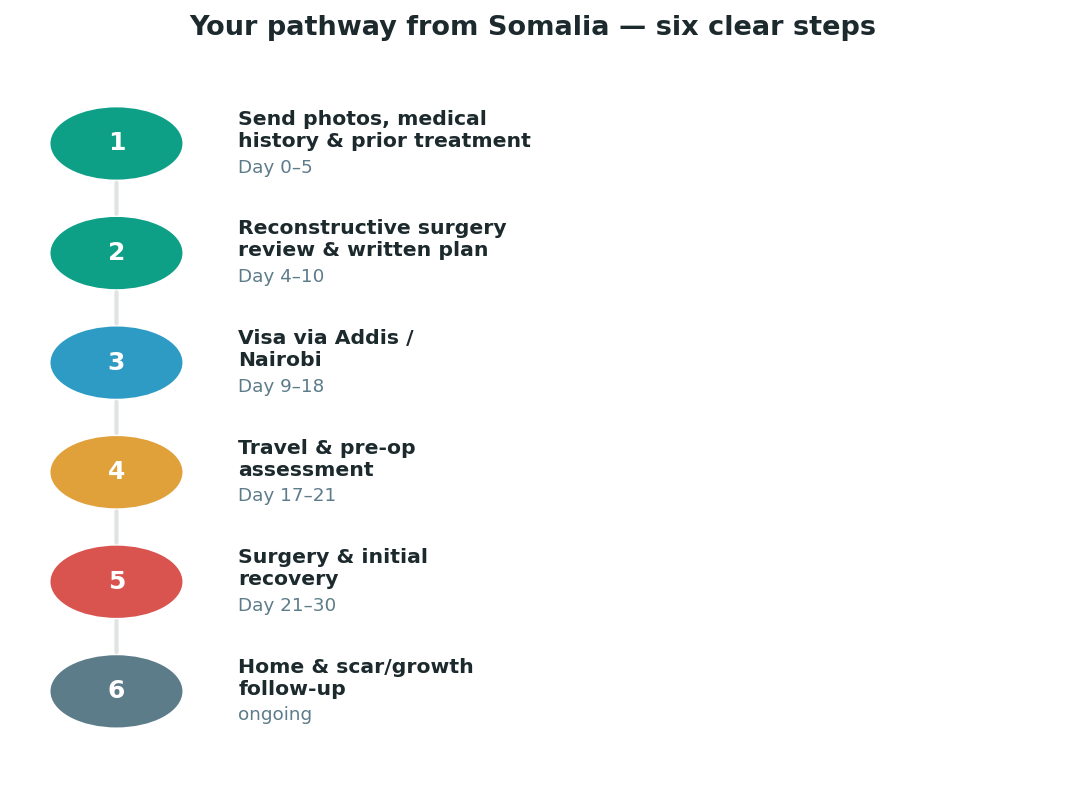
The complete route, start to finish — complex reconstruction may require staged follow-up visits.
A scar does not have to be the last word
Whether the problem is a tightening burn scar, an unrepaired cleft, or an old injury that healed the wrong way, plastic and reconstructive surgery exists precisely to answer the assumption that nothing more can be done. For most patients in this category, more can be done — and often more simply than families expect.
Sources & useful links
- 🌐 Indian medical visa (Somali nationals) — indianvisaonline.gov.in
- 🌐 Embassy of India, Addis Ababa — eoiaddisababa.gov.in
- 🌐 High Commission of India, Nairobi — hcinairobi.gov.in
- 🌐 Yellow-fever requirements — who.int/health-topics/yellow-fever
- 🌐 Hospital accreditation (India) — nabh.co · jointcommissioninternational.org
- 🌐 Verify a surgeon's registration — nmc.org.in
Do not decide alone, and do not decide blind
If you want your case reviewed properly and an honest written plan — including how many procedures it will genuinely take — that is precisely the independent guidance I provide, without a single hospital's interest attached to my advice. Dr. Dheeraj Bojwani · Independent medical travel advisor
Frequently Asked Questions by Somali Patients about Plastic and Reconstructive Surgery in India
What types of reconstructive surgery are commonly discussed for Somali patients?
The guide focuses on burn scar contracture release, cleft lip and palate repair, traumatic soft-tissue reconstruction and other congenital reconstructive needs.
Why are burn scar contractures important in Somali children?
The guide states that approximately 38–54% of burns may develop scar contractures by hospital discharge. In growing children, tightening scars can progressively restrict movement around joints.
What causes most paediatric burns in the Somali study cited?
The study cited in the guide found that 75.7% of paediatric burns were hot-water scalds, followed by open flames and hot oil.
Does every burn scar require reconstructive surgery?
No. Surgery is generally considered when the scar restricts joint movement, causes ongoing pain or repeatedly breaks down. Other scars may be managed conservatively while they mature.
When should a Somali child with a burn scar seek reconstructive assessment?
Warning signs include tight or shiny scar tissue, reduced joint movement, recurrent cracking or breakdown, particularly when the scar crosses the neck, elbow, wrist, knee or another joint.
Can older children or adults still receive cleft repair in India?
Yes. The guide explains that although cleft repair has preferred early treatment windows, later repair can still provide meaningful functional benefits for patients who did not receive treatment during infancy.
How much does reconstructive surgery cost in India for Somali patients?
The guide gives an indicative all-in range of US$1,500–US$6,000. Straightforward procedures may be toward the lower end, while complex multi-stage reconstruction may cost more.
Why is physiotherapy important after burn contracture surgery?
Structured stretching, splinting and physiotherapy help maintain the improvement achieved through surgery and reduce the risk of the scar tightening again.
What should Somali families send before travelling to India?
They should send clear photographs from multiple angles, medical history and previous treatment records. For an old childhood burn, the child's age when the original injury occurred is also important.
What should families check before choosing a reconstructive surgery centre?
They should confirm the surgeon's specific experience with contracture release, cleft repair or the required reconstruction, ask how many procedures may be needed, and ensure a rehabilitation plan is included.
Page Summary
This guide explains the key considerations for Somali patients and families seeking plastic and reconstructive surgery in India, with particular emphasis on burn scar contractures, cleft lip and palate, and traumatic soft-tissue reconstruction. It discusses the high proportion of paediatric burns caused by hot-water scalds in the cited Somali study, the risk of contractures as children grow, warning signs requiring evaluation, when burn scars do and do not require surgery, age-specific considerations for cleft repair, the importance of a dedicated reconstructive team and rehabilitation, indicative costs of US$1,500–US$6,000, travel and visa planning, and the six-step pathway from photographs and medical records through reconstructive surgery and long-term scar or growth follow-up.
Citation Block
| Topic | Information |
|---|---|
| Topic Information | Plastic and Reconstructive Surgery in India for Patients from Somalia |
| Treatment | Plastic and Reconstructive Surgery |
| Intended Audience | Patients and Families from Somalia |
| Key Specialist | Reconstructive Plastic Surgeon |
| Main Condition | Burn Scar Contracture |
| Other Conditions | Cleft Lip/Palate and Traumatic Soft-Tissue Reconstruction |
| Primary Assessment | Clinical Examination and Clear Photographs |
| Main Procedures | Contracture Release, Cleft Repair and Soft-Tissue Reconstruction |
| Indicative Cost | US$1,500–US$6,000 All-In |
| Important Specialist Check | Confirm Specific Experience With the Required Reconstructive Procedure |
| Rehabilitation Requirement | Physiotherapy, Stretching and Splinting |
| Cleft Repair Check | Consider the Child's Age and Functional Needs |
| Procedure Check | Confirm Whether Reconstruction May Require Multiple Stages |
| Pre-Travel Records | Photographs, Medical History and Previous Treatment Details |
| Important Warning | No Physiotherapy or Splinting Plan After Contracture Release |
| Cost Check | Request a Fixed Written Quote Based on the Planned Procedure and Stages |
| Travel Routes | Nairobi, Addis Ababa, Dubai or Djibouti |
| Visa Requirement | Hospital Invitation and Medical Visa |
| Patient Journey | Photos/history → reconstructive review → visa → travel/pre-op → surgery/recovery → home and scar/growth follow-up |
| Follow-Up | Scar, Growth and Functional Rehabilitation |


Our Mission Statement
Our mission is to place patients at the centre of every healthcare decision by providing trustworthy, evidence-based, and unbiased medical information. We believe that informed patients make better decisions. Backed by personalised guidance from our experienced advisory team, we help patients understand their treatment options, compare them objectively, and confidently choose the path that best suits their medical needs and personal circumstances.
Patient Testimonials from Somalia




Ready to Take the First Step?
Share your Medical Reports with our Healthcare Managers Today and Get a FREE CONSULTATION, a Personalized Treatment Plan, and Complete Support from Arrival to Recovery.
Get Your Free ConsultationAreas We Serve
This resource has been thoughtfully prepared for patients from Somalia who are considering medical treatment in India. We also welcome patients from the wider region in the countries mentioned below-
We assist patients from:
- Ethiopia
- Djibouti
- Yemen
- Kenya
- Seychelles
- Somalia
- South Sudan
- Tanzania
- Uganda
- Zambia
- Zimbabwe
- Angola
- Cameroon
- Central African Republic
Many of the insights, treatment pathways, hospital recommendations, travel guidance, and patient support services described here are equally relevant and may be used as a reference when planning treatment in India.
From Somalia to India: Your Complete Patient Support Guide
- Best Brain Tumour Surgeons & Hospitals in India for Somali Patients
- Best Cancer Treatment Surgeons & Hospitals in India for Somali Patients
- Best Cardiac Surgeons & Hospitals in India for Somali Patients
- Best CyberKnife Teams & Centres in India for Somali Patients
- Best Heart Valve Replacement Surgeons & Hospitals in India for Somali Patients
- Best Hip Surgeons & Hospitals in India for Somali Patients
- Best Knee Surgeons & Hospitals in India for Somali Patients
- Best Neurosurgeons & Hospitals in India for Somali Patients
- Best Paediatric Cardiac Surgeons & Hospitals in India for Somali Patients
- Best Paediatric Neurosurgeons & Hospitals in India for Somali Patients
- Best Spine Surgeons & Hospitals in India for Somali Patients
- Bariatric Surgery in India for Patients from Somalia
- Brain Tumour Surgery in India for Patients from Somalia
- Cancer Treatment and Surgery in India for Patients from Somalia
- Cardiac Surgery in India for Patients from Somalia
- Cosmetic and Plastic Surgery in India for Patients from Somalia
- CyberKnife Treatment in India for Patients from Somalia
- Dental Surgery in India for Patients from Somalia