

Penile Implant Surgery in India for Patients from Somalia
Erectile dysfunction is one of the most treatable conditions in modern urology, and one of the least discussed — which means many men live with it for years before ever mentioning it to a doctor.
Erectile dysfunction is common, medically well understood, and treatable at every stage — from simple lifestyle changes through medication, to surgery for the minority of men who need it. What makes it different from most conditions in this series is not the medicine itself but the silence around it: men frequently wait years before raising the subject with any doctor, by which point simpler treatments that might once have worked are no longer enough. For 24 years I have worked with men making exactly this journey, often further along than it needed to be.
India performs penile implant surgery at genuine scale, with urologists trained specifically in prosthetic urology — a distinct subspecialty from general urology — and a full range of device options from cost- effective malleable implants to premium inflatable systems, all with complete discretion, at a fraction of the cost of the same surgery in the Gulf, Europe or the United States. International patients are common, discretion is built into how these programmes operate, and none of the process requires disclosing the reason for travel to anyone beyond the treating team.
Healing Journeys of Somali Patients









Key Takeaways
- The guide explains that erectile dysfunction is common and treatable, but many men delay medical evaluation because of embarrassment or reluctance to discuss the condition.
- Diabetes is highlighted as an important underlying cause. The guide cites published African studies reporting erectile dysfunction in 35–95% of men with diabetes, with risk increasing with age, poor blood-sugar control and longer disease duration.
- The treatment pathway should normally begin with lifestyle and underlying-condition management, followed by oral medication where appropriate. Injection or vacuum-device treatment may also be considered before surgery.
- A penile implant is presented as a permanent treatment for selected men whose other treatments have genuinely failed, rather than as the first treatment for erectile dysfunction.
- The page 2 chart gives an illustrative breakdown of underlying causes among men evaluated for erectile dysfunction: diabetes/vascular causes 45%, post-surgical or trauma-related causes 25%, psychological causes 15% and other/mixed causes 15%.
- The page 3 treatment-ladder chart illustrates reported effectiveness/satisfaction figures of 65% for oral medication, 80% for injections/vacuum devices and 95% for penile implants based on general urology literature.
- India offers both malleable and three-piece inflatable penile implants. The guide stresses that the device type is a major factor in the final cost and should be clearly identified in the written quotation.
- Indicative all-in cost in a reputable private Indian hospital is approximately US$3,500–US$15,000, with malleable devices generally toward the lower end and premium three-piece inflatable systems toward the higher end.
- Specialist selection matters because penile implant surgery is a specific area of prosthetic urology. Patients should ask about the named surgeon's actual annual implant volume and infection-prevention protocol rather than relying only on the hospital's general urology experience.
- Somali patients should send an honest treatment history together with recent blood-sugar and blood-pressure readings where available before travelling. The six-step pathway covers medical history review, urology assessment, visa, travel and pre-operative evaluation, implant surgery with a short hospital stay and home recovery follow-up.
Quick Facts
- Treatment
- Penile Implant Surgery
- Country
- India
- Patients
- Patients from Somalia
- Key Specialist
- Prosthetic Urologist / Urologist
- Main Condition
- Erectile Dysfunction
- Important Underlying Cause
- Diabetes and Vascular Disease
- Initial Assessment
- Urological Evaluation and Medical History
- First-Line Treatment
- Lifestyle and Medical Management
- Other Options
- Oral Medication, Injections and Vacuum Devices
- Surgical Option
- Penile Implant
- Implant Types
- Malleable and Three-Piece Inflatable
- Indicative Cost
- US$3,500–US$15,000 All-In
- Important Check
- Surgeon's Specific Penile Implant Experience
- Infection Check
- Confirm Infection-Prevention Protocol
- Cost Check
- Request a Fixed Quote Identifying the Implant Type
- Pre-Travel Records
- Treatment History, Blood Sugar and Blood Pressure Readings
- Travel Routes
- Nairobi, Addis Ababa, Dubai or Djibouti
- Visa
- Hospital Invitation and Medical Visa
- Hospital Stay
- Short Hospital Stay
- Follow-Up
- Home Recovery and Post-Surgical Follow-Up
- Author
- Dr. Dheeraj Bojwani
- Experience
- 24+ Years
In Brief
For Somali patients considering penile implant surgery in India, the guide recommends proper urological evaluation before deciding on surgery, particularly when diabetes, blood pressure or other underlying conditions may be contributing to erectile dysfunction. Oral medication and, where appropriate, injections or vacuum-device therapy should generally be considered before an implant. If surgery is appropriate, patients should confirm the surgeon's prosthetic-urology experience, understand whether a malleable or three-piece inflatable implant is being proposed, obtain a fixed written quotation and clarify infection-prevention and follow-up arrangements before travelling.
First, know why this condition is under-treated everywhere, and more so here
Erectile dysfunction shares a pattern with several other conditions in this series: the medicine to treat it exists and works well, but reaching it depends on a conversation many men avoid. Research across African healthcare settings has specifically flagged erectile dysfunction as an under-recognised, under- screened complication of diabetes, even in men already attending a clinic for their diabetes itself. As diabetes becomes more common across the region, this gap widens rather than closes, because the underlying disease driving the erectile dysfunction is also increasingly common and often only diagnosed once it is already advanced.
Why diabetes specifically changes the picture
Diabetes damages the small blood vessels and nerves responsible for a normal erection, and the longer it goes unmanaged, the more this damage accumulates. Published studies from diabetes clinics across Africa have found erectile dysfunction in a wide range of patients, worsening with age, poor blood sugar control and duration of disease. This matters directly for treatment choice: oral medications work by enhancing a vascular response that still has to be physically possible, and in men with long-standing, poorly controlled diabetes, that underlying vascular capacity can be reduced to the point where no oral medication, at any dose, will work. This is not a failure of willpower or a sign the medication was wrong — it is a specific, well-understood physiological limit, and it is exactly the situation a penile implant was developed to address.
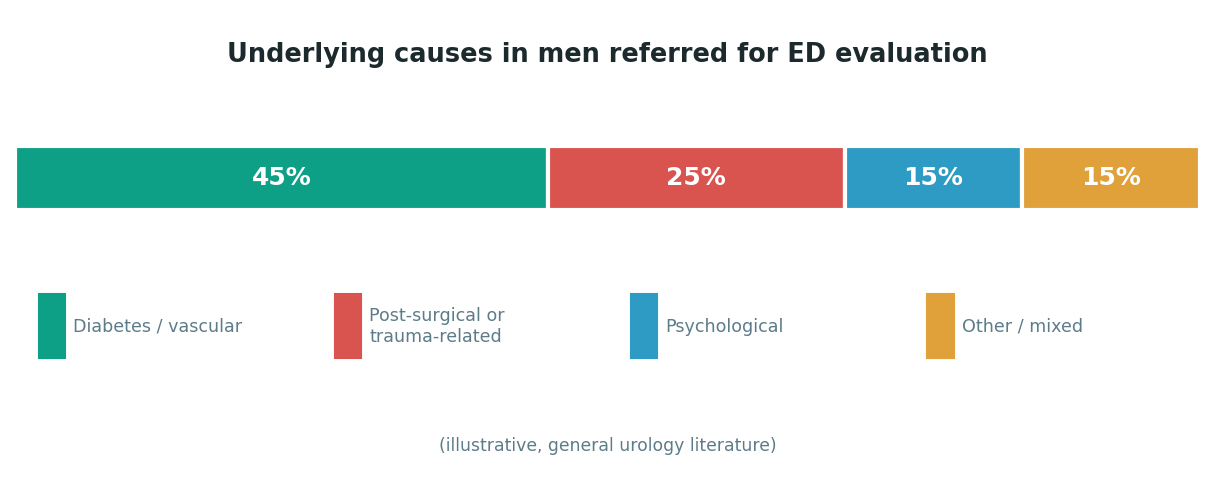
Illustrative breakdown of underlying causes in men evaluated for erectile dysfunction, based on general urology literature.
Why skipping straight to surgery is not the honest first move
A responsible evaluation always starts by asking what has actually been tried, and why it did or did not work. Diabetes control itself, along with blood pressure management and weight, genuinely improves erectile function in many men before any specific ED treatment is even started. Oral medication remains the right first step for most men whose vascular capacity is still adequate. Only when medication, and often injection or vacuum-device therapy as well, have been properly tried and have failed, does a penile implant become the appropriate next step — not a shortcut past the steps that came before it.
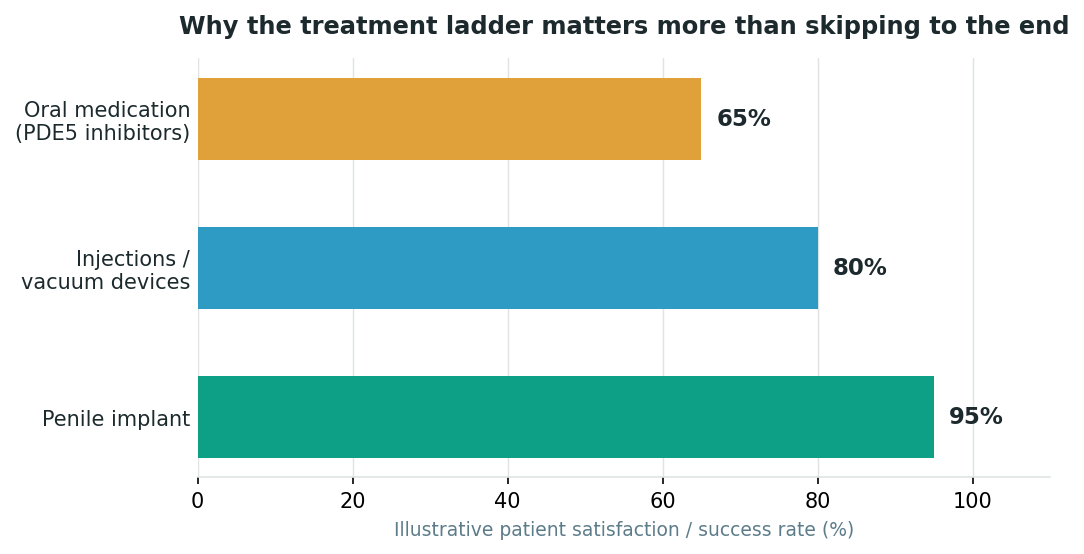
Illustrative effectiveness at each stage of the standard treatment ladder, based on general urology literature.
Know when to seek an evaluation, and do not wait years to do it
Difficulty achieving or maintaining an erection consistently over more than a few weeks, particularly alongside known diabetes, high blood pressure, or high cholesterol, deserves a medical conversation rather than years of quiet adjustment. So does a gradual decline noticed by the man himself before it becomes a source of distress in a relationship, since earlier evaluation genuinely gives more treatment options than a later one. Erectile difficulty can also be an early warning sign of underlying cardiovascular disease, since the blood vessels involved are often affected before those in the heart show symptoms, which makes it worth raising with a doctor even when it does not feel urgent on its own terms.
Not every case needs an implant
A penile implant is a permanent, effective solution for the specific situation where other treatments genuinely have not worked, not a default option for every man with erectile difficulty. Younger men, men whose difficulty is primarily psychological or situational, and men whose diabetes or blood pressure is now well controlled often respond well to medication or counselling alone. A urologist who moves straight to discussing implant surgery without first asking what has been tried, and without a physical examination and relevant blood work, has skipped the steps that determine whether surgery is actually the right answer.
What it costs
In more than 24 years arranging this kind of care, the disputes I have seen were almost never about the price itself — they were about a diagnosis, or a cost, nobody had bothered to write down before the flight was booked. The cost varies substantially by device type, and a written quote should specify exactly which implant is being proposed.
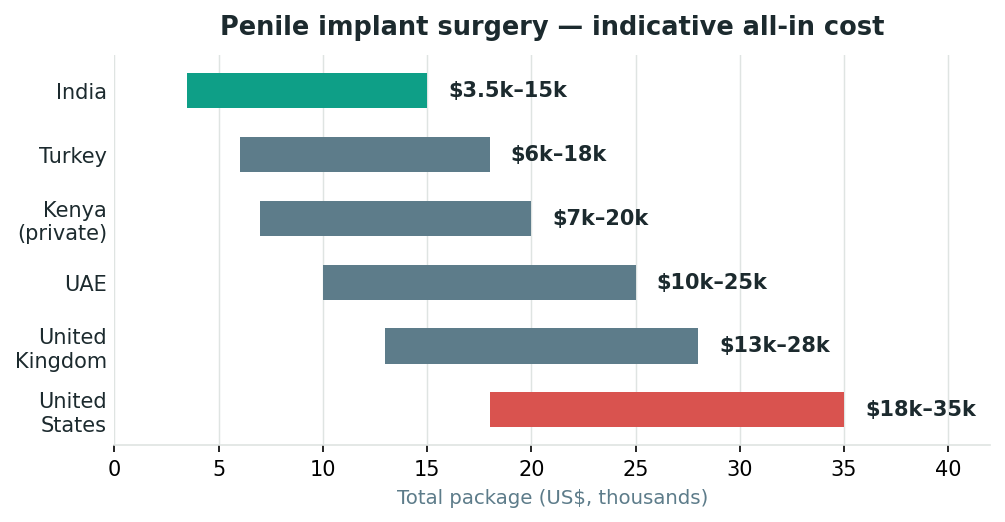
Indicative all-in cost for penile implant surgery. India sits far below every common alternative.
Penile implant surgery in a reputable private Indian hospital typically runs US$3,500 to US$15,000 all- in, with cost-effective malleable devices toward the lower end and premium three-piece inflatable systems toward the top. Ask specifically which device is included in your quote, since this is the single largest driver of the final price.
Why prosthetic urology experience specifically matters
Placing a penile implant well is a distinct technical skill from general urology, with its own learning curve around device selection, sizing and minimising infection risk, which remains the most serious complication of this surgery. Ask specifically how many implant procedures the named surgeon performs each year, not the hospital's general urology caseload, and what infection-prevention protocol is used, since this detail meaningfully affects long-term outcomes. A surgeon with genuine, ongoing volume in this specific procedure is a materially different proposition from a general urologist who performs it occasionally.
Four signals that should make you stop and walk away
No documented trial of medication first. Ask what has actually been tried and for how long before surgery is proposed as the next step.
Diabetes or blood pressure never assessed or discussed. Managing the underlying condition is part of a complete evaluation, not a separate issue to address later.
Only one device type is ever mentioned. Ask about the range of implant options and why a specific one suits your case and preferences.
The price keeps moving. A verbal estimate that shifts each time you ask is not an estimate. Demand a fixed figure in writing, tied to a specific device.
The practical journey from Somalia — plan it before you fly
There is no direct flight between Somalia and India; patients route through Nairobi, Addis Ababa, Dubai or Djibouti. Because there is no full Indian mission inside Somalia, the medical visa is issued through the Embassy of India in Addis Ababa or the High Commission in Nairobi , against a written invitation letter from the treating hospital. Since your route crosses yellow-fever territory, carry a valid yellow-fever vaccination certificate . Above every other instruction: send an honest account of what treatments have already been tried, along with recent blood sugar and blood pressure readings if available, not just a request for surgery, so the urology team can confirm what is actually needed before you ever leave home. Complete discretion is standard practice throughout, from the initial consultation to discharge.
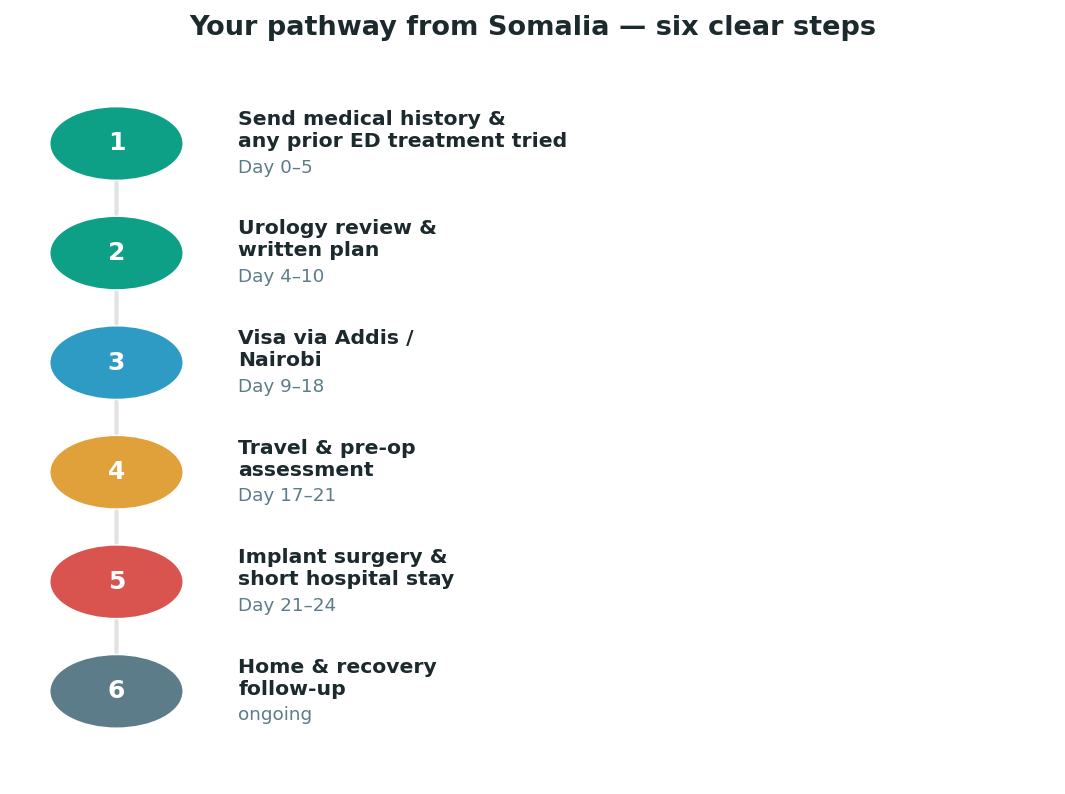
The complete route, start to finish — the procedure itself typically involves a short hospital stay.
A well-understood problem, waiting on a conversation
Erectile dysfunction is rarely the mystery it can feel like. It has known causes, a proven sequence of treatments, and, for the men who genuinely need it, a permanent surgical solution with high satisfaction rates. The hardest part is very often simply raising it — everything that follows is, medically speaking, well-travelled ground.
Sources & useful links
- 🌐 Indian medical visa (Somali nationals) — indianvisaonline.gov.in
- 🌐 Embassy of India, Addis Ababa — eoiaddisababa.gov.in
- 🌐 High Commission of India, Nairobi — hcinairobi.gov.in
- 🌐 Yellow-fever requirements — who.int/health-topics/yellow-fever
- 🌐 Hospital accreditation (India) — nabh.co · jointcommissioninternational.org
- 🌐 Verify a surgeon's registration — nmc.org.in
Do not decide alone, and do not decide blind
If you want your case reviewed properly and an honest written plan — including whether medication could still be the right path — that is precisely the independent guidance I provide, without a single hospital's interest attached to my advice. Dr. Dheeraj Bojwani · Independent medical travel advisor
Frequently Asked Questions by Somali Patients about Penile Implant Surgery in India
Should Somali patients consider penile implant surgery as the first treatment for erectile dysfunction?
No. The guide recommends evaluating lifestyle factors, diabetes and blood pressure management, oral medication and other appropriate treatments before considering an implant.
Why is diabetes important when evaluating erectile dysfunction?
Diabetes can damage the small blood vessels and nerves involved in erections. Poor blood-sugar control and longer disease duration can make erectile dysfunction more difficult to treat with medication.
When may a penile implant become appropriate?
An implant may be considered when medication and, where appropriate, injections or vacuum-device therapy have been properly tried and failed, and the urologist determines that surgery is suitable.
What types of penile implants are available in India?
The guide identifies malleable implants and three-piece inflatable systems. The appropriate option depends on the patient's medical situation, preferences and specialist assessment.
How much does penile implant surgery cost in India for Somali patients?
The guide gives an indicative all-in range of US$3,500–US$15,000. Malleable devices generally fall toward the lower end, while premium inflatable systems may cost more.
Why should Somali patients choose a prosthetic-urology specialist?
Penile implant placement requires specific expertise in device selection, sizing and infection prevention. The guide recommends checking the named surgeon's actual implant experience rather than relying only on the hospital's overall urology volume.
What should be included in the written cost quotation?
The quotation should clearly identify the specific implant/device being proposed and the treatment costs included. The guide warns against relying on a price that changes during the planning process.
What are important warning signs when selecting a penile implant provider?
Warning signs include no documented trial of medication, failure to assess diabetes or blood pressure, discussion of only one implant type and a quotation that keeps changing.
What should Somali patients send before travelling to India?
They should provide an honest account of previous erectile dysfunction treatments, together with recent blood-sugar and blood-pressure readings where available, so the urology team can assess the appropriate treatment.
How does the treatment journey from Somalia to India work?
The guide outlines six stages: medical history and previous treatment review → urology review and written plan → visa → travel and pre-operative assessment → implant surgery and short hospital stay → home recovery and follow-up.
Page Summary
This guide explains the key considerations for Somali patients exploring penile implant surgery in India for erectile dysfunction, focusing on the under-recognition of the condition, the strong association between diabetes and erectile dysfunction, the importance of trying appropriate non-surgical treatments before surgery, and the role of prosthetic-urology expertise. It covers malleable and three-piece inflatable implants, indicative costs of US$3,500–US$15,000, the importance of identifying the exact implant included in the quotation, surgeon-specific implant experience, infection prevention, warning signs when selecting a provider, pre-travel treatment records and blood-pressure/blood-sugar information, visa and travel planning, and the six-step pathway from medical-history review through surgery and recovery follow-up.
Citation Block
| Topic | Information |
|---|---|
| Topic Information | Penile Implant Surgery in India for Patients from Somalia |
| Treatment | Penile Implant Surgery |
| Intended Audience | Patients from Somalia |
| Key Specialist | Prosthetic Urologist / Urologist |
| Main Condition | Erectile Dysfunction |
| Important Underlying Cause | Diabetes and Vascular Disease |
| Primary Assessment | Urological Evaluation and Medical History |
| Initial Treatment | Lifestyle and Underlying-Condition Management |
| Other Treatment Options | Oral Medication, Injections and Vacuum Devices |
| Surgical Option | Penile Implant |
| Implant Types | Malleable and Three-Piece Inflatable |
| Indicative Cost | US$3,500–US$15,000 All-In |
| Important Specialist Check | Confirm the Surgeon's Specific Penile Implant Experience |
| Infection Check | Confirm the Infection-Prevention Protocol |
| Device Check | Confirm the Exact Implant Type Included in the Quote |
| Pre-Travel Records | Treatment History, Blood-Sugar and Blood-Pressure Readings |
| Important Warning | Surgery Proposed Without a Documented Trial of Appropriate Treatment |
| Cost Check | Request a Fixed Written Quote Linked to the Specific Device |
| Travel Routes | Nairobi, Addis Ababa, Dubai or Djibouti |
| Visa Requirement | Hospital Invitation and Medical Visa |
| Patient Journey | Medical history → urology review → visa → travel/pre-op → implant surgery → home recovery/follow-up |
| Hospital Stay | Short Hospital Stay |
| Follow-Up | Home Recovery and Post-Surgical Follow-Up |


Our Mission Statement
Our mission is to place patients at the centre of every healthcare decision by providing trustworthy, evidence-based, and unbiased medical information. We believe that informed patients make better decisions. Backed by personalised guidance from our experienced advisory team, we help patients understand their treatment options, compare them objectively, and confidently choose the path that best suits their medical needs and personal circumstances.
Patient Testimonials from Somalia




Ready to Take the First Step?
Share your Medical Reports with our Healthcare Managers Today and Get a FREE CONSULTATION, a Personalized Treatment Plan, and Complete Support from Arrival to Recovery.
Get Your Free ConsultationAreas We Serve
This resource has been thoughtfully prepared for patients from Somalia who are considering medical treatment in India. We also welcome patients from the wider region in the countries mentioned below-
We assist patients from:
- Ethiopia
- Djibouti
- Yemen
- Kenya
- Seychelles
- Somalia
- South Sudan
- Tanzania
- Uganda
- Zambia
- Zimbabwe
- Angola
- Cameroon
- Central African Republic
Many of the insights, treatment pathways, hospital recommendations, travel guidance, and patient support services described here are equally relevant and may be used as a reference when planning treatment in India.
From Somalia to India: Your Complete Patient Support Guide
- Best Brain Tumour Surgeons & Hospitals in India for Somali Patients
- Best Cancer Treatment Surgeons & Hospitals in India for Somali Patients
- Best Cardiac Surgeons & Hospitals in India for Somali Patients
- Best CyberKnife Teams & Centres in India for Somali Patients
- Best Heart Valve Replacement Surgeons & Hospitals in India for Somali Patients
- Best Hip Surgeons & Hospitals in India for Somali Patients
- Best Knee Surgeons & Hospitals in India for Somali Patients
- Best Neurosurgeons & Hospitals in India for Somali Patients
- Best Paediatric Cardiac Surgeons & Hospitals in India for Somali Patients
- Best Paediatric Neurosurgeons & Hospitals in India for Somali Patients
- Best Spine Surgeons & Hospitals in India for Somali Patients
- Bariatric Surgery in India for Patients from Somalia
- Brain Tumour Surgery in India for Patients from Somalia
- Cancer Treatment and Surgery in India for Patients from Somalia
- Cardiac Surgery in India for Patients from Somalia
- Cosmetic and Plastic Surgery in India for Patients from Somalia
- CyberKnife Treatment in India for Patients from Somalia
- Dental Surgery in India for Patients from Somalia