

Parkinson's Treatment and DBS Surgery in India for Patients from Somalia
A tremor and a slowing gait are a treatable neurological condition long before they are anything else — but reaching that plain medical fact first requires reaching a neurologist at all.
A hand that trembles at rest. Handwriting that shrinks across a page. A walk that slows and stiffens over months rather than days. Parkinson's disease develops gradually enough that its early signs are easy to explain away, and for 24 years I have watched how much harder that already difficult recognition becomes when awareness of the disease itself is low and a neurologist is genuinely hard to find.
India runs some of the region's most established movement disorder programmes, with neurologists who manage Parkinson's medication regimes for years before surgery is ever discussed, and neurosurgical teams performing deep brain stimulation with outcomes that match leading centres in Europe and North America — at a fraction of the cost of the same care in the Gulf, Europe or the United States.
Healing Journeys of Somali Patients









Key Takeaways
- The guide highlights the major shortage of neurological care in Somalia and across Africa. It states that two-thirds of African countries have fewer than 30 neurologists, while Somalia currently has no established DBS programme.
- Early Parkinson's symptoms can be gradual and easily overlooked. Resting tremor, smaller handwriting, slower or stiffer movement, reduced arm swing, softer speech and reduced facial expression should prompt neurological assessment when persistent.
- The guide stresses that medication comes before DBS. Most patients are managed for years with levodopa and other medicines, physiotherapy and movement-disorder specialist care before surgery is considered.
- DBS becomes a potential option when medication no longer controls symptoms consistently, effects wear off unpredictably or medication-related involuntary movements become difficult to manage.
- The guide explains that good levodopa responsiveness is an important predictor of DBS benefit. DBS refines an existing medication response rather than creating a response where none exists.
- A published Moroccan study highlighted on page 3 screened 370 Parkinson's patients, identified 70 genuine DBS candidates and found that only one had actually received DBS, illustrating the gap between eligibility and access even where a DBS programme exists.
- The guide states that DBS pricing in a reputable private Indian hospital is approximately US$18,000–US$28,000 all-in, covering the device, surgery and initial programming. Battery replacement and longer-term follow-up costs need separate planning.
- Programming is a major part of DBS care, not simply an afterthought to surgery. Several sessions may be required, and stimulation settings can continue to be adjusted for months.
- Because Somalia has no local team identified in the guide for DBS fine-tuning, patients should specifically ask about remote programming and long-term follow-up support before choosing a hospital.
- Somali patients should send their neurology notes, current medication list and actual MRI where available before travelling. The six-step pathway covers DBS candidacy review, visa, travel and pre-operative assessment, implant surgery with initial programming, and ongoing remote programming follow-up.
Quick Facts
- Treatment
- Parkinson's Disease Treatment and Deep Brain Stimulation
- Country
- India
- Patients
- Patients from Somalia
- Key Specialist
- Movement Disorder Neurologist / Functional Neurosurgeon
- Main Condition
- Parkinson's Disease
- Primary Assessment
- Neurological Evaluation and Medication Response
- Initial Treatment
- Levodopa and Other Parkinson's Medications
- Surgical Option
- Deep Brain Stimulation
- DBS Requirement
- Appropriate Response to Levodopa
- Indicative Cost
- US$18,000–US$28,000 All-In
- Important Check
- Documented DBS Experience
- Programming
- Multiple Initial Programming and Adjustment Sessions
- Follow-Up Requirement
- Remote DBS Programming Support
- Pre-Travel Records
- Neurology Notes, Medication List and MRI Where Available
- Travel Routes
- Nairobi, Addis Ababa, Dubai or Djibouti
- Visa
- Hospital Invitation and Medical Visa
- Attendants
- Up to Two Medical Attendants
- Long-Term Care
- Medication Management and DBS Programming Follow-Up
- Author
- Dr. Dheeraj Bojwani
- Experience
- 24+ Years
In Brief
For Somali patients considering Parkinson's treatment or DBS surgery in India, the guide recommends starting with a movement-disorder specialist assessment and a review of the patient's medication response, rather than assuming that surgery is immediately required. DBS is presented as an option for selected patients whose symptoms remain responsive to levodopa but are no longer adequately controlled with medication alone. Before travelling, patients should share their neurology notes, current medication list and MRI if available, confirm the surgeon's DBS experience, ask how many programming sessions are included and establish a clear plan for remote programming and long-term follow-up after returning to Somalia.
First, know why Parkinson's is so often missed or misunderstood
Parkinson's disease progresses slowly, and its earliest signs — a slight tremor, quieter speech, smaller handwriting, a stiffer walk — are easy to attribute to age, stress or simple tiredness. A Somali health awareness organisation has specifically noted that stigma surrounding this disease in Somalia can prevent people from receiving the support they need, and research from elsewhere in the region has documented that Parkinson's symptoms are sometimes understood through spiritual or supernatural explanations rather than as a treatable neurological condition. This is not a judgement on anyone's beliefs; it reflects how little public awareness of Parkinson's currently exists in places where the disease has rarely been explained, and it is a genuine, correctable barrier to people getting help earlier.
The Somali difference: the surgery that could help is not the first problem — reaching a neurologist is
Even before deep brain stimulation becomes a question, a Parkinson's diagnosis depends on a neurologist experienced in movement disorders actually examining the patient. Across Africa, two-thirds of countries have fewer than 30 neurologists in total, and some have none at all. Once a diagnosis is made and medication alone is no longer enough to control symptoms, the surgical option narrows further still: deep brain stimulation is available in a meaningful way in only three African countries — Egypt, Morocco and South Africa, with occasional availability in Algeria and Tunisia. Somalia, like the rest of the Horn of Africa, currently has neither the specialist workforce to reliably diagnose advanced Parkinson's nor the neurosurgical infrastructure to treat it surgically.
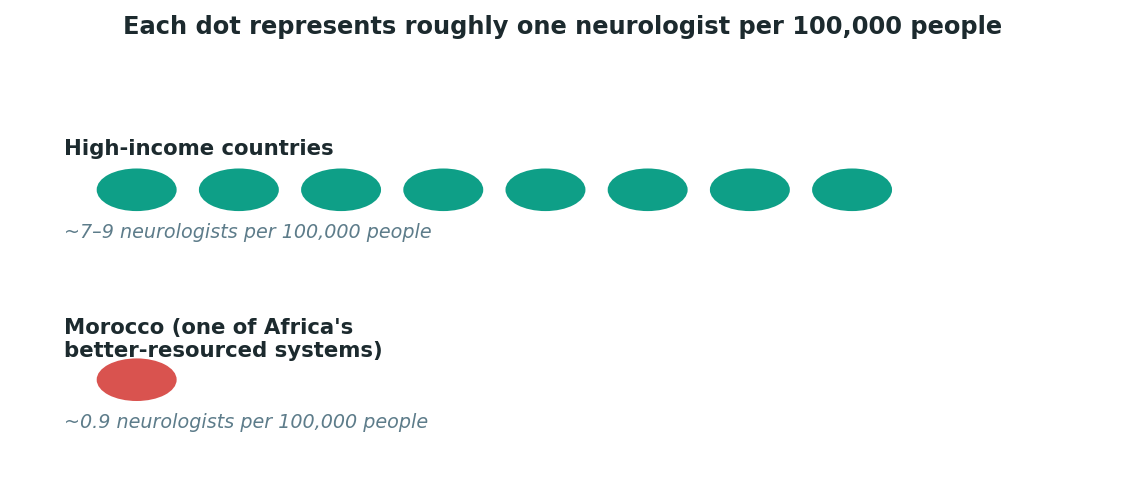
Published data on neurologist density: high-income countries versus Morocco, cited as one of Africa's better-resourced systems — illustrating how much further the gap runs elsewhere on the continent.
Why so few patients who could benefit from DBS ever receive it
A cross-sectional study across 15 public and private centres in Morocco — a country with an established DBS programme, unlike Somalia — screened 370 Parkinson's patients and found that just under one-fifth were genuine candidates for deep brain stimulation. Of that eligible group, only one patient had actually received the surgery. If access remains this limited even in a country with a functioning DBS programme, the effective access rate for patients in a country with no programme at all is, for all practical purposes, zero.
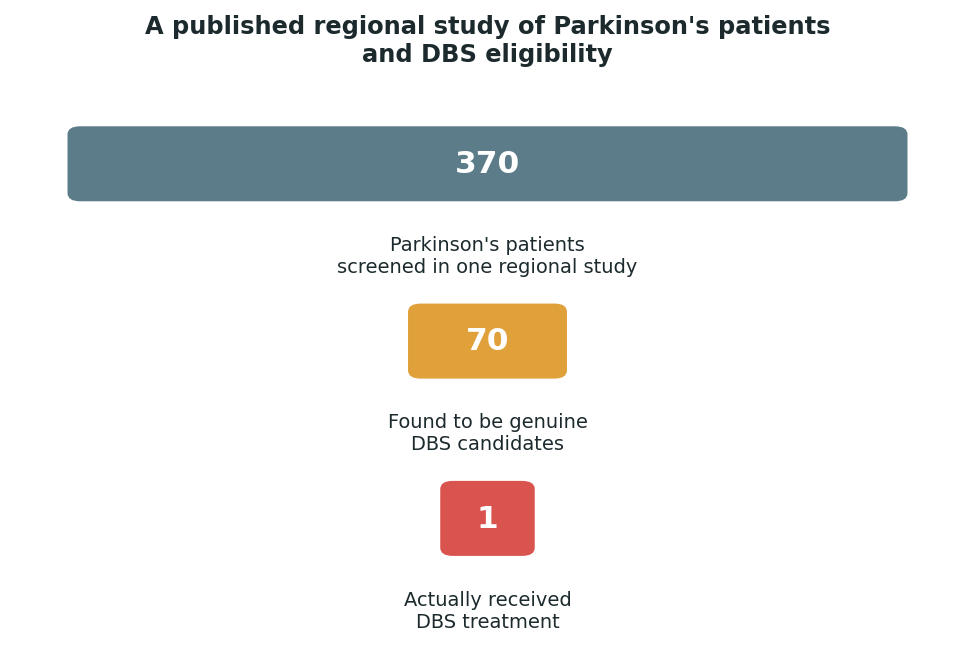
Findings from a published cross-sectional study of Parkinson's patients and DBS eligibility across 15 centres in Morocco.
Know the warning signs, and do not wait them out
A tremor in one hand at rest, which lessens when the hand is actively used, is the classic early sign of Parkinson's, and deserves a neurological opinion rather than an assumption that it will pass. So is a general slowing and stiffening of movement, a reduced arm swing on one side while walking, smaller and more cramped handwriting than before, a softer or more monotone voice, and a reduced blink rate or less expressive face. These signs typically develop gradually over months, which is part of why they are easy to overlook or attribute to other causes. None of them guarantee Parkinson's on their own, but together, or persisting and slowly worsening over time, they are exactly the pattern that deserves a proper neurological examination.
Medication comes first, and surgery is never the first step
Deep brain stimulation is not a treatment for early Parkinson's disease. The great majority of patients are managed for years, often successfully, with levodopa and other medications that replace or support the brain's own dopamine production, alongside physiotherapy and a movement disorder specialist adjusting the regimen as symptoms change. DBS becomes a genuine option specifically when medication alone can no longer control symptoms consistently, when its effects wear off unpredictably between doses, or when side effects like involuntary movements become difficult to manage — and even then, only for patients whose symptoms still respond well to levodopa, since DBS refines a response that is already present rather than creating one from nothing.
What it costs
In more than 24 years arranging this kind of care, the disputes I have seen were almost never about the price itself — they were about a diagnosis, or a cost, nobody had bothered to write down before the flight was booked. DBS pricing covers the device, the implant surgery and initial programming, with ongoing battery and follow-up costs to plan for separately over the years ahead.
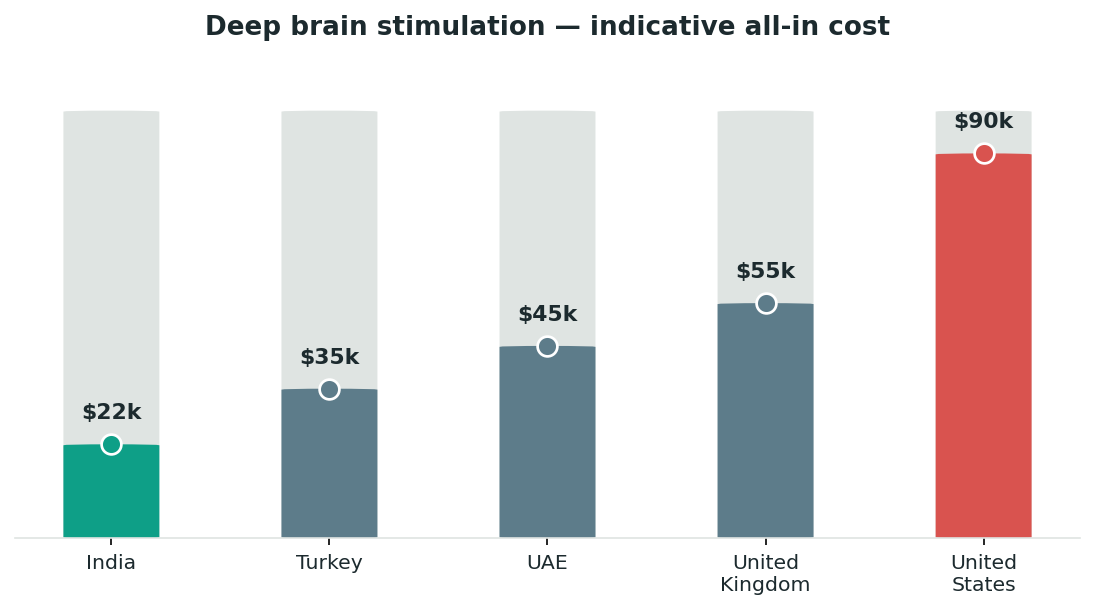
Indicative all-in cost for deep brain stimulation surgery. India sits far below every common alternative.
A DBS case in a reputable private Indian hospital typically runs US$18,000 to US$28,000 all-in, covering the device, the surgery and initial programming sessions. Ask for the figure specific to your actual diagnosis and whether unilateral or bilateral electrode placement is planned, since this affects both cost and outcome.
Why the programming, not just the surgery, decides the outcome
Implanting the DBS electrodes is only the first half of the process. The device is then programmed over several sessions, adjusting stimulation settings against the patient's actual symptoms, and this fine- tuning often continues for months after surgery as the right balance is found. Ask specifically how this initial programming period is structured, how many visits it requires before returning home, and how follow-up adjustments will be managed remotely afterward, since Somalia currently has no local team able to fine-tune the device in person. A hospital with an established remote programming pathway, communicating with the patient's home team by video and adjusting settings accordingly, is a meaningfully better choice than one offering surgery alone with no clear follow-up plan.
Four signals that should make you stop and walk away
DBS proposed without a documented medication trial. Surgery should follow a genuine trial of levodopa and other medications, not replace it. Ask what has already been tried.
No movement disorder specialist involved in the diagnosis. A general physician's impression is not a substitute for a neurologist confirming the Parkinson's diagnosis itself.
No discussion of levodopa responsiveness. How well symptoms respond to medication is one of the strongest predictors of DBS success. It should be tested and discussed before surgery.
The price keeps moving. A verbal estimate that shifts each time you ask is not an estimate. Demand a fixed figure in writing.
The practical journey from Somalia — plan it before you fly
There is no direct flight between Somalia and India; patients route through Nairobi, Addis Ababa, Dubai or Djibouti. Because there is no full Indian mission inside Somalia, the medical visa is issued through the Embassy of India in Addis Ababa or the High Commission in Nairobi , against a written invitation letter from the treating hospital. Somali patients may bring up to two medical attendants on attendant visas. Since your route crosses yellow-fever territory, carry a valid yellow-fever vaccination certificate . Above every other instruction: send your actual neurology notes, current medication list and, if already done, an MRI, not a written summary, so the movement disorder team can confirm candidacy before you ever leave home.
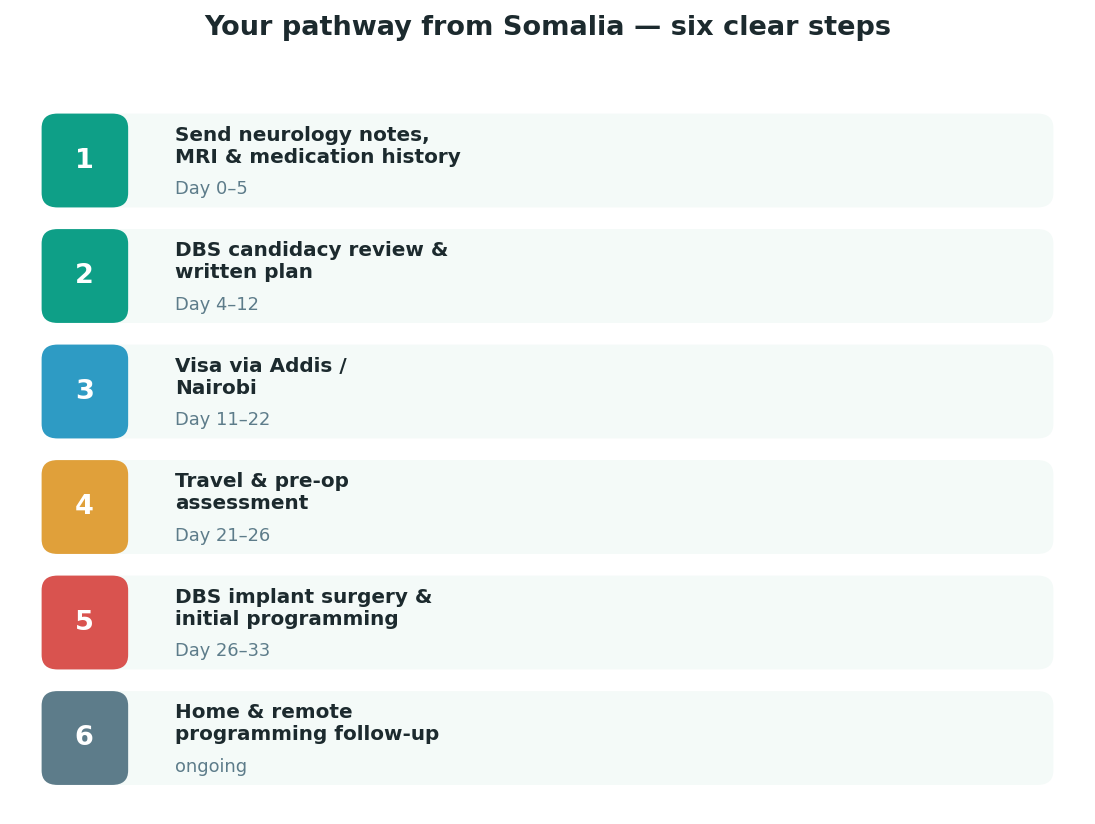
The complete route, start to finish — DBS programming continues remotely for years after the initial surgery.
A tremor is a diagnosis waiting to happen, not a fate
Parkinson's disease remains a lifelong condition, but it is also one of the more manageable chronic neurological diseases in modern medicine, with decades of good function possible through medication alone for most patients, and a genuine surgical option for the minority who need more. Reaching that first, plain diagnosis is the step that changes everything after it.
Sources & useful links
- 🌐 Indian medical visa (Somali nationals) — indianvisaonline.gov.in
- 🌐 Embassy of India, Addis Ababa — eoiaddisababa.gov.in
- 🌐 High Commission of India, Nairobi — hcinairobi.gov.in
- 🌐 Yellow-fever requirements — who.int/health-topics/yellow-fever
- 🌐 Hospital accreditation (India) — nabh.co · jointcommissioninternational.org
- 🌐 Verify a surgeon's registration — nmc.org.in
Do not decide alone, and do not decide blind
If you want your case reviewed properly and an honest written plan — including whether medication alone could still be the right path — that is precisely the independent guidance I provide, without a single hospital's interest attached to my advice. Dr. Dheeraj Bojwani · Independent medical travel advisor
Frequently Asked Questions by Somali Patients about Parkinson's Treatment and DBS Surgery in India
Should Somali patients seek a neurologist before considering DBS surgery?
Yes. The guide recommends a movement-disorder specialist assessment first, because DBS is not an initial treatment and candidacy depends on the diagnosis and medication response.
What are the early signs of Parkinson's disease?
Common signs include resting tremor, smaller handwriting, slower or stiffer movement, reduced arm swing, softer speech and reduced facial expression. Persistent or progressively worsening symptoms should be assessed.
Is DBS the first treatment for Parkinson's disease?
No. The guide states that most patients are treated for years with levodopa and other medications, alongside physiotherapy and specialist management, before DBS is considered.
When may a Somali patient become a candidate for DBS?
DBS may be considered when medication no longer controls symptoms consistently, medication effects fluctuate or involuntary movements become difficult to manage, provided the patient's symptoms still respond appropriately to levodopa.
Why is levodopa response important before DBS?
The guide identifies medication response as one of the strongest predictors of DBS success. DBS is intended to improve an existing levodopa-responsive symptom pattern.
How much does DBS surgery cost in India for Somali patients?
The guide gives an indicative all-in range of US$18,000–US$28,000, covering the device, surgery and initial programming. Future battery and follow-up costs may be additional.
Why is DBS programming important after surgery?
The implanted device requires several programming sessions and ongoing adjustment. The guide notes that fine-tuning may continue for months as stimulation settings are matched to the patient's symptoms.
What should Somali patients check when choosing a DBS centre?
They should confirm the involvement of a movement-disorder specialist, documented DBS experience, levodopa-response assessment and a clear programming and follow-up pathway.
What medical records should Somali patients send before travelling?
Patients should send their actual neurology notes, current medication list and MRI where available, rather than relying only on a written summary.
How will DBS follow-up be managed after returning to Somalia?
The guide recommends confirming a remote programming pathway before travel because ongoing DBS adjustments may be required after the patient returns home.
Page Summary
This guide explains the key considerations for Somali patients exploring Parkinson's disease treatment and deep brain stimulation in India, beginning with the difficulty of accessing neurologists and DBS services in Somalia and much of Africa. It covers common Parkinson's symptoms, the importance of movement-disorder assessment, medication-first management, when DBS may become appropriate, the importance of levodopa responsiveness, the Moroccan study showing 370 patients screened and 70 genuine DBS candidates but only one receiving treatment, indicative DBS costs of US$18,000–US$28,000, the importance of device programming, warning signs when selecting a DBS centre, pre-travel medical records, visa and travel planning, and the six-step journey from candidacy review through surgery, initial programming and long-term remote follow-up.
Citation Block
| Topic | Information |
|---|---|
| Topic Information | Parkinson's Treatment and DBS Surgery in India for Patients from Somalia |
| Treatment | Parkinson's Disease Treatment and Deep Brain Stimulation |
| Intended Audience | Patients from Somalia |
| Key Specialist | Movement Disorder Neurologist / Functional Neurosurgeon |
| Main Condition | Parkinson's Disease |
| Primary Assessment | Neurological Evaluation and Medication Response |
| Initial Treatment | Levodopa and Other Parkinson's Medications |
| Surgical Option | Deep Brain Stimulation |
| DBS Eligibility Factor | Good Response to Levodopa |
| Indicative Cost | US$18,000–US$28,000 All-In |
| Important Check | Documented DBS Experience |
| Programming Requirement | Multiple Sessions and Ongoing Adjustment |
| Follow-Up Requirement | Remote DBS Programming Support |
| Pre-Travel Records | Neurology Notes, Medication List and MRI Where Available |
| Important Warning | DBS Proposed Without a Documented Medication Trial |
| Specialist Warning | No Movement Disorder Specialist Involved in Diagnosis |
| Cost Check | Request a Fixed Written Quote for the Planned DBS Approach |
| Travel Routes | Nairobi, Addis Ababa, Dubai or Djibouti |
| Visa Requirement | Hospital Invitation and Medical Visa |
| Patient Journey | Neurology records → DBS candidacy review → visa → travel/pre-op → DBS surgery and initial programming → remote follow-up |
| Follow-Up | Long-Term Medication Management and DBS Programming |


Our Mission Statement
Our mission is to place patients at the centre of every healthcare decision by providing trustworthy, evidence-based, and unbiased medical information. We believe that informed patients make better decisions. Backed by personalised guidance from our experienced advisory team, we help patients understand their treatment options, compare them objectively, and confidently choose the path that best suits their medical needs and personal circumstances.
Patient Testimonials from Somalia




Ready to Take the First Step?
Share your Medical Reports with our Healthcare Managers Today and Get a FREE CONSULTATION, a Personalized Treatment Plan, and Complete Support from Arrival to Recovery.
Get Your Free ConsultationAreas We Serve
This resource has been thoughtfully prepared for patients from Somalia who are considering medical treatment in India. We also welcome patients from the wider region in the countries mentioned below-
We assist patients from:
- Ethiopia
- Djibouti
- Yemen
- Kenya
- Seychelles
- Somalia
- South Sudan
- Tanzania
- Uganda
- Zambia
- Zimbabwe
- Angola
- Cameroon
- Central African Republic
Many of the insights, treatment pathways, hospital recommendations, travel guidance, and patient support services described here are equally relevant and may be used as a reference when planning treatment in India.
From Somalia to India: Your Complete Patient Support Guide
- Best Brain Tumour Surgeons & Hospitals in India for Somali Patients
- Best Cancer Treatment Surgeons & Hospitals in India for Somali Patients
- Best Cardiac Surgeons & Hospitals in India for Somali Patients
- Best CyberKnife Teams & Centres in India for Somali Patients
- Best Heart Valve Replacement Surgeons & Hospitals in India for Somali Patients
- Best Hip Surgeons & Hospitals in India for Somali Patients
- Best Knee Surgeons & Hospitals in India for Somali Patients
- Best Neurosurgeons & Hospitals in India for Somali Patients
- Best Paediatric Cardiac Surgeons & Hospitals in India for Somali Patients
- Best Paediatric Neurosurgeons & Hospitals in India for Somali Patients
- Best Spine Surgeons & Hospitals in India for Somali Patients
- Bariatric Surgery in India for Patients from Somalia
- Brain Tumour Surgery in India for Patients from Somalia
- Cancer Treatment and Surgery in India for Patients from Somalia
- Cardiac Surgery in India for Patients from Somalia
- Cosmetic and Plastic Surgery in India for Patients from Somalia
- CyberKnife Treatment in India for Patients from Somalia
- Dental Surgery in India for Patients from Somalia