

Pancreatic Cancer Surgery in India for Patients from Somalia
Weight loss is the symptom every pancreatic cancer patient eventually has — and, for a large share of Somali adults, it is also simply what a normal afternoon of khat looks like.
A dull ache under the ribs. Skin and eyes turning faintly yellow. Weight that keeps dropping despite eating normally. Pancreatic cancer is one of the quietest cancers in medicine, giving almost no clear signal until it is already advanced — and for 24 years I have watched how easily its early signs get explained away, nowhere more so than in a population where appetite loss and weight loss are already an accepted part of daily life.
India treats pancreatic cancer at a scale that genuinely changes outcomes for this specific disease. Its leading GI-oncology centres perform the Whipple procedure — one of the most technically demanding operations in all of surgery — often enough that the case volume itself measurably improves survival, backed by interventional endoscopy for jaundice relief even when a cure is no longer possible, and by medical oncology for chemotherapy before or after surgery, all at a fraction of the cost of the same care in the Gulf, Europe or the United States.
Healing Journeys of Somali Patients









Key Takeaways
- The guide explains that pancreatic cancer can be particularly difficult to recognise early in Somalia because gradual weight loss and reduced appetite may be attributed to khat use. The guide states that more than 50% of Somali men and roughly one in five women chew khat regularly, making an important pancreatic-cancer warning sign easier to overlook.
- The guide highlights the importance of early staging and determining whether the tumour is genuinely resectable. Its page 2 graphic presents an illustrative referral pattern in which 45% are locally advanced, 30% metastatic, 15% potentially resectable and 10% benign/other pancreatic masses.
- The Whipple procedure is presented as highly volume-sensitive surgery. The page 2 chart compares illustrative outcomes at low- and high-volume centres, showing lower 30-day mortality and higher curative resection and five-year survival figures for high-volume centres. The guide therefore recommends checking the surgeon's personal pancreatic surgery volume rather than relying only on a hospital's general reputation.
- Not every patient needs or can safely undergo a Whipple. A tumour confined to the pancreatic head without major-vessel involvement may be resectable, while locally advanced or metastatic disease may require chemotherapy, bypass or endoscopic stenting to relieve jaundice rather than curative surgery. The guide stresses that an honest treatment plan should explain which category the patient falls into.
- The guide recommends a dedicated pancreatic or hepatobiliary surgery unit, supported by interventional endoscopy and medical oncology. A multidisciplinary tumour-board review is also identified as essential, rather than allowing the surgical decision to be made by one surgeon alone.
- The page 4 cost chart gives an illustrative Whipple/resection package of approximately US$10,000 in India, compared with about US$18,000 in Turkey, US$20,000 in private Kenya, US$32,000 in the UAE, US$40,000 in the UK and US$75,000 in the US. The written guide gives a more specific Indian range of US$7,000–14,000 all-in, depending on the actual treatment required.
- For Somali patients, the guide recommends sending the actual CT or MRI scans and pathology report, if already available, before travelling. Patients should obtain a written quotation based on their staging scans and clarify whether the planned treatment is a Whipple, another resection, bypass or palliative stenting.
Quick Facts
- Author
- Dr. Dheeraj Bojwani
- Experience
- 24+ Years
- Treatment
- Pancreatic Cancer Surgery
- Patients
- Somali Patients
- Khat Use
- 50%+ of Somali men cited in the guide
- Curative Surgery
- 7% in the cited regional study
- First Assessment
- CT/MRI staging
- Key Specialist
- Pancreatic / Hepatobiliary Surgeon
- Main Surgery
- Whipple procedure where resectable
- Case Volume
- Surgeon-specific pancreatic surgery experience
- Team Check
- Multidisciplinary tumour board
- Support
- Interventional endoscopy and medical oncology
- Jaundice Care
- Endoscopic stenting when surgery is not possible
- India Cost
- US$7,000–14,000 for Whipple/resection
- Cost Check
- Written quote based on staging scans
- Medical Records
- Actual CT/MRI and pathology report
- Visa
- Medical visa through Nairobi or Addis Ababa
- Travel
- Connecting flight required
- Attendants
- Up to two medical attendants
- Entry Requirement
- Valid yellow-fever vaccination certificate
- Follow-Up
- Long-term oncology follow-up plan
- Key Warning
- Surgery proposed before complete staging
- Decision Principle
- Confirm resectability and choose genuine high-volume pancreatic expertise.
In Brief
For Somali patients considering pancreatic cancer surgery in India, the most important checks are complete staging, confirmation of resectability, high-volume Whipple experience, multidisciplinary review, access to endoscopic jaundice relief and a written treatment-specific quotation. Patients should send their actual CT/MRI scans before travelling so the Indian team can assess operability in advance.
First, know why this cancer is so easily missed in Somalia specifically
Pancreatic cancer is notoriously difficult to catch early everywhere in the world, because its first symptoms — vague abdominal discomfort, reduced appetite, gradual weight loss — are so unspecific that they rarely alarm anyone on their own. Somalia adds a genuinely local complication to that already difficult picture.
The Somali difference: a stimulant that hides the cancer's main warning sign
More than half of Somali men and roughly one in five women chew khat regularly, a plant with well-documented appetite-suppressing and gastrointestinal effects, including nausea, constipation and gradual weight loss with prolonged use. Unintentional weight loss is one of the single most consistent early warning signs of pancreatic cancer — but in a population where reduced appetite and weight loss are already a familiar, expected consequence of a widespread daily habit, that warning sign has somewhere to hide. A patient losing weight for months may reasonably assume it is simply the khat, right up until jaundice or severe pain finally forces a hospital visit — by which point, as regional data from neighbouring countries show, the disease has very often progressed beyond the point of a curative operation.
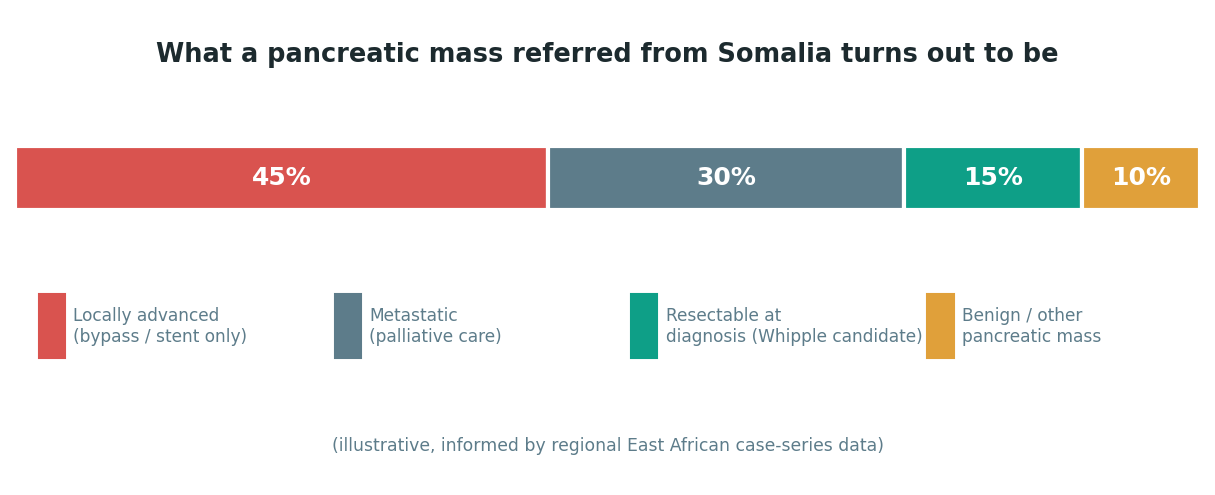
Illustrative breakdown of pancreatic masses referred from Somalia, informed by published East African case series.
Why the surgeon's case volume decides more than almost any other factor
The Whipple procedure removes the head of the pancreas, the duodenum, part of the bile duct and often part of the stomach, then reconstructs the entire digestive tract in one operation — and it is one of the most extensively studied examples in all of surgery of outcomes depending on how often a centre performs a specific operation. Published data across neighbouring East African countries illustrates the gap starkly: in one Kenyan cohort, only 7% of pancreatic cancer patients underwent a curative resection at all, while more than half received palliative surgery only. This is not a reflection of surgical skill so much as of case volume, equipment and the surrounding multidisciplinary team a centre needs to safely
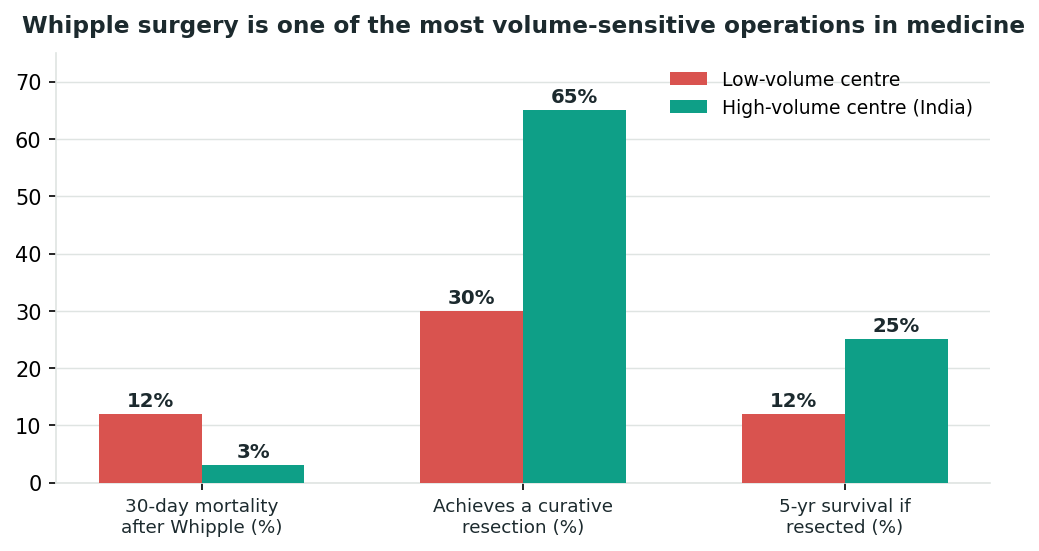
perform this specific operation regularly.
Illustrative comparison of outcomes at low-volume versus high-volume centres for pancreaticoduodenectomy (Whipple procedure), drawn from general surgical literature on the volume-outcome relationship for this operation.
Know the warning signs, and do not wait them out
Yellowing of the skin or the whites of the eyes, dark urine paired with pale, greasy stools, and persistent itching are the classic signs of the bile-duct blockage that pancreatic head tumours often cause, and deserve urgent imaging rather than a wait-and-see approach. Weight loss that continues despite eating normally, new-onset diabetes in someone with no family history or other risk factors, and pain in the upper abdomen or back that is worse at night or after eating are also worth investigating, particularly in anyone over 50. None of these signs are exclusive to cancer, and most people with them will not have pancreatic cancer — but because this disease offers so few early clues, a combination of these signs, or any one of them persisting for more than a few weeks, is exactly the pattern that justifies a scan rather than reassurance alone.
Not every case needs, or can have, a Whipple
An honest team tells a patient plainly which category they fall into. A tumour confined to the head of the pancreas, without involvement of major blood vessels, may genuinely be resectable with a Whipple procedure and a real chance of cure. A tumour that has grown around major vessels or spread to other organs is not, and pursuing surgery anyway would add risk without benefit. For these patients, relieving the jaundice and blockage that cause much of the suffering — through an endoscopic stent placed without open surgery, in the majority of cases — genuinely improves quality of life even when a cure is no longer possible, and should always be offered rather than dismissed as "nothing more to do." Chemotherapy, sometimes given before surgery to shrink a borderline tumour, is a further tool many patients are never offered simply because it was not on hand where they were first seen.
What it costs
In more than 24 years arranging this kind of care, the disputes I have seen were almost never about the price itself — they were about a diagnosis, or a cost, nobody had bothered to write down before the flight was booked. Because pancreatic cancer treatment can mean anything from a stent placed in a day procedure to a multi-hour Whipple resection, a quote should always specify which of these is actually being planned.
Why the wider team matters as much as the surgeon
A Whipple procedure is only ever as safe as the team around it. Ask specifically whether the hospital has a dedicated pancreatic or hepatobiliary surgery unit rather than general surgeons who occasionally take on pancreatic cases, whether an interventional endoscopist is available for stenting if the tumour turns out to be unresectable once the surgeon actually looks inside, and whether a medical oncologist is part of the standing team for chemotherapy before or after surgery. The recovery period matters just as much: ask about the hospital's typical length of stay and how post-operative complications, which are common even at excellent centres, are managed before discharge.
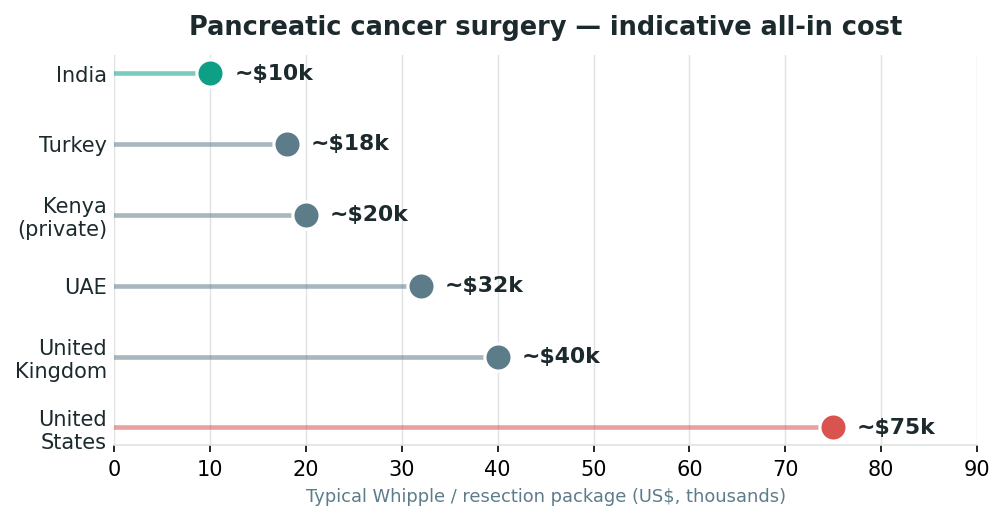
Indicative all-in cost for pancreatic cancer surgery, including the Whipple procedure. India sits far below every common alternative.
A Whipple resection in a reputable private Indian hospital typically runs US$7,000 to US$14,000 all-in, covering diagnosis, the operation, ICU stay and initial recovery; palliative stenting or bypass procedures cost considerably less. Ask for the figure specific to your actual staging scans before committing to anything.
Four signals that should make you stop and walk away
1. Surgery quoted before full staging imaging. A CT scan assessing the major blood vessels around the tumour must come before any resection is planned. Refuse a plan built on incomplete imaging.
2. No tumour board mentioned. This diagnosis should be reviewed by surgery, oncology and radiology together, not decided by one surgeon alone.
3. Jaundice relief not offered when surgery isn't possible. Endoscopic stenting to relieve jaundice should always be discussed, even in advanced disease. Its absence from the plan is a gap.
4. The price keeps moving. A verbal estimate that shifts each time you ask is not an estimate. Demand a fixed figure in writing.
The practical journey from Somalia — plan it before you fly
There is no direct flight between Somalia and India; patients route through Nairobi, Addis Ababa, Dubai or Djibouti. Because there is no full Indian mission inside Somalia, the medical visa is issued through the Embassy of India in Addis Ababa or the High Commission in Nairobi, against a written invitation letter from the treating hospital. Somali patients may bring up to two medical attendants on attendant visas. Since your route crosses yellow-fever territory, carry a valid yellow-fever vaccination certificate. Above every other instruction: send your actual CT or MRI scan, not a written summary, so the surgical team can assess resectability before you ever leave home — and given how quickly this disease can progress, treat that first step as urgent rather than something to schedule around. If a biopsy has already been done, send the pathology report alongside the imaging, since the two together tell the team far more than either does alone.
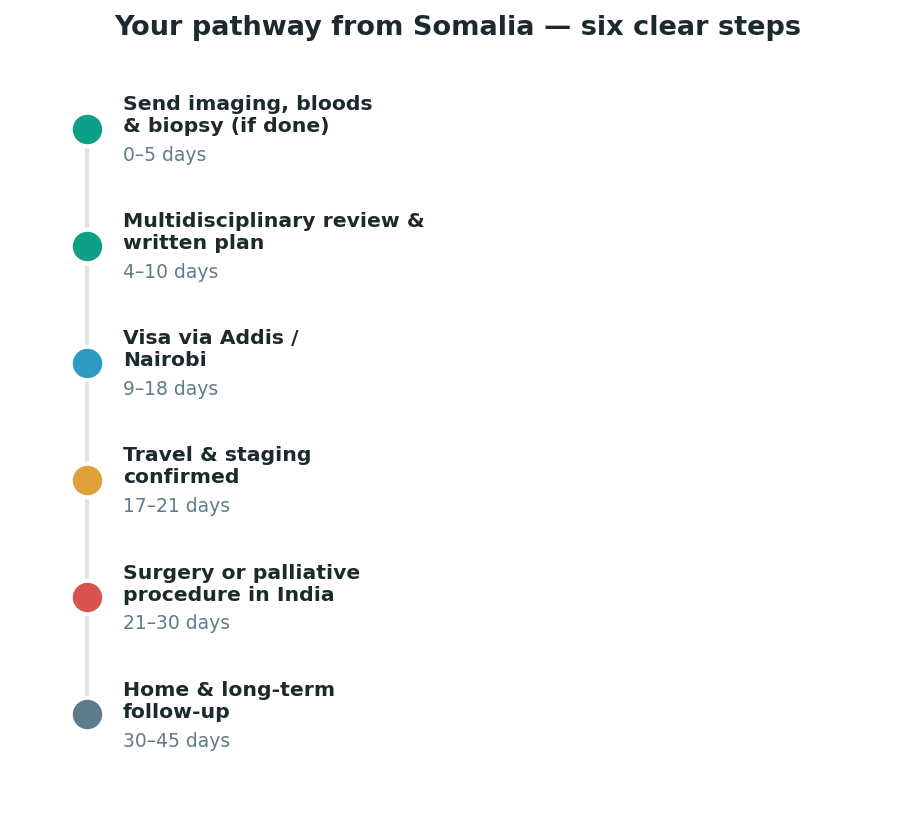
The complete route, start to finish — speed matters more here than in most other cancers.
The window for a cure is real, but it does not stay open
Pancreatic cancer's reputation as a uniformly hopeless diagnosis is not entirely deserved. For the minority of patients caught while a tumour is still confined and operable, a well-performed Whipple procedure at a genuinely high-volume centre offers a real chance at long-term survival — and even for patients past that window, relieving jaundice and pain meaningfully changes the time that remains.
Sources & useful links
- 🌐 Indian medical visa (Somali nationals) — indianvisaonline.gov.in
- 🌐 Embassy of India, Addis Ababa — eoiaddisababa.gov.in
- 🌐 High Commission of India, Nairobi — hcinairobi.gov.in
- 🌐 Yellow-fever requirements — who.int/health-topics/yellow-fever
- 🌐 Hospital accreditation (India) — nabh.co · jointcommissioninternational.org
- 🌐 Verify a surgeon's registration — nmc.org.in
Do not decide alone, and do not decide blind
If you want your scans reviewed properly and an honest written plan — including whether this is genuinely operable — that is precisely the independent guidance I provide.
Dr. Dheeraj Bojwani · Independent medical travel advisor
Frequently Asked Questions by Somali Patients about Pancreatic Cancer Surgery in India
Why should Somali patients take unexplained weight loss seriously?
The guide identifies unintentional weight loss as an important warning sign of pancreatic cancer, but notes that khat-related appetite suppression and weight loss can make this symptom easier to dismiss in Somalia. Persistent weight loss should therefore be medically investigated.
Why is surgeon case volume so important for Somali patients considering Whipple surgery in India?
The Whipple procedure is described as one of the most volume-sensitive operations in surgery. The guide's page 2 chart illustrates better outcomes at high-volume centres, making actual pancreatic surgery volume an important question for Somali patients.
What should a Somali patient send to an Indian pancreatic surgeon before travelling?
Send the actual CT or MRI scan, rather than only a written summary. If a biopsy has already been performed, the pathology report should accompany the imaging so the team can assess the diagnosis and resectability before travel.
How can a Somali patient know whether a Whipple procedure is actually possible?
The guide explains that the decision depends on whether the tumour is confined and operable without unacceptable major-vessel involvement or metastatic spread. Complete staging imaging must therefore precede the surgical decision.
What if a Somali patient's pancreatic cancer cannot be removed surgically?
The guide stresses that “not operable” does not mean “nothing can be done.” Endoscopic stenting can relieve jaundice and obstruction, while chemotherapy may be considered for advanced or borderline disease.
Why should Somali patients ask whether the hospital has interventional endoscopy?
Pancreatic head tumours can block the bile duct and cause jaundice. The guide recommends a centre where endoscopic stenting is available, particularly because it may provide symptom relief when curative surgery is not possible.
What should be included in a Somali patient's pancreatic cancer quotation?
The guide recommends confirming exactly what procedure is planned and obtaining a written figure covering relevant components such as diagnosis, operation, ICU stay and initial recovery. Palliative stenting or bypass should be quoted separately when applicable.
How much does Whipple surgery cost in India for Somali patients?
The guide gives an indicative Indian range of US$7,000–14,000 all-in for Whipple resection, while the page 4 comparison chart uses approximately US$10,000 as India's illustrative figure. The actual cost should be based on the patient's staging and treatment plan.
Why should a Somali patient insist on tumour-board review?
Pancreatic cancer treatment may involve surgery, chemotherapy, radiology and interventional endoscopy. The guide warns against a plan decided by one surgeon alone and recommends multidisciplinary review before treatment is finalised.
What are the biggest warning signs when choosing pancreatic cancer surgery in India?
The guide identifies four major warning signs: surgery quoted before complete staging imaging, no tumour-board review, no discussion of jaundice relief when surgery is not possible, and a treatment price that keeps changing instead of being provided in writing.
Page Summary
This six-page guide explains why pancreatic cancer can be missed in Somalia, why Whipple surgery requires high-volume expertise, when surgery is appropriate, what treatment may cost in India and how Somali patients should plan travel. Page 1 highlights the local diagnostic challenge associated with weight loss and khat use. Page 2 focuses on resectability and the volume-outcome relationship for Whipple surgery. Page 3 covers warning signs, alternatives to surgery and multidisciplinary care. Page 4 compares costs and identifies major warning signs. Page 5 provides the Somalia-to-India pathway, while page 6 reinforces the importance of staging before deciding whether surgery is possible.
Citation Block
| Topic | Information |
|---|---|
| Topic | Pancreatic Cancer Surgery in India for Somali Patients |
| Treatment | Pancreatic Cancer Surgery |
| Patients | Somali Patients |
| First Assessment | CT/MRI staging |
| Key Specialist | Pancreatic / Hepatobiliary Surgeon |
| Main Surgery | Whipple procedure where resectable |
| Case Volume | Personal pancreatic surgery volume |
| Resectability Check | Major-vessel involvement and metastatic spread |
| Team Check | Multidisciplinary tumour board |
| Support | Interventional endoscopy and medical oncology |
| Jaundice Management | Endoscopic stenting where appropriate |
| India Cost | US$7,000–14,000 |
| Cost Check | Quote based on actual staging |
| Medical Records | CT/MRI and pathology report |
| Visa | Nairobi or Addis Ababa |
| Travel | Connecting flights |
| Attendants | Up to two medical attendants |
| Entry Requirement | Valid yellow-fever vaccination certificate |
| Specialist Question | How many Whipple procedures do you personally perform? |
| Resectability Question | Is my tumour genuinely resectable based on the staging scans? |
| Team Question | Has my case been reviewed by surgery, oncology and radiology together? |
| Endoscopy Question | If surgery is not possible, can you provide endoscopic stenting for jaundice? |
| Chemotherapy Question | Could chemotherapy before or after surgery be appropriate? |
| Cost Question | Does the quotation include diagnosis, surgery, ICU and initial recovery? |
| Travel Question | How much treatment can realistically be completed during this trip? |
| Warning Signs | Surgery quoted before full staging imaging |
| Treatment Warning | No tumour-board review or jaundice-relief plan |
| Payment Warning | Verbal or changing treatment price |
| Key Decision | Verify resectability, surgeon volume and multidisciplinary support |


Our Mission Statement
Our mission is to place patients at the centre of every healthcare decision by providing trustworthy, evidence-based, and unbiased medical information. We believe that informed patients make better decisions. Backed by personalised guidance from our experienced advisory team, we help patients understand their treatment options, compare them objectively, and confidently choose the path that best suits their medical needs and personal circumstances.
Patient Testimonials from Somalia




Ready to Take the First Step?
Share your Medical Reports with our Healthcare Managers Today and Get a FREE CONSULTATION, a Personalized Treatment Plan, and Complete Support from Arrival to Recovery.
Get Your Free ConsultationAreas We Serve
This resource has been thoughtfully prepared for patients from Somalia who are considering medical treatment in India. We also welcome patients from the wider region in the countries mentioned below-
We assist patients from:
- Ethiopia
- Djibouti
- Yemen
- Kenya
- Seychelles
- Somalia
- South Sudan
- Tanzania
- Uganda
- Zambia
- Zimbabwe
- Angola
- Cameroon
- Central African Republic
Many of the insights, treatment pathways, hospital recommendations, travel guidance, and patient support services described here are equally relevant and may be used as a reference when planning treatment in India.
From Somalia to India: Your Complete Patient Support Guide
- Best Brain Tumour Surgeons & Hospitals in India for Somali Patients
- Best Cancer Treatment Surgeons & Hospitals in India for Somali Patients
- Best Cardiac Surgeons & Hospitals in India for Somali Patients
- Best CyberKnife Teams & Centres in India for Somali Patients
- Best Heart Valve Replacement Surgeons & Hospitals in India for Somali Patients
- Best Hip Surgeons & Hospitals in India for Somali Patients
- Best Knee Surgeons & Hospitals in India for Somali Patients
- Best Neurosurgeons & Hospitals in India for Somali Patients
- Best Paediatric Cardiac Surgeons & Hospitals in India for Somali Patients
- Best Paediatric Neurosurgeons & Hospitals in India for Somali Patients
- Best Spine Surgeons & Hospitals in India for Somali Patients
- Bariatric Surgery in India for Patients from Somalia
- Brain Tumour Surgery in India for Patients from Somalia
- Cancer Treatment and Surgery in India for Patients from Somalia
- Cardiac Surgery in India for Patients from Somalia
- Cosmetic and Plastic Surgery in India for Patients from Somalia
- CyberKnife Treatment in India for Patients from Somalia
- Dental Surgery in India for Patients from Somalia