

Paediatric Orthopaedic Surgery in India for Patients from Somalia
Somalia has four physiotherapists for a population of roughly 15 million — which means a foot that could be straightened with a few months of gentle casting in infancy is, for many children, still twisted by the time anyone with the right training ever sees it.
Clubfoot is one of the most correctable birth conditions in all of medicine, and one of the most disabling when it is not corrected in time. Treated in the first weeks of life, it usually needs nothing more than a series of gentle castings and, occasionally, a minor procedure to release a tight tendon. Left untreated as a child grows and starts walking on the twisted part of the foot, the same condition becomes rigid, painful and genuinely difficult to fix. For 24 years I have watched this exact window close for families who simply could not reach the right care in time.
India treats children with these conditions at real volume, with paediatric orthopaedic surgeons trained specifically in growing bones and joints, not adult orthopaedics scaled down — using the same casting protocols and, where needed, the same reconstructive techniques used at leading children's hospitals worldwide, at a fraction of the cost of the same care in the Gulf, Europe or the United States.
Healing Journeys of Somali Patients









Key Takeaways
- The guide highlights a major access problem in Somalia, stating that there are around four trained physiotherapists for a population of roughly 15 million people, making regular paediatric orthopaedic care difficult to access.
- Clubfoot is the central condition discussed, with the guide explaining that early treatment usually involves the Ponseti method, using gentle serial casting and, when necessary, a minor Achilles tendon release rather than major surgery.
- Timing is particularly important. A clubfoot treated in the first months of life may require only casting and bracing, whereas a neglected clubfoot presenting at three to five years may become rigid and require more complex treatment.
- The page 2 referral chart gives an illustrative breakdown of paediatric orthopaedic evaluations: clubfoot 40%, hip dysplasia 20%, cerebral-palsy-related deformity 20% and other congenital/limb conditions 20%.
- The guide makes clear that neglected clubfoot is not necessarily untreatable. Older children may still benefit from intensive casting, soft-tissue releases and, in selected cases, bone-level correction.
- The page 3 comparison illustrates the importance of early treatment: Achilles tenotomy alone is shown as sufficient in 85% of early-treated cases versus 15% of neglected cases, while major reconstructive surgery is shown in 8% of early cases compared with 75% of neglected cases.
- Not every child needs surgery. The guide recommends casting, bracing or observation first for many conditions when they are diagnosed early. Surgery becomes more relevant when deformity is rigid, growth is affected or non-surgical treatment has failed.
- Paediatric-specific expertise is important because growing bones and joints require different treatment and surgical planning from adult orthopaedic cases. Families should verify that the hospital has a dedicated paediatric orthopaedic unit and paediatric-specific anaesthesia.
- The indicative all-in cost for paediatric orthopaedic treatment in a reputable private Indian hospital is approximately US$1,500–US$5,000, with casting-based clubfoot treatment toward the lower end and complex reconstructive surgery toward the higher end.
- Somali families should send clear photographs of the affected foot or limb, the child's age, previous X-rays and medical history before travelling. The guide's six-step pathway covers case review, paediatric orthopaedic planning, visa, travel and assessment, casting/tenotomy/surgery and long-term bracing or growth follow-up.
Quick Facts
- Treatment
- Paediatric Orthopaedic Treatment and Surgery
- Country
- India
- Patients
- Children from Somalia
- Key Specialist
- Paediatric Orthopaedic Surgeon
- Main Condition
- Clubfoot
- Other Conditions
- Hip Dysplasia, Cerebral-Palsy-Related Deformity and Congenital/Limb Conditions
- Primary Assessment
- Clinical Examination, Photographs and Imaging
- Main Early Treatment
- Ponseti Casting and Bracing
- Surgical Option
- Achilles Tenotomy or Reconstructive Surgery Where Required
- Indicative Cost
- US$1,500–US$5,000 All-In
- Important Check
- Dedicated Paediatric Orthopaedic Unit
- Specialist Check
- Surgeon's Experience With the Child's Specific Condition
- Anaesthesia Check
- Paediatric-Specific Anaesthesia
- Pre-Travel Records
- Photos, X-Rays, Medical History and Previous Treatment Details
- Travel Routes
- Nairobi, Addis Ababa, Dubai or Djibouti
- Visa
- Hospital Invitation and Medical Visa
- Attendants
- Up to Two Medical Attendants
- Follow-Up
- Bracing, Growth Monitoring and Long-Term Orthopaedic Follow-Up
- Author
- Dr. Dheeraj Bojwani
- Experience
- 24+ Years
In Brief
For Somali families considering paediatric orthopaedic treatment in India, the guide recommends early specialist assessment and sharing clear photographs, X-rays and the child's medical history before travel. Clubfoot should generally be assessed early because Ponseti casting can often correct the deformity without major surgery, while delayed treatment may require more extensive reconstruction. Families should choose a dedicated paediatric orthopaedic team, confirm paediatric-specific anaesthesia and ask for a written treatment plan and cost covering casting, tendon procedures or surgery as appropriate.
First, know why timing matters more here than almost anywhere else
Clubfoot affects roughly one in every 750 to 1,000 babies born worldwide, and Somalia's birth rate is among the highest anywhere, which means a genuinely large number of children are born with this condition every year. The treatment that corrects it, the Ponseti method, is not surgery at all in most cases: a series of gentle castings reshapes the foot over several weeks, sometimes followed by a small tendon release, with excellent long-term results when started in the first months of life. The method depends entirely on trained providers being reachable early — and reachable is precisely the problem in much of Somalia today.
The Somali difference: a treatable window that too often closes before it opens
A programme launched in 2019 by the Somali Red Crescent Society, with international partners, opened just three clinics offering Ponseti treatment across the entire country — and families have travelled as far as 500 kilometres to reach one of them. Somalia has only around four trained physiotherapists for its entire population of roughly 15 million people, a workforce gap that touches nearly every condition in this series but hits clubfoot treatment with particular force, since Ponseti care depends on regular, weekly access to a trained provider during the critical first months of a child's life. A foot that could have been corrected with casting alone at three months old is, by the time a family finally reaches care at three or five years old, a "neglected clubfoot" — rigid, weight-bearing on the wrong surface, and now a genuinely more complex surgical problem.
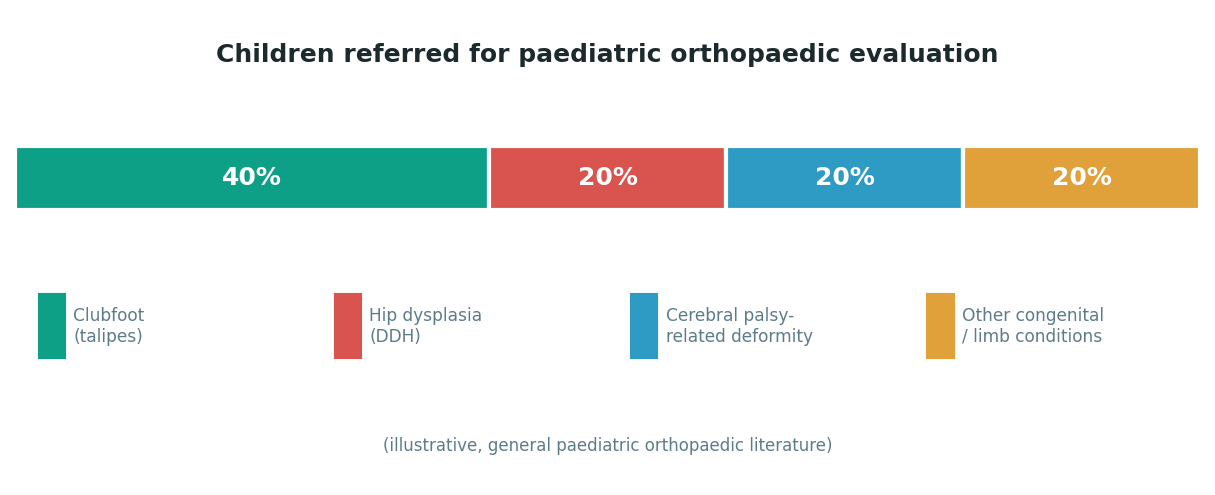
Illustrative breakdown of children referred for paediatric orthopaedic evaluation, based on general paediatric orthopaedic literature.
Why "neglected" does not mean "untreatable"
A rigid, long-untreated clubfoot can still be corrected, even in an older child or, in some cases, an adult — but the path there is different. Where casting alone would have worked in infancy, a neglected foot more often needs a combination of more intensive casting, releases of multiple tight soft tissues, and sometimes bone-level correction to restore a foot that can bear weight properly and fit into ordinary footwear. The outcome can still be genuinely good. It simply asks more of the surgical team, and of the child's recovery, than the same condition would have asked a few years earlier.
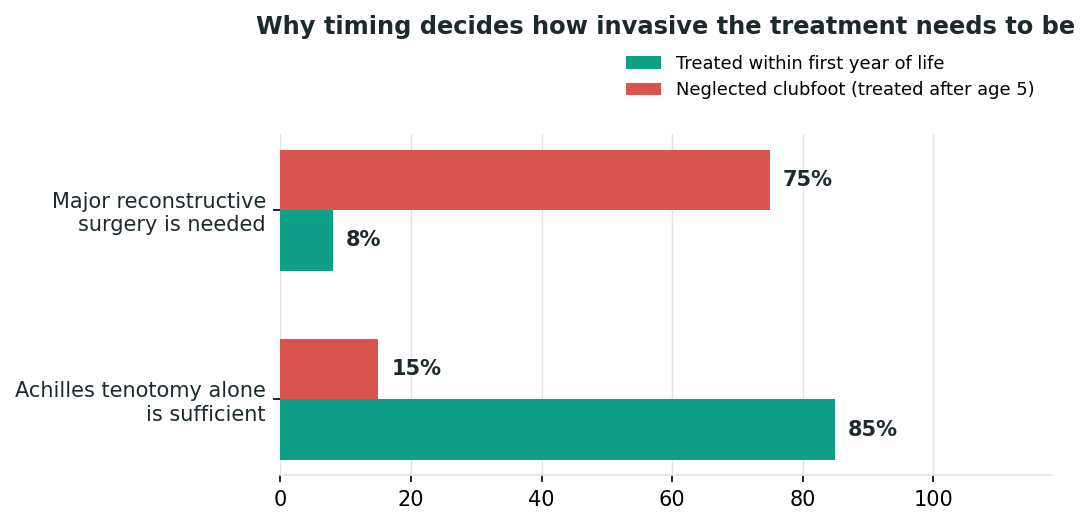
Illustrative comparison of treatment complexity by age at presentation, based on general paediatric orthopaedic literature.
Know the warning signs, and do not wait them out
A newborn's foot that is visibly twisted inward or downward, or that cannot be gently guided back toward a normal position, deserves an orthopaedic assessment in the first weeks of life, not a wait-and- see approach. In slightly older children, a limp with no clear injury behind it, one leg that appears shorter than the other, hips that seem to click or feel unstable, or a delay in starting to walk compared with siblings at the same age are all worth a proper evaluation. For any deformity already present for months or years, it is never truly too late to ask — a neglected clubfoot at five or ten years old is a harder problem than the same condition at three months, but it remains a treatable one, and the sooner a family reaches an evaluation from wherever they currently are in that timeline, the more options remain open.
Not every child needs surgery
The single most important message in paediatric orthopaedics is the one hardest to act on without access to care: most clubfoot, hip dysplasia and similar conditions caught early need casting, bracing or observation, not an operation. Surgery becomes necessary specifically when a deformity has become rigid, when growth has already been affected, or when non-surgical treatment has genuinely been tried and has not achieved a functional result. A team that proposes surgery for a young infant without first attempting casting, or that has never asked how old the child was when the deformity was first noticed, has skipped a step that changes everything about what is actually needed.
What it costs
In more than 24 years arranging this kind of care, the disputes I have seen were almost never about the price itself — they were about a diagnosis, or a cost, nobody had bothered to write down before the flight was booked. A quote should specify whether it covers casting alone, a minor tendon procedure, or full surgical reconstruction, since these differ substantially in cost and in what the child's recovery involves.
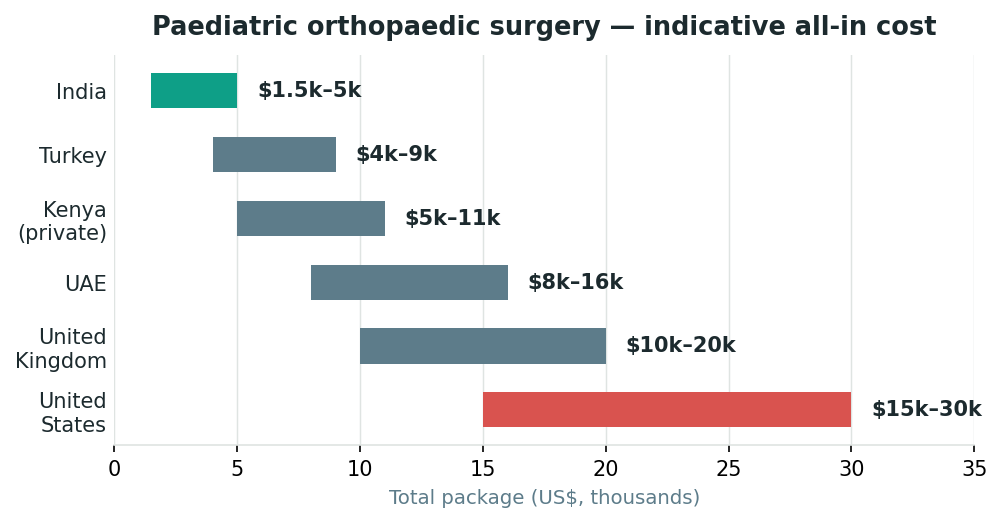
Indicative all-in cost for paediatric orthopaedic treatment, from casting to surgical correction. India sits far below every common alternative.
Paediatric orthopaedic treatment in a reputable private Indian hospital typically runs US$1,500 to US$5,000 all-in, with straightforward casting-based clubfoot correction toward the lower end and complex reconstructive surgery for neglected cases or other congenital conditions toward the top. Ask for the figure specific to your child's actual condition and age before committing to anything.
Why a genuine paediatric orthopaedic team, not a general orthopaedic list, is what to look for
Treating a growing child is not the same discipline as treating an adult, and the difference shows up in real outcomes. A child's bones are still growing, which changes how fractures heal, how deformities correct, and how surgical planning has to account for the years of growth still ahead. Ask specifically whether the hospital has a dedicated paediatric orthopaedic unit, how many children with your child's specific condition the surgeon treats each year, and whether paediatric-specific anaesthesia is standard practice there rather than arranged as an exception. A team that treats children routinely, not occasionally, is a meaningfully different proposition.
Four signals that should make you stop and walk away
Surgery proposed for a young infant without trying casting first. Ponseti casting should be the first approach for most clubfoot cases under one year old. Ask why it was skipped.
No mention of a bracing plan after correction. Correction achieved through casting or surgery can relapse without consistent bracing afterward. A plan without this is incomplete.
No paediatric-specific orthopaedic training mentioned. Growing bones behave differently from adult ones. Ask whether the surgeon specialises in paediatric orthopaedics specifically.
The price keeps moving. A verbal estimate that shifts each time you ask is not an estimate. Demand a fixed figure in writing.
The practical journey from Somalia — plan it before you fly
There is no direct flight between Somalia and India; patients route through Nairobi, Addis Ababa, Dubai or Djibouti. Because there is no full Indian mission inside Somalia, the medical visa is issued through the Embassy of India in Addis Ababa or the High Commission in Nairobi , against a written invitation letter from the treating hospital. Somali patients may bring up to two medical attendants on attendant visas. Since your route crosses yellow-fever territory, carry a valid yellow-fever vaccination certificate . Above every other instruction: send clear photographs of the affected foot or limb and your child's age, not just a description, so the paediatric orthopaedic team can begin planning before you ever leave home. For clubfoot specifically, note whether any casting or treatment has already been tried, even informally, since this shapes the plan considerably.
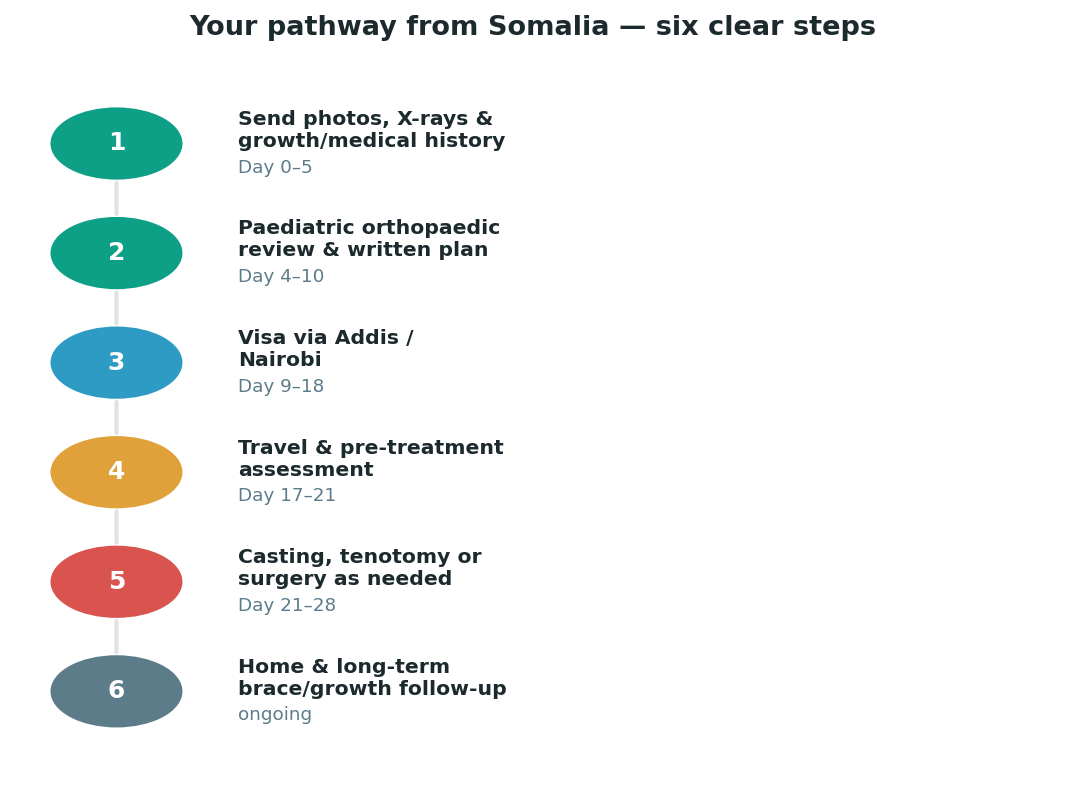
The complete route, start to finish — casting-based treatment often continues with bracing well after the trip home.
The window is narrow, but it is not the only one
A foot corrected in infancy and a foot corrected at five years old can both end up walking normally — one simply asks less of the child, and of everyone involved, to get there. For every family who reaches care after that first window has closed, the second one is still worth taking.
Sources & useful links
- 🌐 Indian medical visa (Somali nationals) — indianvisaonline.gov.in
- 🌐 Embassy of India, Addis Ababa — eoiaddisababa.gov.in
- 🌐 High Commission of India, Nairobi — hcinairobi.gov.in
- 🌐 Yellow-fever requirements — who.int/health-topics/yellow-fever
- 🌐 Hospital accreditation (India) — nabh.co · jointcommissioninternational.org
- 🌐 Verify a surgeon's registration — nmc.org.in
Do not decide alone, and do not decide blind
If you want your child's case reviewed properly and an honest written plan — including whether casting alone could still be an option — that is precisely the independent guidance I provide, without a single hospital's interest attached to my advice. Dr. Dheeraj Bojwani · Independent medical travel advisor
Frequently Asked Questions by Somali Patients about Paediatric Orthopaedic Surgery in India
Why is early clubfoot treatment important for Somali children?
Early treatment usually requires gentle Ponseti casting and bracing, while delayed treatment can make the foot rigid and increase the need for more complex surgery.
What is the Ponseti method?
The Ponseti method uses a series of gentle casts to gradually correct clubfoot, sometimes followed by a small Achilles tendon release and continued bracing.
Does every child with clubfoot need surgery?
No. The guide states that most clubfoot cases caught early can be treated with casting and bracing, with surgery reserved for selected cases where deformity is rigid or non-surgical treatment has not produced a functional correction.
Can neglected clubfoot still be treated in an older child?
Yes. The guide explains that neglected clubfoot remains treatable even in older children, although treatment may require more intensive casting, soft-tissue releases or bone-level correction.
What other paediatric orthopaedic conditions are discussed?
The guide also identifies hip dysplasia, cerebral-palsy-related deformities and other congenital or limb conditions among children requiring paediatric orthopaedic evaluation.
How much does paediatric orthopaedic treatment cost in India for Somali patients?
The guide gives an indicative all-in range of approximately US$1,500–US$5,000. Casting-based clubfoot treatment may be toward the lower end, while complex reconstruction may cost more.
What should Somali families check when choosing a paediatric orthopaedic hospital?
They should confirm a dedicated paediatric orthopaedic unit, specialist experience with the child's condition and paediatric-specific anaesthesia.
Why is bracing important after clubfoot correction?
The guide warns that corrected clubfoot can relapse without consistent bracing. A treatment plan that does not explain the post-correction bracing programme is incomplete.
What should Somali families send before travelling to India?
They should send clear photographs of the affected foot or limb, the child's age, X-rays and medical history, including details of any previous casting or treatment.
What is the treatment journey from Somalia to India?
The guide outlines the process as sending photos/X-rays/history → paediatric orthopaedic review → visa → travel and assessment → casting, tenotomy or surgery as needed → home and long-term bracing/growth follow-up.
Page Summary
This guide explains the key considerations for Somali families seeking paediatric orthopaedic treatment in India, with particular emphasis on clubfoot and the importance of early access to treatment. It covers the limited paediatric rehabilitation workforce in Somalia, the Ponseti method, the difference between early and neglected clubfoot, hip dysplasia and other childhood deformities, situations where casting or bracing may be sufficient, when surgery may become necessary, paediatric-specific surgical expertise, indicative costs of US$1,500–US$5,000, warning signs when choosing a treatment centre, pre-travel photographs and medical records, visa and travel planning, and the six-step pathway from remote assessment through treatment and long-term follow-up.
Citation Block
| Topic | Information |
|---|---|
| Topic Information | Paediatric Orthopaedic Surgery in India for Patients from Somalia |
| Treatment | Paediatric Orthopaedic Treatment / Surgery |
| Intended Audience | Children and Families from Somalia |
| Key Specialist | Paediatric Orthopaedic Surgeon |
| Main Condition | Clubfoot |
| Other Conditions | Hip Dysplasia, Cerebral-Palsy-Related Deformity and Congenital/Limb Conditions |
| Primary Assessment | Clinical Examination, Photographs and Imaging |
| Early Treatment | Ponseti Casting and Bracing |
| Surgical Options | Achilles Tenotomy and Reconstructive Surgery Where Required |
| Indicative Cost | US$1,500–US$5,000 All-In |
| Important Check | Dedicated Paediatric Orthopaedic Unit |
| Specialist Check | Experience With the Child's Specific Condition |
| Anaesthesia Requirement | Paediatric-Specific Anaesthesia |
| Bracing Requirement | Continued Bracing After Correction Where Indicated |
| Pre-Travel Records | Photos, X-Rays, Medical History and Previous Treatment Details |
| Travel Routes | Nairobi, Addis Ababa, Dubai or Djibouti |
| Visa Requirement | Hospital Invitation and Medical Visa |
| Important Warning | Surgery Proposed for Young Clubfoot Without Trying Casting First |
| Cost Check | Request a Fixed Written Quote Based on the Child's Condition and Age |
| Patient Journey | Photos/X-rays/history → paediatric orthopaedic review → visa → travel/pre-treatment assessment → casting/tenotomy/surgery → home and long-term bracing/growth follow-up |
| Follow-Up | Bracing, Growth Monitoring and Long-Term Orthopaedic Follow-Up |


Our Mission Statement
Our mission is to place patients at the centre of every healthcare decision by providing trustworthy, evidence-based, and unbiased medical information. We believe that informed patients make better decisions. Backed by personalised guidance from our experienced advisory team, we help patients understand their treatment options, compare them objectively, and confidently choose the path that best suits their medical needs and personal circumstances.
Patient Testimonials from Somalia




Ready to Take the First Step?
Share your Medical Reports with our Healthcare Managers Today and Get a FREE CONSULTATION, a Personalized Treatment Plan, and Complete Support from Arrival to Recovery.
Get Your Free ConsultationAreas We Serve
This resource has been thoughtfully prepared for patients from Somalia who are considering medical treatment in India. We also welcome patients from the wider region in the countries mentioned below-
We assist patients from:
- Ethiopia
- Djibouti
- Yemen
- Kenya
- Seychelles
- Somalia
- South Sudan
- Tanzania
- Uganda
- Zambia
- Zimbabwe
- Angola
- Cameroon
- Central African Republic
Many of the insights, treatment pathways, hospital recommendations, travel guidance, and patient support services described here are equally relevant and may be used as a reference when planning treatment in India.
From Somalia to India: Your Complete Patient Support Guide
- Best Brain Tumour Surgeons & Hospitals in India for Somali Patients
- Best Cancer Treatment Surgeons & Hospitals in India for Somali Patients
- Best Cardiac Surgeons & Hospitals in India for Somali Patients
- Best CyberKnife Teams & Centres in India for Somali Patients
- Best Heart Valve Replacement Surgeons & Hospitals in India for Somali Patients
- Best Hip Surgeons & Hospitals in India for Somali Patients
- Best Knee Surgeons & Hospitals in India for Somali Patients
- Best Neurosurgeons & Hospitals in India for Somali Patients
- Best Paediatric Cardiac Surgeons & Hospitals in India for Somali Patients
- Best Paediatric Neurosurgeons & Hospitals in India for Somali Patients
- Best Spine Surgeons & Hospitals in India for Somali Patients
- Bariatric Surgery in India for Patients from Somalia
- Brain Tumour Surgery in India for Patients from Somalia
- Cancer Treatment and Surgery in India for Patients from Somalia
- Cardiac Surgery in India for Patients from Somalia
- Cosmetic and Plastic Surgery in India for Patients from Somalia
- CyberKnife Treatment in India for Patients from Somalia
- Dental Surgery in India for Patients from Somalia