

Oral and Maxillofacial Surgery in India for Patients from Somalia
A patch inside the cheek or a stiffening in the mouth is easy to dismiss as an ordinary side effect of khat — and sometimes, that patch is exactly the kind of change a biopsy is built to catch early.
Oral and maxillofacial surgery sits at the intersection of dentistry and medicine, treating everything from jaw fractures and misaligned bites to cysts, tumours and cancers of the mouth and face. It is a broader field than routine dental care, and for a specific reason relevant to Somalia, it is also a field where an early, accurate diagnosis genuinely changes outcomes. For 24 years I have worked with patients whose mouths carried a change for months or years before anyone confirmed what it actually was.
India trains oral and maxillofacial surgeons to a dual medical and dental qualification, giving them genuine depth in biopsy-based diagnosis, jaw reconstruction and head and neck cancer surgery, working alongside oral pathologists and reconstructive teams — at a fraction of the cost of the same care in the Gulf, Europe or the United States.
Healing Journeys of Somali Patients









Key Takeaways
- The guide highlights the importance of oral and maxillofacial evaluation for Somali patients because khat chewing is widespread, with the guide citing more than 50% of Somali men as regular users.
- Regular khat chewing has been linked in published research to oral leukoplakia, erythroplakia and oral submucous fibrosis, which can represent potentially malignant oral changes.
- A long-term study of 567 patients with oral submucous fibrosis found that 5.6% eventually developed oral cancer, highlighting the importance of monitoring and early assessment.
- A white or red patch lasting more than two to three weeks, a non-healing sore, increasing difficulty opening the mouth, a lump, unexplained numbness or associated voice changes should be assessed rather than dismissed.
- The guide stresses that not every oral lesion is cancer. Many mouth changes are benign, but biopsy and pathology are important when a lesion requires confirmation.
- Oral and maxillofacial surgery covers much more than oral lesions, including facial fractures, jaw misalignment, temporomandibular joint disorders, cysts, jaw tumours and reconstructive surgery.
- The guide recommends a surgeon with dual medical-dental training, supported by an oral pathologist, so diagnosis and treatment can be coordinated within the same care pathway.
- Indicative all-in costs in a reputable private Indian hospital are approximately US$2,500–US$8,000, with straightforward biopsy or lesion removal toward the lower end and complex jaw reconstruction or cancer surgery toward the higher end.
- Important warning signs include persistent lesions being dismissed without biopsy, no oral pathologist involved, surgery proposed without appropriate staging imaging for suspected cancer and a quotation that keeps changing.
- Somali patients should send clear photographs of the lesion or facial injury and any existing biopsy results before travelling. The six-step pathway on page 5 covers case submission, OMFS review, visa, travel and pre-operative assessment, surgery and recovery, followed by long-term follow-up.
Quick Facts
- Treatment
- Oral and Maxillofacial Surgery
- Country
- India
- Patients
- Patients from Somalia
- Key Specialist
- Oral and Maxillofacial Surgeon
- Supporting Specialist
- Oral Pathologist
- Main Conditions
- Oral Lesions, Oral Cancer, Jaw Disorders and Facial Trauma
- Important Risk
- Khat-Related Oral Changes
- Primary Assessment
- Oral Examination and Biopsy Where Indicated
- Other Assessment
- Imaging for Jaw, Facial or Suspected Cancer Cases
- Indicative Cost
- US$2,500–US$8,000 All-In
- Important Check
- Dual Medical-Dental Qualification
- Pathology Check
- Confirm Oral Pathologist Involvement
- Cancer Check
- Staging Imaging Before Definitive Cancer Surgery
- Pre-Travel Records
- Lesion Photographs, Scans and Existing Biopsy Results
- Travel Routes
- Nairobi, Addis Ababa, Dubai or Djibouti
- Visa
- Hospital Invitation and Medical Visa
- Attendants
- Up to Two Medical Attendants
- Recovery
- Depends on Biopsy, Surgery or Reconstruction Required
- Follow-Up
- Long-Term Monitoring Where Required
- Author
- Dr. Dheeraj Bojwani
- Experience
- 24+ Years
In Brief
For Somali patients considering oral and maxillofacial treatment in India, the guide recommends starting with a proper examination and biopsy when a persistent or suspicious oral lesion is present, rather than relying on appearance alone. This is particularly relevant for regular khat users because the guide links khat chewing with potentially malignant oral changes. Patients should verify the surgeon's dual medical-dental qualification, confirm access to an oral pathology service and obtain a written treatment-specific quotation before travel. Clear photographs, previous biopsy results and relevant medical records should be shared in advance so the Indian team can assess the case before the patient leaves Somalia.
First, know why khat's effects on the mouth deserve their own attention
Khat is chewed for hours at a time, held against the inside of the cheek, and this sustained contact leaves a genuine mark on the tissue there. Published research has specifically linked regular khat chewing to oral leukoplakia and erythroplakia, white or red patches classified by the World Health Organization as potentially malignant, and to oral submucous fibrosis, a progressive stiffening and scarring of the mouth's lining. These are not simply cosmetic changes. They are recognised warning signs that a maxillofacial surgeon and oral pathologist are specifically trained to evaluate, and in a population where khat use is this widespread, they deserve to be taken seriously rather than assumed to be an unavoidable part of the habit.
The Somali difference: a genuinely common habit, and a genuinely under- recognised risk
A published case report described a patient who developed oral erythroplakia, a lesion with a high risk of malignant transformation, attributed specifically to habitual khat chewing, with no history of tobacco or alcohol use to explain it otherwise. Systematic review evidence has since found consistent associations between khat chewing and oral squamous cell carcinoma as well as these precancerous white and red lesions. With over half of Somali men chewing khat regularly, and a meaningful share of women doing the same, this is not a rare exposure confined to a handful of patients — it is a routine part of daily life for a large share of the population being evaluated for any persistent change inside the mouth.
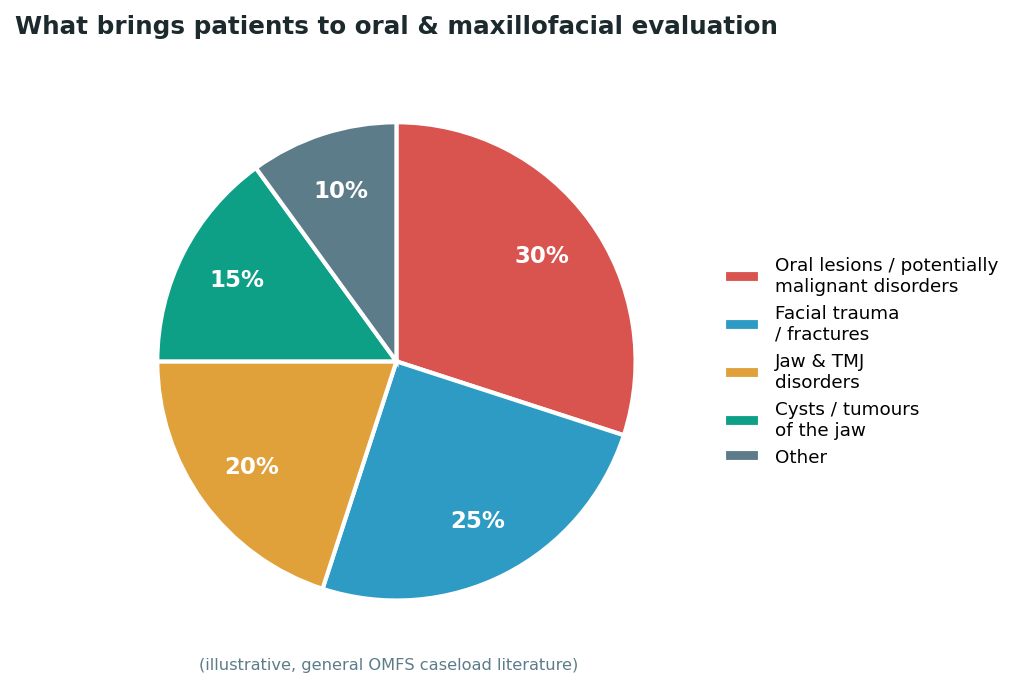
Illustrative breakdown of reasons patients seek oral and maxillofacial evaluation, based on general OMFS caseload literature.
Why a biopsy, not reassurance, is the right first response
A published long-term study following 567 patients with oral submucous fibrosis found that 5.6% eventually developed oral cancer, over an average follow-up spanning decades. That is a real, if modest, risk — and it is a risk that surveillance and early treatment genuinely reduce, since catching a change while it is still confined to the surface layers of tissue offers far more treatment options than catching it once it has already become invasive cancer. A patch, a persistent white or red area, or a mouth that is gradually becoming harder to open fully are not symptoms to wait out; they are exactly the findings a maxillofacial evaluation is designed to assess.
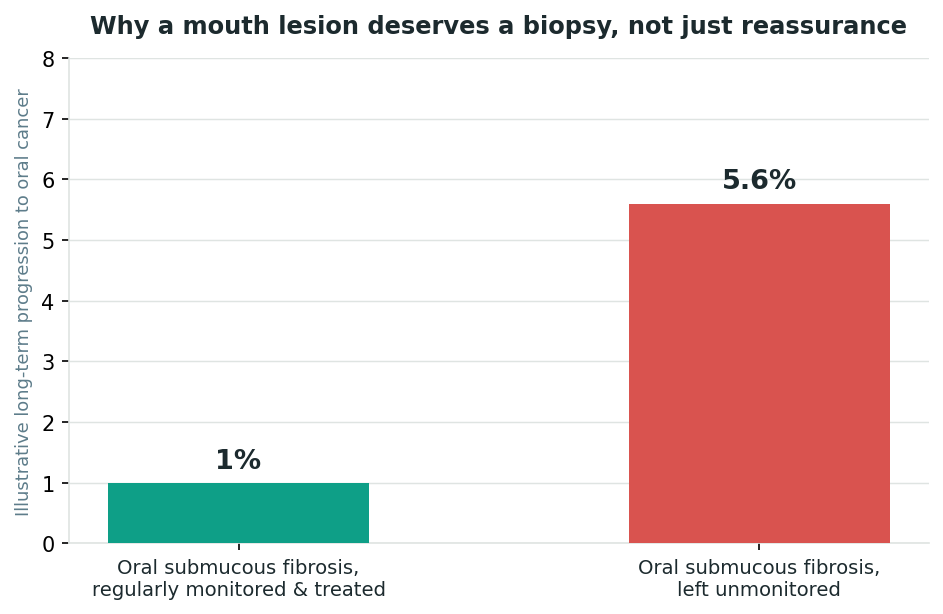
Published long-term progression to oral cancer among patients with oral submucous fibrosis; illustrative comparison with regular monitoring and early treatment, based on general oncology surveillance principles.
Know the warning signs, and do not wait them out
A white or red patch inside the cheek, on the tongue or on the gums that lasts more than two to three weeks deserves an examination, especially in anyone who chews khat regularly. So does a mouth that is gradually becoming harder to open fully, a sore that will not heal, a lump felt inside the cheek or under the jaw, numbness in the lip or chin with no clear cause, or a voice change alongside any of these signs. Facial swelling, pain, or an obvious deformity following any injury to the jaw or face also deserves prompt assessment, since fractures that heal in the wrong position are considerably harder to correct later than to fix properly the first time. None of these signs mean cancer in most cases, but a proper examination, not reassurance based on appearance alone, is what actually settles the question.
Not every mouth change is cancer, and OMFS covers far more than lesions
Most changes found inside the mouth, including many white patches, are benign and resolve or stabilise once the underlying irritation, whether from khat, a rough tooth edge or an ill-fitting denture, is addressed. A biopsy is what actually distinguishes a benign, reactive change from a genuinely precancerous one, and it should never be skipped simply because a lesion looks unremarkable. Beyond oral lesions, maxillofacial surgeons also treat facial fractures from trauma, jaw misalignment affecting speech or chewing, temporomandibular joint disorders causing jaw pain or locking, and cysts or benign tumours of the jawbone — each with its own evaluation and treatment pathway, not a single approach applied to every case.
What it costs
In more than 24 years arranging this kind of care, the disputes I have seen were almost never about the price itself — they were about a diagnosis, or a cost, nobody had bothered to write down before the flight was booked. A quote should specify whether it covers biopsy and diagnosis alone or a full surgical treatment plan, since these differ substantially.
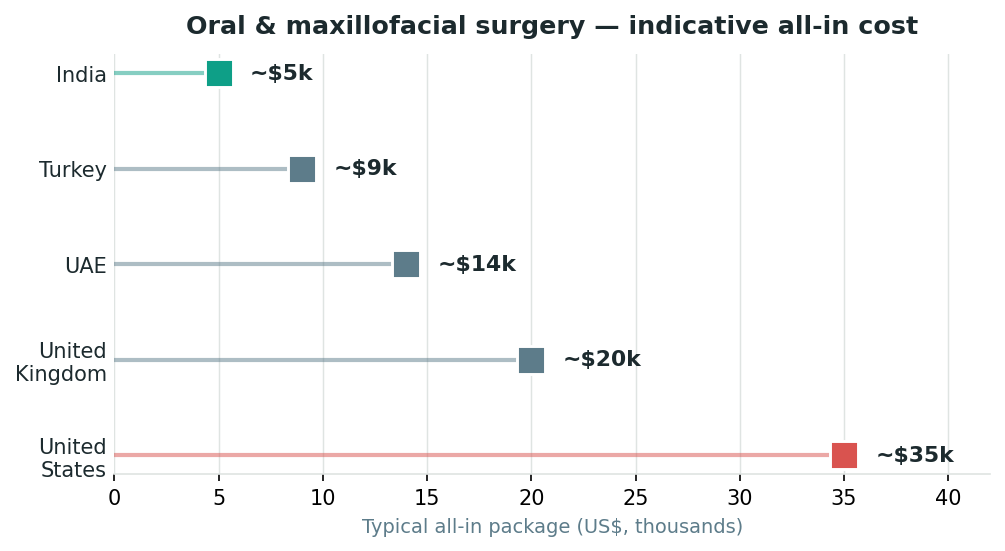
Indicative all-in cost for oral and maxillofacial surgery. India sits far below every common alternative.
Oral and maxillofacial surgery in a reputable private Indian hospital typically runs US$2,500 to US$8,000 all-in, with straightforward biopsy and lesion removal toward the lower end and complex jaw reconstruction or cancer surgery with tissue reconstruction toward the top. Ask for the figure specific to what your evaluation actually finds.
Why the dual medical-dental qualification actually matters
Oral and maxillofacial surgery is unusual among surgical specialties in requiring training in both medicine and dentistry, and this combination is precisely what allows a proper evaluation of a mouth lesion to happen under one roof, from biopsy through pathology reading to surgical treatment if needed. Ask specifically whether the surgeon holds this dual qualification, whether the hospital has its own oral pathology service for reading biopsies rather than sending them elsewhere, and how quickly biopsy results are typically available. A fragmented process, where diagnosis and treatment happen at different facilities with limited communication between them, is where cases most often fall through the cracks.
Four signals that should make you stop and walk away
A persistent lesion dismissed without a biopsy. Any white or red patch lasting more than two to three weeks deserves tissue confirmation, not a visual opinion alone.
No oral pathologist involved in diagnosis. Ask specifically who is reading the biopsy results and whether they specialise in oral pathology.
Surgery proposed without staging imaging for suspected cancer. Confirming whether a lesion has spread should come before finalising a surgical plan.
The price keeps moving. A verbal estimate that shifts each time you ask is not an estimate. Demand a fixed figure in writing.
The practical journey from Somalia — plan it before you fly
There is no direct flight between Somalia and India; patients route through Nairobi, Addis Ababa, Dubai or Djibouti. Because there is no full Indian mission inside Somalia, the medical visa is issued through the Embassy of India in Addis Ababa or the High Commission in Nairobi , against a written invitation letter from the treating hospital. Somali patients may bring up to two medical attendants on attendant visas. Since your route crosses yellow-fever territory, carry a valid yellow-fever vaccination certificate . Above every other instruction: send clear photographs of any lesion, area of concern or facial injury, and any existing biopsy results, not just a description, so the maxillofacial team can begin assessing the case before you ever leave home.
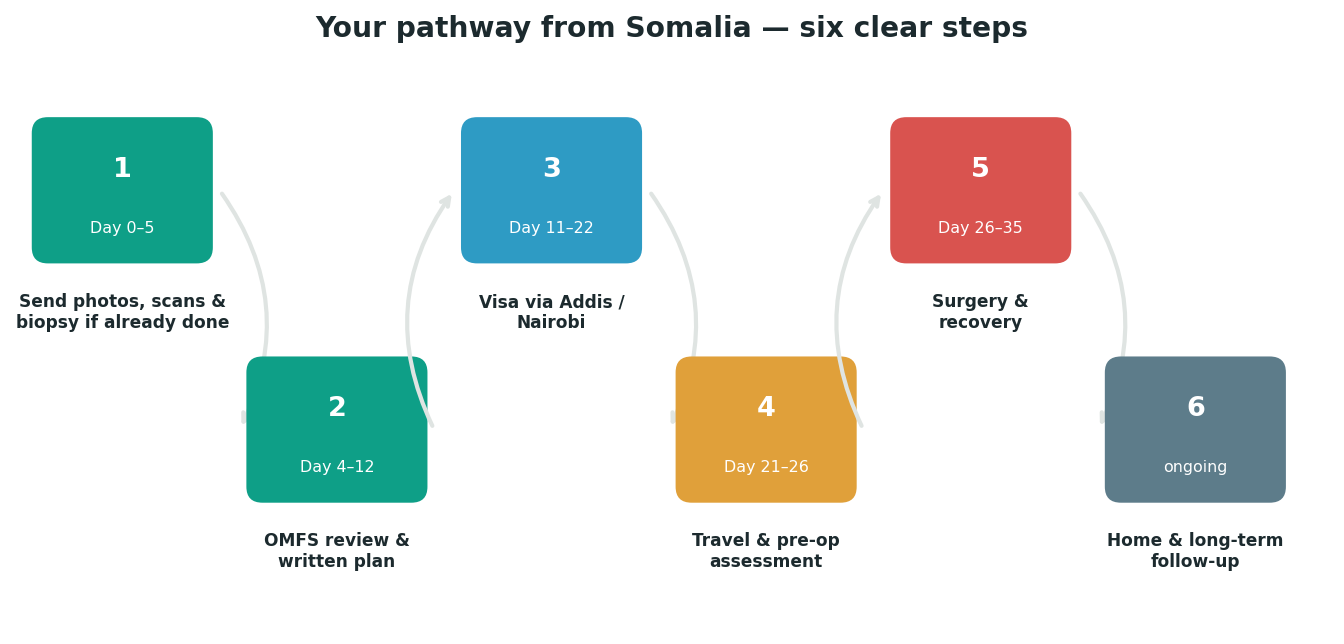
The complete route, start to finish — cases involving cancer treatment may need staged follow-up visits.
A patch caught early is a patch that stays small
Most changes found inside the mouth turn out to be manageable, and the ones that are not respond far better to treatment the earlier they are found. For a habit as common as khat chewing, a routine, unhurried mouth check is a small thing to ask for, and it is exactly the kind of small thing that catches a serious problem while it is still an easy one.
Sources & useful links
- 🌐 Indian medical visa (Somali nationals) — indianvisaonline.gov.in
- 🌐 Embassy of India, Addis Ababa — eoiaddisababa.gov.in
- 🌐 High Commission of India, Nairobi — hcinairobi.gov.in
- 🌐 Yellow-fever requirements — who.int/health-topics/yellow-fever
- 🌐 Hospital accreditation (India) — nabh.co · jointcommissioninternational.org
- 🌐 Verify a surgeon's registration — nmc.org.in
Do not decide alone, and do not decide blind
If you want your case reviewed properly and an honest written plan — including whether a biopsy is genuinely needed — that is precisely the independent guidance I provide, without a single hospital's interest attached to my advice. Dr. Dheeraj Bojwani · Independent medical travel advisor
Frequently Asked Questions by Somali Patients about Oral and Maxillofacial Surgery in India
Why should Somali patients pay particular attention to persistent mouth changes?
The guide highlights the widespread use of khat in Somalia and its reported association with potentially malignant oral changes. Persistent patches or other changes should therefore receive proper clinical assessment.
Can khat chewing cause potentially precancerous oral changes?
The guide states that regular khat chewing has been associated with oral leukoplakia, erythroplakia and oral submucous fibrosis, which require appropriate evaluation.
When should a Somali patient have a mouth lesion examined?
A white or red patch lasting more than two to three weeks, a non-healing sore, increasing difficulty opening the mouth, a lump or unexplained numbness should be assessed promptly.
Does every white or red oral patch mean cancer?
No. The guide explains that many mouth changes are benign. However, biopsy and pathology may be necessary to distinguish a harmless reactive lesion from a potentially precancerous change.
What is oral submucous fibrosis?
It is a progressive stiffening and scarring of the mouth lining. The guide cites a long-term study in which 5.6% of affected patients eventually developed oral cancer.
What conditions besides oral lesions can an oral and maxillofacial surgeon treat?
OMFS specialists also treat facial fractures, jaw misalignment, temporomandibular joint disorders, jaw cysts and tumours, and complex reconstructive problems.
How much does oral and maxillofacial surgery cost in India for Somali patients?
The guide gives an indicative all-in range of US$2,500–US$8,000. Simple biopsy or lesion removal may cost less, while complex reconstruction or cancer surgery can be more expensive.
What should Somali patients check when choosing an OMFS specialist?
They should verify the surgeon's dual medical-dental qualification, experience with the specific condition and whether the hospital has an oral pathology service for biopsy interpretation.
What records should Somali patients send before travelling to India?
Patients should send clear photographs of the lesion, facial injury or area of concern, together with existing biopsy results and relevant scans. This allows the team to begin assessment before travel.
What is the treatment journey from Somalia to India?
The guide outlines the pathway as sending photographs/scans/biopsy → OMFS review and written plan → visa → travel and pre-operative assessment → surgery and recovery → home and long-term follow-up. Cancer cases may require staged follow-up visits.
Page Summary
This guide explains the key considerations for Somali patients exploring oral and maxillofacial surgery in India, with particular emphasis on persistent oral lesions and the potential risks associated with widespread khat chewing. It covers oral leukoplakia, erythroplakia and oral submucous fibrosis, the importance of biopsy and pathology, warning symptoms requiring assessment, other conditions treated by maxillofacial surgeons such as facial fractures and jaw disorders, the importance of dual medical-dental training and oral pathology support, indicative costs of US$2,500–US$8,000, warning signs when selecting a provider, pre-travel photographs and biopsy records, visa and travel planning, and the six-step pathway from case submission through evaluation, treatment, recovery and long-term follow-up. The page 2 chart also illustrates common reasons for OMFS evaluation, with oral lesions/potentially malignant disorders representing 30%, facial trauma 25%, jaw/TMJ disorders 20%, cysts/tumours 15% and other conditions 10%.
Citation Block
| Topic | Information |
|---|---|
| Topic Information | Oral and Maxillofacial Surgery in India for Patients from Somalia |
| Treatment | Oral and Maxillofacial Surgery |
| Intended Audience | Patients from Somalia |
| Key Specialist | Oral and Maxillofacial Surgeon |
| Supporting Specialist | Oral Pathologist |
| Main Conditions | Oral Lesions, Oral Cancer, Jaw Disorders and Facial Trauma |
| Important Risk | Khat-Related Oral Changes |
| Primary Assessment | Oral Examination and Biopsy Where Indicated |
| Other Assessment | Imaging for Jaw, Facial or Suspected Cancer Cases |
| Indicative Cost | US$2,500–US$8,000 All-In |
| Important Check | Dual Medical-Dental Qualification |
| Pathology Requirement | Confirm Oral Pathologist Involvement |
| Biopsy Importance | Helps Assess Suspicious Oral Lesions |
| Cancer Check | Staging Imaging Before Definitive Cancer Surgery |
| Warning Symptoms | Persistent White/Red Patch, Non-Healing Sore, Lump or Restricted Mouth Opening |
| Pre-Travel Records | Lesion Photographs, Scans and Existing Biopsy Results |
| Cost Check | Request a Fixed Written Quote Based on the Diagnosis |
| Travel Routes | Nairobi, Addis Ababa, Dubai or Djibouti |
| Visa Requirement | Hospital Invitation and Medical Visa |
| Patient Journey | Photos/scans/biopsy → OMFS review → visa → travel/pre-op → surgery/recovery → follow-up |
| Follow-Up | Long-Term Monitoring Where Required |


Our Mission Statement
Our mission is to place patients at the centre of every healthcare decision by providing trustworthy, evidence-based, and unbiased medical information. We believe that informed patients make better decisions. Backed by personalised guidance from our experienced advisory team, we help patients understand their treatment options, compare them objectively, and confidently choose the path that best suits their medical needs and personal circumstances.
Patient Testimonials from Somalia




Ready to Take the First Step?
Share your Medical Reports with our Healthcare Managers Today and Get a FREE CONSULTATION, a Personalized Treatment Plan, and Complete Support from Arrival to Recovery.
Get Your Free ConsultationAreas We Serve
This resource has been thoughtfully prepared for patients from Somalia who are considering medical treatment in India. We also welcome patients from the wider region in the countries mentioned below-
We assist patients from:
- Ethiopia
- Djibouti
- Yemen
- Kenya
- Seychelles
- Somalia
- South Sudan
- Tanzania
- Uganda
- Zambia
- Zimbabwe
- Angola
- Cameroon
- Central African Republic
Many of the insights, treatment pathways, hospital recommendations, travel guidance, and patient support services described here are equally relevant and may be used as a reference when planning treatment in India.
From Somalia to India: Your Complete Patient Support Guide
- Best Brain Tumour Surgeons & Hospitals in India for Somali Patients
- Best Cancer Treatment Surgeons & Hospitals in India for Somali Patients
- Best Cardiac Surgeons & Hospitals in India for Somali Patients
- Best CyberKnife Teams & Centres in India for Somali Patients
- Best Heart Valve Replacement Surgeons & Hospitals in India for Somali Patients
- Best Hip Surgeons & Hospitals in India for Somali Patients
- Best Knee Surgeons & Hospitals in India for Somali Patients
- Best Neurosurgeons & Hospitals in India for Somali Patients
- Best Paediatric Cardiac Surgeons & Hospitals in India for Somali Patients
- Best Paediatric Neurosurgeons & Hospitals in India for Somali Patients
- Best Spine Surgeons & Hospitals in India for Somali Patients
- Bariatric Surgery in India for Patients from Somalia
- Brain Tumour Surgery in India for Patients from Somalia
- Cancer Treatment and Surgery in India for Patients from Somalia
- Cardiac Surgery in India for Patients from Somalia
- Cosmetic and Plastic Surgery in India for Patients from Somalia
- CyberKnife Treatment in India for Patients from Somalia
- Dental Surgery in India for Patients from Somalia