

Neuronavigation and Advanced Brain Surgery in India for Patients from Somalia
Neuronavigation works like GPS for the brain, letting a surgeon see exactly where a tumour sits relative to the tissue that controls speech and movement. Without it, "too risky to operate" is often a statement about the equipment in the room, not the tumour itself.
A brain tumour sitting near the areas that control speech, movement or vision is, without the right technology, a genuine surgical dilemma: go in blind and risk permanent damage, or leave it and risk it growing further. Neuronavigation solves this specific problem by fusing a patient's own MRI or CT scan with real-time tracking during surgery, giving the surgeon a constantly updated 3D map of exactly where their instruments sit relative to the tumour and the healthy brain around it. For 24 years I have watched this single piece of technology change "we cannot safely operate" into "we can."
India has built genuine depth in neuronavigation-guided neurosurgery, with dedicated neuro-oncology teams using intraoperative imaging, awake craniotomy and mapping techniques for tumours in the brain's most sensitive regions — at a fraction of the cost of the same care in the Gulf, Europe or the United States.
Healing Journeys of Somali Patients









Key Takeaways
- The guide explains that neuronavigation works like GPS for the brain, combining the patient's MRI or CT scan with real-time tracking to create a continuously updated 3D map during surgery.
- This technology is particularly valuable when a tumour lies near areas controlling speech, movement or vision, where conventional surgery may carry a higher risk of damaging healthy brain tissue.
- Africa carries approximately 15% of the world's neurosurgical disease burden while having access to less than 1% of the world's neurosurgeons, highlighting the significant gap in specialist neurosurgical care and equipment.
- The guide explains that a tumour labelled "inoperable" in one setting may warrant reassessment at a centre equipped with neuronavigation, intraoperative imaging and advanced neuro-oncology expertise.
- Neuronavigation may be particularly useful for deep or functionally sensitive tumours, small lesions that are difficult to distinguish from surrounding tissue and repeat surgery where normal anatomy has been altered.
- For tumours close to speech areas, neuronavigation may be combined with an awake craniotomy, allowing the patient to remain conscious and undergo functional testing while the surgeon works near critical speech regions.
- Not every brain tumour requires neuronavigation. A large, superficial tumour in a less critical location may be safely treated using conventional microsurgical techniques, making case-specific assessment important.
- The guide gives an illustrative rate of 45% safe, meaningful tumour removal without neuronavigation versus 85% with neuronavigation for lesions near critical brain regions, based on general neurosurgical literature rather than Somalia-specific outcomes.
- A neuronavigation-guided brain tumour surgery at a reputable private Indian hospital typically costs approximately US$6,000–US$10,000 all-in, including imaging, surgery, ICU care and initial recovery. Awake craniotomy or additional intraoperative imaging may place the case toward the upper end.
- Somali patients should send their actual MRI or CT scan files rather than only a written radiology report. The guide's six-step pathway on page 5 runs from imaging and medical history through neurosurgical review, visa, travel and pre-operative planning, neuronavigation-guided surgery and ICU recovery, followed by long-term follow-up.
Quick Facts
- Treatment
- Neuronavigation-Guided Brain Surgery
- Country
- India
- Patients
- Patients from Somalia
- Key Specialist
- Neurosurgeon / Neuro-Oncology Specialist
- Main Condition
- Brain Tumours
- Primary Assessment
- MRI or CT Scan and Neurosurgical Review
- Technology
- Real-Time Neuronavigation
- Additional Technique
- Awake Craniotomy Where Indicated
- Indicative Cost
- US$6,000–US$10,000 All-In
- Important Check
- Tumour-Location-Specific Neurosurgical Experience
- Hospital Requirement
- Dedicated Neuro-Oncology Team
- Additional Support
- Neuro-Anaesthesia and Neuro-Critical Care
- Pre-Travel Records
- Actual MRI or CT Scan Files and Medical History
- Travel Routes
- Nairobi, Addis Ababa, Dubai or Djibouti
- Visa
- Hospital Invitation and Medical Visa
- Attendants
- Up to Two Medical Attendants
- Recovery
- Surgery Followed by ICU and Hospital Recovery
- Follow-Up
- Home and Long-Term Monitoring
- Author
- Dr. Dheeraj Bojwani
- Experience
- 24+ Years
In Brief
For Somali patients considering advanced brain surgery in India, the guide recommends obtaining a specialist review of the actual MRI or CT scan before travelling, particularly when a tumour has previously been described as inoperable. Neuronavigation can be especially valuable for tumours near speech, movement or other critical brain regions, while awake craniotomy may be considered for selected tumours close to speech areas. Patients should verify the named neurosurgeon's experience with the tumour's specific location, confirm that the hospital has a coordinated neuro-oncology team and obtain a written quotation specifying whether neuronavigation, intraoperative imaging or awake craniotomy is included.
First, know how large this specific gap actually is
Africa carries roughly 15% of the world's neurosurgical disease burden, from tumours to traumatic brain injury to stroke, while having access to less than 1% of the world's neurosurgeons — a mismatch that puts the continent among the regions facing the largest neurosurgical workforce deficit anywhere. Somalia sits within a region where, according to recent research, a single neurosurgeon can be responsible for the needs of millions of people, and where advanced surgical equipment, not just trained surgeons, remains genuinely scarce. Neuronavigation systems specifically, which depend on expensive, specialised imaging and tracking hardware, are far less commonly available than the workforce shortage alone would suggest.
The Somali difference: "inoperable" is sometimes a statement about the room, not the tumour
Neuronavigation exists specifically because certain brain surgery is too dangerous to attempt using external landmarks and a surgeon's memory of the scan alone. A tumour sitting against the speech centre or motor cortex, without a system precisely tracking the instruments in real time relative to the patient's own imaging, genuinely cannot be safely approached in many cases — and a surgeon operating without this technology will, correctly, often decline to try. The tumour itself has not changed between a hospital with this equipment and one without it. What has changed is whether the surgery can be done safely at all, and for patients referred from a country with severe shortages in both neurosurgical workforce and equipment, that distinction is frequently the difference between a treatable diagnosis and one that gets labelled untreatable.
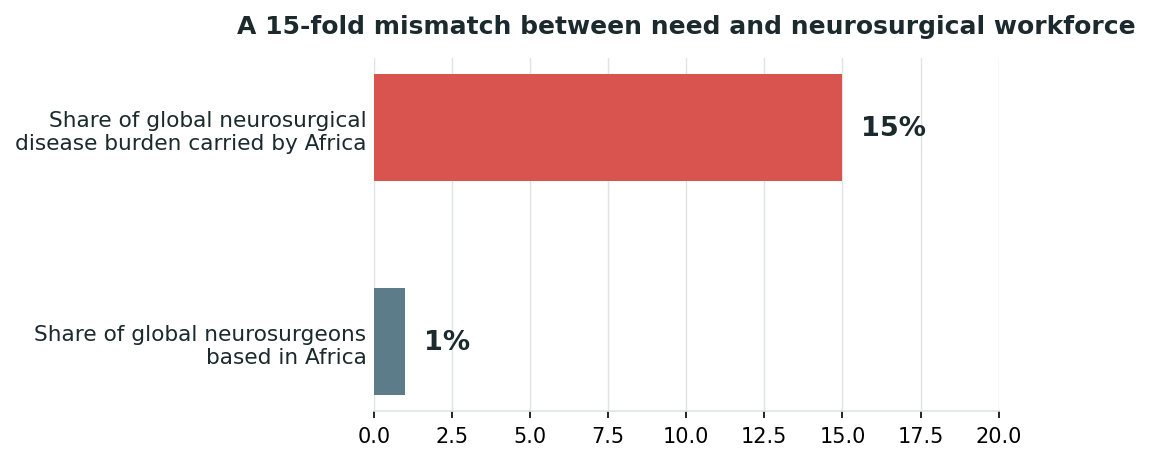
Published data on Africa's share of global neurosurgical disease burden versus its share of the global neurosurgeon workforce.
Why the technology, not just the surgeon's skill, decides what is possible
A highly skilled neurosurgeon without neuronavigation is still working with real limitations once a tumour sits in a deep or functionally critical location; human memory and external anatomical landmarks are simply less precise than a real-time, continuously updated 3D map. With neuronavigation, the same tumour becomes a different proposition: the surgeon can plan the safest possible path before the first incision, confirm their position throughout the operation, and, for tumours near speech areas specifically, combine this with an awake craniotomy, where the patient is kept conscious and tested throughout to confirm critical function is preserved as the tumour is removed.
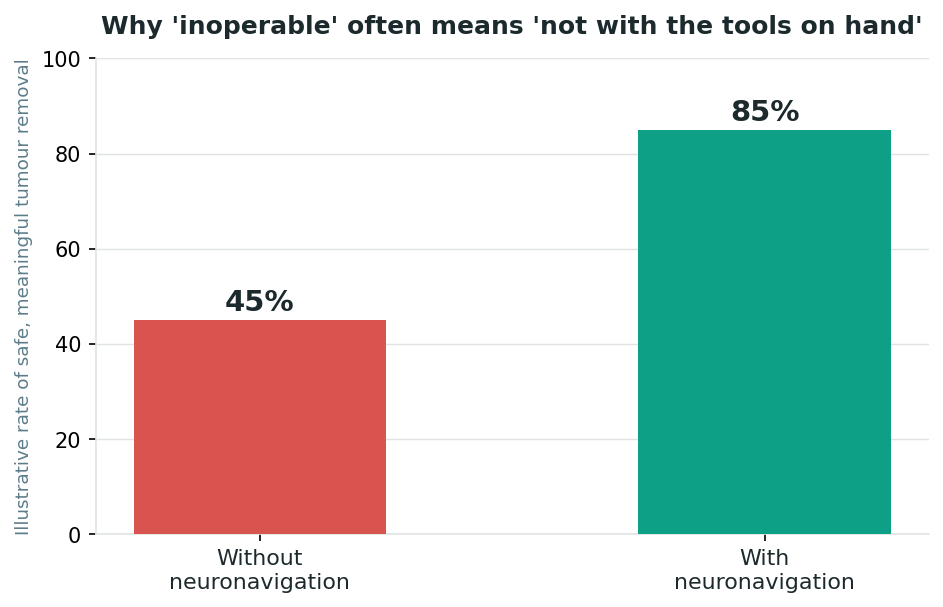
Illustrative rate of safe, meaningful tumour removal for lesions near critical brain regions, with and without neuronavigation guidance, based on general neurosurgical literature.
Know the warning signs, and do not accept the first answer as final
New or worsening headaches, especially ones that wake a person from sleep or are worse in the morning, seizures with no prior history, gradual weakness or numbness on one side of the body, changes in speech or vision, or personality and memory changes are all reasons for brain imaging, not assumption. If imaging already shows a mass and a doctor has said nothing more can be done, it is worth asking specifically what was assessed and what technology the evaluating team had access to, since "inoperable" from one setting is not always the same conclusion a more fully equipped neuro- oncology team would reach. This is one of the few situations in medicine where getting a genuinely well-resourced second opinion, rather than accepting the first answer, can be the single most consequential decision in the entire case.
Not every brain lesion needs this specific technology
Neuronavigation adds the most value for tumours in deep or functionally sensitive locations, for lesions that are small or hard to distinguish from surrounding tissue, and for repeat surgery where normal anatomy has already been altered by a previous operation. For a large, superficial tumour in a less critical area, conventional microsurgical technique alone may be entirely appropriate and no less safe. A surgeon proposing the most advanced, most expensive technology for every case, regardless of the tumour's location, is not necessarily serving the patient better than one who reserves it specifically for the cases that need it.
What it costs
In more than 24 years arranging this kind of care, the disputes I have seen were almost never about the price itself — they were about a diagnosis, or a cost, nobody had bothered to write down before the flight was booked. A quote should specify whether neuronavigation, intraoperative imaging or awake craniotomy technique is included, since these add meaningfully to a standard craniotomy's cost.
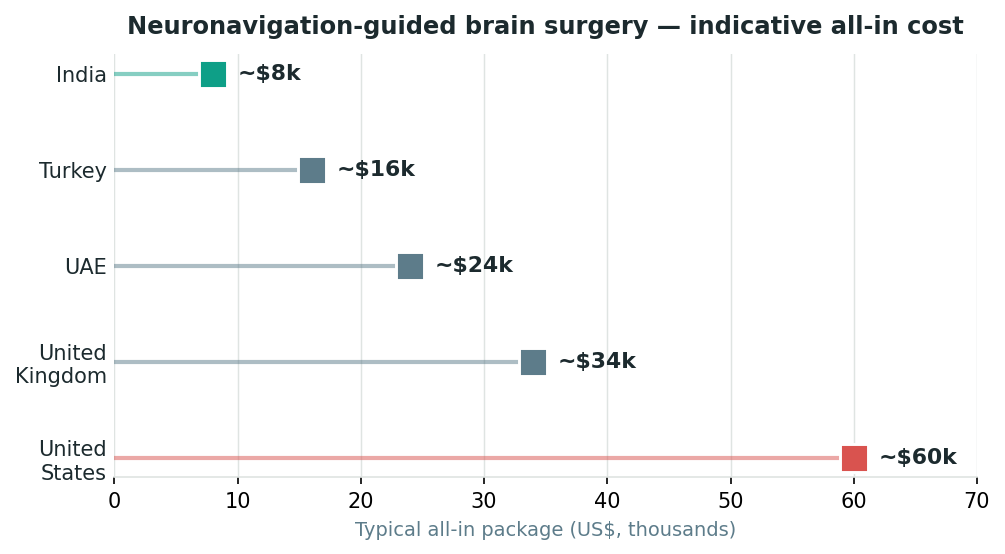
Indicative all-in cost for neuronavigation-guided brain surgery. India sits far below every common alternative.
A neuronavigation-guided brain tumour surgery in a reputable private Indian hospital typically runs US$6,000 to US$10,000 all-in, covering imaging, the surgery itself, ICU care and initial recovery; cases requiring awake craniotomy or additional intraoperative imaging sit toward the top of that range. Ask for the figure specific to your tumour's location and the technology your case actually requires.
Why the surrounding neuro-oncology team matters as much as the equipment
Neuronavigation is a tool, not a guarantee, and its value depends entirely on the team using it. Ask specifically whether the hospital has a dedicated neuro-oncology unit combining neurosurgery, neuro- anaesthesia and neuro-critical care, rather than a general surgical team that occasionally uses navigation equipment. For tumours that may require chemotherapy or radiotherapy afterward, ask whether these specialists are part of the same coordinated team from the outset, since planning surgery in isolation from the rest of the treatment pathway can lead to decisions that complicate care later.
Four signals that should make you stop and walk away
"Inoperable" given without naming what technology was considered. Ask specifically whether neuronavigation or awake craniotomy were assessed as options before that conclusion was reached.
No recent, high-resolution imaging reviewed. Surgical planning depends on the actual scan, not an old or low-resolution one. Ask what imaging the plan is based on.
No named neurosurgeon with tumour-location-specific experience. Ask how many cases in this specific brain region the surgeon has personally handled.
The price keeps moving. A verbal estimate that shifts each time you ask is not an estimate. Demand a fixed figure in writing.
The practical journey from Somalia — plan it before you fly
There is no direct flight between Somalia and India; patients route through Nairobi, Addis Ababa, Dubai or Djibouti. Because there is no full Indian mission inside Somalia, the medical visa is issued through the Embassy of India in Addis Ababa or the High Commission in Nairobi , against a written invitation letter from the treating hospital. Somali patients may bring up to two medical attendants on attendant visas. Since your route crosses yellow-fever territory, carry a valid yellow-fever vaccination certificate . Above every other instruction: send your actual MRI or CT scan files, not a written radiology report, so the neurosurgical team can properly assess whether your case is genuinely operable before you ever leave home.
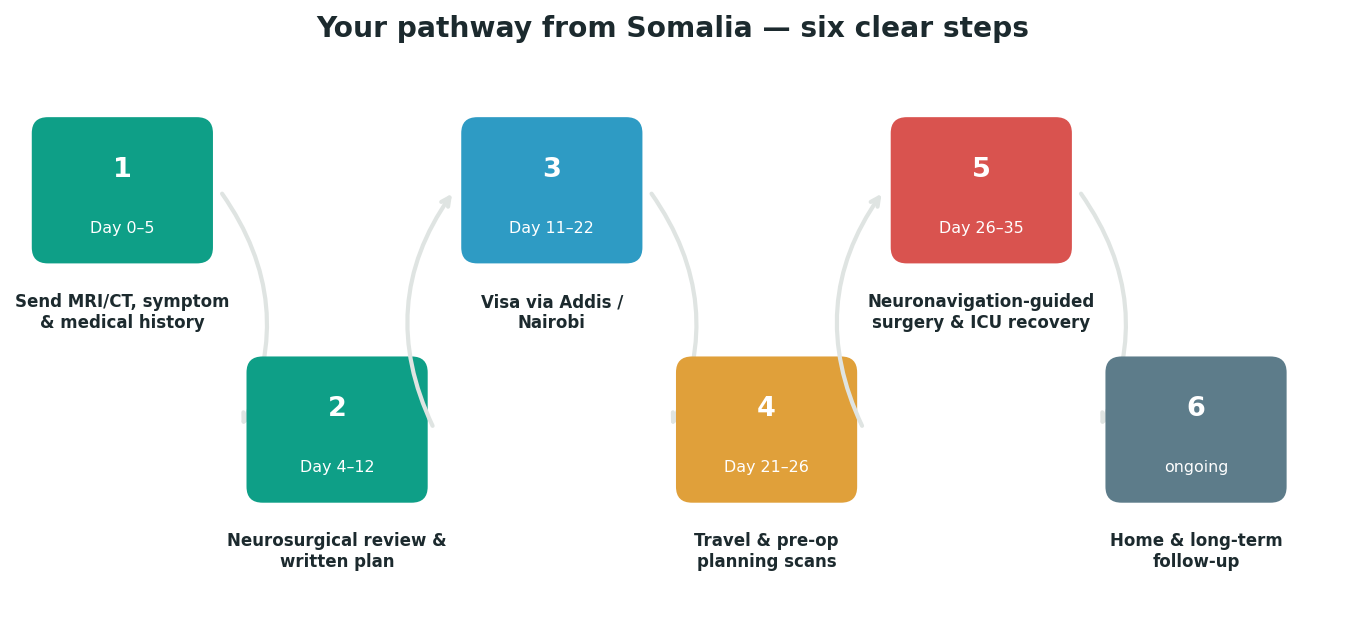
The complete route, start to finish — complex cases involve extended pre-operative planning and ICU recovery.
Ask again, with the actual scan in hand
A tumour called inoperable in one setting is, more often than families realise, simply a tumour that has not yet been reviewed by a team with the right tools. Before accepting that answer as final, it is worth asking again, somewhere equipped to actually judge the question properly.
Sources & useful links
- 🌐 Indian medical visa (Somali nationals) — indianvisaonline.gov.in
- 🌐 Embassy of India, Addis Ababa — eoiaddisababa.gov.in
- 🌐 High Commission of India, Nairobi — hcinairobi.gov.in
- 🌐 Yellow-fever requirements — who.int/health-topics/yellow-fever
- 🌐 Hospital accreditation (India) — nabh.co · jointcommissioninternational.org
- 🌐 Verify a surgeon's registration — nmc.org.in
Do not decide alone, and do not decide blind
If you want your imaging reviewed properly and an honest written answer — including whether your case is genuinely operable with the right technology — that is precisely the independent guidance I provide, without a single hospital's interest attached to my advice. Dr. Dheeraj Bojwani · Independent medical travel advisor
Frequently Asked Questions by Somali Patients about Neuronavigation and Advanced Brain Surgery in India
What is neuronavigation in brain surgery?
Neuronavigation is an image-guided technology that combines the patient's MRI or CT scan with real-time instrument tracking, helping the surgeon understand the exact position of the tumour and surrounding brain tissue.
Why may neuronavigation be particularly important for Somali patients?
The guide highlights the shortage of neurosurgeons and advanced equipment across Africa. It explains that access to neuronavigation may change whether a difficult tumour can be safely approached.
Can a brain tumour called "inoperable" be treated with neuronavigation?
Possibly, depending on its location and characteristics. The guide recommends obtaining a second opinion using the actual MRI or CT scan when an inoperable diagnosis was made without access to advanced surgical technology.
Which brain tumours may benefit most from neuronavigation?
The technology may be particularly valuable for tumours that are deep, close to critical functional areas, small or difficult to distinguish from surrounding tissue, as well as selected repeat surgeries.
What is an awake craniotomy and when may it be used?
For selected tumours close to speech areas, an awake craniotomy may allow the patient to remain conscious and undergo speech and functional testing while the tumour is removed.
Does every Somali patient with a brain tumour need neuronavigation?
No. The guide explains that some large, superficial tumours in less critical areas may be appropriately treated with conventional microsurgical techniques without neuronavigation.
How much does neuronavigation-guided brain surgery cost in India for Somali patients?
The guide gives an indicative all-in cost of approximately US$6,000–US$10,000. Awake craniotomy or additional intraoperative imaging may increase the cost.
What should Somali patients check when choosing a neurosurgeon in India?
They should ask about the surgeon's experience with tumours in the specific brain region involved, rather than relying only on the hospital's overall neurosurgical volume.
What should Somali patients send before travelling to India?
They should send the actual MRI or CT scan files, not just a written radiology report. This allows the neurosurgical team to assess whether surgery is genuinely possible and what technology may be required.
What is the treatment journey from Somalia to India?
The guide outlines the pathway as MRI/CT and medical history → neurosurgical review and written plan → visa → travel and pre-operative scans → neuronavigation-guided surgery and ICU recovery → home and long-term follow-up.
Page Summary
This guide explains the key considerations for Somali patients exploring neuronavigation and advanced brain surgery in India, particularly when brain tumours are located near areas controlling speech, movement or vision. It covers how neuronavigation uses the patient's own MRI or CT imaging for real-time surgical guidance, when awake craniotomy may be considered, why an "inoperable" diagnosis may warrant a second opinion, situations where conventional microsurgery may be sufficient, indicative costs of US$6,000–US$10,000, specialist and neuro-oncology team requirements, warning signs when selecting a centre, pre-travel imaging review, visa and travel planning, and the six-step pathway through surgery, ICU recovery and long-term follow-up. The page 5 pathway specifically shows the progression from MRI/CT and symptom history to neurosurgical review, visa, pre-operative planning, neuronavigation-guided surgery and ongoing follow-up.
Citation Block
| Topic | Information |
|---|---|
| Topic Information | Neuronavigation and Advanced Brain Surgery in India for Patients from Somalia |
| Treatment | Neuronavigation-Guided Brain Surgery |
| Intended Audience | Patients from Somalia |
| Key Specialist | Neurosurgeon / Neuro-Oncology Specialist |
| Main Condition | Brain Tumours |
| Primary Assessment | MRI or CT Scan and Neurosurgical Review |
| Technology | Real-Time Neuronavigation |
| Additional Technique | Awake Craniotomy Where Indicated |
| Indicative Cost | US$6,000–US$10,000 All-In |
| Important Check | Tumour-Location-Specific Neurosurgical Experience |
| Hospital Requirement | Dedicated Neuro-Oncology Unit |
| Team Requirement | Neurosurgery, Neuro-Anaesthesia and Neuro-Critical Care |
| Imaging Requirement | Recent High-Resolution MRI or CT |
| Pre-Travel Records | Actual MRI/CT Files and Medical History |
| Cost Documentation | Written Quote Specifying Navigation and Additional Techniques |
| Travel Routes | Nairobi, Addis Ababa, Dubai or Djibouti |
| Visa Requirement | Hospital Invitation and Medical Visa |
| Attendants | Up to Two Medical Attendants |
| Important Warning | "Inoperable" Diagnosis Without Assessing Available Technology |
| Patient Journey | MRI/CT → neurosurgical review → visa → pre-op planning → neuronavigation surgery/ICU recovery → long-term follow-up |
| Recovery | Extended Pre-Operative Planning and ICU Recovery for Complex Cases |
| Follow-Up | Home and Long-Term Monitoring |


Our Mission Statement
Our mission is to place patients at the centre of every healthcare decision by providing trustworthy, evidence-based, and unbiased medical information. We believe that informed patients make better decisions. Backed by personalised guidance from our experienced advisory team, we help patients understand their treatment options, compare them objectively, and confidently choose the path that best suits their medical needs and personal circumstances.
Patient Testimonials from Somalia




Ready to Take the First Step?
Share your Medical Reports with our Healthcare Managers Today and Get a FREE CONSULTATION, a Personalized Treatment Plan, and Complete Support from Arrival to Recovery.
Get Your Free ConsultationAreas We Serve
This resource has been thoughtfully prepared for patients from Somalia who are considering medical treatment in India. We also welcome patients from the wider region in the countries mentioned below-
We assist patients from:
- Ethiopia
- Djibouti
- Yemen
- Kenya
- Seychelles
- Somalia
- South Sudan
- Tanzania
- Uganda
- Zambia
- Zimbabwe
- Angola
- Cameroon
- Central African Republic
Many of the insights, treatment pathways, hospital recommendations, travel guidance, and patient support services described here are equally relevant and may be used as a reference when planning treatment in India.
From Somalia to India: Your Complete Patient Support Guide
- Best Brain Tumour Surgeons & Hospitals in India for Somali Patients
- Best Cancer Treatment Surgeons & Hospitals in India for Somali Patients
- Best Cardiac Surgeons & Hospitals in India for Somali Patients
- Best CyberKnife Teams & Centres in India for Somali Patients
- Best Heart Valve Replacement Surgeons & Hospitals in India for Somali Patients
- Best Hip Surgeons & Hospitals in India for Somali Patients
- Best Knee Surgeons & Hospitals in India for Somali Patients
- Best Neurosurgeons & Hospitals in India for Somali Patients
- Best Paediatric Cardiac Surgeons & Hospitals in India for Somali Patients
- Best Paediatric Neurosurgeons & Hospitals in India for Somali Patients
- Best Spine Surgeons & Hospitals in India for Somali Patients
- Bariatric Surgery in India for Patients from Somalia
- Brain Tumour Surgery in India for Patients from Somalia
- Cancer Treatment and Surgery in India for Patients from Somalia
- Cardiac Surgery in India for Patients from Somalia
- Cosmetic and Plastic Surgery in India for Patients from Somalia
- CyberKnife Treatment in India for Patients from Somalia
- Dental Surgery in India for Patients from Somalia