

Liver Transplant Treatment in India for Patients from Somalia
Somalia ranks among the handful of countries worldwide with the heaviest burden of hepatitis B-related liver disease — a burden that, for most patients, was entirely silent until it wasn't.
Chronic viral hepatitis causes no symptoms for years, sometimes decades, while it quietly scars the liver. By the time jaundice, swelling or confusion finally appear, the disease has often already progressed to cirrhosis or liver cancer. For 24 years I have worked with patients who had no idea a virus they likely acquired decades earlier was the actual cause of the illness that finally brought them to a hospital.
India performs liver transplants, including living-donor transplants using a portion of a family member's liver, at genuine scale — more than any other country in the world for international patients — with hepatology teams experienced specifically in hepatitis B and C-related liver disease, at a fraction of the cost of the same care in the Gulf, Europe or the United States.
Healing Journeys of Somali Patients









Key Takeaways
- The guide highlights the significant burden of hepatitis B-related liver disease in Somalia, placing the country among those with some of the highest global burdens of hepatitis B-related cirrhosis.
- A Mogadishu case-control study cited in the guide found hepatitis B surface antigen in 37.1% of patients with chronic liver disease, while hepatitis C antibodies were found in 40.3% of the same patient group.
- Chronic hepatitis B and C can remain silent for years or decades, meaning patients may only discover the infection after cirrhosis, liver failure or liver cancer has developed.
- The guide stresses that not every patient with hepatitis requires a transplant. Early diagnosis and antiviral treatment can significantly reduce the risk of progressive liver damage and future transplantation.
- Liver transplantation becomes particularly relevant for decompensated cirrhosis or selected liver cancers confined to the liver and within recognised criteria.
- Most international patients described in the guide use a living donor, usually a close family member. Donor assessment is treated as seriously as recipient evaluation because the donor is a healthy person undergoing major surgery.
- Donor evaluation should include liver-volume imaging to confirm that enough liver tissue will remain for the donor's own health after surgery.
- A living-donor liver transplant in a reputable private Indian hospital typically costs approximately US$22,000–US$40,000 all-in, including evaluation, surgery for donor and recipient and initial recovery. Lifelong immunosuppressive medication is an additional ongoing expense.
- Warning signs include no viral hepatitis testing, transplant being proposed without staging the liver disease, no named hepatology/transplant team and a quotation that keeps changing.
- Somali patients should send their actual liver-function tests, imaging and viral hepatitis results rather than written summaries before travelling. The page 5 pathway shows six stages from initial liver assessment and hepatology review through donor evaluation, visa, transplant surgery, ICU recovery and lifelong follow-up.
Quick Facts
- Treatment
- Liver Transplantation
- Country
- India
- Patients
- Patients from Somalia
- Key Specialists
- Hepatologist / Liver Transplant Surgeon
- Main Conditions
- Hepatitis-Related Cirrhosis, Liver Failure and Selected Liver Cancer
- Primary Assessment
- Liver-Function Tests, Imaging and Viral Hepatitis Testing
- Main Treatment Type
- Living-Donor Liver Transplant
- Donor Requirement
- Usually a Close Family Member
- Donor Assessment
- Health Evaluation and Liver-Volume Imaging
- Indicative Cost
- US$22,000–US$40,000 All-In
- Additional Cost
- Lifelong Immunosuppressant Medication
- Important Check
- Living-Donor Transplant Experience and Donor-Safety Record
- Pre-Travel Records
- Actual Liver Tests, Imaging and Viral Hepatitis Results
- Travel Routes
- Nairobi, Addis Ababa, Dubai or Djibouti
- Visa
- Hospital Invitation and Medical Visa
- Attendant Requirement
- Family/Medical Attendant Planning
- Recovery
- Transplant Surgery Followed by ICU and Hospital Recovery
- Follow-Up
- Lifelong Transplant and Liver Monitoring
- Author
- Dr. Dheeraj Bojwani
- Experience
- 24+ Years
In Brief
For Somali patients considering liver transplant treatment in India, the guide recommends starting with a complete liver assessment, including liver-function tests, imaging and viral hepatitis testing, before deciding whether transplantation is actually necessary. Patients with hepatitis B or C may benefit from antiviral treatment when disease has not progressed to advanced liver failure, while those requiring transplantation should undergo detailed recipient and living-donor evaluation. Patients should verify the transplant team's living-donor experience, donor-safety record and liver-volume assessment process, obtain a written donor-specific quotation and plan for long-term follow-up and lifelong medication after transplantation.
First, know why liver disease is so heavily driven by hepatitis here
Recent global disease burden data places Somalia among the countries with the highest death and disability rates from hepatitis B-related cirrhosis anywhere in the world, alongside Egypt and the Central African Republic. A case-control study at a Mogadishu hospital found hepatitis B surface antigen in 37.1% of patients with chronic liver disease, including liver cancer, compared with 9.7% of matched controls; hepatitis C antibodies were found in 40.3% of the same patient group. This points squarely at viral hepatitis, not diet or alcohol, as the dominant driver of serious liver disease in Somalia — a genuinely different picture from what drives liver transplant need in many other countries.
The Somali difference: a preventable infection, without the infrastructure to catch it early
Both hepatitis B and C spread primarily through blood, including unsafe transfusion and unsafe injections, and hepatitis B specifically can also pass from mother to child at birth without a timely vaccine dose. Where childhood vaccination coverage and routine blood screening are inconsistent, as they remain across much of Somalia, the infection takes hold silently in childhood or early adulthood and is often only discovered decades later, at the point advanced liver disease finally causes symptoms. The tools that would catch this early — a simple blood test, a vaccine given at birth, screened blood for transfusions — are inexpensive and highly effective. The gap is not medical knowledge; it is consistent access to those basic tools for an entire population.
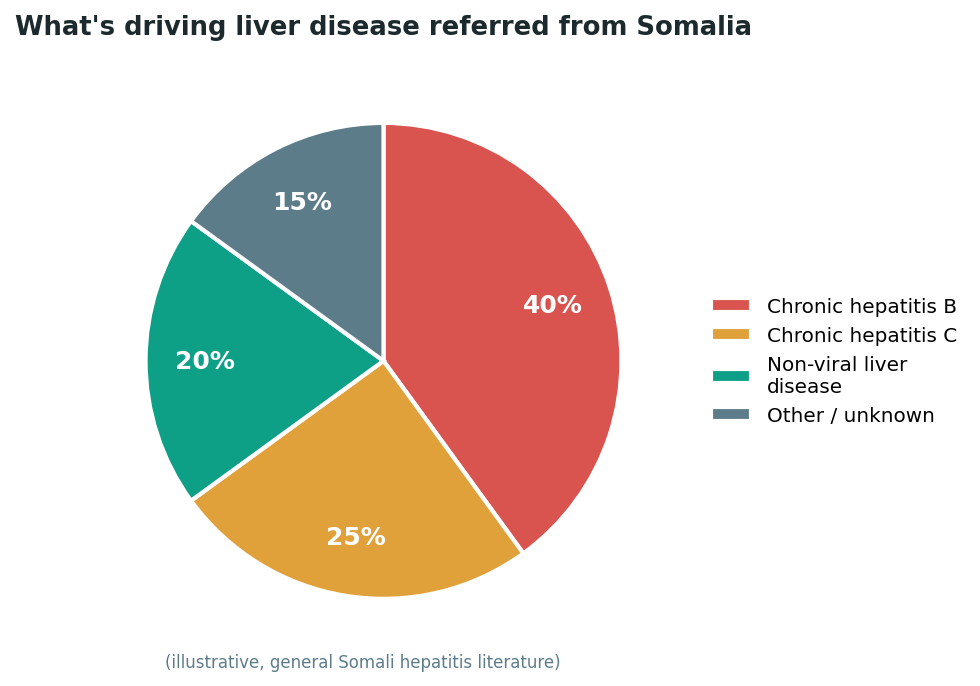
Illustrative breakdown of liver disease referred from Somalia, informed by published Somali hepatitis prevalence studies.
Why the diagnosis, caught early, changes almost everything
Chronic hepatitis B and C are not, on their own, a death sentence for the liver. Modern antiviral treatment can suppress hepatitis B to undetectable levels and cure hepatitis C outright in the large majority of cases, and starting that treatment before significant scarring has occurred dramatically reduces the lifetime risk of ever needing a transplant at all. The problem is timing: a patient diagnosed and treated while liver function is still largely normal has a fundamentally different future than one whose diagnosis only comes once cirrhosis or liver cancer has already developed.
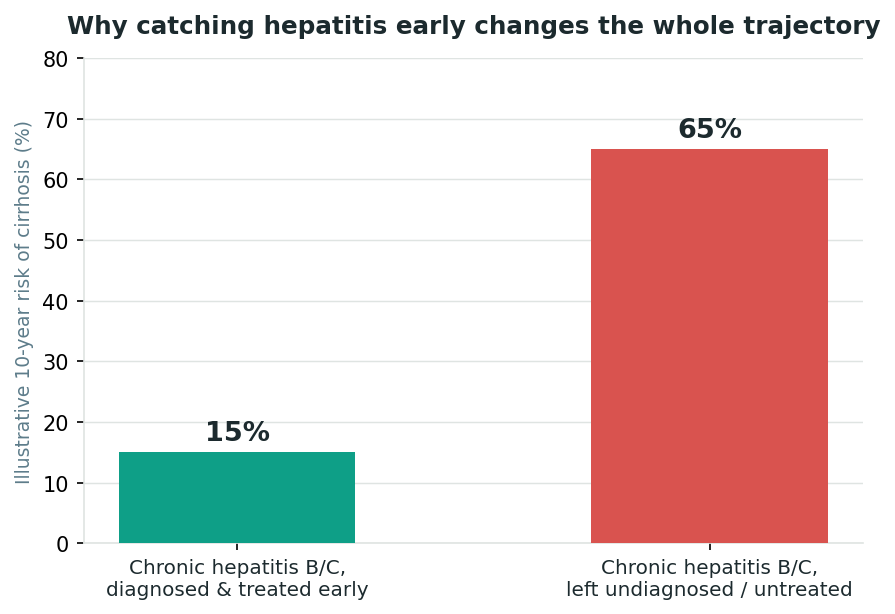
Illustrative long-term cirrhosis risk, chronic hepatitis diagnosed and treated early versus left undiagnosed. General hepatology literature, not a Somalia-specific measured outcome.
Know the warning signs, and ask for a blood test regardless
Yellowing of the skin or eyes, unusually dark urine, pale stools, swelling in the abdomen or legs, unexplained fatigue, and easy bruising or bleeding are all signs of advanced liver disease and deserve prompt evaluation. But because chronic hepatitis causes none of these symptoms for years, the more important message is this: anyone with a family history of liver disease, anyone who has ever received a blood transfusion in a setting where screening could not be confirmed, and honestly any adult in a population with hepatitis B and C prevalence this high, benefits from a simple blood test even in the complete absence of symptoms. Finding the infection before it causes any visible problem is precisely the scenario in which treatment works best.
Not every patient with hepatitis needs a transplant
The great majority of people living with chronic hepatitis B or C never need a liver transplant, particularly when the infection is identified and treated before significant scarring develops. Transplant becomes necessary specifically for decompensated cirrhosis, where the liver can no longer perform its basic functions, or for liver cancer confined to the liver and within recognised size criteria. Everyone else is managed with antiviral medication, regular monitoring, and, where hepatitis C is present, a curable course of direct-acting antivirals. A clinic offering transplant evaluation without first confirming the actual stage of liver disease has skipped the step that determines whether transplant is even the right conversation.
What it costs
In more than 24 years arranging this kind of care, the disputes I have seen were almost never about the price itself — they were about a diagnosis, or a cost, nobody had bothered to write down before the flight was booked. Most international patients bring a living donor, usually a close family member, which changes both the logistics and the cost compared with waiting for a deceased-donor organ.
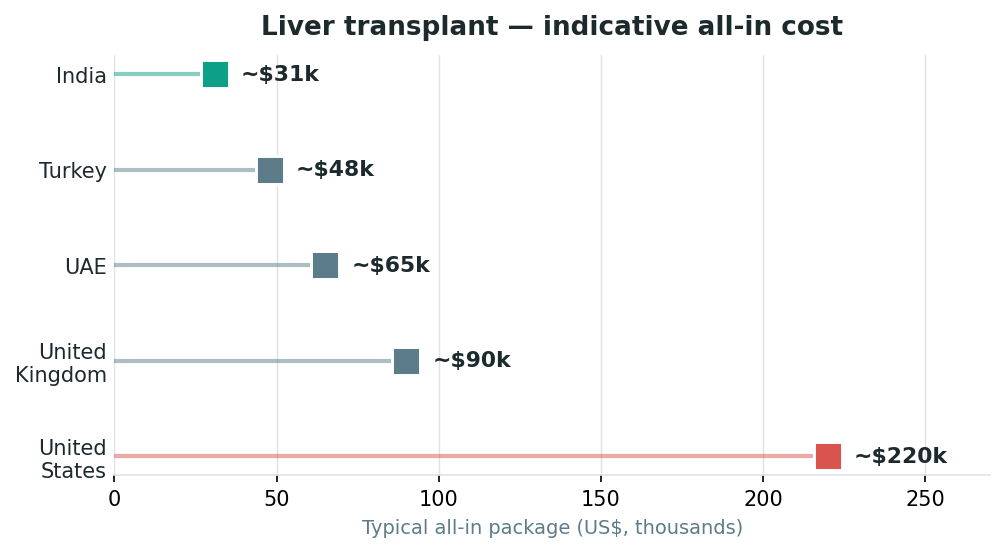
Indicative all-in cost for liver transplant. India sits far below every common alternative.
A living-donor liver transplant in a reputable private Indian hospital typically runs US$22,000 to US$40,000 all-in, covering evaluation, surgery for both donor and recipient, and initial recovery for both. Lifelong immunosuppressant medication after transplant is a separate, ongoing cost to plan for. Ask for a quote specific to your case and donor arrangement.
Why the donor's evaluation matters as much as the recipient's
A living-donor transplant involves two operations and two patients, and a genuinely thorough donor work-up is what protects the healthy family member offering part of their liver. Ask specifically what testing the potential donor undergoes before being cleared, including liver volume imaging to confirm enough tissue will remain for the donor's own health, and what the programme's track record is for donor safety specifically, not just recipient outcomes. A reputable transplant programme treats donor evaluation with the same rigour as recipient evaluation, since the donor is a healthy person taking on real surgical risk to help someone else.
Four signals that should make you stop and walk away
No viral hepatitis testing before a liver disease diagnosis. Given how common hepatitis B and C are as underlying causes, this should be one of the first tests done, not an afterthought.
Transplant proposed without staging the liver disease. Ask specifically what stage of liver disease has been confirmed, and whether antiviral treatment alone was considered first.
No named hepatology and transplant team. Ask how many living-donor transplants the specific surgical team performs each year, not the hospital's overall volume.
The price keeps moving. A verbal estimate that shifts each time you ask is not an estimate. Demand a fixed figure in writing, covering both donor and recipient.
The practical journey from Somalia — plan it before you fly
There is no direct flight between Somalia and India; patients route through Nairobi, Addis Ababa, Dubai or Djibouti. Because there is no full Indian mission inside Somalia, the medical visa is issued through the Embassy of India in Addis Ababa or the High Commission in Nairobi , against a written invitation letter from the treating hospital, and a potential living donor will need documentation confirming the family relationship. Since your route crosses yellow-fever territory, carry a valid yellow-fever vaccination certificate . Above every other instruction: send your actual liver function tests, imaging and viral hepatitis results, not a written summary, so the hepatology team can confirm the stage of disease before you ever leave home.
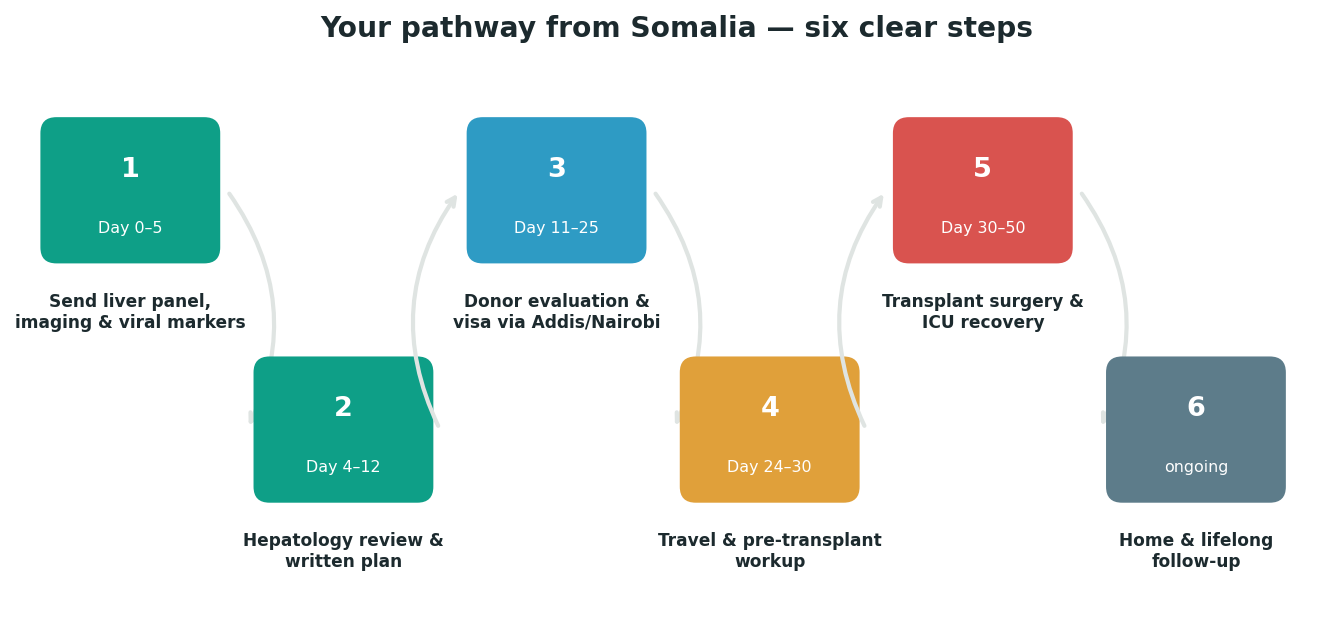
The complete route, start to finish — both donor and recipient need separate evaluation and recovery time.
A silent infection deserves a proper look, whether or not it has caused symptoms yet
Given how common hepatitis B and C are among Somalia's liver disease patients, testing for them is one of the most useful, least expensive steps anyone can take — whether the goal is catching a treatable infection early, or finally explaining an illness that has already progressed further than anyone expected.
Sources & useful links
- 🌐 Indian medical visa (Somali nationals) — indianvisaonline.gov.in
- 🌐 Embassy of India, Addis Ababa — eoiaddisababa.gov.in
- 🌐 High Commission of India, Nairobi — hcinairobi.gov.in
- 🌐 Yellow-fever requirements — who.int/health-topics/yellow-fever
- 🌐 Hospital accreditation (India) — nabh.co · jointcommissioninternational.org
- 🌐 Verify a surgeon's registration — nmc.org.in
Do not decide alone, and do not decide blind
If you want your results reviewed properly and an honest written plan — including whether antiviral treatment alone could still be the right path — that is precisely the independent guidance I provide, without a single hospital's interest attached to my advice. Dr. Dheeraj Bojwani · Independent medical travel advisor
Frequently Asked Questions by Somali Patients about Liver Transplant Treatment in India
Why is hepatitis B important for Somali patients considering liver treatment in India?
The guide highlights Somalia's high burden of hepatitis B-related liver disease and notes that chronic hepatitis can remain silent for years before cirrhosis or liver cancer develops.
Should Somali patients be tested for hepatitis B and C before considering a liver transplant?
Yes. The guide strongly recommends viral hepatitis testing alongside liver-function tests and imaging because identifying and treating the underlying infection may change the treatment pathway.
Does every Somali patient with hepatitis need a liver transplant?
No. Many patients can be managed with antiviral medication and regular monitoring, particularly when hepatitis is identified before significant liver scarring develops.
When may a liver transplant become necessary?
The guide identifies decompensated cirrhosis and selected liver cancers confined to the liver and meeting recognised criteria as situations where transplantation may become appropriate.
Who can be a living liver donor for a Somali patient?
The guide states that most international patients use a living donor who is usually a close family member, subject to medical, ethical and compatibility requirements.
Why is donor evaluation so important in living-donor liver transplantation?
A living donor is a healthy person undergoing major surgery. The guide recommends detailed evaluation, including liver-volume imaging, to ensure that enough liver remains for the donor's own health.
How much does living-donor liver transplantation cost in India for Somali patients?
The guide gives an indicative all-in range of US$22,000–US$40,000, including evaluation, surgery for both donor and recipient and initial recovery. Lifelong immunosuppressive medicines are additional.
What should Somali patients check when choosing a liver transplant centre?
They should confirm the named hepatology and transplant team, living-donor transplant experience, donor-safety record and approach to recipient and donor evaluation.
What medical records should Somali patients send before travelling to India?
Patients should send their actual liver-function tests, imaging and viral hepatitis results, rather than relying only on written summaries. This allows the team to assess the stage of liver disease before travel.
What is the liver transplant journey from Somalia to India?
The guide outlines the pathway as liver panel/imaging/viral markers → hepatology review → donor evaluation and visa → travel and pre-transplant work-up → transplant surgery and ICU recovery → home and lifelong follow-up.
Page Summary
This guide explains the key considerations for Somali patients exploring liver transplant and hepatology treatment in India, with particular emphasis on the high burden of hepatitis B and C-related liver disease highlighted in Somali studies. It covers early hepatitis detection and antiviral treatment, when transplantation may become necessary, living-donor assessment, liver-volume imaging, indicative transplant costs of US$22,000–US$40,000, donor-safety considerations, warning signs when choosing a transplant centre, pre-travel medical records, visa and travel planning, and the six-step pathway from liver assessment and hepatology review through donor evaluation, transplantation, recovery and lifelong follow-up.
Citation Block
| Topic | Information |
|---|---|
| Topic Information | Liver Transplant Treatment in India for Patients from Somalia |
| Treatment | Liver Transplantation / Hepatology Care |
| Intended Audience | Patients from Somalia |
| Key Specialist | Hepatologist / Liver Transplant Surgeon |
| Main Conditions | Hepatitis-Related Cirrhosis, Liver Failure and Selected Liver Cancer |
| Primary Assessment | Liver-Function Tests, Imaging and Viral Hepatitis Testing |
| Main Treatment Type | Living-Donor Liver Transplant |
| Donor Requirement | Usually a Close Family Member |
| Donor Assessment | Health Evaluation and Liver-Volume Imaging |
| Indicative Cost | US$22,000–US$40,000 All-In |
| Additional Cost | Lifelong Immunosuppressant Medication |
| Important Check | Living-Donor Transplant Experience and Donor-Safety Record |
| Disease-Staging Check | Confirm Liver Disease Stage Before Transplant |
| Pre-Travel Records | Actual Liver Tests, Imaging and Viral Hepatitis Results |
| Travel Routes | Nairobi, Addis Ababa, Dubai or Djibouti |
| Visa Requirement | Hospital Invitation and Medical Visa |
| Donor Documentation | Proof of Family Relationship |
| Important Warning | Transplant Proposed Without First Considering Antiviral Treatment or Disease Staging |
| Cost Check | Request a Fixed Quote Covering Both Donor and Recipient |
| Patient Journey | Liver tests/imaging → hepatology review → donor evaluation/visa → travel/pre-transplant work-up → transplant/ICU recovery → lifelong follow-up |
| Recovery | Separate Recovery Periods for Donor and Recipient |
| Follow-Up | Lifelong Transplant and Immunosuppression Monitoring |


Our Mission Statement
Our mission is to place patients at the centre of every healthcare decision by providing trustworthy, evidence-based, and unbiased medical information. We believe that informed patients make better decisions. Backed by personalised guidance from our experienced advisory team, we help patients understand their treatment options, compare them objectively, and confidently choose the path that best suits their medical needs and personal circumstances.
Patient Testimonials from Somalia




Ready to Take the First Step?
Share your Medical Reports with our Healthcare Managers Today and Get a FREE CONSULTATION, a Personalized Treatment Plan, and Complete Support from Arrival to Recovery.
Get Your Free ConsultationAreas We Serve
This resource has been thoughtfully prepared for patients from Somalia who are considering medical treatment in India. We also welcome patients from the wider region in the countries mentioned below-
We assist patients from:
- Ethiopia
- Djibouti
- Yemen
- Kenya
- Seychelles
- Somalia
- South Sudan
- Tanzania
- Uganda
- Zambia
- Zimbabwe
- Angola
- Cameroon
- Central African Republic
Many of the insights, treatment pathways, hospital recommendations, travel guidance, and patient support services described here are equally relevant and may be used as a reference when planning treatment in India.
From Somalia to India: Your Complete Patient Support Guide
- Best Brain Tumour Surgeons & Hospitals in India for Somali Patients
- Best Cancer Treatment Surgeons & Hospitals in India for Somali Patients
- Best Cardiac Surgeons & Hospitals in India for Somali Patients
- Best CyberKnife Teams & Centres in India for Somali Patients
- Best Heart Valve Replacement Surgeons & Hospitals in India for Somali Patients
- Best Hip Surgeons & Hospitals in India for Somali Patients
- Best Knee Surgeons & Hospitals in India for Somali Patients
- Best Neurosurgeons & Hospitals in India for Somali Patients
- Best Paediatric Cardiac Surgeons & Hospitals in India for Somali Patients
- Best Paediatric Neurosurgeons & Hospitals in India for Somali Patients
- Best Spine Surgeons & Hospitals in India for Somali Patients
- Bariatric Surgery in India for Patients from Somalia
- Brain Tumour Surgery in India for Patients from Somalia
- Cancer Treatment and Surgery in India for Patients from Somalia
- Cardiac Surgery in India for Patients from Somalia
- Cosmetic and Plastic Surgery in India for Patients from Somalia
- CyberKnife Treatment in India for Patients from Somalia
- Dental Surgery in India for Patients from Somalia