

Leukemia, Lymphoma and Blood Cancer Treatment in India for Patients from Somalia
Blood cancer is, more than almost any other cancer, a disease that is cured by finishing the treatment plan without interruption — which makes where you start it the single most consequential decision a family makes.
Persistent fever that will not lift. Bruising that appears without a fall. A child who tires walking to school. These are the quiet early signs of leukaemia and lymphoma, and they are also, maddeningly, the everyday signs of ordinary childhood anaemia in Somalia — which is exactly why, for 24 years, I have pushed families toward a proper blood work-up the moment these symptoms fail to resolve, rather than waiting to see if they pass.
India treats blood cancer at a scale few countries can match: dedicated haematology-oncology units running standardised international protocols, blood banks and platelet apheresis services built specifically to support chemotherapy, and bone marrow transplant programmes with among the highest case volumes anywhere — all at a fraction of the cost of the same care in the Gulf, Europe or the United States.
Healing Journeys of Somali Patients









Key Takeaways
- The guide explains why blood cancers can be difficult to recognise early in Somalia, as symptoms such as fatigue, pallor, bruising and fever can overlap with common childhood anaemia. Somalia's 2019 survey found 43% of young children were anaemic, making proper blood testing important when symptoms persist.
- A major treatment challenge is reliable blood and platelet transfusion support. The guide notes Somalia's national blood bank remained non-functional for nearly 30 years before reopening in 2023, while some facilities continue to face shortages of trained staff and supplies.
- The guide stresses that blood-cancer treatment should follow the prescribed protocol without unnecessary interruption. Delays, interruptions or reduced treatment can affect outcomes, particularly in childhood leukemia and lymphoma.
- Diagnosis should begin with a complete blood count and blood-film review, followed by bone marrow examination when clinically indicated. The guide also warns against proposing bone marrow transplantation before the diagnosis and risk assessment are properly established.
- For treatment in India, patients should look for a dedicated haematology-oncology unit with recognised treatment protocols, transfusion support and transplant capability where required. If transplant may be needed, donor search and tissue typing should begin early.
- The guide gives an indicative full-course treatment cost of about US$17,000 in India, while a bone marrow transplant package is typically US$15,000–35,000, depending on the treatment and donor requirements.
- Somali patients should send their actual blood count, blood film and available bone marrow report before travelling and request a staged quotation covering diagnosis, chemotherapy and transplant separately. Transplant cases may require a longer stay in India.
- Travel requires additional planning because there is no direct flight from Somalia to India. Medical visas are processed through Nairobi or Addis Ababa, with up to two medical attendants permitted, and a valid yellow-fever vaccination certificate is highlighted.
Quick Facts
- Author
- Dr. Dheeraj Bojwani
- Experience
- 24+ Years
- Treatment
- Leukemia, Lymphoma & Blood Cancer Treatment
- Patients
- Somali Patients
- Child Anaemia
- 43% of Somali children under 5 in the cited 2019 survey
- First Assessment
- Complete blood count and blood film
- Key Specialist
- Haematologist / Haematology-Oncologist
- Diagnostic Check
- Bone marrow review when clinically indicated
- Main Check
- Dedicated haematology-oncology unit
- Protocol Check
- Recognised international treatment protocols
- Supportive Care
- Blood and platelet transfusion support
- Transplant Check
- Donor search and tissue typing when required
- India Cost
- Approximately US$17,000 indicative full-course figure
- Transplant Cost
- US$15,000–35,000
- Cost Check
- Staged, itemised quotation
- Medical Records
- Blood count, blood film and bone marrow report
- Visa
- Indian medical visa through Nairobi or Addis Ababa
- Travel
- Connecting flight required
- Attendants
- Up to two medical attendants
- Entry Requirement
- Valid yellow-fever vaccination certificate
- Follow-Up
- Long-term home-country follow-up plan
- Key Warning
- Treatment started before proper diagnostic confirmation
- Decision Principle
- Verify diagnosis, protocol continuity and reliable supportive care.
In Brief
For Somali patients seeking leukemia, lymphoma or other blood cancer treatment in India, the key checks are accurate blood-cancer diagnosis, a dedicated haematology-oncology team, recognised treatment protocols, guaranteed blood and platelet support, and transplant capability when clinically required. Families should send actual diagnostic reports before travelling and obtain a staged treatment and cost plan.
First, know why blood cancer is so easily missed in Somalia
Blood cancers are unusual among cancers in that their early symptoms — fatigue, pale skin, unexplained bruising, low-grade fever, bone or joint pain — overlap almost exactly with a condition that is already extremely common in Somalia for entirely different, non-cancerous reasons. Somalia's 2019 national micronutrient survey found that 43% of young children were already anaemic, almost all of it from iron deficiency rather than any blood disorder. In a population where anaemia is this routine, and iron supplements are the default first response, the specific pattern that actually points to leukaemia — bruising out of proportion to any injury, swollen lymph nodes, fevers that do not respond to normal treatment, bone pain that wakes a child at night — can go unrecognised for months, dismissed as "just anaemia" until the child is significantly sicker than the first blood test would have shown.
The Somali difference: even a confirmed diagnosis meets a treatment system without the basics
Blood cancer treatment leans on chemotherapy so intensive that it temporarily destroys the bone marrow's ability to make platelets and red cells, which means reliable, safe blood and platelet transfusion is not an optional extra — it is the support system the entire treatment depends on. Somalia's national blood bank, first established in 1976, sat non-functional for nearly three decades because of conflict, and only reopened in August 2023 with support from the UN and WHO. Even now, the WHO notes that many of the country's transfusion units still lack trained staff, routine supplies and basic amenities. A chemotherapy protocol that assumes platelets will be available on the day the patient needs them is a protocol that, in most of Somalia today, cannot yet be safely completed from start to finish.
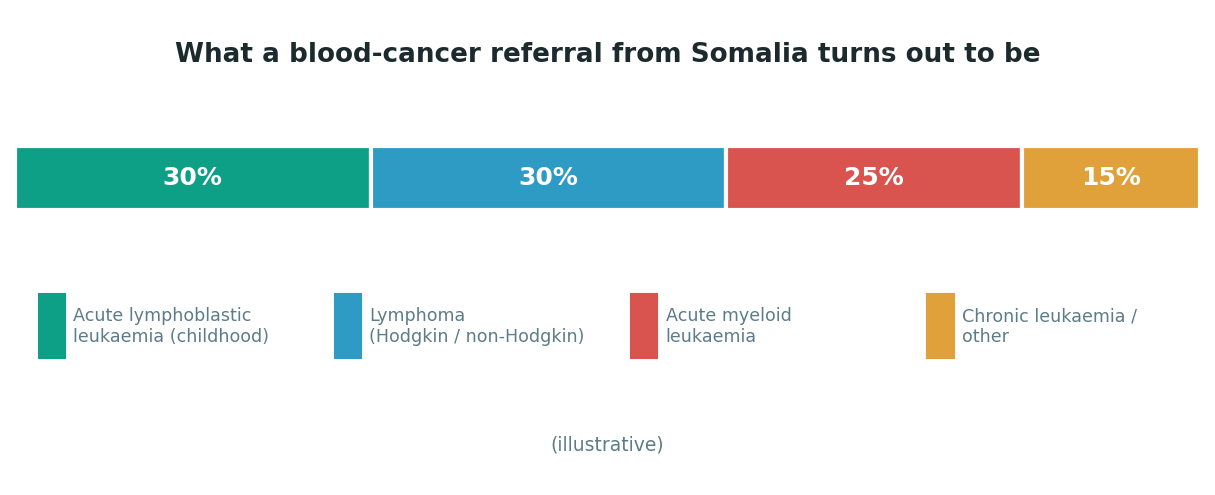
Illustrative breakdown of blood-cancer referrals from Somalia, by diagnosis.
Why finishing the protocol matters more here than in almost any other cancer
Childhood acute lymphoblastic leukaemia, the most common cancer in children worldwide, is also one of the most curable cancers in all of medicine when the full, standard multi-month protocol is completed on schedule — and one of the most likely to relapse when that protocol is interrupted, delayed, or given at reduced doses because supportive care was not reliably available. The same pattern holds for Hodgkin lymphoma and, to a real but lesser degree, acute myeloid leukaemia. This is precisely why the location of treatment matters so much for blood cancer specifically: not because of the diagnosis itself, but because of everything the diagnosis requires to be delivered on time, every cycle, for months.
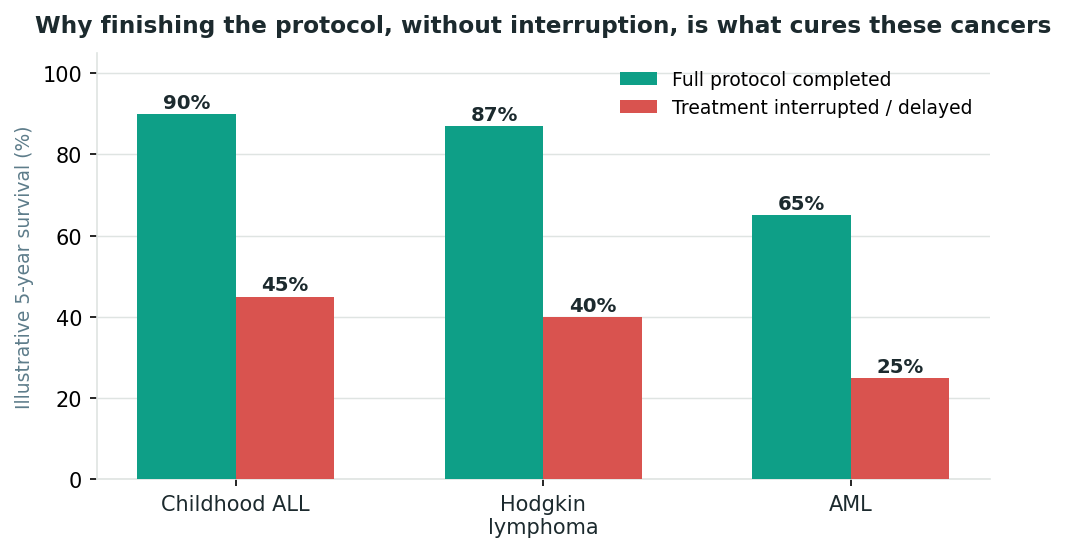
Illustrative five-year survival by broad category: full standard protocol completed, versus treatment interrupted or delayed. General oncology principle, not a Somalia-specific measured outcome.
Know the warning signs, and do not wait them out
Anaemia that does not improve after a genuine course of iron treatment is one of the clearest signals that something else is going on, and deserves a full blood count and blood film, not another round of supplements. So does bruising that appears in unusual places without a clear cause, tiny red or purple spots on the skin, gums that bleed easily, lymph nodes in the neck, armpit or groin that stay swollen for more than a few weeks, drenching night sweats, or unexplained weight loss. In children specifically, bone pain severe enough to wake them at night, or a limp with no clear injury behind it, is a pattern worth taking seriously. None of these signs mean cancer on their own — most of the time they do not — but together, or persisting despite treatment for the more common explanation, they are exactly the combination that should prompt a proper blood work-up.
Not every blood disorder is cancer
Because anaemia, fatigue and easy bruising are also caused by iron deficiency, vitamin deficiency, chronic infection and, occasionally, inherited blood conditions, a proper diagnosis always starts with a complete blood count and blood film review, not assumptions in either direction. A raised or markedly abnormal white cell count, blast cells seen on the blood film, or persistent swollen lymph nodes are what actually justify a bone marrow biopsy and the further staging that confirms a cancer diagnosis. Equally, once leukaemia or lymphoma is confirmed, not every case needs a bone marrow transplant: many are cured with chemotherapy or combination therapy alone, and transplant is reserved for specific high-risk or relapsed disease. A clinic proposing a transplant before completing standard staging has skipped a step that matters.
Why a genuine haematology-oncology team, not a general oncology list, is what to look for
Leukaemia and lymphoma are managed by haematologists, a distinct specialty from the solid-tumour oncologists who treat cancers like breast or lung cancer, and the two skill sets are not interchangeable. Ask specifically whether the hospital has a dedicated haematology-oncology unit, whether it runs recognised international treatment protocols rather than an improvised regimen, and whether a transfusion medicine specialist and microbiologist are part of the standing team, since infection risk during intensive chemotherapy is managed jointly with haematology, not as an afterthought. For any case where transplant is even a possibility, ask early about donor search and tissue-typing turnaround time, since this step alone can take weeks and should start well before it becomes urgent.
What it costs
In more than 24 years arranging this kind of care, the disputes I have seen were almost never about the price itself — they were about a diagnosis, or a cost, nobody had bothered to write down before the flight was booked. Blood cancer treatment costs vary enormously by what is actually needed: straightforward chemotherapy cycles for a standard-risk case sit at the lower end, while a full bone marrow transplant, particularly one needing an unrelated donor, sits much higher.
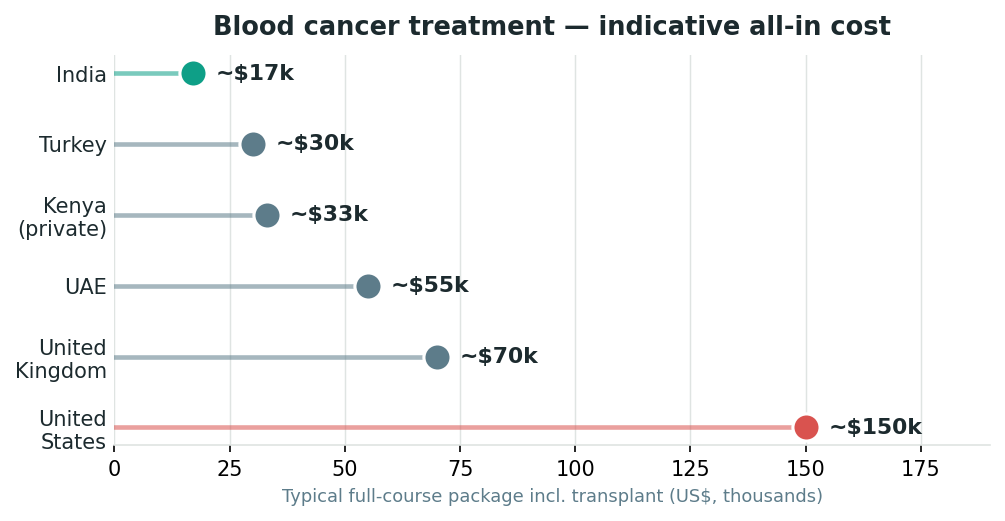
Indicative all-in cost across the full range of blood cancer care, from chemotherapy alone to bone marrow transplant. India sits far below every common alternative.
Chemotherapy-only treatment in a reputable private Indian hospital typically runs a few thousand dollars per cycle, while a full bone marrow transplant package, including donor matching, the transplant itself and extended post-transplant monitoring, typically runs US$15,000 to US$35,000 all-in depending on whether the donor is the patient's own cells, a matched relative, or an unrelated registry donor. Ask for a staged quote that separates diagnosis, each phase of chemotherapy, and any transplant, rather than a single number covering an entire course that may run many months.
Four signals that should make you stop and walk away
1. Treatment started before a bone marrow biopsy. A blood count alone cannot confirm leukaemia or lymphoma. Staging should come before any chemotherapy begins.
2. No mention of a dedicated haematology-oncology team. Blood cancers are treated by haematologists, not general oncologists alone. Ask specifically who is managing the case.
3. No plan for platelet and blood support during treatment. If nobody discusses how transfusion support will be guaranteed through every cycle, the plan is incomplete.
4. The price keeps moving. A verbal estimate that shifts each time you ask is not an estimate. Demand a staged, itemised quote in writing.
The practical journey from Somalia — plan it before you fly
There is no direct flight between Somalia and India; patients route through Nairobi, Addis Ababa, Dubai or Djibouti. Because there is no full Indian mission inside Somalia, the medical visa is issued through the Embassy of India in Addis Ababa or the High Commission in Nairobi, against a written invitation letter from the treating hospital. Somali patients may bring up to two medical attendants on attendant visas, and blood cancer cases in particular should plan for a companion able to stay the full treatment course, which for transplant cases can run several months. Since your route crosses yellow-fever territory, carry a valid yellow-fever vaccination certificate. Above every other instruction: send the actual blood count, blood film and any bone marrow report you already have, not a written summary, so the haematology team can begin planning before you ever leave home.
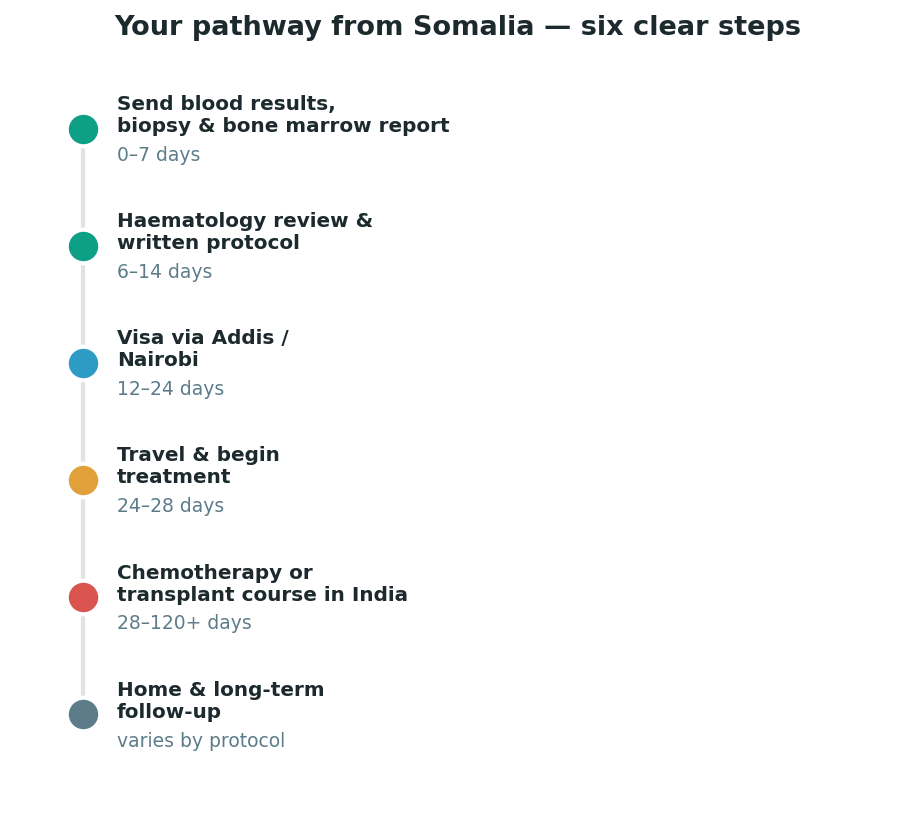
The complete route, start to finish — treatment length varies enormously by protocol and diagnosis.
A curable cancer deserves a system built to actually cure it
Childhood leukaemia and many lymphomas rank among the most curable cancers in all of medicine, but only when every cycle of a demanding protocol is delivered on time, backed by reliable supportive care. Matched to a system built for exactly that, blood cancer in Somalia's young population is, more often than not, a genuinely beatable disease.
Sources & useful links
- 🌐 Indian medical visa (Somali nationals) — indianvisaonline.gov.in
- 🌐 Embassy of India, Addis Ababa — eoiaddisababa.gov.in
- 🌐 High Commission of India, Nairobi — hcinairobi.gov.in
- 🌐 Yellow-fever requirements — who.int/health-topics/yellow-fever
- 🌐 Hospital accreditation (India) — nabh.co · jointcommissioninternational.org
- 🌐 Verify a surgeon's registration — nmc.org.in
Do not decide alone, and do not decide blind
If you want your blood results reviewed properly and an honest written plan — including whether this is genuinely a blood cancer at all — that is precisely the independent guidance I provide.
Dr. Dheeraj Bojwani · Independent medical travel advisor
Frequently Asked Questions by Somali Patients about Leukemia, Lymphoma and Blood Cancer Treatment in India
Why can leukemia be mistaken for anaemia in Somali children?
The guide notes that 43% of Somali children under five were already anaemic in the cited national survey. Because fatigue, pallor and weakness are common with anaemia, persistent bruising, fever, swollen lymph nodes or night-time bone pain should prompt a more complete blood work-up.
What blood tests should a Somali patient have before travelling to India?
The guide specifically recommends sending the actual complete blood count and blood-film results, together with any existing bone marrow report. These give the Indian haematology team information needed to begin reviewing the case before travel.
Why is reliable platelet support particularly important for Somali blood-cancer patients?
Intensive chemotherapy can temporarily reduce platelet and red-cell production. The guide therefore considers reliable blood and platelet transfusion support an essential part of completing treatment safely, rather than an optional hospital service.
Why should Somali families choose a dedicated haematology-oncology unit in India?
Leukemia and lymphoma require specialist management by haematologists, rather than relying only on a general oncology department. The guide recommends checking for a dedicated unit that follows recognised treatment protocols and has integrated supportive-care specialists.
Does every Somali leukemia or lymphoma patient need a bone marrow transplant?
No. The guide specifically explains that many cases can be treated successfully with chemotherapy or combination therapy alone. Transplant is generally reserved for particular high-risk or relapsed situations after appropriate assessment.
When should a Somali family ask about donor search and tissue typing?
If transplant is a realistic possibility, the guide recommends asking early, because donor search and tissue typing can take several weeks. Waiting until transplant becomes urgent may unnecessarily reduce planning time.
How much can blood cancer treatment cost in India for Somali patients?
The guide's page 4 chart gives an indicative full-course figure of approximately US$17,000 in India, while a full bone marrow transplant package is stated at around US$15,000–35,000, depending on donor type and treatment requirements.
What should Somali families check in a blood-cancer treatment quotation?
Ask for separate costs for diagnosis, each chemotherapy phase, transplant if required and extended post-treatment monitoring. The guide recommends a staged quotation rather than one unexplained figure for a treatment course that may last many months.
How should Somali families plan the journey if a child needs prolonged leukemia treatment in India?
The guide notes that treatment can extend for months, particularly for transplant cases. Families should therefore plan for a companion who can remain throughout the required treatment period and clarify which follow-up care can later continue in Somalia.
What are the biggest warning signs when choosing a blood-cancer centre in India?
The guide identifies four major warning signs: treatment started before bone marrow confirmation where indicated, no dedicated haematology-oncology team, no clear plan for blood and platelet support, and a treatment price that keeps changing without a staged written quotation.
Page Summary
This six-page guide explains why blood cancer can be missed in Somalia, why uninterrupted treatment matters, how Somali patients should assess Indian haematology-oncology centres and what the treatment may cost. Page 1 highlights childhood anaemia and the difficulty of recognising blood cancer symptoms. Page 2 focuses on transfusion limitations and treatment continuity. Page 3 covers warning signs, diagnostic confirmation and the need for a dedicated haematology team. Page 4 compares treatment costs and identifies major warning signs. Page 5 provides the Somalia-to-India treatment pathway, while page 6 reinforces the need for proper diagnostic review before treatment.
Citation Block
| Topic | Information |
|---|---|
| Topic | Leukemia, Lymphoma and Blood Cancer Treatment in India for Somali Patients |
| Treatment | Leukemia, Lymphoma & Blood Cancer Treatment |
| Patients | Somali Patients |
| First Assessment | Complete blood count and blood film |
| Key Specialist | Haematologist / Haematology-Oncologist |
| Diagnostic Check | Bone marrow review when clinically indicated |
| Main Centre Check | Dedicated haematology-oncology unit |
| Protocol Check | Recognised international treatment protocols |
| Supportive Care | Blood and platelet transfusion support |
| Transplant Check | Donor search and tissue typing |
| Hospital Team | Haematology, transfusion medicine and microbiology |
| India Cost | Approximately US$17,000 indicative full-course figure |
| Transplant Cost | US$15,000–35,000 |
| Cost Check | Staged, itemised quotation |
| Medical Records | Blood count, blood film and bone marrow report |
| Visa | Nairobi or Addis Ababa |
| Travel | Connecting flights |
| Attendants | Up to two medical attendants |
| Entry Requirement | Valid yellow-fever vaccination certificate |
| Specialist Question | Who will be the named haematologist managing the case? |
| Diagnosis Question | Has the diagnosis been confirmed with the appropriate blood and marrow testing? |
| Protocol Question | Which recognised treatment protocol will be followed? |
| Transfusion Question | How will blood and platelet support be guaranteed during every treatment cycle? |
| Transplant Question | If transplant is needed, how quickly can donor search and tissue typing begin? |
| Cost Question | Does the quotation separately cover diagnosis, chemotherapy and transplant? |
| Travel Question | How long will the patient and attendant need to remain in India? |
| Warning Signs | Treatment started before proper diagnostic confirmation |
| Support Warning | No clear plan for blood and platelet support |
| Payment Warning | Moving or incomplete treatment quotation |
| Key Decision | Verify diagnosis, treatment protocol and reliable supportive-care capacity |


Our Mission Statement
Our mission is to place patients at the centre of every healthcare decision by providing trustworthy, evidence-based, and unbiased medical information. We believe that informed patients make better decisions. Backed by personalised guidance from our experienced advisory team, we help patients understand their treatment options, compare them objectively, and confidently choose the path that best suits their medical needs and personal circumstances.
Patient Testimonials from Somalia




Ready to Take the First Step?
Share your Medical Reports with our Healthcare Managers Today and Get a FREE CONSULTATION, a Personalized Treatment Plan, and Complete Support from Arrival to Recovery.
Get Your Free ConsultationAreas We Serve
This resource has been thoughtfully prepared for patients from Somalia who are considering medical treatment in India. We also welcome patients from the wider region in the countries mentioned below-
We assist patients from:
- Ethiopia
- Djibouti
- Yemen
- Kenya
- Seychelles
- Somalia
- South Sudan
- Tanzania
- Uganda
- Zambia
- Zimbabwe
- Angola
- Cameroon
- Central African Republic
Many of the insights, treatment pathways, hospital recommendations, travel guidance, and patient support services described here are equally relevant and may be used as a reference when planning treatment in India.
From Somalia to India: Your Complete Patient Support Guide
- Best Brain Tumour Surgeons & Hospitals in India for Somali Patients
- Best Cancer Treatment Surgeons & Hospitals in India for Somali Patients
- Best Cardiac Surgeons & Hospitals in India for Somali Patients
- Best CyberKnife Teams & Centres in India for Somali Patients
- Best Heart Valve Replacement Surgeons & Hospitals in India for Somali Patients
- Best Hip Surgeons & Hospitals in India for Somali Patients
- Best Knee Surgeons & Hospitals in India for Somali Patients
- Best Neurosurgeons & Hospitals in India for Somali Patients
- Best Paediatric Cardiac Surgeons & Hospitals in India for Somali Patients
- Best Paediatric Neurosurgeons & Hospitals in India for Somali Patients
- Best Spine Surgeons & Hospitals in India for Somali Patients
- Bariatric Surgery in India for Patients from Somalia
- Brain Tumour Surgery in India for Patients from Somalia
- Cancer Treatment and Surgery in India for Patients from Somalia
- Cardiac Surgery in India for Patients from Somalia
- Cosmetic and Plastic Surgery in India for Patients from Somalia
- CyberKnife Treatment in India for Patients from Somalia
- Dental Surgery in India for Patients from Somalia