

Laparoscopic and Robotic Myomectomy in India for Patients from Somalia
This operation exists for one reason: to remove fibroids while keeping pregnancy possible. In Somalia, where the average woman has six children in her lifetime, that single fact should decide almost everything about how, and by whom, this surgery is done.
Somalia has one of the highest fertility rates on earth, averaging more than six children per woman across a lifetime. That single fact changes what a myomectomy actually means here. For most patients elsewhere, this operation is judged on how well it removes today's fibroids. For a Somali patient, it must also be judged on how safely it protects every pregnancy still to come — because the country already carries one of the world's highest maternal mortality rates, and a poorly performed or poorly closed uterine repair adds risk to each of those future pregnancies, not just this one. For 24 years I have guided patients through decisions where the stakes extend years beyond the operating table, and I write here as an independent adviser with no hospital's interest attached to my advice.
India performs laparoscopic and robotic myomectomy at genuine scale, with surgeons who handle complex, multiple, and deep-seated fibroids as routine work rather than rare cases, at a fraction of what the same care costs in the West or the Gulf. For a Somali patient whose fertility depends on this being done properly, that combination of skill and volume is not a convenience. It is the difference between one safe recovery and years of compounding risk across a lifetime of childbearing that, for most Somali women, is genuinely still ahead of them.
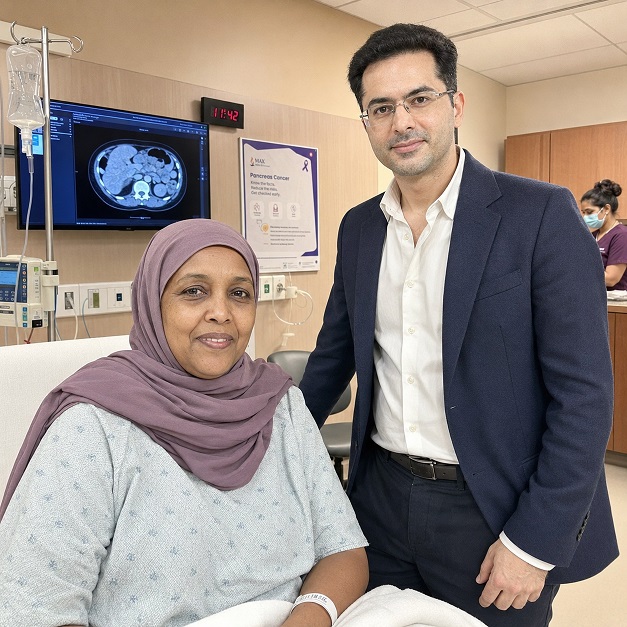
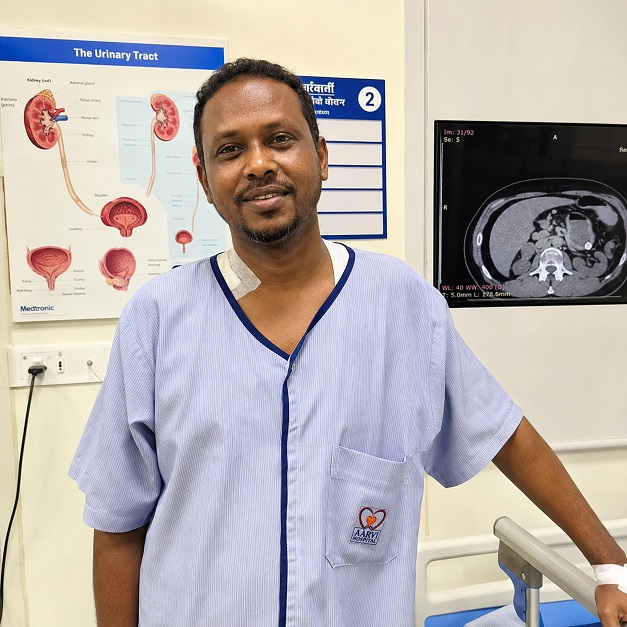
Healing Journeys of Somali Patients
Key Takeaways
- Myomectomy removes uterine fibroids while keeping the uterus intact, making it an important fertility-preserving option for Somali women who may want future pregnancies. The choice of surgery should therefore consider both current fibroid removal and future pregnancy plans.
- The surgical approach matters because open surgery can create more internal scar tissue than laparoscopic or robotic surgery. Minimally invasive techniques may reduce adhesions and can allow a faster return to normal activities when appropriate for the patient's anatomy.
- Not every fibroid can safely be removed through laparoscopic or robotic surgery. The number, size, depth and position of the fibroids must be assessed through proper imaging before the surgeon recommends the safest approach.
- Uterine closure is an important part of fertility-preserving surgery. Somali patients should ask the surgeon how the uterine wall will be repaired after fibroid removal and whether the planned technique is appropriate for future pregnancy.
- Myomectomy removes the fibroids present at the time of surgery but does not eliminate the possibility of new fibroids developing later. Follow-up scans and honest discussion about family planning can help patients plan their future care.
- Choosing the right surgeon and hospital is an important decision. Somali patients should ask how many laparoscopic or robotic myomectomies the surgeon performs each year and check hospital accreditation such as NABH or JCI where applicable.
- Patients travelling from Somalia should arrange the practical details before flying. There are no direct flights to India, medical visas are processed through the Indian missions in Addis Ababa or Nairobi with a hospital invitation, and patients should carry a valid yellow-fever certificate and send their actual ultrasound or MRI for review before travel.
Quick Facts
- Treatment
- Laparoscopic and Robotic Myomectomy
- Country
- India
- Patients
- Somali Patients
- Primary Condition
- Uterine Fibroids
- Main Goal
- Remove Fibroids While Preserving the Uterus
- Fertility Focus
- Preserve Future Pregnancy Possibility
- Main Approaches
- Laparoscopic, Robotic and Open Myomectomy
- Key Surgical Factor
- Number, Size, Depth and Position of Fibroids
- Imaging
- Actual Ultrasound or MRI Should Be Reviewed
- Uterine Closure
- Important for Future Pregnancy Planning
- Minimally Invasive Benefit
- Generally Less Internal Scarring Than Open Surgery
- Recovery
- Approximately 1–2 Weeks for Well-Performed Minimally Invasive Surgery
- Open Surgery Recovery
- Approximately 4–6 Weeks
- Fibroid Recurrence
- New Fibroids May Develop After Surgery
In Brief
Somali patients considering laparoscopic or robotic myomectomy in India should focus on fertility preservation as well as fibroid removal. The number, size, location and depth of the fibroids determine whether minimally invasive surgery is appropriate, while careful uterine closure is important for future pregnancy planning. Patients should review their actual imaging with an experienced gynaecological surgeon, confirm the surgical approach in writing and understand the complete cost before travelling.
Why this operation exists, and why it is not a hysterectomy
Myomectomy removes fibroids while leaving the uterus itself intact, specifically to preserve the ability to become pregnant afterward. Hysterectomy, removing the uterus entirely, is sometimes the right and simpler choice when childbearing is genuinely complete, but it ends that possibility permanently and cannot be reversed. For a Somali patient still building her family, or genuinely uncertain whether she is finished, this distinction is not a technical footnote. It is the entire point of the operation, and a surgeon who proposes hysterectomy without a direct, unhurried conversation about your future plans has skipped the most important question in the room.
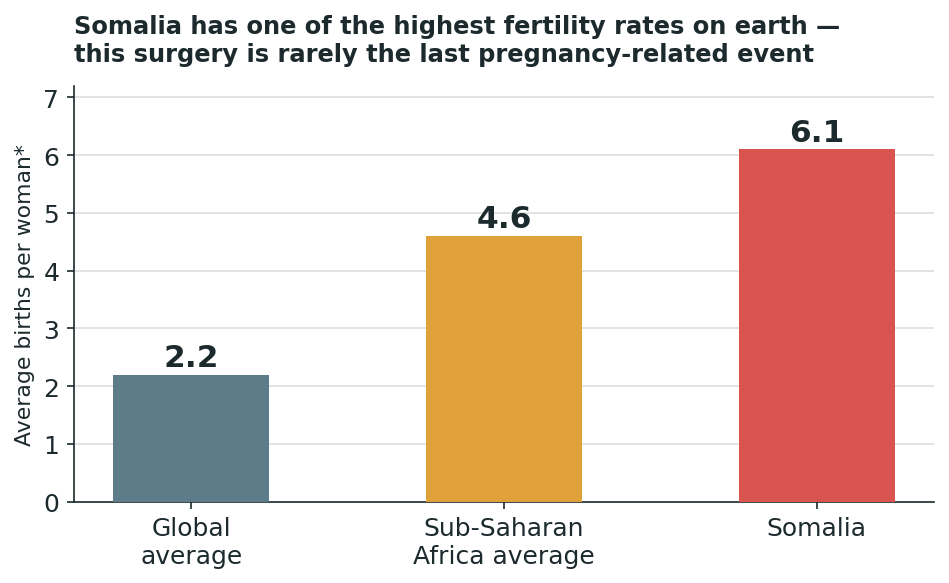
Illustrative comparison. In Somalia, this surgery is rarely the last pregnancy-related event in a woman's life.
The Somali difference: this operation must work for pregnancies you have not had yet
A myomectomy performed through a large open incision heals with far more scar tissue on the uterus itself than one performed through keyhole or robotic technique. That scar tissue matters enormously here, because Somalia's exceptionally high fertility rate means most patients will carry and deliver several more children after this surgery — and a uterus already carrying one of the world's highest maternal mortality burdens cannot afford an avoidable weak point.
This is why the surgical approach, and specifically how carefully the uterine wall is closed afterward, deserves as much attention as the fibroid removal itself. A surgeon who cannot explain their closure technique in plain terms has not thought carefully enough about your next pregnancy.
Why minimally invasive matters for your next pregnancy, not just this one
This is worth understanding on its own, because it shapes the entire decision. Open surgery through a traditional abdominal incision tends to produce significantly more internal scar tissue, known as adhesions, than laparoscopic or robotic approaches performed through small incisions. Beyond the discomfort adhesions can cause, a heavily scarred uterine wall carries a higher risk of complications in a future pregnancy and delivery, including uterine rupture in rare but serious cases. Recovery time also differs meaningfully: open surgery typically needs four to six weeks before normal activity resumes, while a well-performed laparoscopic or robotic procedure often allows a return to ordinary life within one to two weeks.
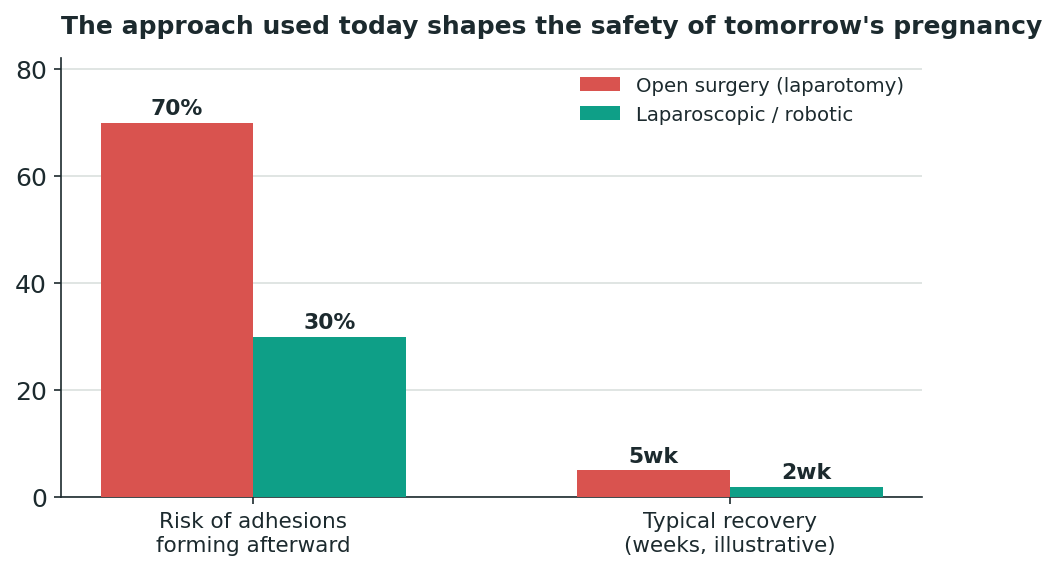
Illustrative comparison. The approach chosen today shapes the safety of every pregnancy that follows.
Why anatomy decides whether keyhole surgery is even possible
Not every fibroid can safely be removed through keyhole or robotic technique, and a responsible surgeon says so honestly rather than promising a minimally invasive approach before actually examining your imaging. The number, size, depth and position of your fibroids within the uterine wall determine what is genuinely feasible. A single, well-positioned fibroid is a very different case from multiple large fibroids embedded deep in the muscle wall, and the right plan is decided by your specific anatomy, not by which technique a clinic prefers to sell. Fibroids are classified by where they sit in relation to the uterine cavity and outer wall, and this classification, not guesswork, is what a genuine specialist uses to decide the safest route in.
Why removing today's fibroids does not guarantee they will never return
This is worth understanding honestly before surgery, not discovering afterward. A myomectomy removes the fibroids present at the time of the operation; it does not change the underlying tendency of the uterus to grow new ones. Depending on age, number of fibroids removed, and years remaining before menopause, a meaningful share of patients will eventually develop new fibroids requiring attention. This is not a reason to avoid the operation — for a patient hoping to become pregnant now, treating the fibroids that exist today is what matters most — but it is a reason to keep having follow-up scans in the years after surgery, and to discuss family planning timing honestly with your surgeon, since completing childbearing sooner rather than later can mean fewer future procedures over a lifetime.
Choosing the surgeon and hospital is the real decision
Ask specifically how many laparoscopic or robotic myomectomies this surgeon performs each year, and how they describe their approach to uterine closure. Confirm NABH accreditation in India or, better, international JCI accreditation, and ask whether a genuine gynaecological surgery team, not a general surgeon occasionally handling fibroids, will be performing your operation. These are not formalities. They shape whether your next pregnancy is straightforward or complicated.
What it costs — a number you can actually plan around
Somalia has run on the US dollar for a generation, the shilling itself never meaningfully reissued since 1991, so it fits that Indian hospitals quote this care the same way — in dollars, not a currency that shifts by the week. A laparoscopic or robotic myomectomy in a reputable private Indian hospital typically runs US$2,800 to US$6,000 all-in, covering diagnosis, surgery, hospital stay and initial follow-up. Set that beside the alternatives and the case makes itself.
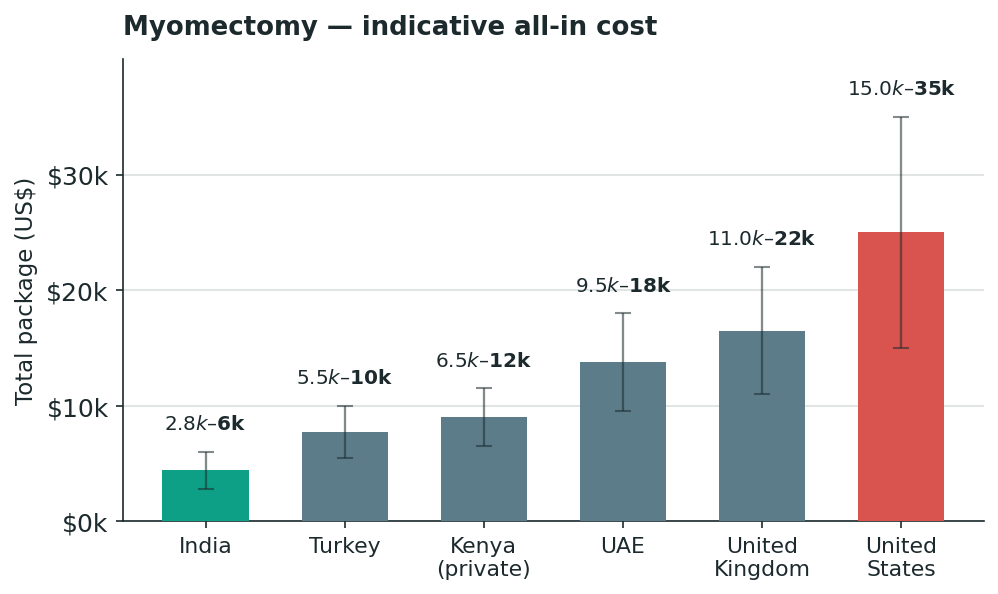
Indicative all-in cost for a laparoscopic or robotic myomectomy. India sits far below every common alternative.
One rule protects every Somali family who makes this journey: get the estimate in writing before a single flight is booked , and confirm it names the actual surgical approach, not just "fibroid surgery." In more than 24 years arranging this kind of care, the disputes I have seen were almost never about the price itself — they were about an approach, or a technique, nobody had bothered to write down.
Four signals that should make you stop and walk away
- Hysterectomy proposed without discussion — if your future fertility plans were never asked about, the recommendation was made too quickly.
- A technique promised before imaging is reviewed — nobody can honestly promise keyhole surgery without first examining your actual scans.
- No mention of uterine closure — if the surgeon cannot explain how the uterine wall will be repaired, ask more questions.
- The price keeps moving — a verbal estimate that shifts each time you ask is not an estimate. Demand a fixed figure in writing.
The practical journey from Somalia — plan it before you fly
The medicine is the easy part; the logistics are what genuinely trip families up. There is no direct flight between Somalia and India; patients route through Nairobi, Addis Ababa, Dubai or Djibouti. Because there is no full Indian mission inside Somalia, the medical visa is issued through the Embassy of India in Addis Ababa or the High Commission in Nairobi , against a written invitation letter from the treating hospital. Somali patients may bring up to two medical attendants on attendant visas. Since your route crosses yellow-fever territory, carry a valid yellow-fever vaccination certificate . Above every other instruction: send your actual ultrasound or MRI, not a written summary , so the surgeon can plan the real operation before you ever leave home.
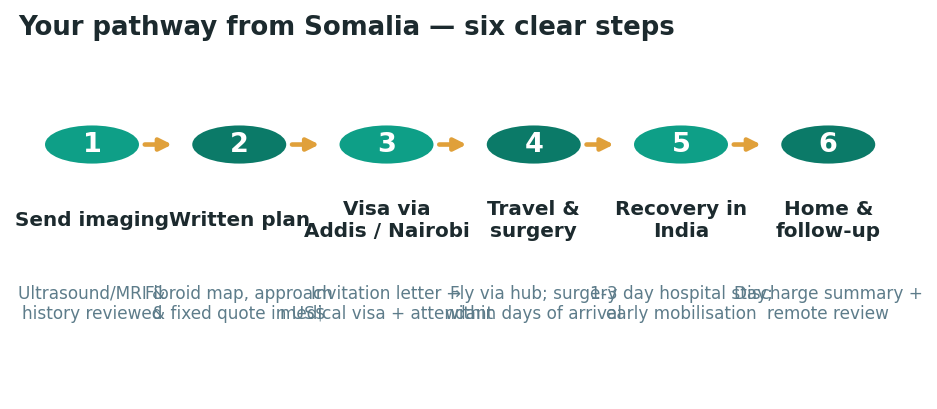
The complete route, start to finish — most of it arranged before you ever leave Somalia.
Removing a fibroid should never mean removing your future
Somalia's families have carried enormous burdens with enormous dignity, and a woman's ability to keep building hers should not depend on chance. A properly performed myomectomy protects both the pregnancy you are hoping for now and the ones that may follow. That is worth choosing carefully, not quickly.
Sources
- 🌐 Indian medical visa (Somali nationals): indianvisaonline.gov.in
- 🌐 Embassy of India, Addis Ababa: eoiaddisababa.gov.in
- 🌐 High Commission of India, Nairobi: hcinairobi.gov.in
- 🌐 Yellow-fever requirements: who.int/health-topics/yellow-fever
- 🌐 Hospital accreditation (India): nabh.co · jointcommissioninternational.org
- 🌐 Verify a surgeon's registration: nmc.org.in
Do not decide alone, and do not decide blind
If you want your imaging reviewed properly and an honest written plan — including whether keyhole surgery is genuinely possible for your fibroids, and how the uterine wall will be closed — that is precisely the independent guidance I provide, without a single hospital's interest attached to my advice. Dr. Dheeraj Bojwani
Frequently Asked Questions by Somali Patients about Laparoscopic and Robotic Myomectomy in India
Why should Somali patients consider myomectomy in India?
Somali patients may consider India for laparoscopic or robotic myomectomy when they need experienced gynaecological surgeons, treatment for complex fibroids or a fertility-preserving surgical approach. The guide highlights India's experience with complex, multiple and deep-seated fibroids.
How much does laparoscopic or robotic myomectomy cost in India for Somali patients?
The guide gives an indicative all-inclusive cost of approximately USD 2,800–6,000, covering diagnosis, surgery, hospital stay and initial follow-up. Patients should obtain a written estimate before booking travel.
Can Somali patients preserve fertility after myomectomy in India?
Yes. Myomectomy removes fibroids while leaving the uterus intact, specifically to preserve the possibility of pregnancy. The surgical approach and uterine closure should be discussed carefully with the surgeon.
Is laparoscopic or robotic myomectomy possible for every Somali patient?
No. The number, size, depth and position of the fibroids determine whether minimally invasive surgery is appropriate. The surgeon should review the patient's actual ultrasound or MRI before confirming the surgical approach.
Why is uterine closure important for Somali women undergoing myomectomy?
Uterine closure is particularly important when future pregnancy is planned. Patients should ask the surgeon how the uterine wall will be repaired after the fibroids are removed and how the technique supports future pregnancy planning.
How long does recovery take after laparoscopic or robotic myomectomy in India?
The guide states that a well-performed laparoscopic or robotic procedure may allow a return to ordinary life within approximately 1–2 weeks, while open surgery typically requires around 4–6 weeks before normal activity resumes.
Can fibroids return after myomectomy for Somali patients?
Yes. Myomectomy removes the fibroids present at the time of surgery but does not remove the underlying tendency to develop new fibroids. Follow-up scans may therefore be needed after treatment.
How can Somali patients choose a myomectomy surgeon in India?
Patients should ask how many laparoscopic or robotic myomectomies the surgeon performs each year and ask about their approach to uterine closure. Hospital accreditation, including NABH or JCI where applicable, should also be checked.
How do Somali patients travel to India for myomectomy treatment?
There is no direct flight between Somalia and India. Patients can travel through Nairobi, Addis Ababa, Dubai or Djibouti. Medical visas are issued through the Indian missions in Addis Ababa or Nairobi against a hospital invitation letter, and patients should carry a valid yellow-fever vaccination certificate.
What should Somali patients send to the Indian hospital before travelling for myomectomy?
Patients should send their actual ultrasound or MRI images, rather than only a written medical summary. This allows the surgeon to assess the fibroids and determine whether laparoscopic or robotic surgery is genuinely appropriate before the patient leaves Somalia.
Page Summary
Laparoscopic and robotic myomectomy can remove uterine fibroids while preserving the uterus, making fertility preservation a central consideration for Somali patients. The safest surgical approach depends on the number, size, depth and position of the fibroids and should be decided after reviewing actual imaging. Minimally invasive surgery may reduce internal scarring and shorten recovery compared with open surgery when clinically suitable. Patients should carefully evaluate the surgeon's experience, uterine closure technique and hospital accreditation. The guide also covers indicative costs, medical visas, travel routes and practical preparation for Somali patients travelling to India.
Citation Block
| Topic | Information |
|---|---|
| Topic Information | Laparoscopic and Robotic Myomectomy in India for Somali Patients |
| Treatment | Fertility-Preserving Myomectomy |
| Country | India |
| Intended Audience | Somali Patients |
| Primary Condition | Uterine Fibroids |
| Main Surgical Approaches | Laparoscopic, Robotic and Open Myomectomy |
| Procedure Selection | Based on Fibroid Number, Size, Depth and Position |
| Imaging Requirement | Actual Ultrasound or MRI Should Be Reviewed |
| Fertility Consideration | Protect Future Pregnancy Possibility |
| Uterine Closure | Discuss Closure Technique With the Surgeon |
| Recovery | Approximately 1–2 Weeks for Minimally Invasive Surgery; 4–6 Weeks for Open Surgery |
| Fibroid Recurrence | New Fibroids May Develop After Myomectomy |
| Surgeon Selection | Ask About Annual Laparoscopic and Robotic Myomectomy Volume |
| Hospital Accreditation | Check NABH or JCI Accreditation |

Our Mission Statement
Our mission is to place patients at the centre of every healthcare decision by providing trustworthy, evidence-based, and unbiased medical information. We believe that informed patients make better decisions. Backed by personalised guidance from our experienced advisory team, we help patients understand their treatment options, compare them objectively, and confidently choose the path that best suits their medical needs and personal circumstances.
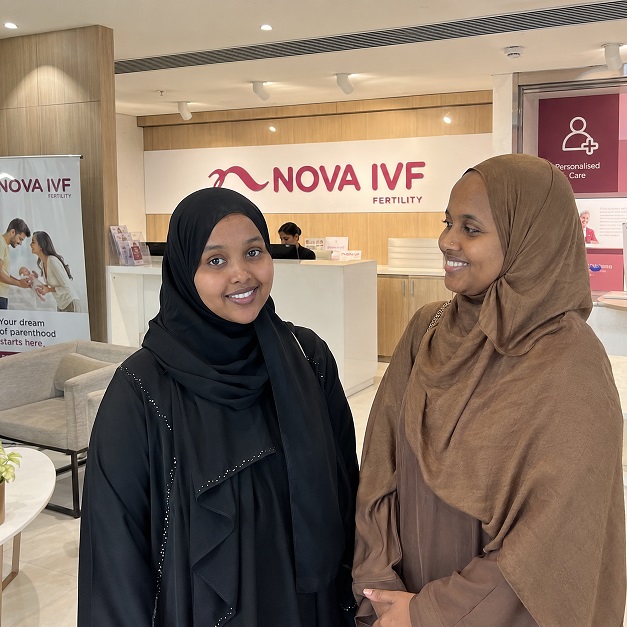
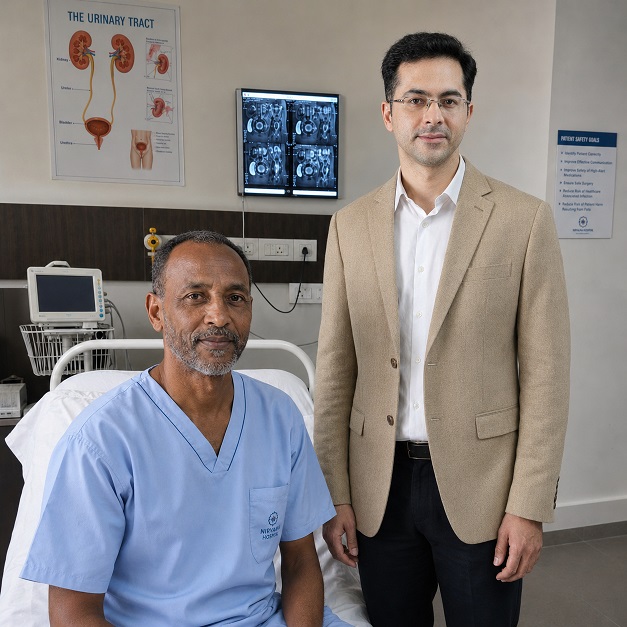
Patient Testimonials from Somalia
Ready to Take the First Step?
Share your Medical Reports with our Healthcare Managers Today and Get a FREE CONSULTATION, a Personalized Treatment Plan, and Complete Support from Arrival to Recovery.
Get Your Free ConsultationAreas We Serve
This resource has been thoughtfully prepared for patients from Somalia who are considering medical treatment in India. We also welcome patients from the wider region in the countries mentioned below-
We assist patients from:
- Ethiopia
- Djibouti
- Yemen
- Kenya
- Seychelles
- Somalia
- South Sudan
- Tanzania
- Uganda
- Zambia
- Zimbabwe
- Angola
- Cameroon
- Central African Republic
Many of the insights, treatment pathways, hospital recommendations, travel guidance, and patient support services described here are equally relevant and may be used as a reference when planning treatment in India.
From Somalia to India: Your Complete Patient Support Guide
- Best Brain Tumour Surgeons & Hospitals in India for Somali Patients
- Best Cancer Treatment Surgeons & Hospitals in India for Somali Patients
- Best Cardiac Surgeons & Hospitals in India for Somali Patients
- Best CyberKnife Teams & Centres in India for Somali Patients
- Best Heart Valve Replacement Surgeons & Hospitals in India for Somali Patients
- Best Hip Surgeons & Hospitals in India for Somali Patients
- Best Knee Surgeons & Hospitals in India for Somali Patients
- Best Neurosurgeons & Hospitals in India for Somali Patients
- Best Paediatric Cardiac Surgeons & Hospitals in India for Somali Patients
- Best Paediatric Neurosurgeons & Hospitals in India for Somali Patients
- Best Spine Surgeons & Hospitals in India for Somali Patients
- Bariatric Surgery in India for Patients from Somalia
- Brain Tumour Surgery in India for Patients from Somalia
- Cancer Treatment and Surgery in India for Patients from Somalia
- Cardiac Surgery in India for Patients from Somalia
- Cosmetic and Plastic Surgery in India for Patients from Somalia
- CyberKnife Treatment in India for Patients from Somalia
- Dental Surgery in India for Patients from Somalia