

Kidney Transplant Treatment in India for Patients from Somalia
Kidney transplant and peritoneal dialysis are not currently available anywhere in Somalia. Hemodialysis, from what is often the country's only referral centre, is the sole option holding patients' lives in place.
When kidneys fail completely, a patient has two real options: dialysis, which filters the blood mechanically several times a week for the rest of their life, or a transplant, which restores the kidney's own function through a single operation. Most countries offer both, letting patients choose or move between them as circumstances change. Somalia, for the most part, currently offers only one. For 24 years I have watched what that narrowed choice actually costs patients, in a way that goes well beyond money.
India performs kidney transplants at genuine scale, almost always using a living donor from the patient's own family, with success rates matching international standards and nephrology teams experienced in exactly the kind of advanced, dialysis-dependent kidney failure common among patients referred from Somalia — at a fraction of the cost of the same care in the Gulf, Europe or the United States.
Healing Journeys of Somali Patients









Key Takeaways
- The guide states that peritoneal dialysis and kidney transplantation are currently unavailable in Somalia, leaving haemodialysis as the main available treatment option for end-stage kidney failure.
- The guide highlights the risks associated with interrupted dialysis. A published study cited in the guide found uraemia from missed dialysis sessions accounted for 26.4% of ICU admissions among Somali dialysis patients.
- The causes of kidney failure shown in the page 2 chart include hypertension at 30%, diabetes at 28%, glomerular disease at 20% and other causes at 22%.
- The guide stresses that not every dialysis patient is automatically a transplant candidate. The recipient must be medically fit for major surgery and lifelong immunosuppression, while the proposed donor must be healthy and compatible.
- For international patients, the guide explains that a living donor will generally be a close family member, with blood-type and tissue compatibility assessed before travel.
- Living-donor transplantation requires assessment of both the recipient and donor. Patients are advised to ask how many living-donor transplants the named surgical team performs each year and whether the centre has a dedicated living-donor coordinator.
- A living-donor kidney transplant at a reputable private Indian hospital is estimated at approximately US$9,000–US$18,000 all-in, including evaluation, donor and recipient surgery and initial recovery. Lifelong immunosuppressant medication is a separate ongoing cost.
- The final cost may depend on donor blood-type compatibility. The guide recommends obtaining a written quotation specific to the donor and recipient rather than relying on a general transplant package price.
- Important warning signs include no cardiovascular assessment before surgery, donor compatibility not being confirmed before travel, no plan for uninterrupted dialysis during travel, and a quotation that keeps changing.
- Somali patients should send actual kidney-function tests and a complete dialysis history, while ensuring dialysis is not missed during the travel period. The page 5 pathway shows the process from initial records and nephrology review through donor work-up, visa, final compatibility testing, transplant/recovery and long-term follow-up.
Quick Facts
- Treatment
- Kidney Transplantation
- Country
- India
- Patients
- Patients from Somalia
- Key Specialists
- Nephrologist / Kidney Transplant Surgeon
- Main Treatment Setting
- Living-Donor Kidney Transplant
- Primary Assessment
- Nephrology Evaluation and Donor Compatibility Testing
- Donor Requirement
- Healthy and Compatible Family Donor
- Compatibility
- Blood Type and Tissue Matching
- Indicative Cost
- US$9,000–US$18,000 All-In
- Additional Cost
- Lifelong Immunosuppressant Medication
- Important Check
- Living-Donor Transplant Experience of the Named Team
- Cardiovascular Assessment
- Required Before Major Transplant Surgery
- Pre-Travel Records
- Kidney Function Tests and Complete Dialysis History
- Travel Routes
- Nairobi, Addis Ababa, Dubai or Djibouti
- Visa
- Hospital Invitation and Medical Visa
- Important Travel Requirement
- Maintain Uninterrupted Dialysis During Travel Planning
- Follow-Up
- Long-Term Transplant and Immunosuppression Monitoring
- Author
- Dr. Dheeraj Bojwani
- Experience
- 24+ Years
In Brief
For Somali patients considering kidney transplantation in India, the guide recommends beginning with a proper nephrology assessment and evaluation of a potential family donor, rather than arranging travel before compatibility and medical suitability are established. Blood-type and tissue matching, cardiovascular assessment and donor health evaluation should be completed before travel wherever possible. Patients should also maintain uninterrupted dialysis while the transplant is being arranged, obtain a written donor-specific quotation, and choose a centre with substantial living-donor transplant experience and a dedicated donor coordinator.
First, know exactly how narrow the options are inside Somalia today
A published study from a major Mogadishu hospital states the situation plainly: peritoneal dialysis and kidney transplantation are not available in Somalia, leaving haemodialysis as the sole viable option for end-stage kidney failure. Even haemodialysis itself is concentrated in very few centres; one of the country's principal dialysis programmes has functioned as effectively the only referral centre serving patients from across the region. For a patient whose kidneys have failed completely, this means life depends on reaching one of a handful of machines, several times a week, indefinitely — with no domestic path to the operation that could end that dependency altogether.
The Somali difference: dialysis itself is the fragile link, not just the wait for transplant
Missing even a single dialysis session is not a minor inconvenience; it allows waste products to build rapidly to dangerous levels. A study of hospital readmissions among Somali dialysis patients found that uraemia caused directly by missed dialysis sessions accounted for over a quarter of all ICU admissions in this group, behind only pulmonary oedema and sepsis as leading causes. The reasons patients miss sessions are rarely medical: cost, distance to the one available centre, and gaps in understanding about why the treatment cannot simply be paused are all cited factors. A transplant does not just end the search for a machine — it removes the single point of failure that dialysis dependency in Somalia currently represents.
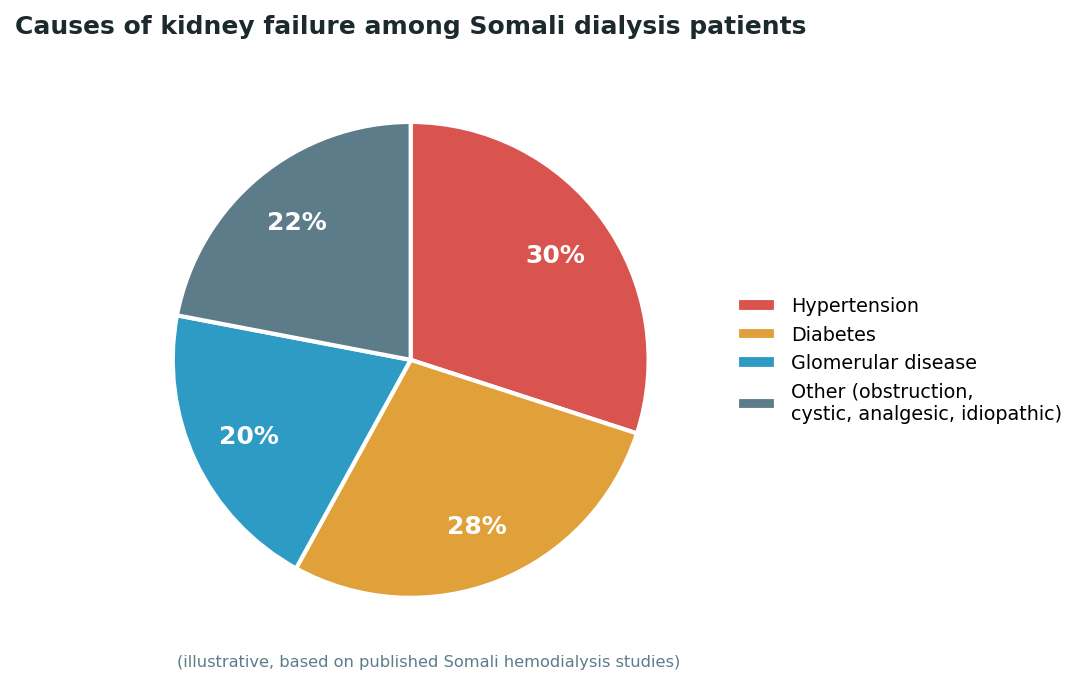
Illustrative breakdown of underlying causes of kidney failure among Somali dialysis patients, based on published risk-factor data.
Why the emergency pattern keeps repeating
The same published research found that heart failure, coronary artery disease and other cardiovascular complications affect close to a third of Somali dialysis patients, driven heavily by diabetes, anaemia and hypertension — the same conditions that caused the kidney failure in the first place, now compounding it further. This is a well-recognised pattern in dialysis medicine everywhere, but it becomes more dangerous specifically where reliable, uninterrupted dialysis cannot be guaranteed. A transplant, once it takes hold, restores continuous kidney function around the clock rather than the intermittent filtering dialysis provides only a few hours at a time, several days a week.
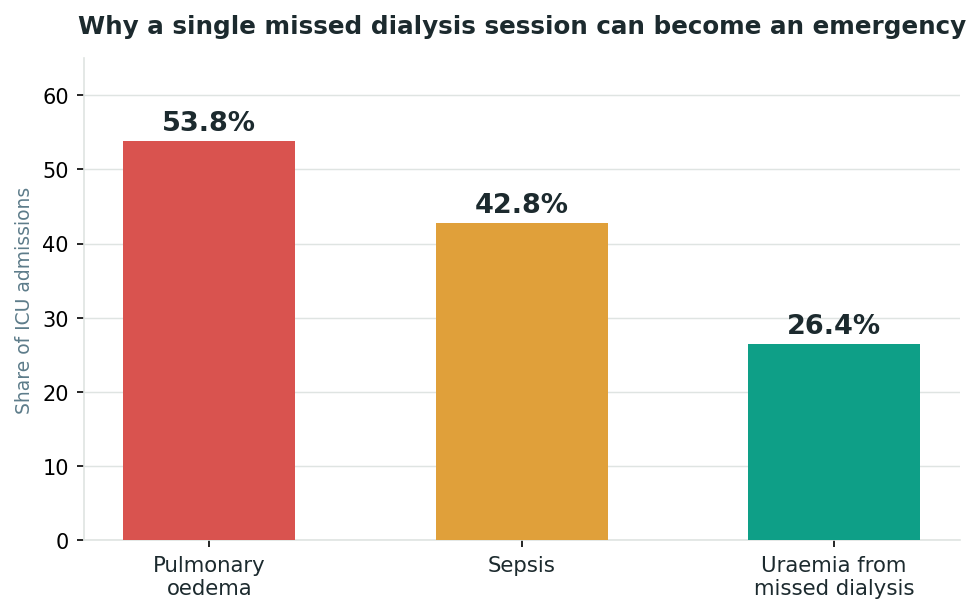
Published leading causes of ICU admission among Somali hemodialysis patients readmitted to hospital.
Know when to seek an evaluation, and do not wait for a crisis
Swelling in the legs, ankles or around the eyes, foamy or unusually coloured urine, persistent fatigue out of proportion to daily activity, and a marked drop in how much urine is passed are all signs of declining kidney function worth investigating with a simple blood and urine test, well before dialysis becomes necessary at all. For anyone already on dialysis, this guide's most urgent message is simpler still: never treat a missed session as something to make up later if it can possibly be avoided, and if travel or cost pressures are making regular sessions difficult, that difficulty itself is a reason to accelerate, not delay, exploring a transplant. Diabetes and high blood pressure, the two leading causes of kidney failure among Somali dialysis patients, are also the two most manageable when caught and treated early, long before they progress to the point of needing dialysis at all.
Not every patient on dialysis is automatically a transplant candidate
A kidney transplant requires a recipient healthy enough to withstand major surgery and lifelong immunosuppression, and a donor, almost always a close family member for international patients under Indian regulations, who is confirmed healthy and compatible through blood type and tissue matching. Active infection, certain cancers, and some cardiovascular conditions can delay or rule out transplant until they are addressed. This is precisely why a proper nephrology evaluation, not just a wish to stop dialysis, has to come first — and why bringing potential donors' basic health information alongside your own is one of the most useful things a family can do before travelling.
What it costs
In more than 24 years arranging this kind of care, the disputes I have seen were almost never about the price itself — they were about a diagnosis, or a cost, nobody had bothered to write down before the flight was booked. Cost depends on donor blood-type compatibility, since a mismatch requiring additional treatment to proceed safely increases the total significantly.
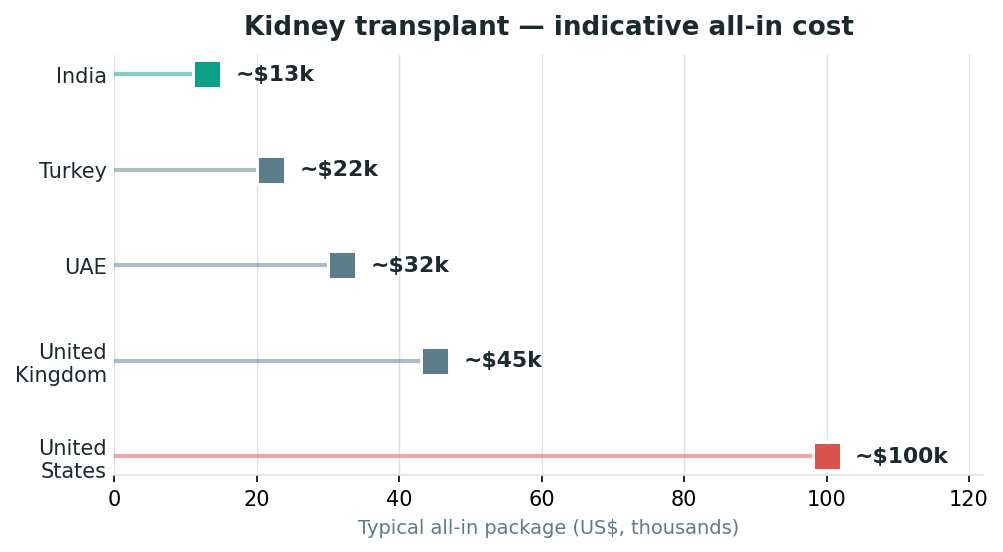
Indicative all-in cost for kidney transplant. India sits far below every common alternative.
A living-donor kidney transplant in a reputable private Indian hospital typically runs US$9,000 to US$18,000 all-in, covering evaluation, surgery for both donor and recipient, and initial recovery. Lifelong immunosuppressant medication after transplant is a separate, ongoing cost. Ask for a quote specific to your donor's blood type compatibility with yours.
Why the transplant centre's living-donor experience specifically matters
Living-donor kidney transplant is a genuinely different discipline from deceased-donor transplant, since it involves two simultaneous, carefully coordinated operations and a healthy donor whose long-term wellbeing matters just as much as the recipient's outcome. Ask specifically how many living-donor transplants, not transplants overall, the named surgical team performs each year, what the donor's own long-term follow-up plan looks like, and whether the centre has a dedicated living-donor coordinator managing the process. A programme built specifically around living donation, rather than one that occasionally accommodates it, tends to run this two-patient process considerably more smoothly.
Four signals that should make you stop and walk away
No cardiovascular assessment before surgery is planned. Given how common heart complications are in dialysis-dependent patients, this should be standard, not optional.
Donor compatibility not confirmed before travel. Blood type and tissue matching should be tested before committing to travel, not discovered on arrival.
No plan for dialysis continuity while travel is arranged. The weeks before transplant still require uninterrupted dialysis. Ask how this is being coordinated.
The price keeps moving. A verbal estimate that shifts each time you ask is not an estimate. Demand a fixed figure in writing, covering both donor and recipient.
The practical journey from Somalia — plan it before you fly
There is no direct flight between Somalia and India; patients route through Nairobi, Addis Ababa, Dubai or Djibouti. Because there is no full Indian mission inside Somalia, the medical visa is issued through the Embassy of India in Addis Ababa or the High Commission in Nairobi , against a written invitation letter from the treating hospital, and a living donor will need documentation confirming the family relationship, since Indian regulations require this for international patients. Since your route crosses yellow-fever territory, carry a valid yellow-fever vaccination certificate . Above every other instruction: send your actual kidney function tests and complete dialysis history, not just a summary, and coordinate the timing so dialysis is never missed during the travel period itself.
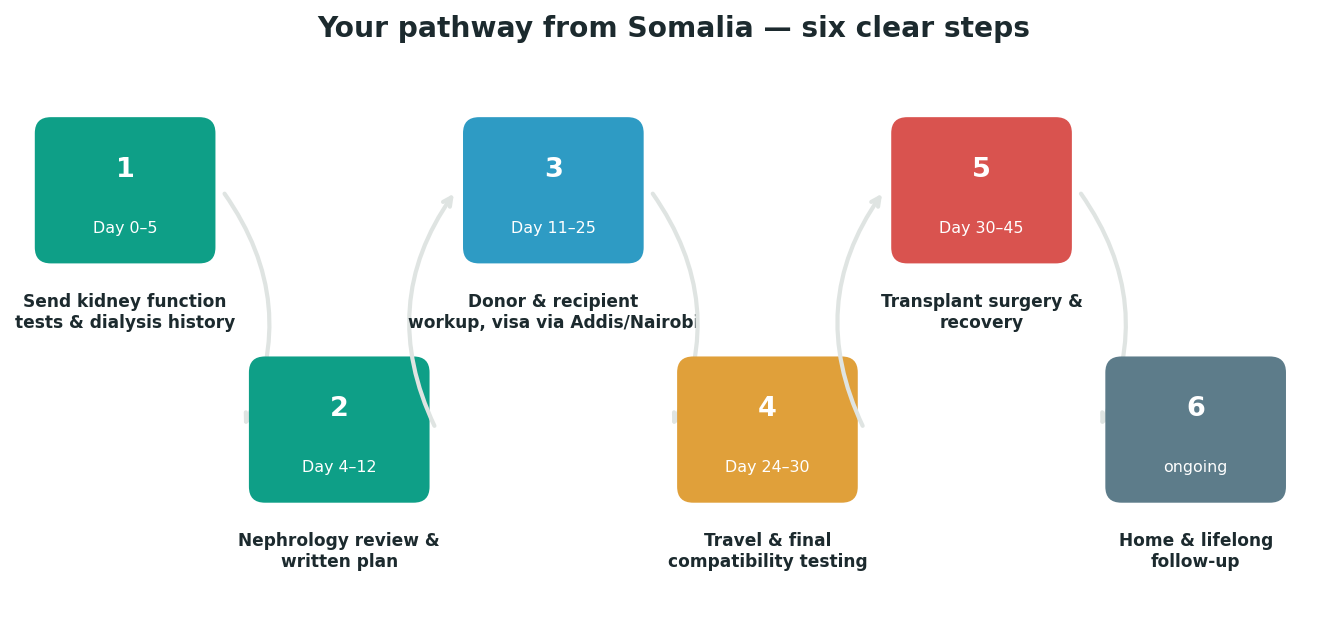
The complete route, start to finish — both donor and recipient need separate evaluation and recovery time.
A single point of failure does not have to be permanent
Dependence on one dialysis centre, reachable a few times a week for the rest of a life, is not the only outcome available once kidneys fail. A transplant, from a willing and compatible family member, offers a way out of that dependency entirely — and it is more reachable, and more affordable, than most families initially assume.
Sources & useful links
- 🌐 Indian medical visa (Somali nationals) — indianvisaonline.gov.in
- 🌐 Embassy of India, Addis Ababa — eoiaddisababa.gov.in
- 🌐 High Commission of India, Nairobi — hcinairobi.gov.in
- 🌐 Yellow-fever requirements — who.int/health-topics/yellow-fever
- 🌐 Hospital accreditation (India) — nabh.co · jointcommissioninternational.org
- 🌐 Verify a surgeon's registration — nmc.org.in
Do not decide alone, and do not decide blind
If you want your case reviewed properly and an honest written plan — including a realistic assessment of donor options within your family — that is precisely the independent guidance I provide, without a single hospital's interest attached to my advice. Dr. Dheeraj Bojwani · Independent medical travel advisor
Frequently Asked Questions by Somali Patients about Kidney Transplant Treatment in India
Is kidney transplantation available in Somalia?
The guide states that kidney transplantation and peritoneal dialysis are currently unavailable in Somalia, leaving haemodialysis as the main available treatment for end-stage kidney failure.
Why is uninterrupted dialysis important for Somali patients waiting for a transplant?
The guide highlights that missed dialysis can cause dangerous accumulation of waste products. Uraemia caused by missed sessions accounted for 26.4% of ICU admissions in the cited Somali dialysis study.
Can every Somali dialysis patient receive a kidney transplant in India?
No. The recipient must be healthy enough for major surgery and lifelong immunosuppression, and conditions such as active infection, certain cancers or some cardiovascular problems may delay or prevent transplantation.
Who can donate a kidney to a Somali patient in India?
The guide states that international patients generally require a close family member as the living donor, with the donor's health and compatibility assessed before transplantation.
What compatibility tests are required before kidney transplantation?
The guide highlights blood-type and tissue matching. It recommends completing donor compatibility testing before committing to travel.
How much does kidney transplantation cost in India for Somali patients?
The guide gives an indicative all-in range of US$9,000–US$18,000, covering evaluation, surgery for both donor and recipient and initial recovery. Lifelong immunosuppressant medicines are additional.
Does donor blood-type compatibility affect the transplant cost?
Yes. The guide explains that a blood-type mismatch may require additional treatment and can increase the overall cost. Patients should request a quotation based on their specific donor-recipient compatibility.
What should Somali patients check when choosing a kidney transplant centre in India?
They should ask about the team's annual living-donor transplant experience, donor follow-up, cardiovascular assessment, compatibility testing and whether the hospital has a dedicated living-donor coordinator.
What records should Somali patients send before travelling to India?
Patients should send their actual kidney-function tests and complete dialysis history. Potential donors should also provide their basic health information so the transplant team can begin evaluating suitability.
What is the kidney transplant journey from Somalia to India?
The guide outlines the process as kidney-function tests and dialysis history → nephrology review → donor work-up and visa → final compatibility testing → travel and transplant/recovery → home and lifelong follow-up. It also stresses that dialysis should not be missed while travel and transplantation are being arranged.
Page Summary
This guide explains the key considerations for Somali patients exploring kidney transplantation in India, particularly because kidney transplantation and peritoneal dialysis are described as unavailable in Somalia. It covers the risks of missed haemodialysis, causes of kidney failure, transplant eligibility, living-donor and recipient assessment, blood-type and tissue compatibility, cardiovascular evaluation, indicative costs of US$9,000–US$18,000, hospital and surgical-team selection, dialysis continuity during travel, visa arrangements and the six-step pathway from medical records and nephrology review through transplant recovery and lifelong follow-up.
Citation Block
| Topic | Information |
|---|---|
| Topic Information | Kidney Transplant Treatment in India for Patients from Somalia |
| Treatment | Kidney Transplantation |
| Intended Audience | Patients from Somalia |
| Key Specialist | Nephrologist / Kidney Transplant Surgeon |
| Main Treatment Type | Living-Donor Kidney Transplant |
| Primary Assessment | Nephrology Evaluation and Donor Compatibility Testing |
| Donor Requirement | Healthy and Compatible Family Donor |
| Compatibility Testing | Blood Type and Tissue Matching |
| Indicative Cost | US$9,000–US$18,000 All-In |
| Additional Cost | Lifelong Immunosuppressant Medication |
| Important Check | Living-Donor Transplant Experience of the Named Team |
| Cardiovascular Assessment | Required Before Surgery |
| Pre-Travel Records | Kidney Function Tests and Complete Dialysis History |
| Dialysis Requirement | Avoid Missing Dialysis During Travel Planning |
| Travel Routes | Nairobi, Addis Ababa, Dubai or Djibouti |
| Visa Requirement | Hospital Invitation and Medical Visa |
| Donor Documentation | Proof of Family Relationship |
| Patient Journey | Kidney tests/dialysis history → nephrology review → donor work-up/visa → final compatibility testing → transplant/recovery → long-term follow-up |
| Follow-Up | Long-Term Transplant and Immunosuppression Monitoring |


Our Mission Statement
Our mission is to place patients at the centre of every healthcare decision by providing trustworthy, evidence-based, and unbiased medical information. We believe that informed patients make better decisions. Backed by personalised guidance from our experienced advisory team, we help patients understand their treatment options, compare them objectively, and confidently choose the path that best suits their medical needs and personal circumstances.
Patient Testimonials from Somalia




Ready to Take the First Step?
Share your Medical Reports with our Healthcare Managers Today and Get a FREE CONSULTATION, a Personalized Treatment Plan, and Complete Support from Arrival to Recovery.
Get Your Free ConsultationAreas We Serve
This resource has been thoughtfully prepared for patients from Somalia who are considering medical treatment in India. We also welcome patients from the wider region in the countries mentioned below-
We assist patients from:
- Ethiopia
- Djibouti
- Yemen
- Kenya
- Seychelles
- Somalia
- South Sudan
- Tanzania
- Uganda
- Zambia
- Zimbabwe
- Angola
- Cameroon
- Central African Republic
Many of the insights, treatment pathways, hospital recommendations, travel guidance, and patient support services described here are equally relevant and may be used as a reference when planning treatment in India.
From Somalia to India: Your Complete Patient Support Guide
- Best Brain Tumour Surgeons & Hospitals in India for Somali Patients
- Best Cancer Treatment Surgeons & Hospitals in India for Somali Patients
- Best Cardiac Surgeons & Hospitals in India for Somali Patients
- Best CyberKnife Teams & Centres in India for Somali Patients
- Best Heart Valve Replacement Surgeons & Hospitals in India for Somali Patients
- Best Hip Surgeons & Hospitals in India for Somali Patients
- Best Knee Surgeons & Hospitals in India for Somali Patients
- Best Neurosurgeons & Hospitals in India for Somali Patients
- Best Paediatric Cardiac Surgeons & Hospitals in India for Somali Patients
- Best Paediatric Neurosurgeons & Hospitals in India for Somali Patients
- Best Spine Surgeons & Hospitals in India for Somali Patients
- Bariatric Surgery in India for Patients from Somalia
- Brain Tumour Surgery in India for Patients from Somalia
- Cancer Treatment and Surgery in India for Patients from Somalia
- Cardiac Surgery in India for Patients from Somalia
- Cosmetic and Plastic Surgery in India for Patients from Somalia
- CyberKnife Treatment in India for Patients from Somalia
- Dental Surgery in India for Patients from Somalia