

Joint Arthroscopy and Sports Medicine in India for Patients from Somalia
A knee that gave way on a football pitch and was told to simply "rest" is, a year on, a very different repair from the one it could have been in the first six weeks.
A knee that buckles mid-stride. A shoulder that slips out during a tackle. A locking, catching sensation that never fully goes away after a fall. These are the everyday injuries of an active young population, and for 24 years I have helped patients work out which ones need nothing more than rehabilitation, and which ones need a surgeon before the damage compounds.
India is where that distinction gets made properly. Its leading orthopaedic centres perform arthroscopic knee, shoulder and ankle surgery in genuinely high volume, with fellowship-trained sports medicine surgeons, dedicated arthroscopy suites, and the imaging to tell a repairable tear from one that has already gone too far — at a fraction of the cost of the same evaluation in the Gulf, Europe or the United States.
Healing Journeys of Somali Patients









Key Takeaways
- The guide highlights Somalia's very young population, with a median age of 15.6 years and approximately 47% of the population under 15. Combined with widespread football participation and uneven playing surfaces, this creates a significant setting for sports-related knee and shoulder injuries.
- Common injuries discussed include ACL tears, meniscus tears, shoulder instability, multi-ligament trauma and cartilage or loose-body problems. The illustrative referral chart on page 2 shows ACL tears at 40%, meniscus tears at 25%, multi-ligament trauma at 20% and cartilage/loose-body problems at 15%.
- Delayed diagnosis can worsen an ACL injury. Repeated episodes of knee instability may progressively damage the meniscus and cartilage, turning what could have been a relatively focused ligament reconstruction into a more complex procedure.
- The guide identifies several warning signs that deserve MRI assessment rather than prolonged rest, including rapid swelling after a twisting injury, a distinct popping sensation, repeated giving-way, recurrent shoulder dislocation and a locked knee that cannot fully straighten.
- Not every ligament or meniscus injury requires surgery. Partial ACL injuries, small stable meniscus tears and some first-time shoulder dislocations may be managed with structured rehabilitation, depending on the patient's activity level and goals.
- Surgery may be more appropriate for a complete ACL tear in someone returning to pivoting sports or physical work, a mechanically locking meniscus tear, recurrent shoulder dislocation or symptomatic loose cartilage fragments.
- The guide stresses that surgeon-specific experience matters. Patients should ask how many ACL reconstructions, meniscus repairs and shoulder arthroscopies the named surgeon performs each year, rather than relying only on the hospital's overall orthopaedic volume.
- Meniscus preservation is particularly important in young patients. Tears in the outer blood-supplied zone may often be repaired, while deeper poorly vascularised tears may require partial removal when repair is unlikely to heal.
- A surgical arthroscopy case at a reputable private Indian hospital is estimated at approximately US$3,500–US$8,000 all-in. Straightforward ACL reconstruction may fall toward the lower end, while combined ligament, meniscus and cartilage procedures may approach the higher end.
- Somali patients should send their actual MRI images rather than only a written radiology report before travelling. The treatment plan should also consider the patient's sport, position, physical demands and rehabilitation goals.
Quick Facts
- Treatment
- Joint Arthroscopy and Sports Medicine
- Country
- India
- Patients
- Patients from Somalia
- Key Specialist
- Sports Medicine / Arthroscopic Orthopaedic Surgeon
- Main Injuries
- ACL Tears, Meniscus Tears and Shoulder Instability
- Primary Assessment
- MRI and Orthopaedic Sports-Medicine Review
- Treatment Options
- Rehabilitation, Arthroscopy, ACL Reconstruction and Meniscus Repair
- Indicative Cost
- US$3,500–US$8,000 All-In
- Important Check
- Named Surgeon's Annual Arthroscopy Experience
- ACL Check
- Graft Type and Fixation Method
- Meniscus Check
- Ask Whether Repair Is Possible Before Removal
- Pre-Travel Records
- Actual MRI Images and Previous Medical Records
- Travel Routes
- Nairobi, Addis Ababa, Dubai or Djibouti
- Visa
- Hospital Invitation and Medical Visa
- Attendants
- Up to Two Medical Attendants
- Recovery
- Surgery Followed by Structured Rehabilitation
- Follow-Up
- Rehabilitation and Return-to-Activity Monitoring
- Author
- Dr. Dheeraj Bojwani
- Experience
- 24+ Years
In Brief
For Somali patients considering joint arthroscopy in India, the guide recommends reviewing the actual MRI and the patient's activity goals before deciding on surgery, because not every ACL, meniscus or shoulder injury requires reconstruction. Where surgery is appropriate, patients should verify the named surgeon's specific arthroscopy experience, understand the proposed graft or fixation method for ACL reconstruction, and ask whether meniscus repair is possible before accepting removal. A written quotation should clearly identify ligament, meniscus and cartilage procedures, while travel planning should allow sufficient time for surgery and recovery in India.
First, know why Somalia's sports injuries look different
This is, on paper, one of the best possible populations for arthroscopic sports medicine to matter. Somalia's median age is 15.6 years, among the youngest of any country in the world, with nearly half the population under 15. Football is by far the country's dominant sport, played constantly and informally on whatever open ground is available. That combination — huge youth participation, high- energy pivoting sports, uneven playing surfaces — produces exactly the injury pattern that arthroscopic surgery was built to treat: ACL tears, meniscus tears, and shoulder instability in otherwise healthy young people with decades of active life ahead of them.
The Somali difference: the injury exists, the subspecialty does not
What is largely missing is not the injury, but the ability to treat it as what it is. Arthroscopy is not general orthopaedics with a smaller incision; it requires a dedicated camera tower, specific instrumentation, and a surgeon with focused sports-medicine training beyond a general orthopaedic qualification. Against Somalia's severe shortage of surgical specialists overall, dedicated arthroscopic capacity is essentially absent outside a handful of facilities. The practical result is that a torn ACL is very often diagnosed, if at all, as "a bad sprain," treated with rest, and left to declare itself as chronic instability months or years later — by which point it is rarely still just an ACL problem.
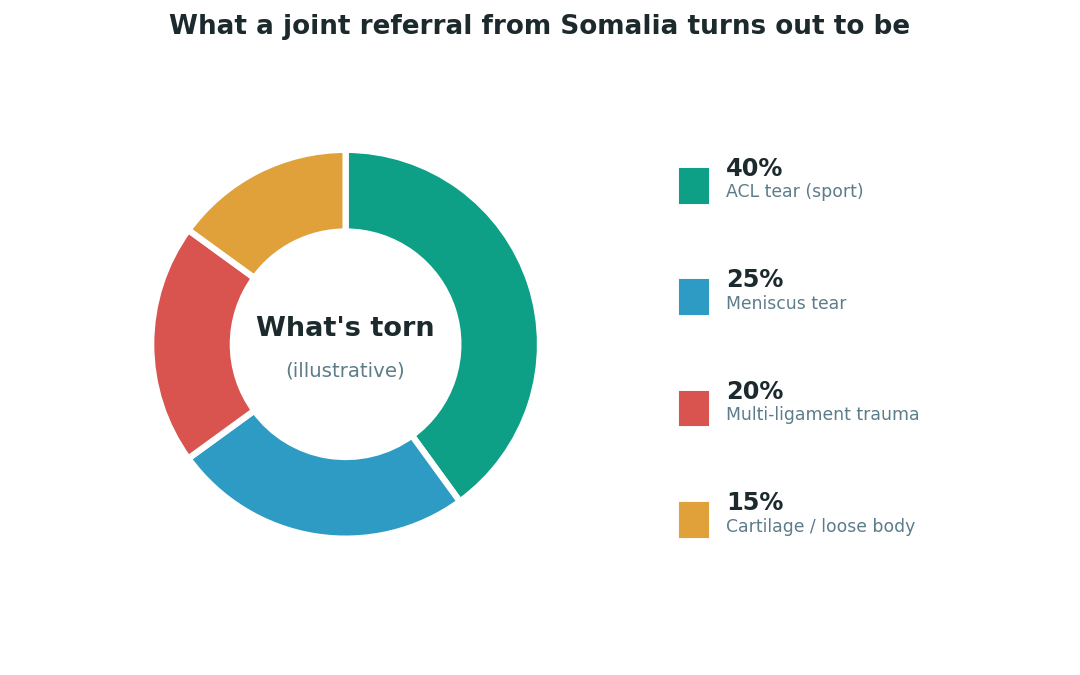
Illustrative breakdown of joint referrals from Somalia, by underlying injury.
Why the wait itself does damage
An ACL-deficient knee does not sit still while it waits for a diagnosis. Every time it gives way — on a football pitch, on a market floor, on uneven ground — it grinds and shears the meniscus and the cartilage lining the joint a little more. What starts as a single, cleanly reconstructable ligament tear can, over months of repeated instability episodes, become a knee with a torn meniscus, damaged cartilage and early degenerative change layered on top. The reconstruction itself does not get harder with time in the way a neglected fracture does, but the knee arriving at surgery does — and what should have been a single clean repair often becomes two or three problems solved at once.
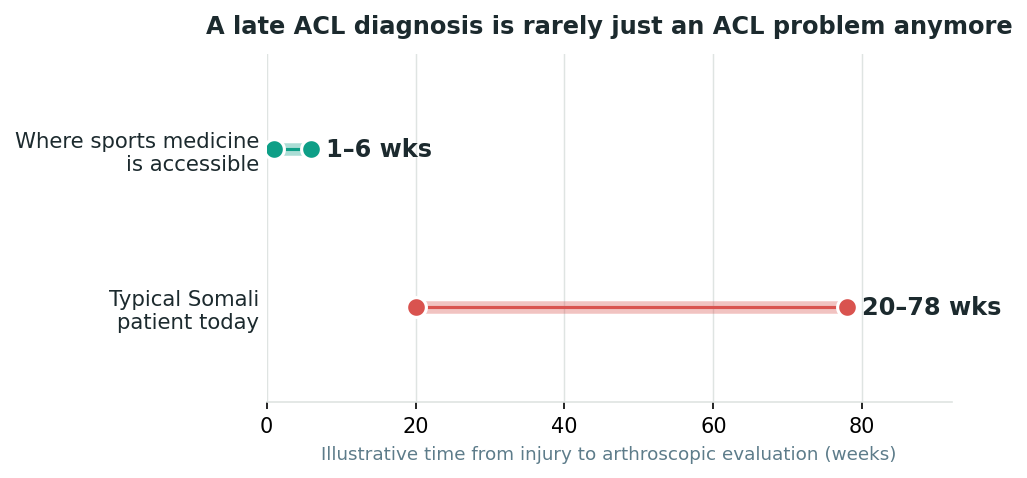
Illustrative time from injury to arthroscopic evaluation: where sports medicine is accessible, versus a typical Somali patient today.
Know the warning signs, and do not wait them out
A knee that swells within hours of a twisting injury, a distinct popping sensation at the moment of injury, a joint that repeatedly gives way or feels unstable on uneven ground, or a shoulder that has slipped out of place more than once are all signs that deserve an MRI, not simply rest and hope. So is a knee that locks, catching in a bent position and refusing to straighten, which often signals a meniscus fragment displaced into the joint itself. Because sports-medicine-trained specialists and MRI access are concentrated in a handful of Somali cities, many young patients are told to rest an injury that will not settle with rest alone — and go on playing or working on a joint that is quietly getting worse with every twist.
Not every torn ligament needs reconstruction
Plenty of knee and shoulder injuries genuinely do not need surgery. A partial ACL sprain, a small stable meniscus tear, or a first-time shoulder dislocation in someone willing to commit to structured rehabilitation can often be managed without an operation, particularly in a less physically demanding lifestyle. Surgery is the right call for a complete ACL tear in someone returning to pivoting sport or physical labour, a meniscus tear causing mechanical locking, recurrent shoulder dislocation, or loose cartilage fragments causing catching and pain. An honest surgeon reviews the actual MRI and asks about activity level and goals before recommending either path — not the imaging report alone.
Why the surgeon's specific caseload matters here more than almost anywhere
Arthroscopic technique is unusually sensitive to a surgeon's ongoing case volume; graft placement in ACL reconstruction, in particular, is a technically exacting step where small errors in tunnel position meaningfully affect long-term stability. Ask directly how many ACL reconstructions and arthroscopic meniscus or shoulder procedures the named surgeon performs each year, not the hospital's total across every orthopaedic surgeon on staff, and whether the graft and fixation hardware being proposed are ones they use routinely rather than occasionally.
Meniscus: repair versus removal
A torn meniscus is not automatically removed, and it should not be treated as disposable cartilage. Tears in the outer, blood-supplied third of the meniscus can often be repaired and stitched back together, preserving the cushioning effect that protects the knee from early arthritis decades later. Tears deeper in the middle, poorly vascularised zone more often need partial removal of the damaged fragment, since that tissue typically will not heal even when repaired. The distinction matters enormously for a teenager or young adult: a knee that has had most of its meniscus removed wears down its cartilage far faster over the following decades than one where the meniscus was preserved. Ask specifically whether repair was attempted and, if not, why the tear was judged unrepairable.
What it costs
In more than 24 years arranging this kind of care, the disputes I have seen were almost never about the price itself — they were about a diagnosis, or a cost, nobody had bothered to write down before the flight was booked. A written quote should say plainly which procedures are included: ligament reconstruction, meniscus work and any cartilage treatment are often billed and planned separately, and a fair quote names all three if all three are needed.
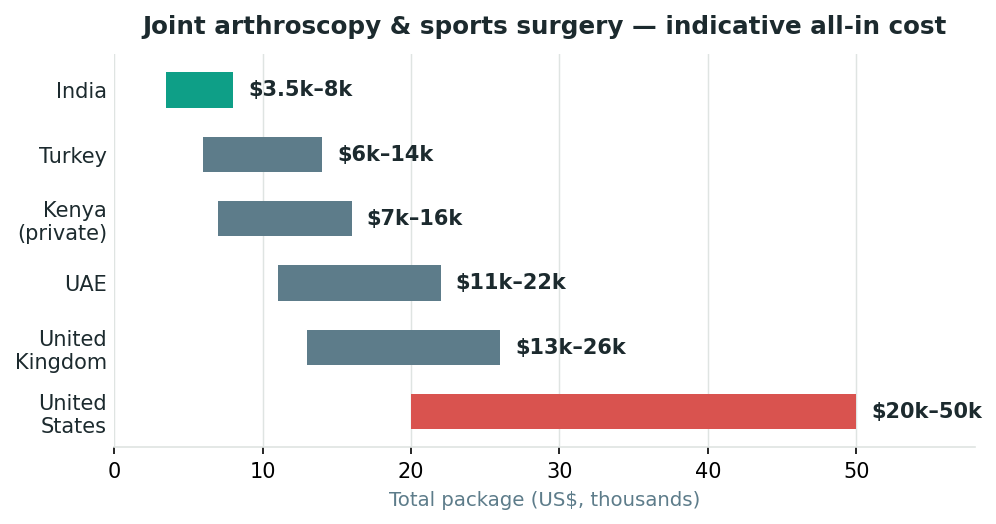
Indicative all-in cost for arthroscopic knee or shoulder surgery. India sits far below every common alternative.
A surgical arthroscopy case in a reputable private Indian hospital typically runs US$3,500 to US$8,000 all-in, with a straightforward single-ligament ACL reconstruction toward the lower end and combined ligament, meniscus and cartilage procedures toward the top. Ask for the figure specific to your actual MRI findings before committing to anything.
Four signals that should make you stop and walk away
Surgery quoted from an X-ray alone. Ligament and meniscus tears do not show on plain X-ray. An MRI review should come before any date is discussed.
No question about activity level or goals. The right treatment for a competitive athlete and a sedentary adult with the same MRI can genuinely differ. If nobody asks, be cautious.
No mention of graft type or fixation. For ACL reconstruction specifically, ask what graft is being used and why. Vague answers are a warning sign.
The price keeps moving. A verbal estimate that shifts each time you ask is not an estimate. Demand a fixed figure in writing.
The practical journey from Somalia — plan it before you fly
There is no direct flight between Somalia and India; patients route through Nairobi, Addis Ababa, Dubai or Djibouti. Because there is no full Indian mission inside Somalia, the medical visa is issued through the Embassy of India in Addis Ababa or the High Commission in Nairobi , against a written invitation letter from the treating hospital. Somali patients may bring up to two medical attendants on attendant visas. Since your route crosses yellow-fever territory, carry a valid yellow-fever vaccination certificate . Above every other instruction: send your actual MRI films, not a written radiology summary, so the surgical team can confirm exactly what is torn before you ever leave home. For a young athlete, it also helps to note the specific sport and position played, since rehabilitation and return-to-play timelines differ between, say, a footballer pivoting on a torn ACL and someone whose daily demands are less explosive.
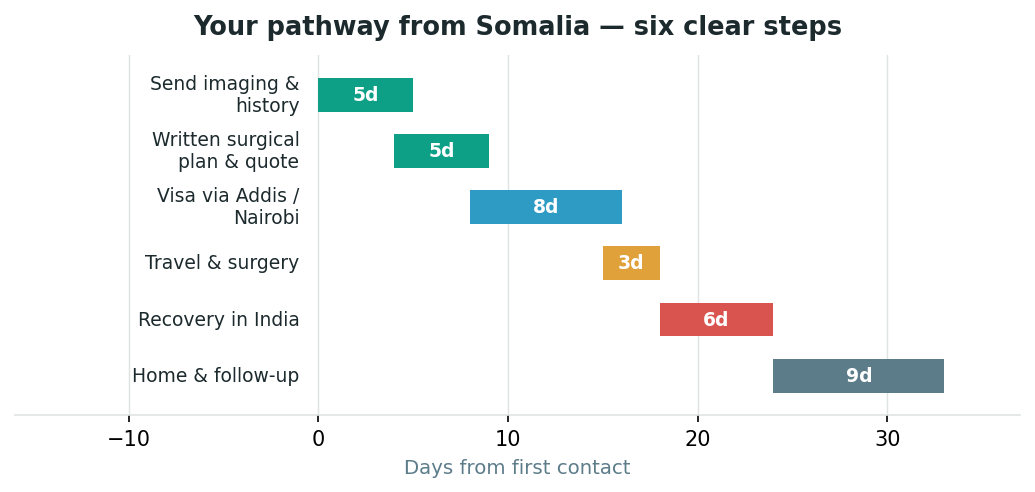
The complete route, start to finish — most of it arranged before you ever leave Somalia.
A young population deserves a young joint's worth of function back
A seventeen-year-old with a reconstructed ACL has, in all likelihood, sixty or more years of walking, working and playing ahead on that knee. Matched to the right procedure early, before instability compounds into further damage, arthroscopic surgery gives Somalia's exceptionally young population back exactly that — a joint that works for the decades still ahead of it.
Sources & useful links
- 🌐 Indian medical visa (Somali nationals) — indianvisaonline.gov.in
- 🌐 Embassy of India, Addis Ababa — eoiaddisababa.gov.in
- 🌐 High Commission of India, Nairobi — hcinairobi.gov.in
- 🌐 Yellow-fever requirements — who.int/health-topics/yellow-fever
- 🌐 Hospital accreditation (India) — nabh.co · jointcommissioninternational.org
- 🌐 Verify a surgeon's registration — nmc.org.in
Do not decide alone, and do not decide blind
If you want your MRI reviewed properly and an honest written plan — including whether rehabilitation alone could still work — that is precisely the independent guidance I provide, without a single hospital's interest attached to my advice. Dr. Dheeraj Bojwani · Independent medical travel advisor
Frequently Asked Questions by Somali Patients about Joint Arthroscopy and Sports Medicine in India
What are the most common sports injuries discussed for Somali patients?
The guide focuses on ACL tears, meniscus tears, shoulder instability, multi-ligament injuries and cartilage or loose-body problems, particularly among young people involved in football and other pivoting activities.
When should a Somali patient get an MRI after a knee injury?
MRI should be considered when there is rapid swelling, a popping sensation, repeated giving-way or instability, or a knee that locks and cannot fully straighten.
Does every ACL tear require reconstruction?
No. The guide explains that treatment depends on the type of tear, activity level and goals. A complete ACL tear in someone returning to pivoting sport or demanding physical work is more likely to require reconstruction.
Can an ACL injury become worse if treatment is delayed?
Yes. Repeated instability can cause additional meniscus and cartilage damage, potentially making the eventual treatment more complex.
Can a meniscus tear be repaired instead of removed?
Sometimes. Tears in the outer blood-supplied portion may be suitable for repair, while deeper tears with limited blood supply may require partial removal when healing is unlikely.
What should Somali patients ask about an ACL surgeon's experience?
They should ask how many ACL reconstructions the named surgeon performs each year, along with the graft and fixation method proposed for their specific case.
How much does arthroscopic surgery cost in India for Somali patients?
The guide gives an indicative all-in range of approximately US$3,500–US$8,000. Simple ACL reconstruction may be toward the lower end, while combined procedures may cost more.
Can some sports injuries be treated without surgery?
Yes. Some partial ACL injuries, stable meniscus tears and first-time shoulder dislocations may respond to structured rehabilitation, depending on the patient's condition and activity requirements.
What should Somali patients send before travelling to India?
They should send the actual MRI images rather than only a written radiology report, along with relevant medical records. Athletes should also provide information about their sport, playing position and activity goals.
What is the treatment journey from Somalia to India?
The guide outlines the pathway as imaging and history review → written surgical plan and quotation → visa → travel and surgery → recovery in India → home and follow-up. The page 5 timeline illustrates these stages across the treatment journey.
Page Summary
This guide explains the key considerations for Somali patients exploring joint arthroscopy and sports medicine treatment in India, focusing on ACL tears, meniscus injuries, shoulder instability and other sports-related joint problems. It covers the risks of delayed ACL diagnosis, warning signs requiring MRI, situations where rehabilitation may be sufficient, indications for surgery, the importance of meniscus preservation and surgeon-specific case volume, indicative costs of US$3,500–US$8,000, pre-travel MRI review, visa and travel arrangements, and the treatment pathway through surgery, recovery and rehabilitation. The pathway chart on page 5 outlines imaging and history review, surgical planning, visa processing, travel and surgery, recovery in India, and home follow-up.
Citation Block
| Topic | Information |
|---|---|
| Topic Information | Joint Arthroscopy and Sports Medicine in India for Patients from Somalia |
| Treatment | Joint Arthroscopy / Sports Medicine |
| Intended Audience | Patients from Somalia |
| Key Specialist | Sports Medicine / Arthroscopic Orthopaedic Surgeon |
| Main Injuries | ACL Tears, Meniscus Tears, Shoulder Instability |
| Other Conditions | Multi-Ligament Trauma, Cartilage and Loose-Body Problems |
| Primary Assessment | MRI and Sports-Medicine Orthopaedic Review |
| Treatment Options | Rehabilitation, Arthroscopy, ACL Reconstruction and Meniscus Repair |
| Indicative Cost | US$3,500–US$8,000 All-In |
| Important Check | Named Surgeon's Specific Arthroscopy Experience |
| ACL Assessment | Graft Type and Fixation Method |
| Meniscus Assessment | Determine Whether Repair Is Possible |
| Pre-Travel Records | Actual MRI Images and Previous Medical Records |
| Hospital Requirement | Dedicated Arthroscopy and Sports-Medicine Facilities |
| Travel Routes | Nairobi, Addis Ababa, Dubai or Djibouti |
| Visa Requirement | Hospital Invitation and Medical Visa |
| Attendants | Up to Two Medical Attendants |
| Patient Journey | MRI/history → surgical plan → visa → travel/surgery → recovery → home follow-up |
| Recovery | Structured Rehabilitation |
| Follow-Up | Return-to-Activity and Long-Term Joint Monitoring |


Our Mission Statement
Our mission is to place patients at the centre of every healthcare decision by providing trustworthy, evidence-based, and unbiased medical information. We believe that informed patients make better decisions. Backed by personalised guidance from our experienced advisory team, we help patients understand their treatment options, compare them objectively, and confidently choose the path that best suits their medical needs and personal circumstances.
Patient Testimonials from Somalia




Ready to Take the First Step?
Share your Medical Reports with our Healthcare Managers Today and Get a FREE CONSULTATION, a Personalized Treatment Plan, and Complete Support from Arrival to Recovery.
Get Your Free ConsultationAreas We Serve
This resource has been thoughtfully prepared for patients from Somalia who are considering medical treatment in India. We also welcome patients from the wider region in the countries mentioned below-
We assist patients from:
- Ethiopia
- Djibouti
- Yemen
- Kenya
- Seychelles
- Somalia
- South Sudan
- Tanzania
- Uganda
- Zambia
- Zimbabwe
- Angola
- Cameroon
- Central African Republic
Many of the insights, treatment pathways, hospital recommendations, travel guidance, and patient support services described here are equally relevant and may be used as a reference when planning treatment in India.
From Somalia to India: Your Complete Patient Support Guide
- Best Brain Tumour Surgeons & Hospitals in India for Somali Patients
- Best Cancer Treatment Surgeons & Hospitals in India for Somali Patients
- Best Cardiac Surgeons & Hospitals in India for Somali Patients
- Best CyberKnife Teams & Centres in India for Somali Patients
- Best Heart Valve Replacement Surgeons & Hospitals in India for Somali Patients
- Best Hip Surgeons & Hospitals in India for Somali Patients
- Best Knee Surgeons & Hospitals in India for Somali Patients
- Best Neurosurgeons & Hospitals in India for Somali Patients
- Best Paediatric Cardiac Surgeons & Hospitals in India for Somali Patients
- Best Paediatric Neurosurgeons & Hospitals in India for Somali Patients
- Best Spine Surgeons & Hospitals in India for Somali Patients
- Bariatric Surgery in India for Patients from Somalia
- Brain Tumour Surgery in India for Patients from Somalia
- Cancer Treatment and Surgery in India for Patients from Somalia
- Cardiac Surgery in India for Patients from Somalia
- Cosmetic and Plastic Surgery in India for Patients from Somalia
- CyberKnife Treatment in India for Patients from Somalia
- Dental Surgery in India for Patients from Somalia