

Selecting the Best IVF and Fertility Specialists in India — A Somali Patient's Guide
"Success rate" is one of the most manipulated numbers in medicine — many clinics quote it per embryo transfer, quietly excluding the roughly 30% of cycles that never reach transfer at all. This guide sets out how to ask for the honest version.
Few numbers in medicine are quoted as selectively as an IVF "success rate." The most commonly advertised figure — pregnancy or live birth rate per embryo transfer — leaves out cycles that never reach transfer at all, which can be up to 30% of everyone who starts. A more honest figure, live birth rate per started cycle, tells a fuller story, and age-stratified data matters enormously: live birth rates run around 46% per transfer for women under 35, falling to roughly 2% by age 44 and older. A related, quieter issue is embryo transfer strategy — transferring two embryos instead of one modestly raises the live birth rate per cycle, but substantially raises the risk of twins, which carry real health risks for both mother and babies. In 24 years of guiding patients through fertility decisions, I have found that asking a clinic how it actually calculates its quoted success rate reveals more about its honesty than any other single question. This guide sets out, plainly, how a Somali patient should verify both the specialist and the clinic's reporting practices before committing to travel.
Healing Journeys of Somali Patients









Key Takeaways
- The guide explains that IVF success rates can be presented in misleading ways, particularly when clinics quote live-birth or pregnancy rates per embryo transfer while excluding cycles that never reach transfer. Up to around 30% of IVF cycles may not reach embryo transfer, so Somali patients should ask whether the quoted figure is calculated per started cycle or per transfer. Age-specific reporting is also important, with the guide citing substantially lower outcomes at older ages.
- Before comparing clinics or prices, Somali patients should establish what is actually causing or contributing to infertility, such as ovarian reserve, male factor or previous failed IVF cycles. The guide recommends that a genuine reproductive endocrinologist review the patient's actual fertility and hormone test results rather than providing a generic estimate based mainly on age.
- For specialist selection, the guide prioritises a named reproductive endocrinologist with dedicated fertility fellowship training, an individualised stimulation protocol and an honest assessment of realistic chances. It also considers willingness to recommend pausing or reconsidering a cycle when the patient's results suggest that proceeding may not be the wisest option.
- The page 3 ranking chart places a named reproductive specialist with dedicated fertility fellowship training highest at 16, followed by honest age-adjusted success rates per started cycle at 15, a default single-embryo-transfer policy at 14 and disclosed embryology laboratory quality at 11. Individualised stimulation, realistic-chance counselling, OHSS monitoring, ART registration and complete costing are also ranked.
- The guide gives particular importance to single embryo transfer as the default approach, with multiple embryos reserved for specific clinical circumstances because transferring more embryos can increase twin pregnancy risk. Patients should also ask about the clinic's blastocyst formation rate, which provides useful information about the performance of its embryology laboratory.
- The guide recommends checking for a structured ovarian hyperstimulation syndrome (OHSS) monitoring protocol, ART-clinic accreditation or registration and a complete written quotation. Medication charges and frozen embryo transfers may be priced separately, so Somali patients should obtain every cost component in writing and plan financially for the possibility that more than one cycle may be required.
- For Somali patients, the guide recommends sending actual hormone and fertility test results to every clinic being compared, rather than providing age alone. It also notes that clinic-scale payments are generally quoted in US dollars and recommends budgeting for more than one cycle because success is not guaranteed on the first attempt.
- Travel should be arranged only after receiving a written treatment plan and cost estimate. The guide notes that India has no resident mission in Mogadishu, with Somali passport holders applying through the Indian High Commission in Nairobi or Embassy of India in Addis Ababa, and that there is no direct Mogadishu–India flight. A clear early-pregnancy follow-up plan should also be arranged before returning home.
Quick Facts
- Author
- Dr. Dheeraj Bojwani
- Experience
- 24+ Years
- Treatment
- IVF & Fertility Treatment
- Patients
- Somali Patients
- First Assessment
- Ovarian reserve, hormone and fertility tests
- Key Specialist
- Reproductive Endocrinologist
- Specialist Training
- Dedicated Fertility / Reproductive Medicine Fellowship
- Case Assessment
- Individualised stimulation protocol
- Success Rate Check
- Per started cycle vs per embryo transfer
- Embryo Transfer
- Single embryo as default
- Lab Check
- Blastocyst formation rate
- Safety
- Structured OHSS monitoring
- Clinic Check
- ART registration / accreditation
- Cost Check
- Written estimate including medications and frozen transfers
- Medical Records
- Actual hormone and fertility test results
- Budget
- Plan for potentially more than one cycle
- Visa
- Medical visa through relevant Indian mission
- Travel
- Connecting flights from Mogadishu
- Follow-Up
- Early-pregnancy monitoring plan
- Key Warning
- Success rate quoted without explaining calculation
- Decision Principle
- Prioritise specialist expertise and transparent IVF outcome reporting.
This is not a case against IVF in India, which offers genuinely excellent programmes with strong outcomes. It is a case for making sure any number you are shown means what you think it means.
In Brief
For Somali patients considering IVF in India, the key decision is to verify a fertility-fellowship-trained reproductive specialist and a clinic that reports success rates honestly per started cycle rather than relying only on attractive per-transfer figures. Patients should also confirm an individualised stimulation plan, single-embryo-transfer policy, embryology laboratory quality, OHSS monitoring, complete costs and a written early-pregnancy follow-up plan before travelling.
First, Establish What Your Case Actually Needs
Before comparing clinics or prices, get clarity on what is driving your specific infertility — ovarian reserve, male factor, prior failed cycles, or another cause — and how that shapes your realistic chances and treatment plan. This assessment should come from a genuine reproductive endocrinologist reviewing your actual test results, not a general estimate based on age alone.
Two Decisions, Not One
Choosing well depends on two things: the specialist's own dedicated fertility training, and the clinic's honesty in how it reports outcomes and manages embryo transfer. Because success-rate reporting and transfer policy are clinic-level practices that shape both the numbers you are shown and your actual medical risk, the clinic's own transparency carries particular weight in this guide.
Part One: Verifying the Specialist
These points matter more than a clinic's advertised success rate or general marketing claims.
1. A named reproductive endocrinologist with a dedicated fertility fellowship, not a general gynaecologist offering IVF as one of several services.
2. An individualised stimulation protocol, matched to your specific ovarian reserve and hormone profile, not a single standard protocol applied to every patient.
3. An honest discussion of your realistic chances, given your specific age and diagnosis, rather than a generic optimistic estimate.
4. A genuine willingness to say a cycle should be paused or reconsidered, if your specific results suggest that is the wiser course.
| Stage | What it means |
|---|---|
| MBBS | Basic medical degree — the entry point, not evidence of fertility-specific skill. |
| MD Obstetrics & Gynaecology | The base postgraduate qualification — years of foundational training. |
| Fellowship in Reproductive Medicine / Infertility | Additional focused training in assisted reproduction specifically — the credential that actually confirms the specialist skill this guide is asking you to verify. |
Ask for this exact credential chain — a general obstetrics qualification alone does not confirm fertility-specific training.
Part Two: Verifying the Clinic
Once the specialist's approach is confirmed, the clinic's own reporting habits and lab quality shape both the numbers you are shown and your actual chances.
5. An honest, age-adjusted success rate quoted per started cycle, not just per embryo transfer — ask directly which figure you are being shown, and expect a clear answer.
6. A default single embryo transfer policy, with multiple-embryo transfer reserved for specific, clearly explained circumstances, not used routinely to inflate apparent success.
7. Embryology lab quality disclosed, including the clinic's blastocyst formation rate, which reflects the lab's own culture conditions.
8. A structured monitoring protocol for ovarian hyperstimulation syndrome (OHSS), a real risk of the stimulation process.
9. ART-clinic accreditation or registration, and a written, itemised cost estimate covering the full cycle, medications, and any frozen embryo transfers.
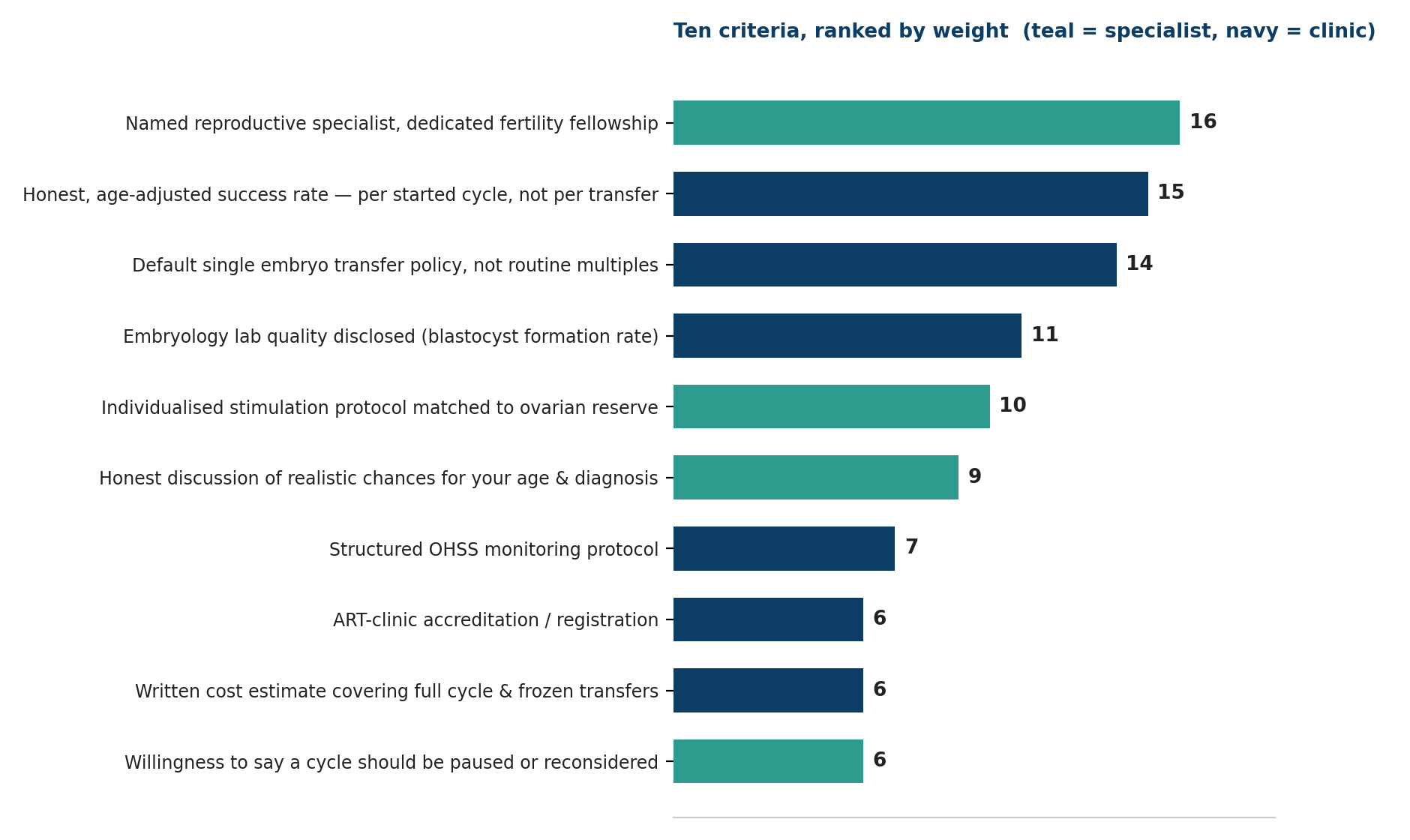
All ten criteria ranked by relative weight — honest success-rate reporting and transfer policy dominate the list.
| Verification check | Genuine fertility specialist | General, unverified provider |
|---|---|---|
| Named specialist, dedicated fertility fellowship | Yes | No |
| Success rate quoted per started cycle | Yes | No |
| Default single embryo transfer policy | Yes | Partly |
| Embryology lab quality disclosed | Yes | No |
| Written cost estimate incl. frozen transfers | Yes | Partly |
A simple check to run against any specialist or clinic you are considering, before booking anything.
What the quote doesn't always show. In 24 years of reviewing these estimates, I have found disputes almost never concern the headline number — they concern what it silently left out: medication costs quoted separately from the "package price," or a frozen embryo transfer priced as though it were an entirely new cycle. Get every line item in writing before paying any deposit.
What a Somali Patient Should Weigh in Particular
Send your actual hormone and fertility test results, not just your age, to every clinic being compared — a real assessment depends on your specific ovarian reserve and diagnosis.
Currency and budget. Somalia is heavily dollarised — clinic-scale payments are quoted and settled in US dollars, not the shilling (roughly 570 SOS/US$1 in mid-2026). Budget for more than one cycle, since success is rarely guaranteed on the first attempt.
Visa timing. India has no resident mission in Mogadishu, so Somali passport holders apply through the Indian High Commission in Nairobi or the Embassy of India in Addis Ababa, with a no-objection letter from the Somali embassy there.
No direct flight. Ethiopian Airlines via Addis Ababa is the most frequent route from Mogadishu; flydubai, Emirates, and Qatar Airways offer alternatives via Dubai or Doha.
A Somali- or Arabic-speaking coordinator, and a clear plan for early-pregnancy monitoring once home — specialist fertility follow-up capacity within Somalia itself remains limited.
Four Signals That Should Make You Pause
1. A success rate quoted without clarifying whether it is per started cycle or per transfer.
2. Multiple embryo transfer suggested routinely, without a specific clinical reason.
3. No willingness to disclose embryology lab performance.
4. Pressure to pay the full balance before a written treatment plan exists.
Questions Worth Asking Directly
| Ask the specialist | Ask the clinic |
|---|---|
| What are my realistic chances, specifically? | Is your success rate per started cycle or per transfer? |
| Why this stimulation protocol, for my case? | What is your blastocyst formation rate? |
| Would you recommend single or multiple embryo transfer, and why? | What does the full cost cover, including medications? |
A Closing Word
An IVF success rate is only as honest as the way it is calculated, which is why a clinic's willingness to explain its own numbers matters as much as the specialist's skill. A named, fertility-fellowship-trained specialist, backed by a clinic that reports success per started cycle and defaults to single embryo transfer, is the baseline worth insisting on before any deposit is paid. If you can share your fertility test results, I am glad to review them honestly.
Sources
- 🌐 National Medical Commission of India — verify any specialist's registration — nmc.org.in
- 🌐 Indian Council of Medical Research — ART (Regulation) Act clinic registry — icmr.gov.in
- 🌐 High Commission of India, Nairobi — visa services for Somali nationals — hcinairobi.gov.in
- 🌐 Embassy of India, Addis Ababa — medical visa requirements — indianembassy.gov.et
- 🌐 Peer-reviewed literature on IVF success-rate reporting and embryo transfer outcomes — ncbi.nlm.nih.gov
Frequently Asked Questions by Somalis about IVF and Fertility Specialists in India
Why should IVF success rates be questioned?
Some clinics quote success per embryo transfer, excluding cycles that never reach transfer. Patients should ask for the rate per started cycle as well.
What type of fertility specialist should Somali patients choose?
Look for a named reproductive endocrinologist with dedicated fertility or reproductive-medicine fellowship training.
Why is an individualised stimulation protocol important?
The guide recommends matching stimulation to the patient's ovarian reserve and hormone profile, rather than applying one standard protocol to everyone.
Should multiple embryos routinely be transferred?
No. The guide recommends single embryo transfer as the default, with multiple transfer reserved for clearly explained clinical circumstances.
What should patients ask about the embryology laboratory?
Ask for the clinic's blastocyst formation rate and expect the laboratory's performance to be disclosed clearly.
Why is OHSS monitoring important?
Ovarian hyperstimulation syndrome is a recognised risk of fertility stimulation, so the guide recommends a structured monitoring protocol.
What should the IVF quotation include?
The written estimate should clearly cover the full cycle, medications and any frozen embryo transfers, rather than only the initial treatment package.
What should Somali patients send before travelling?
Send actual hormone and fertility test results, including information relevant to ovarian reserve and previous treatment, to each clinic being compared.
Should patients budget for more than one IVF cycle?
Yes. The guide recommends planning financially for more than one cycle, because successful pregnancy is not guaranteed on the first attempt.
What are the main warning signs?
Be cautious if a clinic cannot explain how its success rate is calculated, routinely recommends multiple embryo transfer without a specific reason, refuses to disclose laboratory performance or pressures the patient to pay before a written treatment plan.
Page Summary
This five-page guide focuses on fertility-specialist expertise and honest IVF outcome reporting. Page 1 explains why success rates should be assessed per started cycle and why age and diagnosis matter, while page 2 covers fertility fellowship training, individualised stimulation, realistic counselling and clinic-level laboratory and safety checks. The page 3 ranking chart places dedicated fertility fellowship training, transparent success-rate reporting, single embryo transfer and disclosed embryology quality highest, while pages 3–4 address OHSS monitoring, complete costing, Somali visa and travel planning, communication and early-pregnancy follow-up.
Citation Block
| Topic | Information |
|---|---|
| Topic | IVF & Fertility Specialists in India for Somali Patients |
| Treatment | IVF & Fertility Treatment |
| Patients | Somali Patients |
| First Assessment | Ovarian reserve, hormone and fertility tests |
| Key Specialist | Reproductive Endocrinologist |
| Specialist Training | Dedicated Fertility / Reproductive Medicine Fellowship |
| Treatment Planning | Individualised stimulation protocol |
| Success Rate Check | Per started cycle vs per embryo transfer |
| Success Rate Reporting | Age-adjusted realistic outcomes |
| Embryo Transfer Policy | Single embryo as default |
| Multiple Transfer | Specific clinical circumstances only |
| Embryology Check | Blastocyst formation rate disclosed |
| Safety Check | Structured OHSS monitoring |
| Clinic Check | ART registration / accreditation |
| Cost Check | Written estimate covering full cycle, medications and frozen transfers |
| Cost Risk | Medications or frozen embryo transfer may be separately charged |
| Budget | Plan for potentially more than one cycle |
| Medical Records | Hormone and fertility test results |
| Visa Planning | Nairobi or Addis Ababa |
| Travel | Connecting flights from Mogadishu |
| Communication | Somali- or Arabic-speaking coordinator |
| Home Follow-Up | Early-pregnancy monitoring plan |
| Specialist Question | What are my realistic chances for my specific age and diagnosis? |
| Clinic Question | Is your success rate calculated per started cycle or per transfer? |
| Embryology Question | What is your blastocyst formation rate? |
| Treatment Question | Why is this stimulation protocol appropriate for my ovarian reserve? |
| Transfer Question | Would you recommend single or multiple embryo transfer, and why? |
| Warning Signs | Success rate not clearly defined or routinely multiple embryos recommended |
| Transparency Check | No willingness to disclose embryology laboratory performance |
| Payment Warning | Full balance requested before a written treatment plan |
| Key Decision | Verify fertility expertise and transparent success-rate reporting |


Our Mission Statement
Our mission is to place patients at the centre of every healthcare decision by providing trustworthy, evidence-based, and unbiased medical information. We believe that informed patients make better decisions. Backed by personalised guidance from our experienced advisory team, we help patients understand their treatment options, compare them objectively, and confidently choose the path that best suits their medical needs and personal circumstances.
Patient Testimonials from Somalia




Ready to Take the First Step?
Share your Medical Reports with our Healthcare Managers Today and Get a FREE CONSULTATION, a Personalized Treatment Plan, and Complete Support from Arrival to Recovery.
Get Your Free ConsultationAreas We Serve
This resource has been thoughtfully prepared for patients from Somalia who are considering medical treatment in India. We also welcome patients from the wider region in the countries mentioned below-
We assist patients from:
- Ethiopia
- Djibouti
- Yemen
- Kenya
- Seychelles
- Somalia
- South Sudan
- Tanzania
- Uganda
- Zambia
- Zimbabwe
- Angola
- Cameroon
- Central African Republic
Many of the insights, treatment pathways, hospital recommendations, travel guidance, and patient support services described here are equally relevant and may be used as a reference when planning treatment in India.
From Somalia to India: Your Complete Patient Support Guide
- Best Brain Tumour Surgeons & Hospitals in India for Somali Patients
- Best Cancer Treatment Surgeons & Hospitals in India for Somali Patients
- Best Cardiac Surgeons & Hospitals in India for Somali Patients
- Best CyberKnife Teams & Centres in India for Somali Patients
- Best Heart Valve Replacement Surgeons & Hospitals in India for Somali Patients
- Best Hip Surgeons & Hospitals in India for Somali Patients
- Best Knee Surgeons & Hospitals in India for Somali Patients
- Best Neurosurgeons & Hospitals in India for Somali Patients
- Best Paediatric Cardiac Surgeons & Hospitals in India for Somali Patients
- Best Paediatric Neurosurgeons & Hospitals in India for Somali Patients
- Best Spine Surgeons & Hospitals in India for Somali Patients
- Bariatric Surgery in India for Patients from Somalia
- Brain Tumour Surgery in India for Patients from Somalia
- Cancer Treatment and Surgery in India for Patients from Somalia
- Cardiac Surgery in India for Patients from Somalia
- Cosmetic and Plastic Surgery in India for Patients from Somalia
- CyberKnife Treatment in India for Patients from Somalia
- Dental Surgery in India for Patients from Somalia