

HIPEC Cancer Surgery in India for Patients from Somalia
"The cancer has spread through the abdomen" used to be the sentence that ended treatment discussions. For a genuine subset of patients, it no longer has to be.
A cancer of the colon, ovary, stomach or appendix that has already seeded itself across the lining of the abdomen — the peritoneum — was, for decades, treated as a sign that curative treatment was no longer possible. That is no longer universally true. For 24 years I have watched a specific, demanding combination of surgery and heated chemotherapy change that conversation for a real subset of patients, and I have also watched how rarely that conversation happens at all for patients referred from countries, including Somalia, where the disease is more often caught only once it has already spread this far.
India is one of a genuinely limited number of countries with the specific infrastructure this treatment demands: a dedicated peritoneal surface malignancy team, the operating time to perform surgery that can run six to ten hours, and the ICU capacity for a demanding recovery — delivered at a fraction of the cost of the same care in the Gulf, Europe or the United States, where few hospitals outside major cancer centres offer it at all.
Healing Journeys of Somali Patients









Key Takeaways
- The guide explains that peritoneal spread is not automatically the end of treatment options. For carefully selected patients, cytoreductive surgery (CRS) combined with heated intraperitoneal chemotherapy (HIPEC) may offer a potentially longer-term treatment approach.
- The treatment is particularly relevant to selected cancers of the colon, ovary, stomach and appendix that have spread across the peritoneal lining of the abdomen.
- A case report from a Mogadishu hospital published in 2026 documented ovarian cancer presenting as an acute abdominal emergency, with surgery revealing extensive peritoneal spread. The guide uses this to illustrate the importance of specialist assessment when abdominal cancers are diagnosed late.
- CRS removes visible tumour deposits from the abdominal cavity, while HIPEC circulates heated chemotherapy through the abdomen for approximately 90 minutes to target microscopic remaining cancer cells.
- The guide gives a typical combined CRS and HIPEC operating time of approximately 6–10 hours. Recovery can be demanding and may include an extended ICU and hospital stay.
- Not every patient is suitable. The Peritoneal Cancer Index (PCI) helps assess how extensive the disease is and whether complete cytoreduction is realistically achievable. Disease outside the abdomen, tumour that cannot be completely removed or poor overall fitness may make CRS and HIPEC unsuitable.
- The guide gives illustrative outcomes from general colorectal peritoneal-carcinomatosis literature: median survival of approximately 36 months with CRS + HIPEC versus 14 months with systemic chemotherapy alone, and 3-year survival of approximately 45% versus 15% in carefully selected patients. These figures are not Somalia-specific and individual outcomes vary.
- A combined CRS and HIPEC procedure in a reputable private Indian hospital typically costs approximately US$10,000–US$15,000 all-in, including surgery, extended ICU care and initial follow-up. More complex cases involving multiple organ resections may approach the upper end.
- Somali patients should send actual imaging, biopsy information and previous operative notes before travelling. The guide recommends choosing a dedicated peritoneal surface malignancy programme, confirming annual CRS+HIPEC experience, obtaining a PCI-linked written cost range and planning for several weeks of recovery in India.
Quick Facts
- Treatment
- Cytoreductive Surgery and HIPEC
- Country
- India
- Patients
- Patients from Somalia
- Key Specialist
- Peritoneal Surface Malignancy / Surgical Oncology Specialist
- Main Cancers
- Colorectal, Ovarian, Gastric and Appendiceal Cancers
- Primary Assessment
- Imaging, Biopsy and Peritoneal Cancer Index
- HIPEC Duration
- Approximately 90 Minutes
- Operating Time
- Approximately 6–10 Hours
- Indicative Cost
- US$10,000–US$15,000 All-In
- Important Eligibility Check
- Complete Cytoreduction Must Be Realistically Achievable
- Hospital Requirement
- Dedicated Peritoneal Surface Malignancy Programme
- Pre-Travel Records
- Actual Imaging, Biopsy and Previous Operative Notes
- Travel Routes
- Nairobi, Addis Ababa, Dubai or Djibouti
- Visa
- Hospital Invitation and Medical Visa
- Recovery
- Extended ICU and Hospital Recovery
- Follow-Up
- Home and Long-Term Follow-Up
- Author
- Dr. Dheeraj Bojwani
- Experience
- 24+ Years
In Brief
For Somali patients considering CRS and HIPEC in India, the guide recommends a specialist eligibility assessment before travel, because peritoneal spread alone does not determine whether this demanding treatment is appropriate. The team should review actual imaging, calculate or assess the Peritoneal Cancer Index, determine whether complete tumour removal is realistic and evaluate the patient's overall fitness for a 6–10-hour operation and extended recovery. Patients should choose a dedicated peritoneal surface malignancy programme, obtain a written cost range linked to their imaging and plan for several weeks in India with appropriate follow-up.
First, know why this specific scenario happens in Somalia
This is not a hypothetical concern. A case report published from a Mogadishu hospital in 2026 documented exactly this pattern: a woman with an ovarian mucinous cystadenocarcinoma who first presented as an acute abdominal emergency, only for surgery to reveal the tumour had already spread extensively across the peritoneum. This is the direct, logical consequence of the pattern described in every other cancer guide in this series — colorectal, gastric, ovarian and appendiceal cancers across Somalia are disproportionately caught late, often at the point of a surgical emergency, precisely when peritoneal spread is most likely to have already occurred.
The Somali difference: the exact patients this treatment was designed for, with nowhere nearby to receive it
Peritoneal spread from colorectal, gastric, ovarian and appendiceal cancer is treated, worldwide, as a specialist problem requiring a specialist centre — even wealthier neighbouring regions report limited and inconsistent access to peritoneal surface malignancy treatment networks. For Somalia specifically, where the underlying cancers are already documented to present late, and where general oncology and surgical capacity is itself severely constrained, CRS and HIPEC are not currently available at all. A patient found to have peritoneal spread during emergency surgery is, today, very often told nothing more can be done — not because nothing more can be done, but because the specific team and equipment this treatment requires simply is not present.
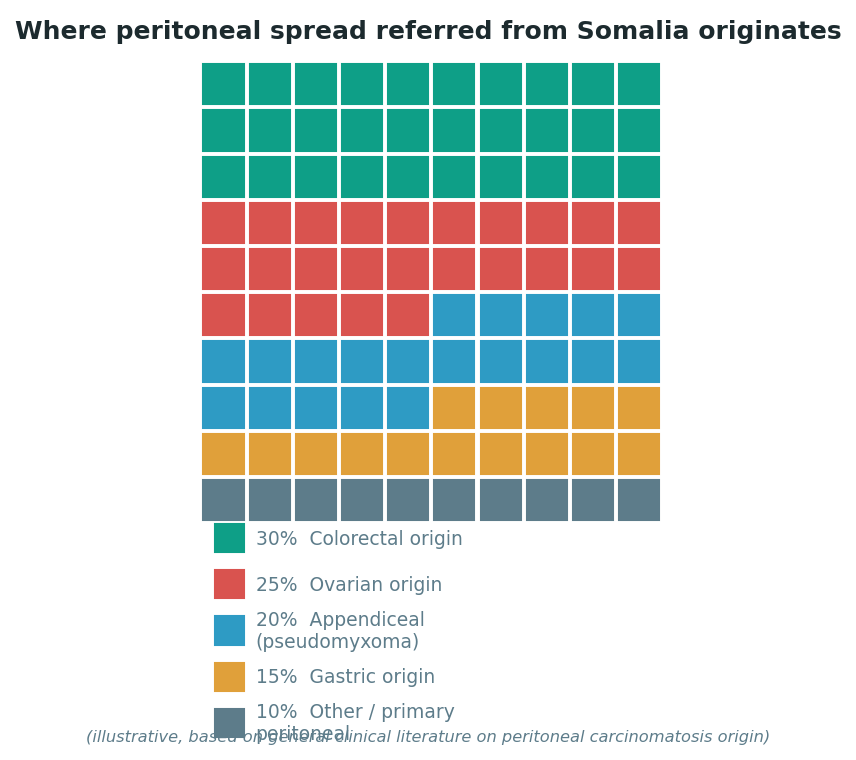
Illustrative breakdown of the underlying cancers behind peritoneal spread, based on general clinical literature on peritoneal carcinomatosis.
What CRS and HIPEC actually change
Cytoreductive surgery removes every visible deposit of tumour from the surfaces of the abdominal cavity, sometimes including parts of the peritoneal lining itself, the omentum, or portions of affected organs. Immediately afterward, a heated chemotherapy solution is circulated through the abdomen for roughly ninety minutes, reaching microscopic cancer cells the surgeon's eye cannot see, at concentrations far higher than intravenous chemotherapy could safely deliver to the whole body. For carefully selected patients, this combination has moved outcomes that were once measured in months into outcomes measured in years.
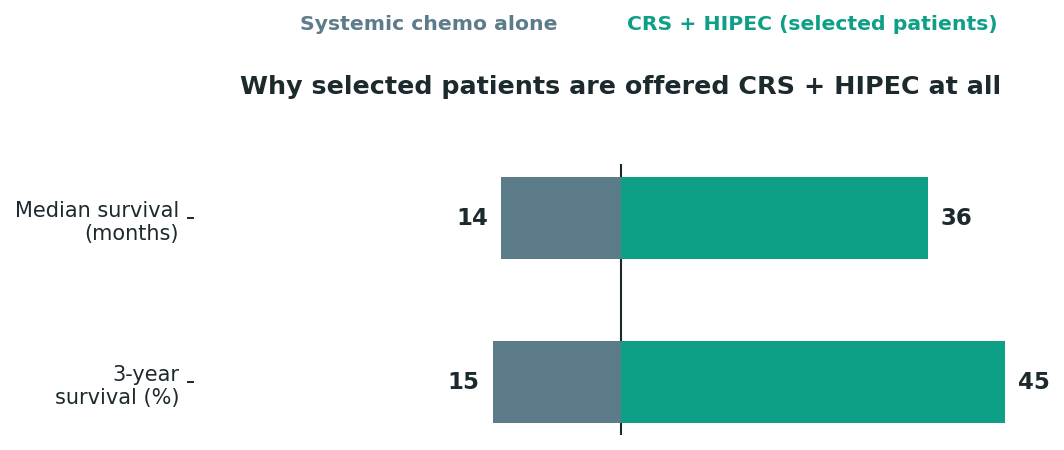
Illustrative outcomes for peritoneal spread from colorectal cancer: systemic chemotherapy alone, versus CRS+HIPEC in carefully selected patients. General oncology literature, not a Somalia-specific measured outcome; individual eligibility and results vary widely.
Know the warning signs, and do not wait them out
Progressive abdominal swelling or a sense of fullness that does not resolve, new or worsening ascites (fluid building up in the abdomen), a change in bowel habit combined with a known or suspected abdominal cancer, or unexplained weight loss alongside abdominal discomfort are all reasons for imaging that specifically looks for peritoneal disease, not just the primary tumour. For anyone who has already had surgery for a colorectal, ovarian, gastric or appendiceal cancer, new abdominal symptoms months or years later deserve the same attention, since peritoneal recurrence can appear well after an apparently successful first operation. None of this means peritoneal spread is present, but it is exactly the pattern that justifies asking the question directly rather than assuming the original treatment was the end of the story.
Not every patient with peritoneal spread is a candidate
This is the point where honesty matters most. CRS and HIPEC are demanding on the body, and they only help patients where the disease can genuinely be reduced to no visible tumour remaining; a peritoneal cancer index score, calculated during imaging and confirmed at surgery, measures exactly how extensive the spread is and whether complete cytoreduction is realistic. Patients with disease outside the abdomen, with tumour too extensively spread to fully remove, or without the general fitness to survive a long operation and demanding recovery are not good candidates, and a genuinely expert team will say so rather than operating regardless. Appendiceal pseudomyxoma peritonei, notably, tends to respond particularly well to this approach and is sometimes discovered unexpectedly during what was thought to be routine appendicitis surgery — worth knowing if that has ever happened to you or a family member.
What it costs
In more than 24 years arranging this kind of care, the disputes I have seen were almost never about the price itself — they were about a diagnosis, or a cost, nobody had bothered to write down before the flight was booked. Because the extent of surgery needed is often only fully clear once a surgeon can see inside the abdomen, a fair quote should give a range tied to the peritoneal cancer index score from your imaging, not a single fixed number promised in advance.
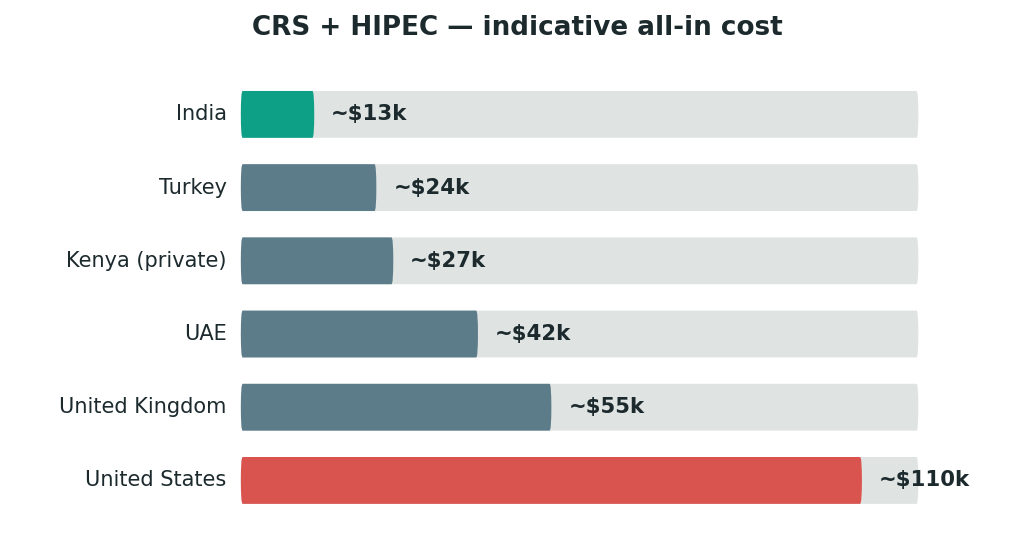
Indicative all-in cost for combined cytoreductive surgery and HIPEC. India sits far below every common alternative.
A combined CRS and HIPEC case in a reputable private Indian hospital typically runs US$10,000 to US$15,000 all-in, covering the surgery, the extended ICU stay this recovery requires, and initial follow- up. Complex cases needing multiple organ resections sit toward the top of that range. Ask for the figure specific to your actual imaging before committing to anything.
Why the surrounding team decides as much as the surgeon
A CRS+HIPEC programme lives or dies on the team around the operating table. Ask specifically whether the hospital runs a dedicated peritoneal surface malignancy programme with its own protocols, rather than an occasional case taken on by a general surgical oncologist; whether a specialist anaesthesia and critical care team experienced in the fluid shifts and prolonged surgery this operation involves is standing by; and how many CRS+HIPEC cases the centre performs in a typical year. This is a genuinely low-volume, high-complexity operation worldwide, and the gap between a centre that does a handful of cases occasionally and one with a dedicated programme shows up directly in complication rates.
Four signals that should make you stop and walk away
No peritoneal cancer index calculated. This score, from imaging and confirmed at surgery, is what determines whether complete cytoreduction is realistic. Its absence is a real gap.
No discussion of eligibility criteria. An honest team explains why you are, or are not, a candidate before proposing a date. Universal "yes" answers are a warning sign.
No dedicated peritoneal surface malignancy team. This is a subspecialty within surgical oncology. Ask how many CRS+HIPEC cases the named surgeon performs each year.
The price keeps moving. A verbal estimate that shifts each time you ask is not an estimate. Demand a clear range tied to your actual imaging, in writing.
The practical journey from Somalia — plan it before you fly
There is no direct flight between Somalia and India; patients route through Nairobi, Addis Ababa, Dubai or Djibouti. Because there is no full Indian mission inside Somalia, the medical visa is issued through the Embassy of India in Addis Ababa or the High Commission in Nairobi , against a written invitation letter from the treating hospital. Somali patients may bring up to two medical attendants on attendant visas, and given the length of recovery this surgery requires, plan for a companion able to stay several weeks. Since your route crosses yellow-fever territory, carry a valid yellow-fever vaccination certificate . Above every other instruction: send your actual imaging and, if surgery has already been performed elsewhere, the operative notes describing what was found, not a written summary, so the team can assess eligibility before you ever leave home.
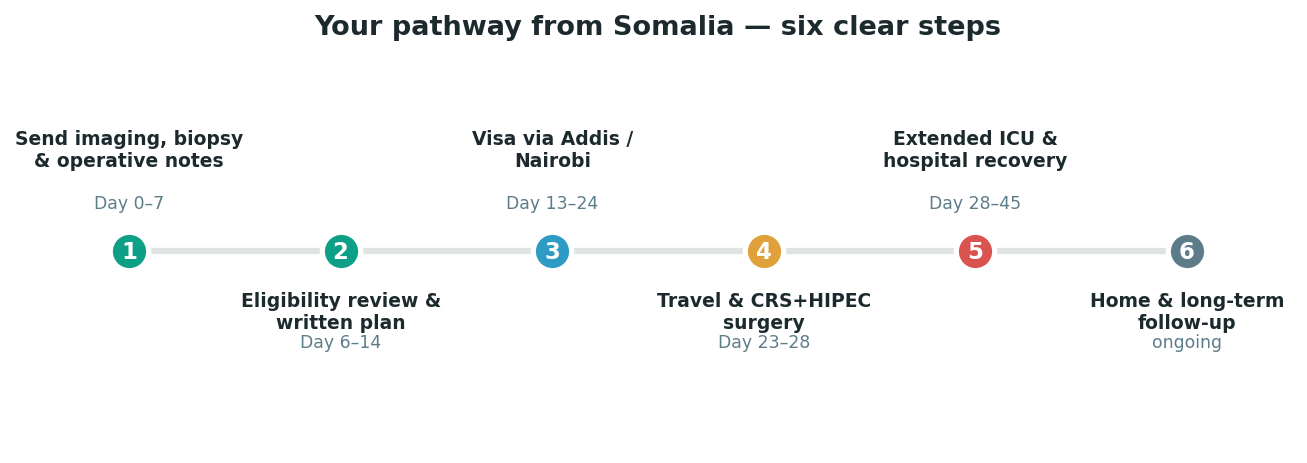
The complete route, start to finish — recovery from this surgery is longer than most other cancer procedures.
"Nothing more can be done" is not always the last word
For a genuine subset of patients with peritoneal spread, that sentence is no longer accurate — it simply reflects what a given hospital, in a given country, currently has the ability to offer. A proper eligibility assessment, by a team built specifically for this disease, is what actually answers the question.
Sources & useful links
- 🌐 Indian medical visa (Somali nationals) — indianvisaonline.gov.in
- 🌐 Embassy of India, Addis Ababa — eoiaddisababa.gov.in
- 🌐 High Commission of India, Nairobi — hcinairobi.gov.in
- 🌐 Yellow-fever requirements — who.int/health-topics/yellow-fever
- 🌐 Hospital accreditation (India) — nabh.co · jointcommissioninternational.org
- 🌐 Verify a surgeon's registration — nmc.org.in
Do not decide alone, and do not decide blind
If you want your case reviewed properly and an honest written answer on eligibility — including whether CRS and HIPEC are genuinely an option — that is precisely the independent guidance I provide, without a single hospital's interest attached to my advice. Dr. Dheeraj Bojwani · Independent medical travel advisor
Frequently Asked Questions by Somali Patients about HIPEC Cancer Surgery in India
What is HIPEC and how is it used for peritoneal cancer?
HIPEC is heated chemotherapy delivered directly into the abdominal cavity after cytoreductive surgery has removed visible tumour deposits. The guide describes the heated chemotherapy circulation as lasting approximately 90 minutes.
Which cancers may be treated with CRS and HIPEC in India?
The guide focuses on selected cases of colorectal, ovarian, gastric and appendiceal cancers that have spread across the peritoneal lining.
Does peritoneal cancer automatically mean that CRS and HIPEC cannot be performed?
No. The guide explains that a subset of patients with peritoneal spread may still be considered for potentially aggressive treatment, provided the disease can be adequately removed and the patient is fit enough for the procedure.
What is the Peritoneal Cancer Index and why is it important?
The PCI measures the extent of tumour spread within the peritoneal cavity. It helps the specialist team determine whether complete cytoreduction is realistically achievable.
Who may not be a suitable candidate for CRS and HIPEC?
Patients with disease outside the abdomen, tumour that cannot be completely removed, or insufficient general fitness to tolerate a long operation and demanding recovery may not be suitable.
How long does CRS and HIPEC surgery take?
The guide gives a typical operating time of approximately 6–10 hours, followed by an extended ICU and hospital recovery depending on the complexity of the surgery.
How much does CRS and HIPEC cost in India for Somali patients?
The guide gives an indicative all-in range of US$10,000–US$15,000 in a reputable private Indian hospital. Complex cases involving multiple organ resections may be toward the higher end.
What should Somali patients check before choosing a HIPEC centre in India?
They should confirm that the hospital has a dedicated peritoneal surface malignancy programme, experienced anaesthesia and critical-care support, and a meaningful annual volume of CRS+HIPEC procedures.
What medical records should Somali patients send before travelling to India?
Patients should send their actual imaging, biopsy information and previous operative notes. The guide specifically advises against relying only on written summaries when assessing eligibility.
What travel arrangements should Somali patients make for CRS and HIPEC treatment in India?
The guide describes routes through Nairobi, Addis Ababa, Dubai or Djibouti. Medical visas are obtained through the Indian mission in Addis Ababa or Nairobi using a hospital invitation, and patients should plan for a companion able to remain in India for several weeks during recovery.
Page Summary
This guide explains the key considerations for Somali patients exploring CRS and HIPEC in India for selected cancers that have spread across the peritoneum, particularly colorectal, ovarian, gastric and appendiceal cancers. It covers how CRS removes visible tumour and HIPEC treats microscopic disease, the importance of the Peritoneal Cancer Index and patient fitness, illustrative survival outcomes from general colorectal literature, indicative costs of US$10,000–US$15,000, specialist-team and hospital requirements, warning signs when selecting a centre, travel and visa planning, and the extended recovery and follow-up pathway.
Citation Block
| Topic | Information |
|---|---|
| Topic Information | HIPEC Cancer Surgery in India for Patients from Somalia |
| Treatment | Cytoreductive Surgery + HIPEC |
| Intended Audience | Patients from Somalia |
| Key Specialist | Peritoneal Surface Malignancy / Surgical Oncology Specialist |
| Main Cancers | Colorectal, Ovarian, Gastric and Appendiceal Cancers |
| Primary Assessment | Imaging, Biopsy and Peritoneal Cancer Index |
| HIPEC Duration | Approximately 90 Minutes |
| Operating Time | Approximately 6–10 Hours |
| Indicative Cost | US$10,000–US$15,000 All-In |
| Eligibility Check | Assess whether complete cytoreduction is realistic |
| Hospital Requirement | Dedicated Peritoneal Surface Malignancy Programme |
| Team Requirement | Specialist Surgical, Anaesthesia and Critical-Care Support |
| Important Check | Confirm annual CRS+HIPEC experience |
| Cost Documentation | Written range linked to actual imaging and PCI |
| Pre-Travel Records | Imaging, Biopsy and Previous Operative Notes |
| Travel Routes | Nairobi, Addis Ababa, Dubai or Djibouti |
| Visa Requirement | Hospital Invitation and Medical Visa |
| Patient Journey | Records → eligibility review → visa → travel/CRS+HIPEC → ICU/recovery → long-term follow-up |
| Recovery | Extended ICU and Hospital Recovery |
| Follow-Up | Home and Long-Term Monitoring |


Our Mission Statement
Our mission is to place patients at the centre of every healthcare decision by providing trustworthy, evidence-based, and unbiased medical information. We believe that informed patients make better decisions. Backed by personalised guidance from our experienced advisory team, we help patients understand their treatment options, compare them objectively, and confidently choose the path that best suits their medical needs and personal circumstances.
Patient Testimonials from Somalia




Ready to Take the First Step?
Share your Medical Reports with our Healthcare Managers Today and Get a FREE CONSULTATION, a Personalized Treatment Plan, and Complete Support from Arrival to Recovery.
Get Your Free ConsultationAreas We Serve
This resource has been thoughtfully prepared for patients from Somalia who are considering medical treatment in India. We also welcome patients from the wider region in the countries mentioned below-
We assist patients from:
- Ethiopia
- Djibouti
- Yemen
- Kenya
- Seychelles
- Somalia
- South Sudan
- Tanzania
- Uganda
- Zambia
- Zimbabwe
- Angola
- Cameroon
- Central African Republic
Many of the insights, treatment pathways, hospital recommendations, travel guidance, and patient support services described here are equally relevant and may be used as a reference when planning treatment in India.
From Somalia to India: Your Complete Patient Support Guide
- Best Brain Tumour Surgeons & Hospitals in India for Somali Patients
- Best Cancer Treatment Surgeons & Hospitals in India for Somali Patients
- Best Cardiac Surgeons & Hospitals in India for Somali Patients
- Best CyberKnife Teams & Centres in India for Somali Patients
- Best Heart Valve Replacement Surgeons & Hospitals in India for Somali Patients
- Best Hip Surgeons & Hospitals in India for Somali Patients
- Best Knee Surgeons & Hospitals in India for Somali Patients
- Best Neurosurgeons & Hospitals in India for Somali Patients
- Best Paediatric Cardiac Surgeons & Hospitals in India for Somali Patients
- Best Paediatric Neurosurgeons & Hospitals in India for Somali Patients
- Best Spine Surgeons & Hospitals in India for Somali Patients
- Bariatric Surgery in India for Patients from Somalia
- Brain Tumour Surgery in India for Patients from Somalia
- Cancer Treatment and Surgery in India for Patients from Somalia
- Cardiac Surgery in India for Patients from Somalia
- Cosmetic and Plastic Surgery in India for Patients from Somalia
- CyberKnife Treatment in India for Patients from Somalia
- Dental Surgery in India for Patients from Somalia