

Hip Surgery in India for Patients from Somalia
A hip that has failed you does not have to define the rest of your life. It is a solvable problem, with a fixed dollar price and a route already walked by patients from every corner of Somalia. Here is that route, told without flattery.
A failed hip takes more from a person than almost any other joint. It steals the ability to stand at prayer, to carry a child, to walk to market, to simply sit on the ground and rise again without help. And for a great many Somali patients, the hip did not fail through age alone — it failed because a problem present since birth was never caught, or because a fracture went unfixed for weeks when it should have been treated in days. Somalia's health system, still rebuilding after decades of conflict, does not yet have the screening infrastructure or trauma capacity to catch these problems early. That is not a judgment on Somalia. It is the reason this guide exists. For 24 years I have guided patients from difficult places to the surgeons who can put this right, and I write here as an independent adviser with no hospital's interest attached to my advice.
India has become the destination of choice for exactly this reason: volume, skill and arithmetic, not persuasion. Its leading private hospitals replace hips by the thousand every year, using the same international implant brands fitted in London or Dubai, at a fraction — not a discount, a fraction — of what the same operation costs in the West or the Gulf. For a Somali family assembling funds from relatives abroad, that arithmetic decides whether treatment happens at all.
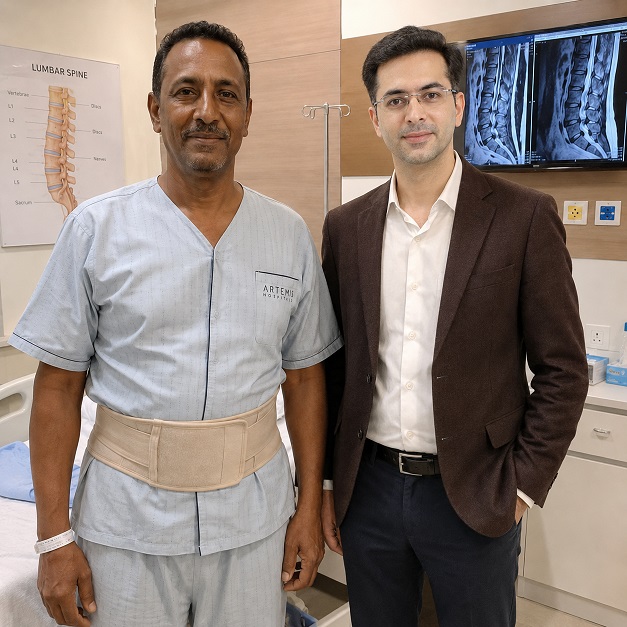
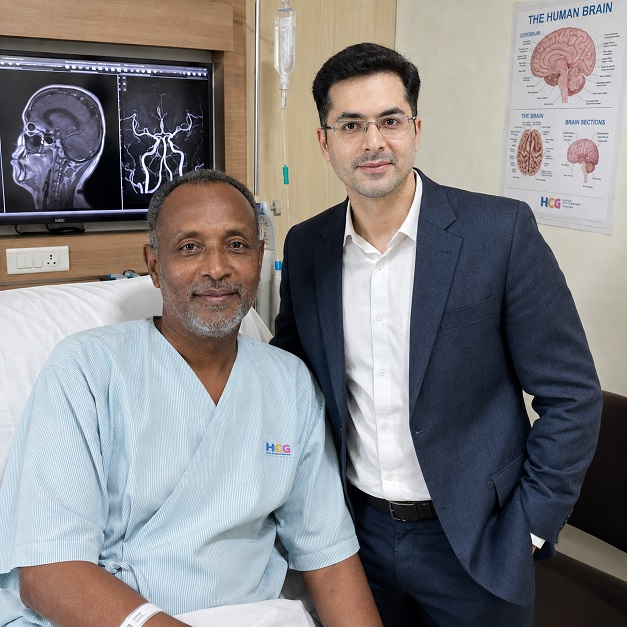
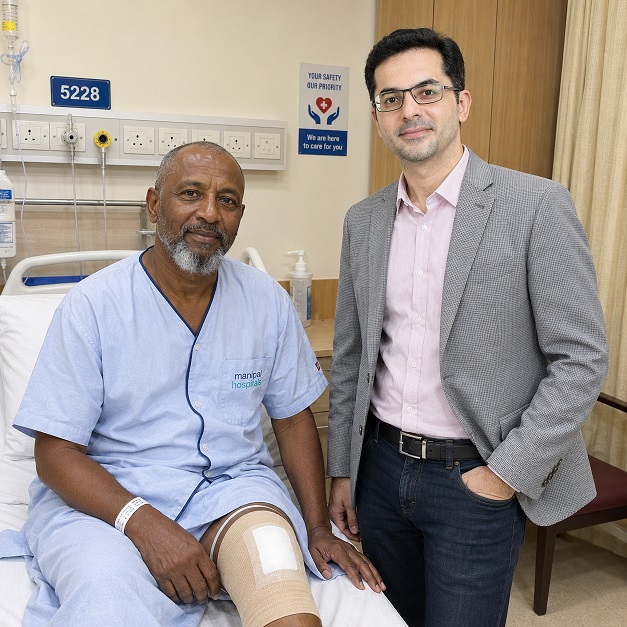
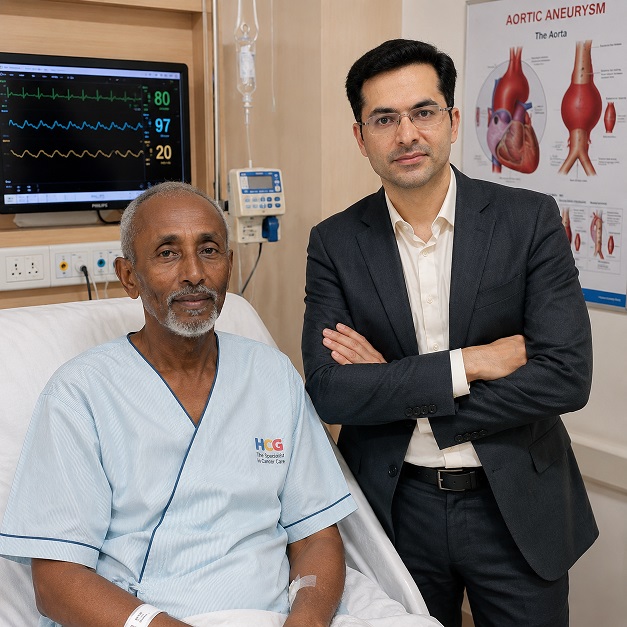
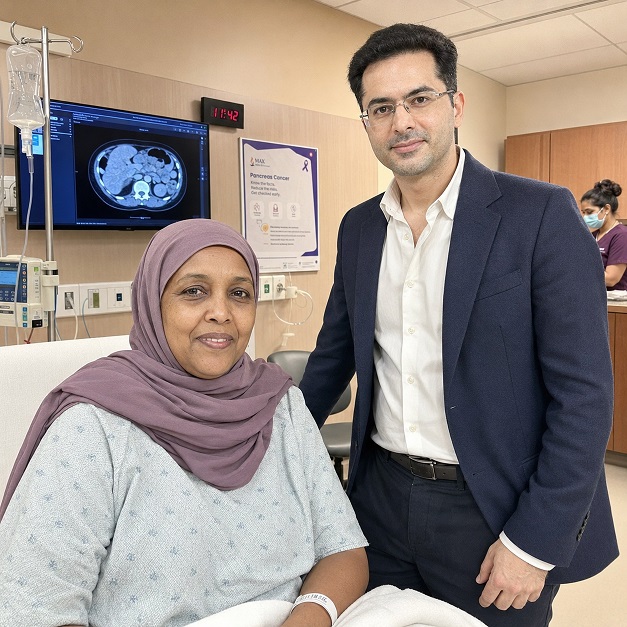
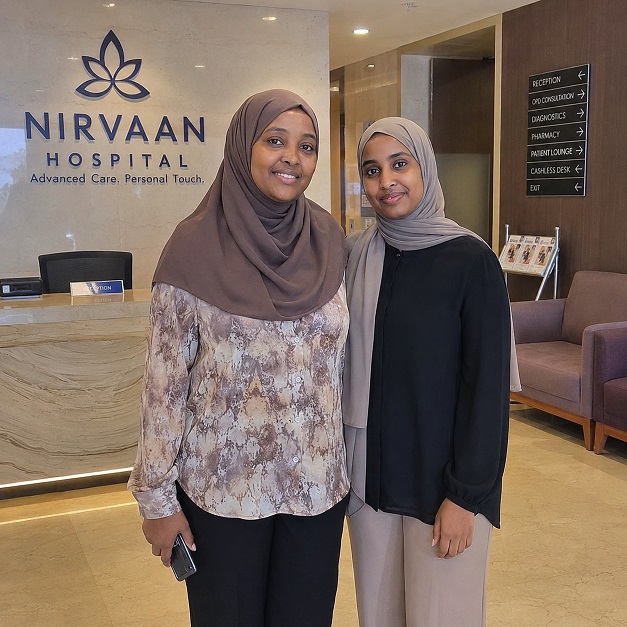
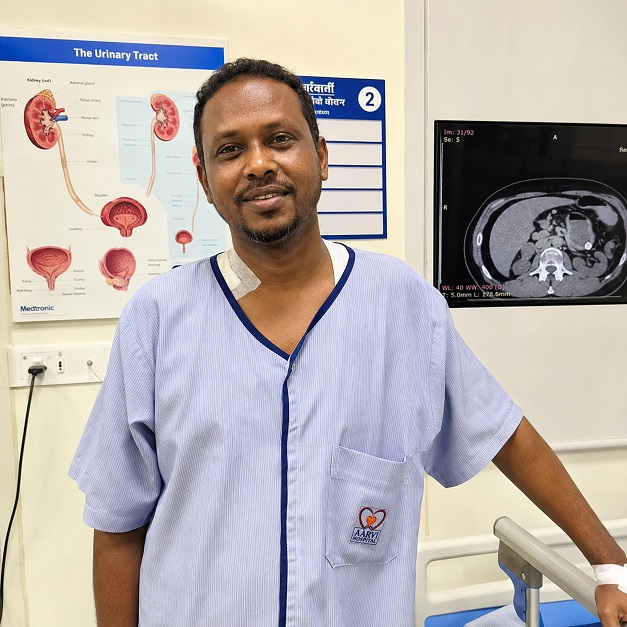
Healing Journeys of Somali Patients
Key Takeaways
- Hip problems among Somali patients may have causes that began many years before severe pain developed. The guide particularly highlights untreated childhood hip dysplasia and neglected fractures leading to avascular necrosis as important causes alongside osteoarthritis.
- The chart on page 2 gives an illustrative breakdown of Horn-of-Africa hip referrals: childhood hip dysplasia 34%, primary osteoarthritis 30%, neglected fracture/avascular necrosis 24%, and inflammatory or infective causes including TB 12%.
- Hip dysplasia occurs when the hip joint forms shallow or unstable at birth. Without organised newborn screening, it may remain undetected until a patient develops serious arthritis in their 20s or 30s.
- A neglected hip fracture can also lose its blood supply when treatment is delayed. This can lead to avascular necrosis, where the bone dies and a full hip replacement may ultimately become necessary.
- Full hip replacement should not automatically be the first option for every younger patient. The guide explains that some people with early dysplasia may benefit from a joint-preserving osteotomy that reshapes the existing bone.
- Hip replacement becomes more appropriate once cartilage has been severely lost, pain interferes with sleep and walking has become significantly difficult.
- During total hip replacement, the damaged ball and socket are replaced with a precision-engineered artificial joint using materials such as metal, ceramic and hard-wearing plastic.
- The operation itself typically takes approximately 90 minutes to two hours, with patients encouraged to stand and take supported steps within 24–48 hours. Hospital stay is generally around four to six days.
- The implant survivorship chart on page 3 shows illustrative implant function of 100% initially, 98% at 5 years, 96% at 10 years, 92% at 15 years, 85% at 20 years and 75% at 25 years.
- Surgeon experience is particularly important for Somali patients with complex dysplastic or post-fracture hips. The guide recommends asking about the surgeon's qualifications and how many hip replacements they perform each year.
Quick Facts
- Treatment
- Hip Surgery & Total Hip Replacement
- Country
- India
- Intended Audience
- Somali Patients
- Major Conditions Covered
- Hip Dysplasia, Osteoarthritis, Neglected Hip Fracture and Avascular Necrosis
- Illustrative Childhood Hip Dysplasia Referrals
- 34%
- Illustrative Primary Osteoarthritis Referrals
- 30%
- Illustrative Neglected Fracture/Avascular Necrosis Referrals
- 24%
- Illustrative Inflammatory/Infective Referrals
- 12%
- Joint-Preserving Option
- Osteotomy for Selected Younger Patients with Early Dysplasia
- Hip Replacement Materials
- Metal, Ceramic and Hard-Wearing Plastic
- Typical Surgery Duration
- Approximately 90 Minutes to 2 Hours
- First Supported Steps
- Within 24–48 Hours
- Typical Hospital Stay
- Approximately 4–6 Days
- Implants Working at 5 Years – Illustrative
- 98%
In Brief
Hip surgery in India for Somali patients may address untreated childhood hip dysplasia, osteoarthritis, neglected fractures and avascular necrosis. Younger patients with early dysplasia may sometimes benefit from joint-preserving osteotomy before full replacement is considered. Total hip replacement generally involves a four-to-six-day hospital stay, supported walking within 24–48 hours, and an estimated all-in cost of approximately US$4,800–US$8,200.
First, name what actually destroyed the hip
This is the single most important step in the entire journey, and it is where a serious hospital distinguishes itself from a careless one. A painful hip is never just "wear and tear" — and for patients from the Horn of Africa, the true cause is very often something that could have been caught decades earlier.
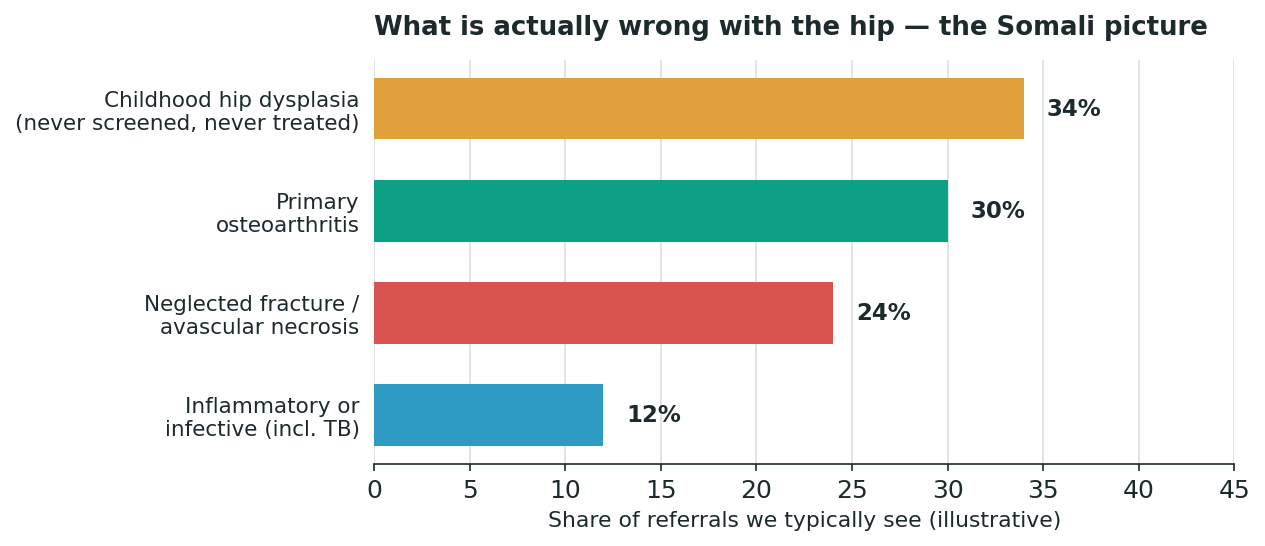
Illustrative breakdown of what typically lies behind a failed hip in Horn-of-Africa referrals.
The Somali difference: a hip problem that began at birth
Hip dysplasia — a hip joint that formed shallow or unstable at birth — is, worldwide, the leading cause of hip arthritis in adults under 40 and accounts for a significant share of all hip replacements performed globally. In countries with organised newborn hip screening, it is caught and corrected in infancy. Somalia has no such national programme, so the condition goes undetected for decades, quietly grinding the joint down until a patient in their 20s or 30s arrives with the hip of someone three times their age.
The second Somali reality is just as urgent: a broken hip that waits weeks for surgery, rather than days, can lose its blood supply entirely. What should have been a straightforward fixation becomes avascular necrosis — dead bone that only a full replacement can fix. Both problems share the same lesson: the damage was preventable, and the fix, while later than ideal, still works extremely well.
Is replacement truly necessary, or is there a step before it?
A trustworthy surgeon will tell you plainly when you do not yet need a new hip. Younger patients with early dysplasia sometimes benefit from a joint-preserving osteotomy that reshapes the existing bone rather than replacing it — a very different operation with a very different recovery, and one that should always be discussed before replacement is assumed. Full replacement earns its place once the cartilage is gone, pain disturbs your sleep, and walking has become something to be endured rather than done. Any clinic that skips straight to a replacement quote without this conversation has skipped the most important part of your care.
What the operation actually restores
Hip replacement removes the damaged ball and socket and replaces them with a precision-engineered joint of metal, ceramic and hard-wearing plastic. In a well-run Indian unit the surgery itself takes around ninety minutes to two hours. Patients are helped to stand and take supported steps within twenty-four to forty-eight hours — a deliberate part of recovery, not an afterthought — with a hospital stay of four to six days. What should matter most to you is not the operation itself, but how long it holds.
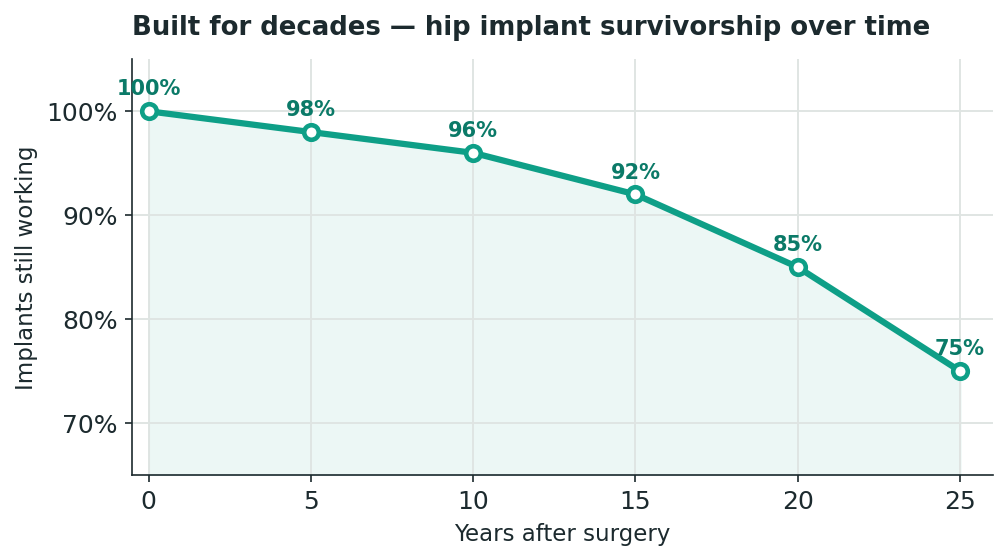
Modern hip implants: the great majority still working well fifteen to twenty years after surgery.
Choosing the surgeon and hospital is the real decision
The name on the gate matters far less than two facts behind it: how many hips the surgeon replaces each year, and whether the hospital carries genuine accreditation. Volume predicts safety — a surgeon managing hundreds of hips annually handles the complex dysplastic and post-fracture cases common among Somali patients far more capably than one who sees only a handful. Ask for the surgeon's name, qualifications and annual numbers before agreeing to anything. Confirm NABH accreditation in India or, better, international JCI accreditation. These are not formalities. They are your protection when you are a very long way from home.
What it costs — a number you can actually plan around
Somalia has run on the US dollar for a generation, the shilling itself never meaningfully reissued since 1991, so it fits that Indian hospitals quote hip surgery the same way — in dollars, not a currency that shifts by the week. A single total hip replacement in a reputable private Indian hospital typically runs US$4,800 to US$8,200 all-in: surgeon, implant, theatre, hospital stay and initial physiotherapy. Set that beside the alternatives and the case makes itself.
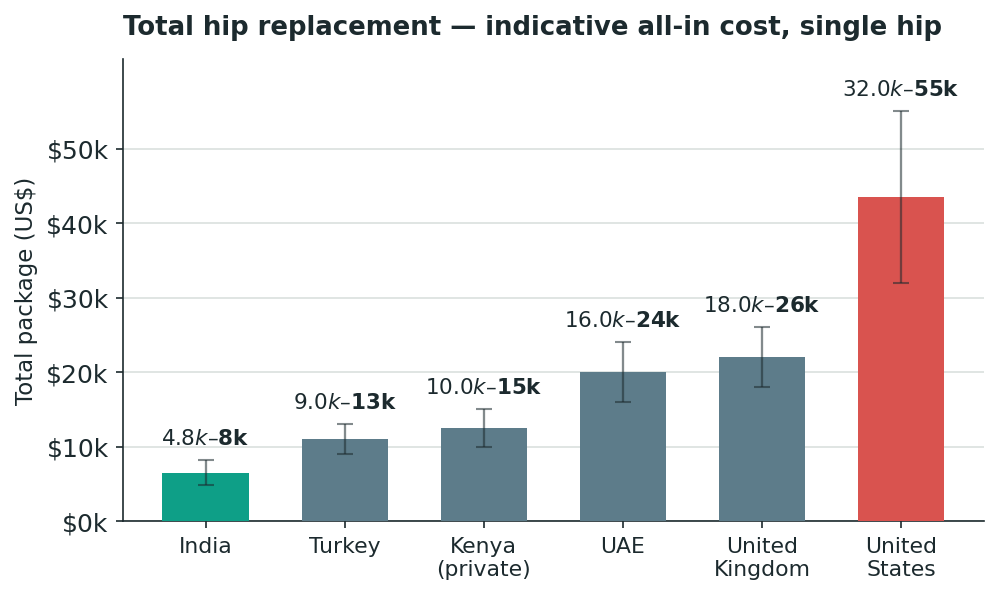
Indicative all-in cost of a single hip replacement. India sits far below every common alternative.
One rule protects every Somali family who makes this journey: get the estimate in writing before a single flight is booked. Diaspora relatives contribute against a real number, not a guess. In more than 24 years arranging this kind of care, the disputes I have seen were almost never about the price itself — they were about a cost nobody had bothered to write down.
Four signals that should make you stop and walk away
- No proper diagnosis — A surgery quote arrives before anyone has reviewed your scans or explained what actually caused the damage. Refuse it.
- The price keeps moving — A verbal estimate that shifts each time you ask is not an estimate. Demand a fixed figure in writing.
- No named surgeon — If you cannot learn who will actually operate, and how many hips they do a year, keep looking.
- No mention of dysplasia or fracture history — If nobody asks about a lifelong limp or an old fracture, the diagnosis has been rushed.
Straight answers for Somali Patients about Hip Surgery in India
How long will I actually need to stay in India?
Plan on three to four weeks in total: four to six days in hospital, the remainder for physiotherapy and a final review, so you fly home walking with confidence and a clear recovery plan.
I have limped my whole life — is it too late to fix?
No. Long-standing dysplasia is treated every day in high-volume Indian centres, though it can require a more complex procedure than a standard replacement. This is exactly why sending your imaging in advance matters so much.
Can both hips be done in a single trip?
Sometimes, yes. Many patients stage the two hips; some surgeons will do both in one trip if the patient is otherwise well. Let the surgeon decide after examining you and reviewing your scans.
What happens once I am home in Somalia?
You leave with a complete discharge summary, exact implant details and a physiotherapy schedule. A properly run hospital reviews your progress remotely by phone or video — essential when specialist follow-up inside Somalia remains scarce.
The practical journey from Somalia — plan it before you fly
The medicine is the easy part; the logistics are what genuinely trip families up. There is no direct flight between Somalia and India; patients route through Nairobi, Addis Ababa, Dubai or Djibouti. Because there is no full Indian mission inside Somalia, the medical visa is issued through the Embassy of India in Addis Ababa or the High Commission in Nairobi, against a written invitation letter from the treating hospital. Somali patients may bring up to two medical attendants on attendant visas. Since your route crosses yellow-fever territory, carry a valid yellow-fever vaccination certificate. And above every other instruction: send your actual X-rays and scans, not a written summary, so the surgeon can plan the real operation, including whether an osteotomy or a full replacement is the right call, before you ever leave home.
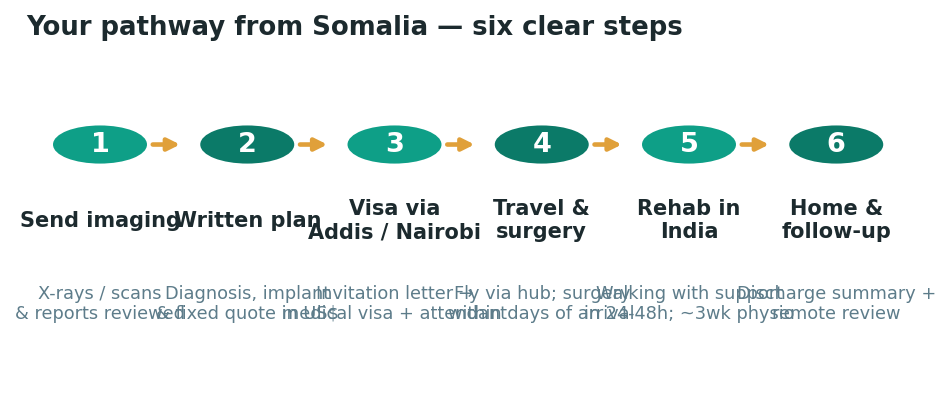
The complete route, start to finish — most of it arranged before you ever leave Somalia.
Walking again is not a luxury — it is a right you can still claim
A hip damaged since childhood, or broken and left too long, is not a life sentence. It is a solvable problem with a known price and a proven path. Somalia's families have carried enormous burdens with enormous dignity; the ability to walk without pain should not be reserved for the fortunate few.
Sources & Useful Links
- 🌐 Indian medical visa (Somali nationals): indianvisaonline.gov.in
- 🌐 Embassy of India, Addis Ababa: eoiaddisababa.gov.in
- 🌐 High Commission of India, Nairobi: hcinairobi.gov.in
- 🌐 Yellow-fever requirements: who.int/health-topics/yellow-fever
- 🌐 Hospital accreditation (India): nabh.co · jointcommissioninternational.org
- 🌐 Verify a surgeon's registration: nmc.org.in
Do not decide alone, and do not decide blind
If you want your scans reviewed properly and an honest written plan — including whether an osteotomy could spare you a full replacement — that is precisely the independent guidance I provide, without a single hospital's interest attached to my advice.
Dr. Dheeraj Bojwani · Independent medical travel advisor
Frequently Asked Questions by Somali Patients about Hip Surgery in India
Why do Somali patients travel to India for hip surgery?
India offers high-volume orthopaedic centres that treat complex hip problems such as dysplasia, neglected fractures and avascular necrosis. These cases may require specialist hip reconstruction experience.
How much does hip replacement surgery cost in India for Somali patients?
A single total hip replacement is estimated at approximately US$4,800–US$8,200 all-in. This includes the surgeon, implant, theatre, hospital stay and initial physiotherapy.
Can untreated childhood hip dysplasia in Somali patients be treated in India?
Yes. Long-standing dysplasia can be treated, although surgery may be more complex than a standard hip replacement. Actual X-rays and scans should be reviewed before travel.
Do all Somali patients with severe hip pain need total hip replacement?
No. Selected younger patients with early dysplasia may benefit from a joint-preserving osteotomy. The surgeon should determine whether the natural joint can still be preserved.
Can avascular necrosis after a neglected hip fracture be treated in India?
Yes. A fracture that loses its blood supply can progress to avascular necrosis. When damage is advanced, total hip replacement may become necessary.
How soon can Somali patients walk after hip replacement in India?
Patients are generally helped to stand and take supported steps within 24–48 hours. Early mobilisation is an important part of the recovery programme.
How long should Somali patients stay in India after hip replacement?
The guide recommends approximately three to four weeks in India. This includes around four to six hospital days followed by physiotherapy and a final review.
How long can a modern hip implant last?
The page 3 chart shows 92% of implants still working at 15 years and 85% at 20 years on an illustrative basis. Actual implant longevity varies between patients.
What should Somali patients send before travelling for hip surgery?
Patients should send their actual X-rays and scans rather than only written reports. These help the surgeon determine the diagnosis and whether osteotomy or replacement is appropriate.
What are the red flags when arranging hip surgery in India?
Four warning signs are highlighted: no proper diagnosis, a changing price, no named surgeon, and no discussion of dysplasia or previous fracture history.
Page Summary
This guide explains hip surgery in India for Somali patients, with particular attention to the causes of severe hip damage commonly seen in Horn-of-Africa referrals. Untreated childhood hip dysplasia, primary osteoarthritis, neglected fractures with avascular necrosis, and inflammatory or infective conditions are highlighted.
Citation Block
| Topic | Information |
|---|---|
| Topic Information | Details |
| Procedure | Hip Surgery & Total Hip Replacement |
| Country | India |
| Intended Audience | Somali Patients |
| Conditions Covered | Hip Dysplasia, Primary Osteoarthritis, Neglected Hip Fracture, Avascular Necrosis and Inflammatory/Infective Hip Disease |
| Procedures | Total Hip Replacement and Joint-Preserving Osteotomy in Selected Patients |
| Implant Materials | Metal, Ceramic and Hard-Wearing Plastic |
| Typical Surgery Duration | Approximately 90 Minutes to 2 Hours |
| First Supported Walking | Approximately 24–48 Hours After Surgery |
| Hospital Stay | Approximately 4–6 Days |
| Typical Stay in India | Approximately 3–4 Weeks |
| Recovery | Hospital Mobilisation Followed by Physiotherapy and Final Review Before Travel |
| Average Treatment Cost | US$4,800–US$8,200 All-In for One Hip |
| Cost Includes | Surgeon, Implant, Theatre, Hospital Stay and Initial Physiotherapy |


Our Mission Statement
Our mission is to place patients at the centre of every healthcare decision by providing trustworthy, evidence-based, and unbiased medical information. We believe that informed patients make better decisions. Backed by personalised guidance from our experienced advisory team, we help patients understand their treatment options, compare them objectively, and confidently choose the path that best suits their medical needs and personal circumstances.
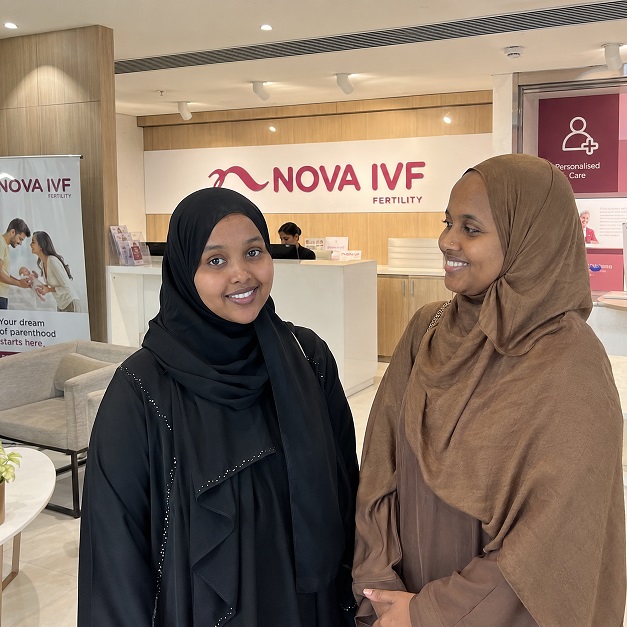
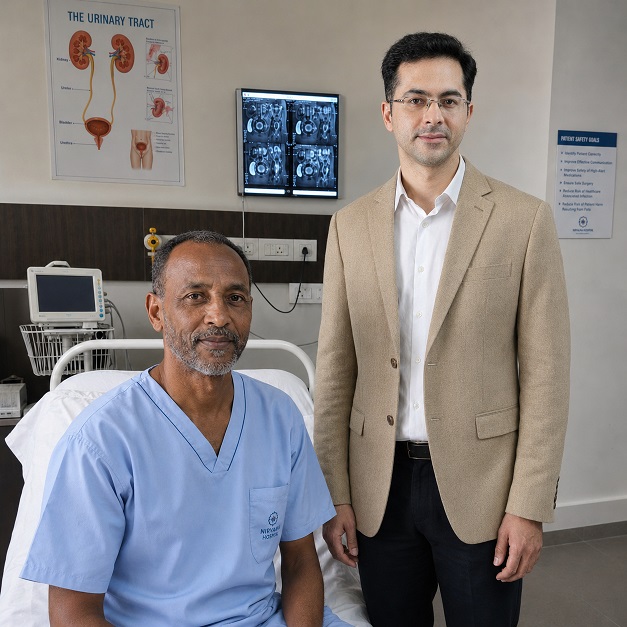
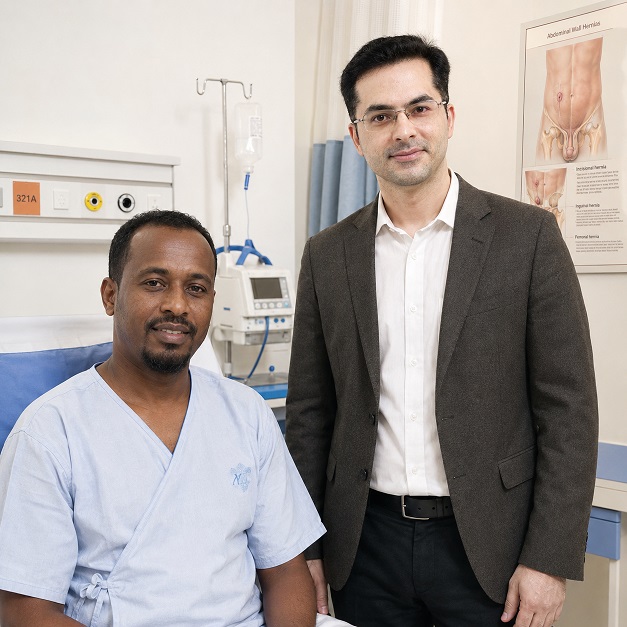
Patient Testimonials from Somalia

Ready to Take the First Step?
Share your Medical Reports with our Healthcare Managers Today and Get a FREE CONSULTATION, a Personalized Treatment Plan, and Complete Support from Arrival to Recovery.
Get Your Free ConsultationAreas We Serve
This resource has been thoughtfully prepared for patients from Somalia who are considering medical treatment in India. We also welcome patients from the wider region in the countries mentioned below-
We assist patients from:
- Ethiopia
- Djibouti
- Yemen
- Kenya
- Seychelles
- Somalia
- South Sudan
- Tanzania
- Uganda
- Zambia
- Zimbabwe
- Angola
- Cameroon
- Central African Republic
Many of the insights, treatment pathways, hospital recommendations, travel guidance, and patient support services described here are equally relevant and may be used as a reference when planning treatment in India.
From Somalia to India: Your Complete Patient Support Guide
- Best Brain Tumour Surgeons & Hospitals in India for Somali Patients
- Best Cancer Treatment Surgeons & Hospitals in India for Somali Patients
- Best Cardiac Surgeons & Hospitals in India for Somali Patients
- Best CyberKnife Teams & Centres in India for Somali Patients
- Best Heart Valve Replacement Surgeons & Hospitals in India for Somali Patients
- Best Hip Surgeons & Hospitals in India for Somali Patients
- Best Knee Surgeons & Hospitals in India for Somali Patients
- Best Neurosurgeons & Hospitals in India for Somali Patients
- Best Paediatric Cardiac Surgeons & Hospitals in India for Somali Patients
- Best Paediatric Neurosurgeons & Hospitals in India for Somali Patients
- Best Spine Surgeons & Hospitals in India for Somali Patients
- Bariatric Surgery in India for Patients from Somalia
- Brain Tumour Surgery in India for Patients from Somalia
- Cancer Treatment and Surgery in India for Patients from Somalia
- Cardiac Surgery in India for Patients from Somalia
- Cosmetic and Plastic Surgery in India for Patients from Somalia
- CyberKnife Treatment in India for Patients from Somalia
- Dental Surgery in India for Patients from Somalia