

Heart Failure Treatment and Surgery in India for Patients from Somalia
Nigeria has recorded the highest rate of pregnancy-related heart failure anywhere in the world, as high as one in every 100 deliveries — and its early symptoms look, at first, exactly like an ordinary late pregnancy.
Peripartum cardiomyopathy is a form of heart failure that strikes young, previously healthy women in the last weeks of pregnancy or the months after childbirth, and it is disproportionately common across West and East Africa. Its early symptoms — breathlessness, swollen legs, fatigue — are nearly identical to the ordinary discomforts of late pregnancy, which is precisely why it is so often missed until the heart is already significantly weakened. For 24 years I have worked with women whose diagnosis came only once their heart failure had progressed far further than it needed to.
India treats heart failure across its full range, from medication and device therapy through to left ventricular assist devices and heart transplant for the most advanced cases, with cardiology teams experienced specifically in peripartum and other cardiomyopathies — at a fraction of the cost of the same care in the Gulf, Europe or the United States.
Healing Journeys of Somali Patients









Key Takeaways
- The guide places particular emphasis on peripartum cardiomyopathy, a form of heart failure affecting women during the final weeks of pregnancy or months after childbirth. Its symptoms—breathlessness, swelling and fatigue—can easily be mistaken for normal pregnancy-related discomfort.
- The guide cites published African data showing a substantial diagnostic delay, with a median of 23 days from symptom onset to diagnosis in African settings compared with 6 days in Europe. Early recognition is presented as an important factor in improving recovery.
- A study from Kampala cited in the guide found peripartum cardiomyopathy in more than 17% of women presenting with acute heart failure symptoms during pregnancy, with multiple pregnancy identified as the strongest predictor.
- Warning signs include severe breathlessness that interrupts conversation or wakes a woman from sleep, swelling extending beyond the ankles, rapid or irregular heartbeat, chest discomfort, persistent cough and severe fatigue, particularly when symptoms appear suddenly or continue after delivery.
- The guide stresses that echocardiography is essential for distinguishing significant heart failure from ordinary pregnancy symptoms. Patients should send their actual echocardiogram and ECG rather than relying only on a description of symptoms.
- Most appropriately diagnosed peripartum cardiomyopathy cases are initially managed with standard heart failure medication and careful monitoring. Device therapy may be required for persistent severe dysfunction or dangerous rhythms, while mechanical support or transplant is reserved for advanced cases that do not recover.
- The guide gives an indicative Indian private-hospital cost of US$8,000–US$15,000 all-in for heart failure evaluation and standard device therapy. More advanced treatment may cost approximately US$30,000 for LVAD implantation and US$70,000 or more for heart transplantation.
- Patients should choose a genuine cardiomyopathy programme rather than general cardiology alone, particularly for peripartum cardiomyopathy. The treating cardiologist should have experience with the condition and provide a plan for repeat echocardiograms and follow-up after the patient returns home.
- Somali patients should arrange their echocardiogram, ECG and symptom history before travelling. The six-step pathway shown on page 5 runs from initial records and cardiology review through visa processing, travel and treatment, followed by ongoing home and long-term cardiac follow-up.
Quick Facts
- Treatment
- Heart Failure Treatment and Surgery
- Country
- India
- Patients
- Patients from Somalia
- Key Specialist
- Cardiologist / Heart Failure Specialist
- Main Condition Highlighted
- Peripartum Cardiomyopathy
- Primary Assessment
- Echocardiogram and ECG
- Initial Treatment
- Heart Failure Medication and Monitoring
- Device Therapy
- Defibrillator or Specialised Pacemaker Where Indicated
- Indicative Cost
- US$8,000–US$15,000 for Evaluation and Standard Device Therapy
- Advanced Treatment
- LVAD or Heart Transplant for Selected Severe Cases
- LVAD Cost
- Approximately US$30,000
- Heart Transplant Cost
- Approximately US$70,000 or More
- Important Check
- Cardiomyopathy-Specific Expertise and Follow-Up Plan
- Pre-Travel Records
- Actual Echocardiogram, ECG and Symptom History
- Travel Routes
- Nairobi, Addis Ababa, Dubai or Djibouti
- Follow-Up
- Repeat Echocardiograms and Long-Term Cardiac Monitoring
- Author
- Dr. Dheeraj Bojwani
- Experience
- 24+ Years
In Brief
For Somali patients considering heart failure treatment in India, the guide recommends starting with proper cardiac assessment, particularly echocardiography and ECG, rather than assuming breathlessness, swelling or fatigue during or after pregnancy are normal. Peripartum cardiomyopathy may improve substantially when treated early, while advanced cases may require device therapy, LVAD or transplant. Patients should select a cardiology programme experienced in cardiomyopathy, obtain a diagnosis- and treatment-specific written quotation, and establish repeat echocardiography and long-term follow-up before travelling.
First, know why this specific heart failure is so easy to miss
Peripartum cardiomyopathy causes the heart's main pumping chamber to weaken significantly, and its hallmark symptoms — shortness of breath, leg swelling, fatigue — are shared with completely normal late pregnancy. Distinguishing the two requires an echocardiogram, a test that is not routinely performed on every pregnant or newly postpartum woman reporting these symptoms. Research across multiple African countries has found this condition strikingly common, with Nigeria recording the highest incidence reported anywhere in the world, and a documented, genetic-independent link to multiple pregnancy specifically, which measurably raises the risk.
The Somali difference: a young mother's breathlessness deserves the same scrutiny as any other heart symptom
A study following women with acute heart failure symptoms during pregnancy in Kampala found peripartum cardiomyopathy in over 17% of cases, and identified multiple pregnancy as the single strongest predictor. Alongside this, published data comparing time to diagnosis found a median delay of just six days in Europe against 23 days across African settings — nearly four times longer, largely because the same fatigue and swelling that would prompt an urgent cardiac work- up elsewhere is, in many settings, simply assumed to be a normal part of a difficult pregnancy. In a population with a high birth rate, this delay compounds across a genuinely large number of pregnancies each year, meaning many cases progress further than they would with earlier recognition.
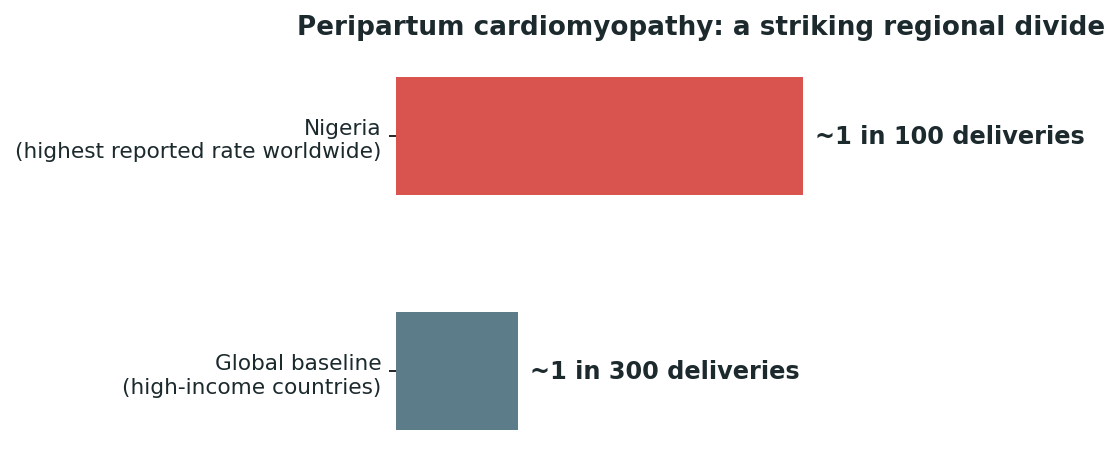
Published data on peripartum cardiomyopathy incidence: Nigeria's reported rate against a global high-income-country baseline.
Why the delay itself worsens the outcome
The heart muscle in peripartum cardiomyopathy has a genuine chance of recovering much or all of its function, but that recovery depends heavily on starting appropriate heart failure treatment as early as possible after the weakness begins. A heart caught early, still only mildly weakened, generally responds well to standard heart failure medication. A heart not diagnosed until it has already deteriorated significantly, sometimes into cardiogenic shock, faces a far harder road back and, in the most severe cases, may need mechanical support or transplant rather than medication alone. The underlying disease is the same in both scenarios. The timing of the diagnosis is what changes everything about how far it has to travel to reach that point.
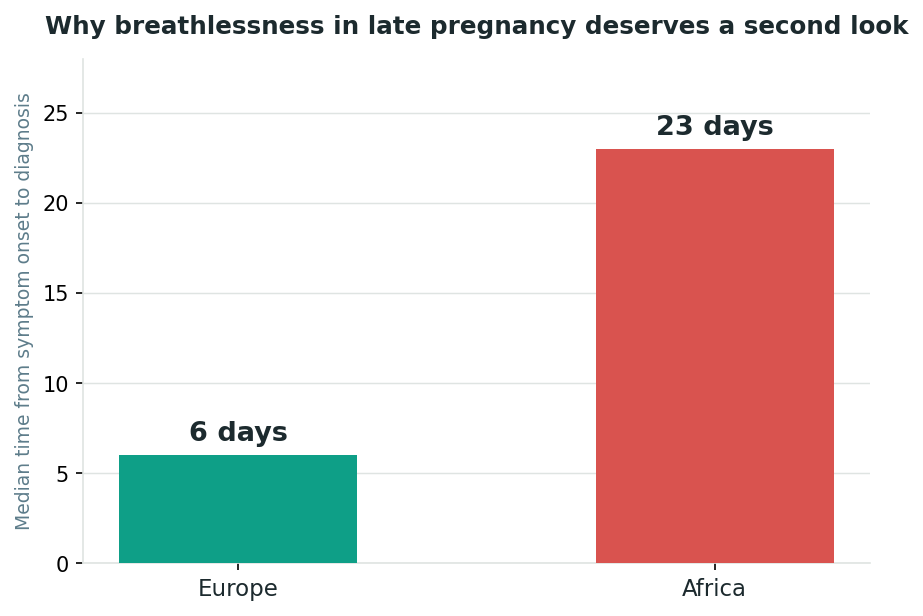
Published median time from peripartum cardiomyopathy symptom onset to diagnosis, Europe versus Africa.
Know the warning signs, and do not dismiss them as normal pregnancy
Breathlessness that is severe enough to interrupt a conversation or wake a woman from sleep, swelling that extends well beyond the ankles into the lower legs, a rapid or irregular heartbeat, chest discomfort, or a cough that will not settle are all worth raising directly with a doctor rather than accepting as an unavoidable part of pregnancy or the weeks after delivery. So is fatigue severe enough to limit ordinary daily activity, particularly when it appears or worsens suddenly rather than building up gradually over the pregnancy. These signs do not mean peripartum cardiomyopathy in most cases, since mild versions of several of them are genuinely common in pregnancy. What matters is asking for an echocardiogram when they are severe, sudden, or persist well after delivery, rather than assuming they will resolve on their own the way ordinary pregnancy discomfort does.
Not every case needs surgery, and heart failure has many causes
The majority of peripartum cardiomyopathy cases, caught reasonably early, are managed successfully with standard heart failure medication, careful monitoring, and time; many women recover substantial or complete heart function within months. Device therapy, such as a defibrillator or a specialised pacemaker that helps the heart's chambers beat in better coordination, becomes relevant for a smaller group with persistent, severe dysfunction or dangerous heart rhythms. Mechanical support or transplant is reserved for the minority whose heart function does not recover despite proper treatment. Heart failure in general also has other major causes beyond pregnancy, including long-standing high blood pressure, valve disease and coronary artery disease, each requiring its own specific evaluation rather than one approach applied to every case.
What it costs
In more than 24 years arranging this kind of care, the disputes I have seen were almost never about the price itself — they were about a diagnosis, or a cost, nobody had bothered to write down before the flight was booked. A quote should specify whether it covers evaluation and medication management alone, device implantation, or advanced mechanical support, since these differ enormously in cost.
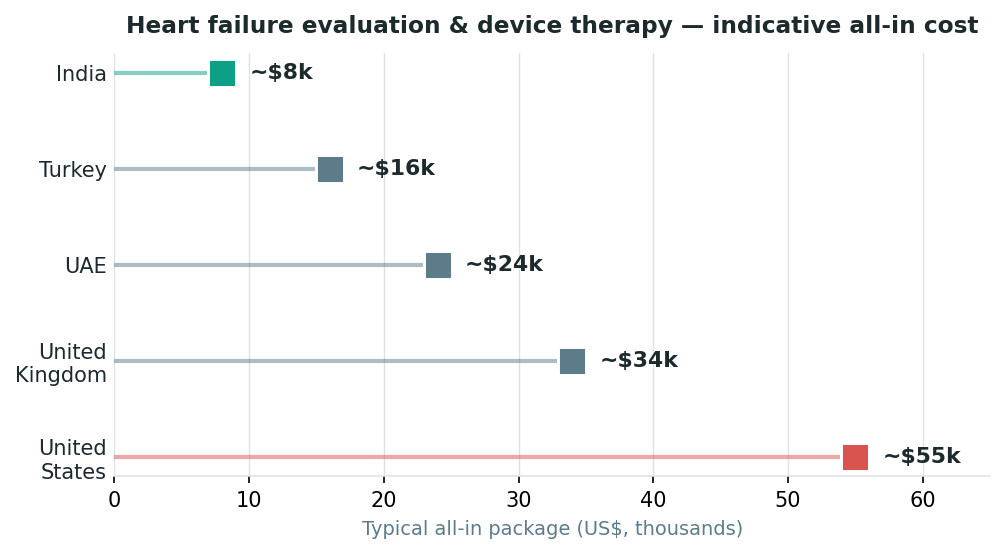
Indicative all-in cost for heart failure evaluation and device therapy. India sits far below every common alternative.
Heart failure evaluation and standard device therapy in a reputable private Indian hospital typically runs US$8,000 to US$15,000 all-in. For the minority of patients needing a mechanical assist device or heart transplant, costs run considerably higher, from roughly US$30,000 for LVAD implantation to US$70,000 or more for a full heart transplant, still far below equivalent care elsewhere. Ask for a quote specific to what your actual echocardiogram findings indicate.
Why a genuine cardiomyopathy programme, not general cardiology alone, is what to look for
Peripartum cardiomyopathy specifically benefits from a team that manages it regularly, since medication choices need adjusting carefully around breastfeeding and any future pregnancy plans, and the pace of recovery has to be tracked with repeat echocardiograms over months, not assumed from a single visit. Ask specifically whether the treating cardiologist has managed peripartum cardiomyopathy cases before, not heart failure in general terms only, and how follow-up echocardiograms will be scheduled and reviewed once you are back home. For the rare patient who does need a mechanical assist device or transplant, ask about the programme's specific experience with this diagnosis, since the underlying disease process differs in important ways from heart failure caused by, for example, longstanding coronary artery disease.
Four signals that should make you stop and walk away
Breathlessness in pregnancy dismissed without an echocardiogram. If symptoms are more severe than typical late pregnancy, or persist after delivery, ask for cardiac imaging directly.
Advanced device or surgery proposed before medication is properly trialled. Most cases respond to standard heart failure medication first. Ask what has been tried and for how long.
No cardiology follow-up plan after initial treatment. Recovery, when it happens, unfolds over months and needs monitoring. A one-time treatment plan without follow-up is incomplete.
The price keeps moving. A verbal estimate that shifts each time you ask is not an estimate. Demand a fixed figure in writing.
The practical journey from Somalia — plan it before you fly
There is no direct flight between Somalia and India; patients route through Nairobi, Addis Ababa, Dubai or Djibouti. Because there is no full Indian mission inside Somalia, the medical visa is issued through the Embassy of India in Addis Ababa or the High Commission in Nairobi , against a written invitation letter from the treating hospital. Somali patients may bring up to two medical attendants on attendant visas. Since your route crosses yellow-fever territory, carry a valid yellow-fever vaccination certificate . Above every other instruction: send your actual echocardiogram results and ECG, not just a description of symptoms, so the cardiology team can confirm the diagnosis and its severity before you ever leave home.
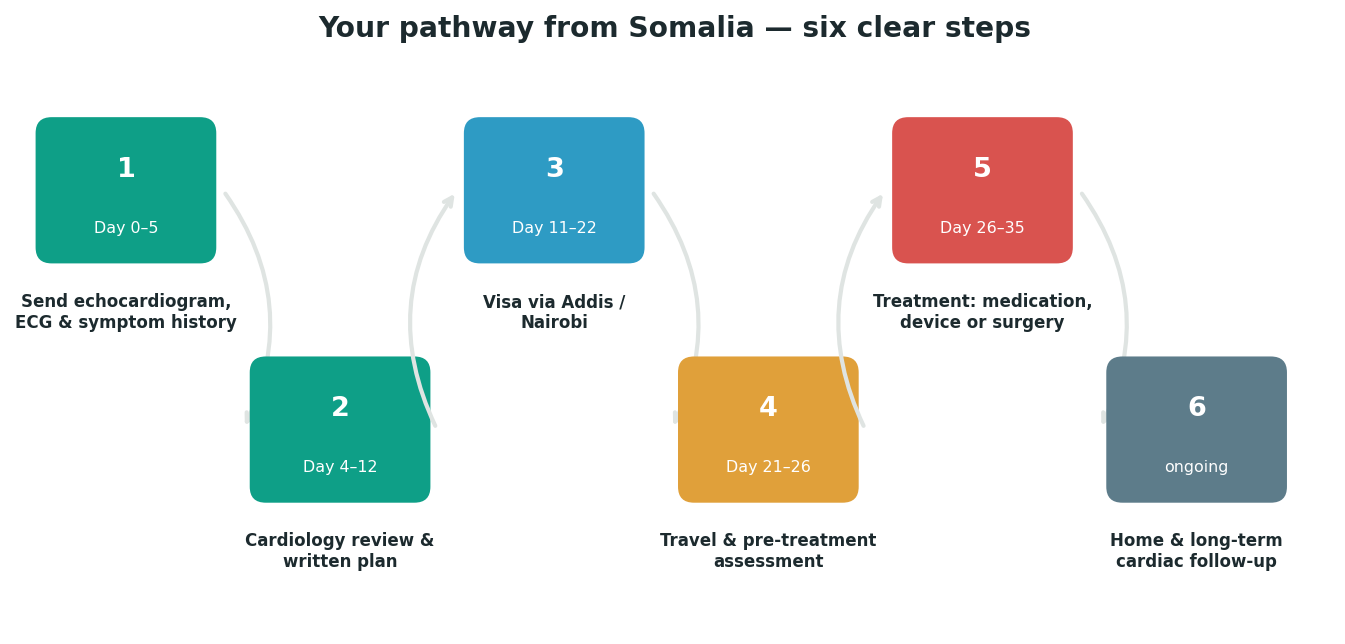
The complete route, start to finish — recovery and follow-up continue well beyond the initial treatment.
A young mother's heart deserves the same urgency as any other emergency
Peripartum cardiomyopathy strikes women at exactly the moment their lives are otherwise full of new demands, and its symptoms are easy to explain away. Caught early and treated properly, a genuine majority recover meaningful heart function — which makes the six-to-twenty-three-day gap in diagnosis time one of the more consequential, and correctable, delays in this entire field.
Sources & useful links
- 🌐 Indian medical visa (Somali nationals) — indianvisaonline.gov.in
- 🌐 Embassy of India, Addis Ababa — eoiaddisababa.gov.in
- 🌐 High Commission of India, Nairobi — hcinairobi.gov.in
- 🌐 Yellow-fever requirements — who.int/health-topics/yellow-fever
- 🌐 Hospital accreditation (India) — nabh.co · jointcommissioninternational.org
- 🌐 Verify a surgeon's registration — nmc.org.in
Do not decide alone, and do not decide blind
If you want your results reviewed properly and an honest written plan — including whether medication alone could still be the right path — that is precisely the independent guidance I provide, without a single hospital's interest attached to my advice. Dr. Dheeraj Bojwani · Independent medical travel advisor
Frequently Asked Questions by Somali Patients about Heart Failure Treatment and Surgery in India
Why can peripartum cardiomyopathy be missed during pregnancy?
Its main symptoms—breathlessness, swollen legs and fatigue—can resemble normal late-pregnancy discomfort. The guide recommends cardiac assessment when symptoms are unusually severe, sudden or persist after delivery.
What is peripartum cardiomyopathy?
It is a form of heart failure in which the heart's main pumping chamber becomes significantly weakened during the final weeks of pregnancy or the months following childbirth.
Should Somali patients ask for an echocardiogram if pregnancy-related breathlessness becomes severe?
Yes. The guide identifies echocardiography as an important test for distinguishing significant heart weakness from ordinary pregnancy symptoms.
What warning signs should Somali women not dismiss during or after pregnancy?
Severe breathlessness, swelling extending beyond the ankles, rapid or irregular heartbeat, chest discomfort, persistent cough and severe fatigue should be discussed with a doctor, particularly if they are sudden or worsening.
Can peripartum cardiomyopathy recover without surgery?
Many cases can be managed with standard heart failure medication, monitoring and time, and substantial or complete heart-function recovery may occur. More advanced cases may require additional support.
When might a heart device be needed for a Somali patient?
Device therapy may be considered when there is persistent severe heart dysfunction or a dangerous heart rhythm despite appropriate medical treatment. The specific device depends on the cardiac findings.
How much does heart failure treatment cost in India for Somali patients?
The guide gives an indicative range of US$8,000–US$15,000 for evaluation and standard device therapy. LVAD and heart transplantation are considerably more expensive and require individual quotations.
When may an LVAD or heart transplant be considered?
The guide reserves these advanced treatments for the minority of patients whose heart function does not recover despite appropriate treatment or who develop severe, advanced heart failure.
What should Somali patients send to an Indian cardiology team before travelling?
They should send the actual echocardiogram results, ECG and symptom history, allowing the cardiology team to assess the diagnosis and severity before travel.
What is the treatment journey from Somalia to India for heart failure care?
The guide outlines six stages: send echocardiogram/ECG → cardiology review and written plan → visa → travel and pre-treatment assessment → medication, device or surgery → home and long-term cardiac follow-up.
Page Summary
This guide explains the key considerations for Somali patients exploring heart failure treatment and surgery in India, with particular emphasis on early recognition of peripartum cardiomyopathy and the importance of echocardiography when symptoms during or after pregnancy appear unusually severe or persistent. It covers warning signs, diagnostic delays, medication, device therapy, LVAD and heart transplantation for advanced cases, indicative costs, cardiomyopathy-specific hospital selection, pre-travel cardiac records, visa and travel arrangements, and the six-step treatment pathway through long-term follow-up.
Citation Block
| Topic | Information |
|---|---|
| Topic Information | Heart Failure Treatment and Surgery in India for Patients from Somalia |
| Treatment | Heart Failure Treatment / Cardiac Surgery |
| Intended Audience | Patients from Somalia |
| Key Specialist | Cardiologist / Heart Failure Specialist |
| Main Condition | Peripartum Cardiomyopathy |
| Primary Assessment | Echocardiogram and ECG |
| Initial Treatment | Heart Failure Medication and Careful Monitoring |
| Device Therapy | Defibrillator or Specialised Pacemaker Where Indicated |
| Advanced Treatment | LVAD or Heart Transplant for Selected Severe Cases |
| Indicative Cost | US$8,000–US$15,000 for Evaluation and Standard Device Therapy |
| LVAD Cost | Approximately US$30,000 |
| Heart Transplant Cost | Approximately US$70,000 or More |
| Important Warning Signs | Severe breathlessness, swelling, rapid heartbeat, chest discomfort or persistent cough |
| Important Check | Cardiomyopathy-Specific Expertise and Follow-Up Plan |
| Pre-Travel Records | Actual Echocardiogram, ECG and Symptom History |
| Travel Routes | Nairobi, Addis Ababa, Dubai or Djibouti |
| Visa Requirement | Hospital Invitation and Medical Visa |
| Attendants | Up to Two Medical Attendants |
| Patient Journey | Records → cardiology review → visa → travel/assessment → treatment → long-term follow-up |
| Follow-Up | Repeat Echocardiograms and Long-Term Cardiac Monitoring |


Our Mission Statement
Our mission is to place patients at the centre of every healthcare decision by providing trustworthy, evidence-based, and unbiased medical information. We believe that informed patients make better decisions. Backed by personalised guidance from our experienced advisory team, we help patients understand their treatment options, compare them objectively, and confidently choose the path that best suits their medical needs and personal circumstances.
Patient Testimonials from Somalia




Ready to Take the First Step?
Share your Medical Reports with our Healthcare Managers Today and Get a FREE CONSULTATION, a Personalized Treatment Plan, and Complete Support from Arrival to Recovery.
Get Your Free ConsultationAreas We Serve
This resource has been thoughtfully prepared for patients from Somalia who are considering medical treatment in India. We also welcome patients from the wider region in the countries mentioned below-
We assist patients from:
- Ethiopia
- Djibouti
- Yemen
- Kenya
- Seychelles
- Somalia
- South Sudan
- Tanzania
- Uganda
- Zambia
- Zimbabwe
- Angola
- Cameroon
- Central African Republic
Many of the insights, treatment pathways, hospital recommendations, travel guidance, and patient support services described here are equally relevant and may be used as a reference when planning treatment in India.
From Somalia to India: Your Complete Patient Support Guide
- Best Brain Tumour Surgeons & Hospitals in India for Somali Patients
- Best Cancer Treatment Surgeons & Hospitals in India for Somali Patients
- Best Cardiac Surgeons & Hospitals in India for Somali Patients
- Best CyberKnife Teams & Centres in India for Somali Patients
- Best Heart Valve Replacement Surgeons & Hospitals in India for Somali Patients
- Best Hip Surgeons & Hospitals in India for Somali Patients
- Best Knee Surgeons & Hospitals in India for Somali Patients
- Best Neurosurgeons & Hospitals in India for Somali Patients
- Best Paediatric Cardiac Surgeons & Hospitals in India for Somali Patients
- Best Paediatric Neurosurgeons & Hospitals in India for Somali Patients
- Best Spine Surgeons & Hospitals in India for Somali Patients
- Bariatric Surgery in India for Patients from Somalia
- Brain Tumour Surgery in India for Patients from Somalia
- Cancer Treatment and Surgery in India for Patients from Somalia
- Cardiac Surgery in India for Patients from Somalia
- Cosmetic and Plastic Surgery in India for Patients from Somalia
- CyberKnife Treatment in India for Patients from Somalia
- Dental Surgery in India for Patients from Somalia