

Selecting the Best Heart Failure and Transplant Surgeons in India — A Somali Patient's Guide
India performs only around 200 to 250 heart transplants a year against roughly 50,000 people who need one, and allocation rules now prioritise Indian citizens first. This guide sets out how to get an honest answer about what is actually achievable for you.
Heart transplantation remains the most effective treatment for end-stage heart failure, but it depends entirely on a scarce, non-renewable resource: a donor heart from someone who has died. India performs roughly 200 to 250 heart transplants annually against an estimated 50,000 people who develop heart failure each year, and Indian authorities tightened allocation rules in 2018 specifically to ensure Indian patients on the waiting list are prioritised over foreign nationals. Foreign patients can still be listed, but honestly, wait times are uncertain and can be long. This is exactly the information a genuine heart failure programme should volunteer, not a detail a Somali patient discovers after arriving. Left ventricular assist devices (LVADs) — mechanical pumps that support a failing heart — offer a genuinely effective alternative with survival outcomes studies show are broadly comparable to transplant, whether used as a bridge while waiting or as a long-term destination therapy in their own right. In 24 years of guiding patients through heart failure decisions, I have found that a programme's honesty about these realities, upfront, says more about its integrity than any other factor. This guide sets out, plainly, how a Somali patient should verify both the transplant reality and the LVAD alternative before committing to travel.
Healing Journeys of Somali Patients









Key Takeaways
- The guide explains that heart transplantation depends on a scarce donor resource, with India performing roughly 200–250 heart transplants annually against an estimated 50,000 people who need one. Indian allocation rules prioritise Indian citizens, so Somali patients should receive an honest explanation of realistic foreign-patient waiting times before travelling.
- Before comparing transplant programmes, Somali patients should establish whether their heart failure is severe enough to require transplant evaluation, continued medical therapy or an LVAD. This assessment should come from a genuine heart failure specialist reviewing actual cardiac function reports rather than from symptoms alone.
- The guide gives particular importance to a genuine, active LVAD programme, because an LVAD may serve as a bridge to transplant or as destination therapy. Patients should verify that the programme actually performs LVAD implantation and can support ongoing device monitoring rather than mentioning LVAD only as a secondary option.
- For specialist selection, the guide prioritises a named heart failure specialist with dedicated transplant fellowship training, recent transplant or LVAD case volume and an honest explanation of what is realistically achievable for a foreign patient. The page 3 ranking chart places honest foreign-patient waiting-time disclosure highest at 18, followed by dedicated transplant fellowship at 15, a genuine active LVAD programme at 14 and recent transplant/LVAD case volume at 10.
- The guide also recommends checking for a multidisciplinary heart failure team, involving cardiology, cardiac surgery and transplant coordination before a treatment plan is proposed. A dedicated transplant or cardiac ICU, NABH/JCI accreditation and remote monitoring capability should also be verified before travel.
- Cost transparency is important because LVAD device replacement or battery costs and lifelong immunosuppression may not be included in the initial quotation. Somali patients should obtain a written, itemised estimate covering the initial treatment and long-term costs, while also budgeting for a potentially extended transplant wait.
- For Somali patients, the guide recommends sending actual echocardiogram and cardiac-function reports to every programme being compared. It also highlights the need for a clear lifelong follow-up and remote-monitoring plan after returning home, as dedicated heart-failure and transplant follow-up capacity within Somalia is described as extremely limited.
Quick Facts
- Author
- Dr. Dheeraj Bojwani
- Experience
- 24+ Years
- Treatment
- Heart Failure & Heart Transplant
- Patients
- Somali Patients
- First Assessment
- Echocardiogram and cardiac-function reports
- Key Specialist
- Heart Failure / Transplant Specialist
- Specialist Training
- Dedicated Heart Failure & Transplant Fellowship
- Case Volume
- Transplant or LVAD cases in last 12 months
- Treatment Choice
- Transplant vs LVAD vs medical therapy
- Wait-Time Check
- Honest foreign-patient transplant timeline
- LVAD Check
- Genuine active programme
- Team Review
- Multidisciplinary heart failure team
- Monitoring
- Lifelong rejection or device monitoring
- Hospital Check
- Dedicated transplant/cardiac ICU and accreditation
- Cost Check
- Written estimate including long-term costs
- Medical Records
- Echocardiogram and cardiac reports
- Budget
- Plan for extended waiting and long-term costs
- Visa
- Medical visa through relevant Indian mission
- Travel
- Connecting flights from Mogadishu
- Follow-Up
- Lifelong remote-monitoring plan
- Key Warning
- Vague transplant waiting-time assurances
- Decision Principle
- Prioritise programme honesty, transplant expertise and a genuine LVAD alternative.
This is not a case against seeking heart transplant care in India, which has genuinely skilled transplant teams. It is a case for making sure the full picture — including realistic waiting, and LVAD as a genuine option — is on the table from the start.
In Brief
For Somali patients considering heart failure or transplant treatment in India, the key decision is to verify a transplant-fellowship-trained heart failure specialist and a genuine LVAD-capable programme that provides an honest assessment of transplant waiting times for foreign patients. Patients should also confirm multidisciplinary review, long-term monitoring, complete costs and a written follow-up plan before travelling.
First, Establish What Your Case Actually Needs
Before comparing programmes, get clarity on whether your heart failure is severe enough to warrant transplant evaluation, or whether medical therapy or an LVAD might serve you as well, sooner. This assessment should come from a genuine heart failure specialist reviewing your actual cardiac function, not a general recommendation based on symptoms alone.
Two Decisions, Not One
Choosing well depends on two things: the specialist's own dedicated heart failure and transplant training, and the programme's honesty about what is genuinely achievable for a foreign patient. Because donor-heart scarcity is a hard structural reality that no amount of surgical skill can overcome, the programme's transparency about realistic timelines and its genuine LVAD capability carry particular weight in this guide.
Part One: Verifying the Programme's Honesty
This comes first, because no surgical skill can substitute for an honest picture of what is achievable.
1. A clear, honest disclosure of realistic transplant wait-time for a foreign patient, given that Indian nationals are now prioritised on the waiting list — treat vague reassurance as a signal to ask again, more specifically.
2. A genuine, active LVAD programme, offered as a real bridge-to-transplant or destination-therapy option, not mentioned only in passing.
3. Multidisciplinary heart failure team review, involving cardiology, cardiac surgery, and transplant coordination, before a plan is proposed.
| Stage | What it means |
|---|---|
| MBBS | Basic medical degree — the entry point, not evidence of transplant-specific skill. |
| MD Cardiology or MS/MCh Cardiothoracic Surgery | The base postgraduate qualification — years of foundational training. |
| Fellowship in Heart Failure & Transplant Cardiology/Surgery | Additional focused training in advanced heart failure management, LVAD implantation, and transplant surgery specifically — the credential that actually confirms the specialist skill this guide is asking you to verify. |
Part Two: Verifying the Specialist and Follow-Up Plan
Once the programme's honesty is confirmed, the specialist's own expertise and the long-term follow-up plan shape the rest of your decision.
4. A named heart failure specialist with a dedicated transplant fellowship, not a general cardiologist managing this as one of many conditions.
5. Documented case volume in transplant or LVAD specifically, in the last 12 months.
6. A structured lifelong rejection- or device-monitoring plan, with remote monitoring capability confirmed for follow-up once you are home.
7. A dedicated transplant or cardiac ICU, NABH or JCI accreditation, and a written, itemised cost estimate covering both the initial treatment and lifelong follow-up.
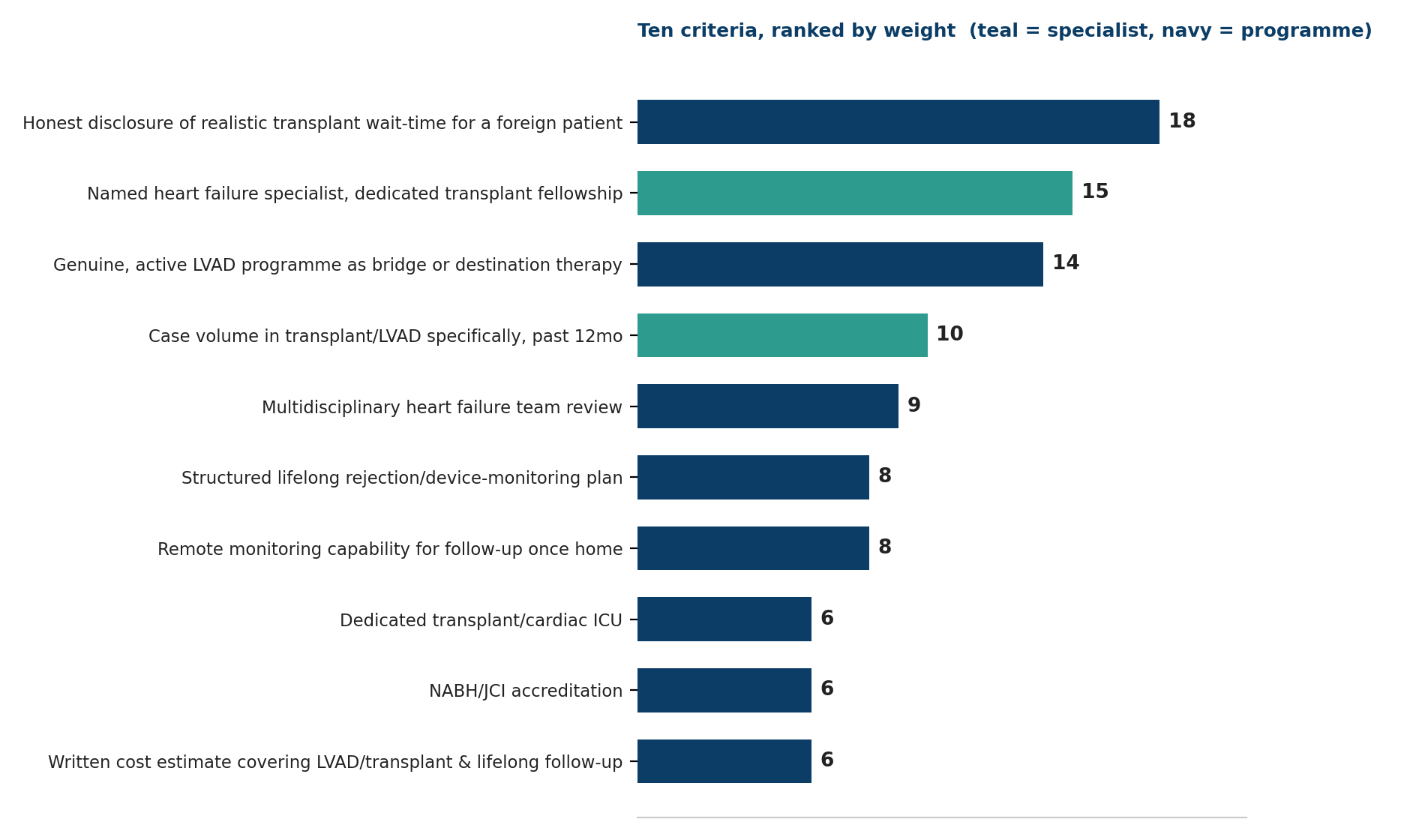
All ten criteria ranked by relative weight — honest disclosure of realistic wait-times dominates the list.
| Verification check | Genuine, honest programme | General, unverified provider |
|---|---|---|
| Honest wait-time disclosure for foreign patients | Yes | No |
| Named specialist, dedicated transplant fellowship | Yes | No |
| Genuine, active LVAD programme | Yes | No |
| Multidisciplinary heart failure team review | Yes | Partly |
| Written cost estimate incl. lifelong follow-up | Yes | Partly |
A simple check to run against any programme you are considering, before booking anything.
What the quote doesn't always show. In 24 years of reviewing these estimates, I have found disputes almost never concern the headline number — they concern what it silently left out: LVAD device replacement or battery costs not included in the original plan, or lifelong immunosuppression medication priced as though it were a one-time expense. Get every line item in writing before paying any deposit.
What a Somali Patient Should Weigh in Particular
Send your actual echocardiogram and cardiac function reports, not just a description of symptoms, to every programme being compared — the right path depends on your specific heart function.
Currency and budget. Somalia is heavily dollarised — hospital-scale payments are quoted and settled in US dollars, not the shilling (roughly 570 SOS/US$1 in mid-2026). Budget for a potentially long wait, and for lifelong medication or device-maintenance costs.
Visa timing for an uncertain, possibly extended stay. India has no resident mission in Mogadishu, so Somali passport holders apply through the Indian High Commission in Nairobi or the Embassy of India in Addis Ababa. A transplant wait cannot be scheduled precisely, so plan visa renewal into your timeline from the start.
No direct flight. Ethiopian Airlines via Addis Ababa is the most frequent route from Mogadishu; flydubai, Emirates, and Qatar Airways offer alternatives via Dubai or Doha.
A Somali- or Arabic-speaking coordinator, and a clear, written plan for lifelong follow-up once home — genuine heart failure and transplant follow-up capacity within Somalia itself is essentially absent.
Four Signals That Should Make You Pause
1. No honest discussion of realistic wait-times for a foreign patient.
2. LVAD dismissed or barely mentioned as an alternative.
3. No clear confirmation of dedicated transplant fellowship training.
4. Pressure to pay a large deposit before an honest assessment exists.
Questions Worth Asking Directly
| Ask the specialist | Ask the programme |
|---|---|
| Realistically, how long might I wait for a donor heart? | How many transplants and LVADs have you done this year? |
| Is an LVAD a genuine option for me, now or later? | Does the device support remote monitoring after I go home? |
| How many cases like mine have you managed this year? | What does the full cost cover, over the long term? |
A Closing Word
Donor-heart scarcity is a reality no programme can talk its way around, which is why honesty about realistic timelines matters as much as surgical skill. A named, transplant-fellowship-trained specialist, backed by a genuine LVAD programme and honest about what a foreign patient can realistically expect, is the baseline worth insisting on before any deposit is paid. If you can share your cardiac function reports, I am glad to review them honestly.
Sources
- 🌐 National Medical Commission of India — verify any specialist's registration — nmc.org.in
- 🌐 National Organ and Tissue Transplant Organisation (NOTTO) — allocation policy — notto.mohfw.gov.in
- 🌐 National Accreditation Board for Hospitals & Healthcare Providers (NABH) — nabh.co
- 🌐 High Commission of India, Nairobi — visa services for Somali nationals — hcinairobi.gov.in
- 🌐 Embassy of India, Addis Ababa — medical visa requirements — indianembassy.gov.et
Frequently Asked Questions by Somalis about Heart Failure and Transplant Surgeons in India
How many heart transplants does India perform annually?
The guide states that India performs roughly 200–250 heart transplants a year, while demand is substantially higher.
Can Somali patients receive a heart transplant in India?
Foreign patients can still be listed, but the guide stresses that waiting times are uncertain because Indian nationals are prioritised. Patients should obtain an honest assessment before travelling.
What alternatives should be discussed?
Patients should discuss whether medical therapy, LVAD or heart transplantation is most appropriate based on their actual cardiac condition.
What type of specialist should Somali patients choose?
Look for a named heart failure specialist with dedicated transplant fellowship training and recent transplant or LVAD experience.
Why is an active LVAD programme important?
An LVAD can serve as a bridge to transplant or destination therapy, making genuine LVAD capability an important alternative when donor-heart availability is uncertain.
Why is multidisciplinary review important?
The guide recommends review involving cardiology, cardiac surgery and transplant coordination before a treatment plan is proposed.
What should the cost estimate include?
Patients should obtain a written estimate covering initial treatment and long-term costs, including potential LVAD device or lifelong medication expenses.
What records should Somali patients send?
Send actual echocardiogram and cardiac-function reports to every programme being compared.
What should patients plan for after returning to Somalia?
The guide recommends a lifelong follow-up and remote-monitoring plan, particularly for rejection or device monitoring.
What are the main warning signs?
Be cautious if there is no honest discussion of foreign-patient waiting times, LVAD is dismissed, transplant fellowship training is unclear or a large deposit is requested before proper assessment.
Page Summary
This five-page guide focuses on realistic transplant access for Somali patients and the importance of a genuine LVAD alternative. Page 1 explains donor scarcity and foreign-patient allocation realities, while page 2 covers programme honesty, LVAD capability, multidisciplinary review, specialist training and lifelong monitoring. The page 3 ranking chart places honest waiting-time disclosure highest, followed by transplant fellowship, active LVAD capability and recent case volume. Pages 3–4 also address long-term costs, cardiac reports, visa flexibility, travel, communication, remote monitoring and warning signs.
Citation Block
| Topic | Information |
|---|---|
| Topic | Heart Failure & Transplant Surgeons in India for Somali Patients |
| Treatment | Heart Failure / Heart Transplant / LVAD |
| Patients | Somali Patients |
| First Assessment | Echocardiogram and cardiac-function reports |
| Key Specialist | Heart Failure / Transplant Specialist |
| Specialist Training | Dedicated Heart Failure & Transplant Fellowship |
| Case Volume | Transplant or LVAD cases in last 12 months |
| Treatment Choice | Transplant vs LVAD vs medical therapy |
| Wait-Time Check | Honest realistic timeline for foreign patients |
| LVAD Programme | Genuine active bridge-to-transplant or destination therapy |
| Team Review | Multidisciplinary heart failure team |
| Monitoring | Lifelong rejection or device monitoring |
| Remote Follow-Up | Remote monitoring capability after returning home |
| Hospital Check | Dedicated transplant/cardiac ICU |
| Accreditation | NABH / JCI |
| Cost Check | Written itemised estimate including long-term follow-up |
| Cost Risk | LVAD replacement/battery or lifelong medication costs may be additional |
| Medical Records | Echocardiogram and cardiac-function reports |
| Visa Planning | Nairobi or Addis Ababa |
| Travel | Connecting flights from Mogadishu |
| Communication | Somali- or Arabic-speaking coordinator |
| Home Follow-Up | Lifelong follow-up and remote-monitoring plan |
| Patient Question | Realistically, how long might I wait for a donor heart? |
| Alternative Question | Is an LVAD a genuine option for me now or later? |
| Programme Question | How many transplants and LVADs have you performed this year? |
| Warning Signs | No honest foreign-patient waiting-time discussion |
| Alternative Warning | LVAD dismissed or barely mentioned |
| Payment Warning | Large deposit requested before an honest assessment |
| Key Decision | Verify transplant feasibility, LVAD capability and lifelong follow-up |


Our Mission Statement
Our mission is to place patients at the centre of every healthcare decision by providing trustworthy, evidence-based, and unbiased medical information. We believe that informed patients make better decisions. Backed by personalised guidance from our experienced advisory team, we help patients understand their treatment options, compare them objectively, and confidently choose the path that best suits their medical needs and personal circumstances.
Patient Testimonials from Somalia




Ready to Take the First Step?
Share your Medical Reports with our Healthcare Managers Today and Get a FREE CONSULTATION, a Personalized Treatment Plan, and Complete Support from Arrival to Recovery.
Get Your Free ConsultationAreas We Serve
This resource has been thoughtfully prepared for patients from Somalia who are considering medical treatment in India. We also welcome patients from the wider region in the countries mentioned below-
We assist patients from:
- Ethiopia
- Djibouti
- Yemen
- Kenya
- Seychelles
- Somalia
- South Sudan
- Tanzania
- Uganda
- Zambia
- Zimbabwe
- Angola
- Cameroon
- Central African Republic
Many of the insights, treatment pathways, hospital recommendations, travel guidance, and patient support services described here are equally relevant and may be used as a reference when planning treatment in India.
From Somalia to India: Your Complete Patient Support Guide
- Best Brain Tumour Surgeons & Hospitals in India for Somali Patients
- Best Cancer Treatment Surgeons & Hospitals in India for Somali Patients
- Best Cardiac Surgeons & Hospitals in India for Somali Patients
- Best CyberKnife Teams & Centres in India for Somali Patients
- Best Heart Valve Replacement Surgeons & Hospitals in India for Somali Patients
- Best Hip Surgeons & Hospitals in India for Somali Patients
- Best Knee Surgeons & Hospitals in India for Somali Patients
- Best Neurosurgeons & Hospitals in India for Somali Patients
- Best Paediatric Cardiac Surgeons & Hospitals in India for Somali Patients
- Best Paediatric Neurosurgeons & Hospitals in India for Somali Patients
- Best Spine Surgeons & Hospitals in India for Somali Patients
- Bariatric Surgery in India for Patients from Somalia
- Brain Tumour Surgery in India for Patients from Somalia
- Cancer Treatment and Surgery in India for Patients from Somalia
- Cardiac Surgery in India for Patients from Somalia
- Cosmetic and Plastic Surgery in India for Patients from Somalia
- CyberKnife Treatment in India for Patients from Somalia
- Dental Surgery in India for Patients from Somalia