

Selecting the Best Dental Surgeons and Hospitals in India — A Somali Patient's Guide
A crown or implant that fails does not fail on the day it is placed — it fails months later, far from the clinic that placed it. This guide sets out how to verify the specialist and the clinic before that happens.
Few gaps in this guide series are as costly as an implant placed by an unnamed dentist inside a general "dental package," because the consequence rarely shows up the same day. In 24 years of guiding patients through treatment decisions, dental work is the category I see go wrong most quietly — a crown that loosens at eighteen months, an implant that never truly integrated. This guide sets out, plainly, how a Somali patient should verify a dental specialist and clinic before committing to travel, and to a treatment plan.
Healing Journeys of Somali Patients









Key Takeaways
- The guide explains that dental treatment should begin with a clear assessment of what the patient's case actually requires, whether that is a single implant, full-mouth rehabilitation, root canal and crown, bridge, denture or reconstructive work. Somali patients should have their actual X-rays or scans reviewed by a qualified specialist rather than accepting a treatment recommendation based only on a written description.
- For specialist selection, the guide prioritises a named dentist with genuine MDS postgraduate qualification in the relevant speciality, such as prosthodontics, implantology or oral and maxillofacial surgery. It also recommends checking the specialist's documented experience with the exact procedure during the previous 12 months and whether the dentist provides an honest comparison between an implant, bridge or denture when more than one option is possible.
- The page 2 weighting graphic gives 58% importance to the dental specialist and 42% to the clinic or hospital, making specialist judgement the larger consideration. The page 3 ranking chart places a named MDS specialist highest at 17, followed by a genuine and traceable implant brand at 15, exact-procedure case volume at 13 and an honest treatment plan at 11.
- The guide also highlights important clinic-level checks, including disclosure and traceability of the implant or material brand, in-house CBCT and guided digital planning, a named prosthetics laboratory or accredited external lab partner, demonstrable sterilisation and infection-control procedures and NABH or equivalent dental-specific accreditation.
- Cost transparency is particularly important because the guide warns that lab charges or warranty exclusions may not appear in the headline price. Somali patients should obtain a written, itemised quotation explaining the implant or material brand, what the warranty covers and what happens if the dental work needs to be redone within the warranty period. A 15–20% financial margin above the written estimate is recommended.
- For Somali patients, the guide recommends sending photographs and X-rays or CBCT files to every clinic being compared, because a reliable quotation depends on the patient's actual dental condition. It also recommends confirming a Somali- or Arabic-speaking coordinator and establishing who will manage follow-up after the patient returns home.
- Travel planning should follow confirmation of the specialist and treatment plan. The guide notes that India has no resident mission in Mogadishu, with Somali passport holders applying through Nairobi or Addis Ababa, and that there is no direct Mogadishu–India flight. Connecting routes through Addis Ababa, Dubai or Doha may therefore need to be planned in advance.
Quick Facts
- Author
- Dr. Dheeraj Bojwani
- Experience
- 24+ Years
- Treatment
- Dental Treatment & Implant Dentistry
- Patients
- Somali Patients
- First Assessment
- Dental examination, X-rays or CBCT
- Key Specialist
- MDS Dental Specialist
- Specialist Training
- Prosthodontics, Implantology or Oral & Maxillofacial Surgery
- Decision Weighting
- Specialist 58% / Clinic 42%
- Case Volume
- Exact procedure in last 12 months
- Treatment Choice
- Implant vs bridge vs denture
- Implant Check
- Genuine, traceable implant brand
- Planning
- CBCT and guided digital planning
- Laboratory
- Named in-house or accredited external lab
- Safety
- Sterilisation and infection-control protocol
- Cost Check
- Written itemised estimate
- Warranty
- Written coverage and redo terms
- Medical Records
- Photographs and X-rays / CBCT
- Budget
- 15–20% margin
- Visa
- Medical visa through relevant Indian mission
- Travel
- Connecting flights from Mogadishu
- Follow-Up
- Clear home follow-up plan
- Key Warning
- Treatment proposed without reviewing actual scans
- Decision Principle
- Prioritise specialist expertise and traceable dental materials.
None of this is a case against dental travel itself. India remains a well-used option for Somali patients precisely because it combines specialist training, modern implant systems, and cost that few nearby alternatives can match — provided the right specialist and clinic are confirmed first.
In Brief
For Somali patients seeking dental treatment in India, the key decision is to verify an MDS-qualified specialist with documented experience in the exact procedure and an honest recommendation between implants, bridges or dentures. Patients should also confirm traceable implant materials, CBCT-based planning, appropriate laboratory support, written warranty terms, complete costs and a clear follow-up plan before travelling.
First, Establish What Your Case Actually Needs
Before comparing clinics or prices, get clarity on what your specific case requires — a single implant, full- mouth rehabilitation, a root canal and crown, or reconstructive work after trauma or decay. This assessment should come from a genuine specialist reviewing your actual X-rays or scans, not a general estimate given from a written description alone. If treatment elsewhere has not held up, this is not a reason for self-blame — it is the starting point for an honest opinion on what can still be done.
Two Decisions, Not One
Choosing well depends on two things: the specialist's own postgraduate training, and the clinic's supporting infrastructure — its lab, its imaging, its sterilisation standard. Both carry real weight, though the treating specialist's judgement — deciding whether an implant, a bridge, or a denture is right for your case — edges out
as the larger factor.
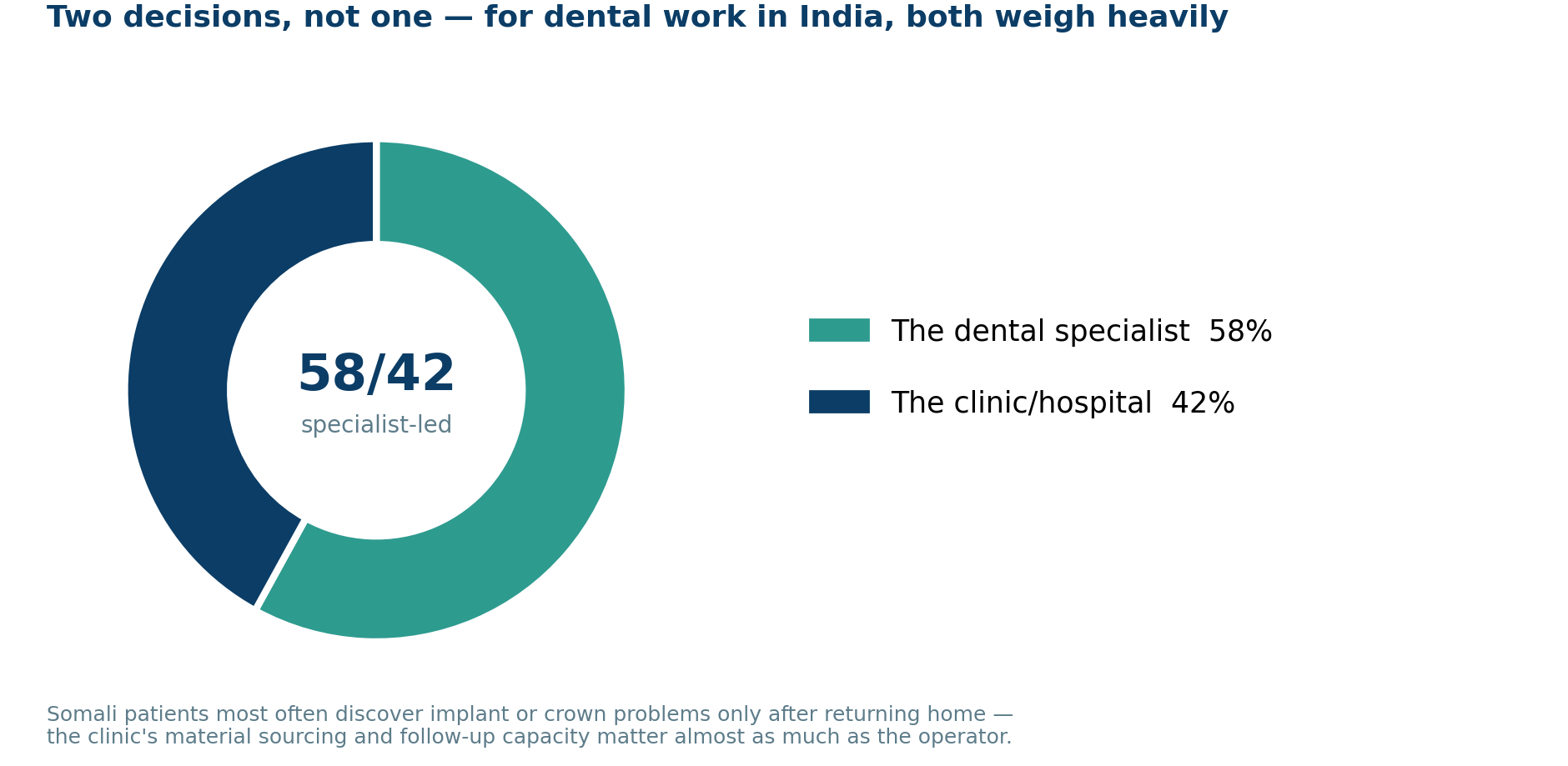
Both the specialist and the clinic behind them carry real weight in dental outcomes — the specialist's judgement edges ahead.
Part One: Verifying the Specialist
These three points matter more than a clinic's marketing claims.
1. A named specialist with genuine postgraduate qualification (MDS) in the relevant sub-specialty — prosthodontics, implantology, or oral & maxillofacial surgery — not a general dentist (BDS only) presenting routine work as specialist care.
2. Documented case volume in your exact procedure, in the last 12 months — general dental caseload does not indicate implant-specific experience.
3. An honest recommendation between treatment options — implant versus bridge versus denture — explained clearly for your case, not defaulted to whichever the clinic prefers to sell.
| Stage | What it means |
|---|---|
| BDS | Basic dental degree — the entry point, not evidence of specialist skill in implants or prosthodontics on its own. |
| MDS | Postgraduate dental specialisation — three years of focused training in a specific stream such as prosthodontics or oral surgery. |
| Fellowship / Certification in Implantology | Additional focused training in implant placement and full-mouth rehabilitation — the credential that actually confirms the hands-on skill this guide is asking you to verify. |
Ask for this exact credential chain — a general dental degree alone does not confirm implant-specific training.
Part Two: Verifying the Clinic
Once the specialist is confirmed, the clinic's own infrastructure shapes how predictably the treatment and materials hold up.
4. A genuine implant or material brand disclosed and traceable, with warranty documentation — unbranded or unverifiable implants are a real, recurring risk in cross-border dental travel.
5. In-house CBCT scanning and guided digital planning, rather than treatment planned from a 2D X-ray alone.
6. An own prosthetics lab, or a named, accredited external lab partner for crowns, bridges, and dentures.
7. A demonstrable sterilisation and infection-control protocol, not a general assurance of "international standards."
8. NABH accreditation, or an equivalent dental-specific accreditation.
9. A written, itemised cost estimate covering the full course, including what happens if work needs redoing within the warranty period.
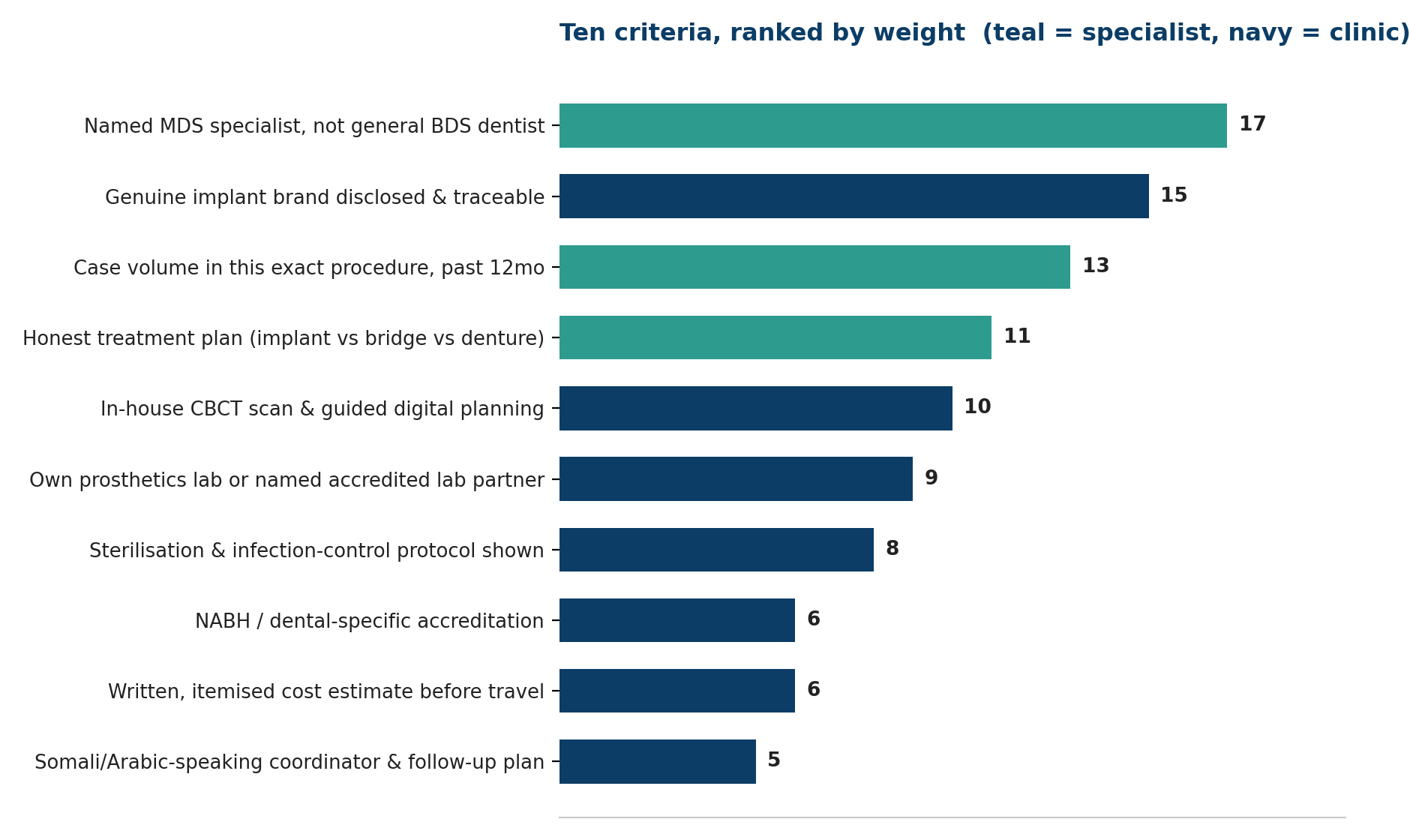
All ten criteria ranked by relative weight — genuine specialist training and traceable materials dominate the list.
| Verification check | Genuine specialist clinic | General, unverified provider |
|---|---|---|
| Named MDS specialist, sub-specialty confirmed | Yes | No |
| Genuine implant brand disclosed & traceable | Yes | No |
| Honest treatment plan explained | Yes | Partly |
| In-house CBCT & guided digital planning | Yes | No |
| Written, itemised cost estimate | Yes | Partly |
A simple check to run against any clinic you are considering, before booking anything.
What the quote doesn't always show. In 24 years of reviewing these estimates, I have found disputes almost never concern the headline number — they concern what it silently left out: a lab fee charged separately, or a "lifetime warranty" that excludes the crown sitting on top of the implant. Get every line item in writing, including what the warranty covers, before paying any deposit.
What a Somali Patient Should Weigh in Particular
Send photographs and X-rays or CBCT files, not just a description, to every clinic being compared — a real quote depends on the actual images, not a summary paragraph.
Currency and budget. Somalia is heavily dollarised — hospital-scale payments are quoted and settled in US dollars, not the shilling (roughly 570 SOS/US$1 in mid-2026). Budget with a 15–20% margin above the written estimate.
Visa timing. India has no resident mission in Mogadishu, so Somali passport holders apply through the Indian High Commission in Nairobi or the Embassy of India in Addis Ababa, with a no-objection letter from the Somali embassy there; occasional consular camps are also held in Mogadishu. Up to two attendants can be included on the same application.
No direct flight. Ethiopian Airlines via Addis Ababa is the most frequent route from Mogadishu; flydubai, Emirates, and Qatar Airways offer alternatives via Dubai or Doha.
A Somali- or Arabic-speaking coordinator, and a clear plan for who manages follow-up care once home — implant follow-up capacity within Somalia itself remains limited, so confirm the clinic's remote follow-up process before travel, not after.
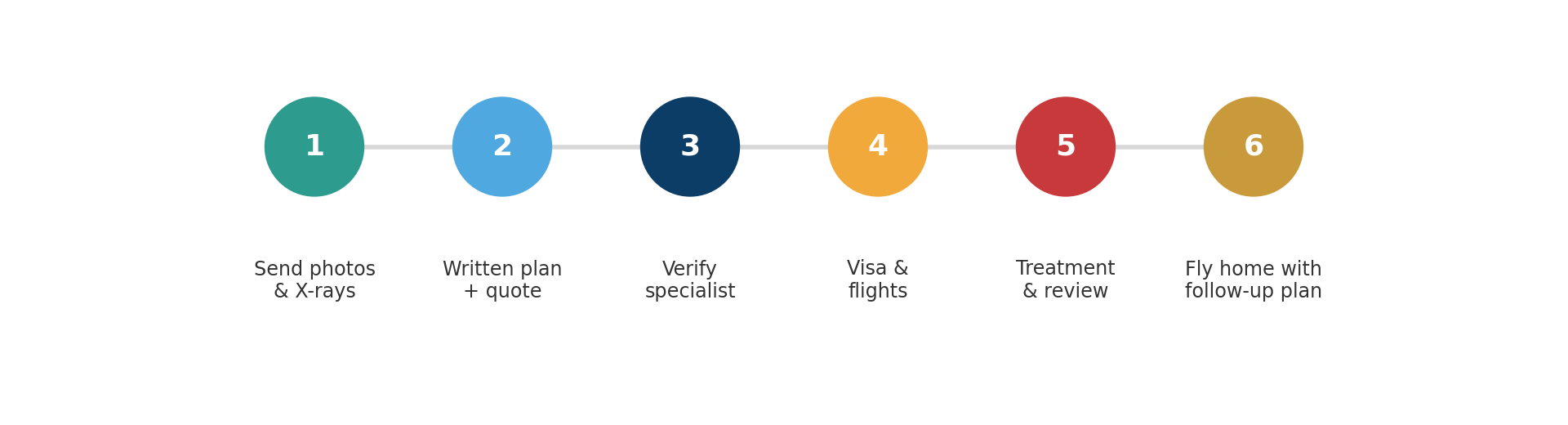
The practical sequence once you have chosen and verified your specialist and clinic.
Four Signals That Should Make You Pause
1. No clear confirmation of genuine MDS-level specialist training.
2. No implant brand or material disclosed in the written estimate.
3. Treatment proposed without reviewing your actual X-rays or scans.
4. Pressure to pay the full balance before a written treatment plan exists.
Questions Worth Asking Directly
| Ask the specialist | Ask the clinic |
|---|---|
| Are you MDS-qualified in this specific area? | Which implant or material brand will be used? |
| How many cases like mine have you treated this year? | Do you have in-house CBCT and a named lab partner? |
| What are my options, and why this one for me? | What does the warranty actually cover, in writing? |
A Closing Word
Dental work is meant to last years, which is why the clinic behind it matters nearly as much as the specialist performing it. A named, MDS-qualified specialist, working with a clinic that discloses its implant brand and stands behind its warranty in writing, is the baseline worth insisting on before any deposit is paid — and no genuine clinic will hesitate to confirm this clearly. If you can share your X-rays or a quote already received, I am glad to review it honestly, including telling you if a clinic's credentials do not hold up to scrutiny.
Sources
- 🌐 National Medical Commission of India / Dental Council — verify practitioner registration — dciindia.gov.in
- 🌐 National Accreditation Board for Hospitals & Healthcare Providers (NABH) — nabh.co
- 🌐 High Commission of India, Nairobi — visa services for Somali nationals — hcinairobi.gov.in
- 🌐 Embassy of India, Addis Ababa — medical visa requirements — indianembassy.gov.et
- 🌐 Wise / Xe — SOS to USD exchange rate reference — wise.com
Frequently Asked Questions by Somalis about Dental Surgeons and Hospitals in India
What qualification should Somali patients look for?
The guide recommends an MDS-qualified specialist in the relevant dental speciality, such as prosthodontics, implantology or oral and maxillofacial surgery.
Why is exact-procedure experience important?
A general dental caseload does not necessarily demonstrate experience with a specific procedure such as implant placement or full-mouth rehabilitation.
Should an implant always be chosen?
No. The guide recommends an honest comparison of implant, bridge and denture options according to the patient's actual dental condition.
Why should the implant brand be disclosed?
A genuine and traceable implant or material brand allows the patient to know what is being used and what warranty documentation applies.
Why is CBCT planning important?
The guide recommends CBCT scanning and guided digital planning rather than planning treatment from a 2D X-ray alone.
What should patients ask about the dental laboratory?
Confirm whether the clinic has an own prosthetics lab or a named, accredited external laboratory for crowns, bridges and dentures.
What should the written quotation include?
It should clearly identify the full treatment cost, materials, laboratory charges and warranty terms, including what happens if work needs to be redone.
What should Somali patients send before travelling?
Send photographs and X-rays or CBCT files so the clinic can assess the actual dental condition before providing a treatment plan.
Why is follow-up planning important?
Dental complications may appear after returning home, so patients should confirm who will manage follow-up and whether remote support is available before travelling.
What are the main warning signs?
Be cautious if MDS-level specialist training is unclear, implant materials are not disclosed, treatment is proposed without reviewing scans or full payment is requested before a written treatment plan.
Page Summary
This five-page guide focuses on specialist qualification, exact-procedure experience and traceable dental materials. Page 1 explains why Somali patients should first establish their actual dental treatment needs, while page 2 gives 58% weighting to the dental specialist and 42% to the clinic. The page 3 ranking chart places MDS specialist qualification, traceable implant materials, procedure-specific case volume and honest treatment planning highest, while pages 3–4 address CBCT planning, laboratory support, infection control, warranties, costs, Somali visa and travel planning, communication and follow-up.
Citation Block
| Topic | Information |
|---|---|
| Topic | Dental Surgeons & Hospitals in India for Somali Patients |
| Treatment | Dental Treatment & Implant Dentistry |
| Patients | Somali Patients |
| First Assessment | Dental examination, X-rays or CBCT |
| Key Specialist | MDS Dental Specialist |
| Specialist Training | Prosthodontics, Implantology or Oral & Maxillofacial Surgery |
| Decision Weighting | Specialist 58% / Clinic 42% |
| Case Volume | Exact procedure in last 12 months |
| Treatment Choice | Implant vs bridge vs denture |
| Implant Materials | Genuine, disclosed and traceable brand |
| Digital Planning | In-house CBCT and guided planning |
| Laboratory Check | Own lab or named accredited external lab |
| Infection Control | Demonstrable sterilisation protocol |
| Accreditation | NABH or equivalent dental-specific accreditation |
| Cost Check | Written, itemised estimate |
| Warranty | Written coverage and redo terms |
| Cost Risk | Lab charges or warranty exclusions may apply |
| Budget | 15–20% margin |
| Medical Records | Photographs and X-rays / CBCT files |
| Visa Planning | Nairobi or Addis Ababa |
| Travel | Connecting flights from Mogadishu |
| Communication | Somali- or Arabic-speaking coordinator |
| Home Follow-Up | Clear remote follow-up process |
| Material Question | Which implant or material brand will be used? |
| Planning Question | Is CBCT and guided digital planning available? |
| Warning Signs | Unverified specialist training or undisclosed materials |
| Payment Warning | Full balance requested before written treatment plan |
| Key Decision | Verify specialist qualification, exact-procedure experience and material traceability |


Our Mission Statement
Our mission is to place patients at the centre of every healthcare decision by providing trustworthy, evidence-based, and unbiased medical information. We believe that informed patients make better decisions. Backed by personalised guidance from our experienced advisory team, we help patients understand their treatment options, compare them objectively, and confidently choose the path that best suits their medical needs and personal circumstances.
Patient Testimonials from Somalia




Ready to Take the First Step?
Share your Medical Reports with our Healthcare Managers Today and Get a FREE CONSULTATION, a Personalized Treatment Plan, and Complete Support from Arrival to Recovery.
Get Your Free ConsultationAreas We Serve
This resource has been thoughtfully prepared for patients from Somalia who are considering medical treatment in India. We also welcome patients from the wider region in the countries mentioned below-
We assist patients from:
- Ethiopia
- Djibouti
- Yemen
- Kenya
- Seychelles
- Somalia
- South Sudan
- Tanzania
- Uganda
- Zambia
- Zimbabwe
- Angola
- Cameroon
- Central African Republic
Many of the insights, treatment pathways, hospital recommendations, travel guidance, and patient support services described here are equally relevant and may be used as a reference when planning treatment in India.
From Somalia to India: Your Complete Patient Support Guide
- Best Brain Tumour Surgeons & Hospitals in India for Somali Patients
- Best Cancer Treatment Surgeons & Hospitals in India for Somali Patients
- Best Cardiac Surgeons & Hospitals in India for Somali Patients
- Best CyberKnife Teams & Centres in India for Somali Patients
- Best Heart Valve Replacement Surgeons & Hospitals in India for Somali Patients
- Best Hip Surgeons & Hospitals in India for Somali Patients
- Best Knee Surgeons & Hospitals in India for Somali Patients
- Best Neurosurgeons & Hospitals in India for Somali Patients
- Best Paediatric Cardiac Surgeons & Hospitals in India for Somali Patients
- Best Paediatric Neurosurgeons & Hospitals in India for Somali Patients
- Best Spine Surgeons & Hospitals in India for Somali Patients
- Bariatric Surgery in India for Patients from Somalia
- Brain Tumour Surgery in India for Patients from Somalia
- Cancer Treatment and Surgery in India for Patients from Somalia
- Cardiac Surgery in India for Patients from Somalia
- Cosmetic and Plastic Surgery in India for Patients from Somalia
- CyberKnife Treatment in India for Patients from Somalia
- Dental Surgery in India for Patients from Somalia