

Dental Implants and Smile Makeover in India for Patients from Somalia
Nearly four in ten procedures performed by traditional healers in Somalia are tooth extractions — which is a very different starting point for a smile than most countries researching dental implants ever have.
Most people researching dental implants abroad are replacing one or two teeth lost later in life. For a meaningful number of Somali patients, the starting point is different: several missing teeth, often extracted young, sometimes years or decades ago, by whoever was reachable at the time rather than a dentist. For 24 years I have helped patients rebuild a full, functioning smile from exactly this starting point, and it changes what "dental implants" actually needs to mean for the case in front of me.
India runs implant and cosmetic dentistry programmes with genuinely deep experience in full-mouth rebuilding, not just single-tooth replacement, using digital smile design, CAD/CAM crown and veneer fabrication, and the same implant systems used at leading clinics worldwide — at a fraction of the cost of the same care in the Gulf, Europe or the United States.
Healing Journeys of Somali Patients









Key Takeaways
- The guide explains that many Somali patients may present with multiple missing teeth rather than a single missing tooth, with tooth extraction historically being a common response to dental pain and decay.
- A regional study cited in the guide found that tooth extractions accounted for 38% of surgical procedures performed by traditional healers in Somalia, while a related practice of infant tooth-bud extraction has also been documented across parts of Africa, including Somalia.
- Long-standing missing teeth can cause neighbouring teeth to tilt or drift, opposing teeth to over-erupt and jawbone to resorb, making later implant treatment more complex and sometimes requiring bone grafting.
- Warning signs include gaps present for several months, visibly shifting teeth, changes in the bite or facial shape, persistent bad breath, bleeding gums and loose teeth. A dental examination is recommended before the condition progresses further.
- Not every patient needs implants for every tooth. The guide explains that implants, bridges, partial dentures, crowns, veneers and professional whitening may each have a role depending on whether teeth are missing, damaged or mainly require cosmetic improvement.
- A full-mouth implant plan should assess bone quantity and quality, gum health, the number of implants required, possible bone grafting and the planned crown or veneer material before treatment begins.
- The guide gives an indicative cost of US$4,000–US$8,000 all-in for a full-mouth implant and smile makeover package in a reputable Indian dental centre, including implants, crowns, required bone grafting and cosmetic finishing.
- Patients should verify the implant brand and documentation, the dentist's experience with full-mouth cases, CBCT or X-ray assessment and whether bone grafting has been properly considered. A changing verbal price or one technique being applied to every gap is a warning sign.
- Somali patients should send clear photographs, existing X-rays and dental history before travelling. Full-mouth implant treatment typically requires two visits several months apart to allow healing before final crowns or veneers are fitted.
Quick Facts
- Treatment
- Dental Implants and Smile Makeover
- Country
- India
- Patients
- Patients from Somalia
- Key Specialist
- Implant Dentist / Prosthodontic Specialist
- Main Assessment
- Dental Examination with X-Ray or CBCT
- Treatment Options
- Implants, Bridges, Partial Dentures, Crowns and Veneers
- Indicative Cost
- US$4,000–US$8,000 for Full-Mouth Package
- Bone Grafting
- May Be Required Where Bone Has Been Lost
- Important Check
- Implant Brand and Dentist's Full-Mouth Experience
- Pre-Travel Records
- Dental Photographs, X-Rays and Dental History
- Treatment Visits
- Typically Two Visits Several Months Apart
- Travel Routes
- Nairobi, Addis Ababa, Dubai or Djibouti
- Visa
- Hospital/Clinic Invitation and Relevant Indian Mission
- Attendants
- Up to Two Medical Attendants
- Follow-Up
- Healing Period and Final Crown/Veneer Placement
- Author
- Dr. Dheeraj Bojwani
- Experience
- 24+ Years
In Brief
For Somali patients considering dental implants and smile makeover treatment in India, the guide recommends starting with a complete assessment of which teeth can be saved, which require replacement and which only need cosmetic treatment, rather than automatically placing implants for every gap. X-rays or CBCT imaging should assess available bone, while the written plan should specify the number of implants, possible bone grafting and crown or veneer materials. Because full-mouth treatment usually requires healing between implant placement and final restoration, patients should plan for two visits several months apart and obtain a detailed written quotation before travelling.
First, know why so many Somali patients start with multiple gaps, not one
A published study of oral health practice in Somalia found widespread misconceptions around dental care, including a common belief that extraction is the only real answer to dental pain, and that professional dental treatment itself is inherently risky. Combined with genuine barriers to reaching a trained dentist, tooth extraction, not preservation, has often been the default response to decay or pain for an entire generation. The result, for many adult patients, is not one missing tooth needing replacement but several, spread across the mouth, each extracted at a different point over years.
The Somali difference: extraction has often been the first resort, not the last
A regional study found that tooth extractions account for 38% of all surgical procedures performed by traditional healers in Somalia — the single most common procedure of any kind. This reflects real, practical barriers: professional dental clinics are concentrated in cities, cost is a genuine concern, and where a trained dentist is not reachable, a traditional healer using non-sterile instruments is often the nearest available option, sometimes leading to complications well beyond the original problem. A related, separate practice documented across parts of Africa, including Somalia, involves extracting unerupted primary canine tooth buds in infancy in the belief that they cause childhood illness; published case reports describe this leading to malformed adult teeth, infection and other complications later in life. None of this reflects poorly on the families who made these choices under real constraints, often with no dentist within reach. It does mean that many adults now carry the accumulated result: gaps and malformed teeth across the mouth built up over years and even from infancy, rather than arriving all at once.
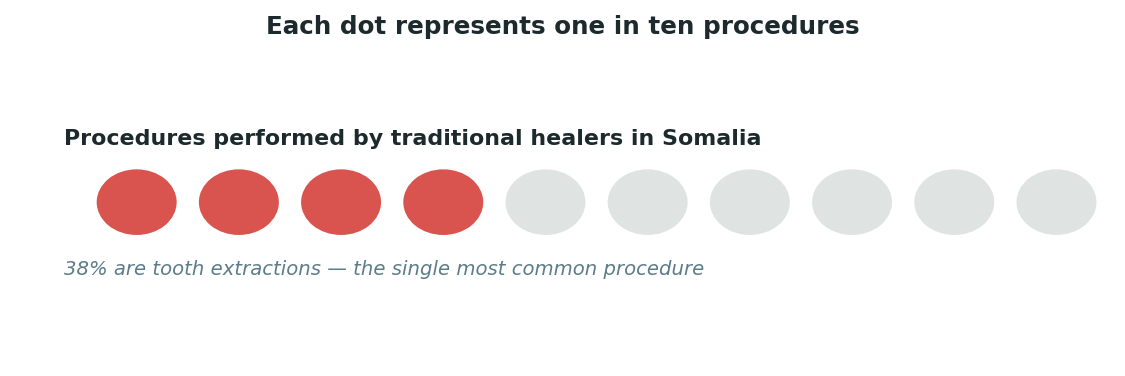
Published research on traditional healer practice in Somalia, showing tooth extraction as the single most common procedure performed.
Why a missing tooth is never really just one tooth's problem
A gap left unaddressed does not stay contained. Neighbouring teeth gradually tilt and drift into the space, the opposing tooth in the other jaw can over-erupt with nothing to meet it, and the jawbone that used to support the missing tooth's root begins to resorb without the stimulation a tooth root normally provides. Over years, this changes the fit of the remaining bite, makes later implant placement more complex, and can visibly alter the shape of the lower face. This is precisely why a genuine treatment plan for multiple missing teeth is a sequenced, full-mouth plan, not a series of unrelated single-tooth fixes decided one visit at a time.
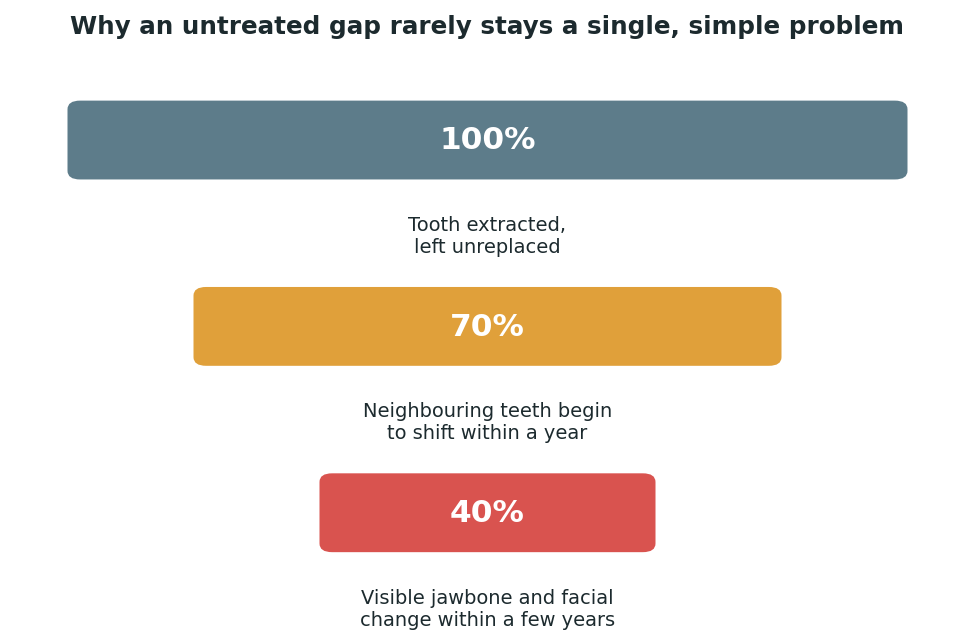
Illustrative progression of consequences from a missing tooth left unreplaced, based on general dental literature.
Know the warning signs, and do not wait them out
A gap that has sat empty for more than a few months, teeth that have visibly begun tilting toward a nearby space, a bite that feels different than it used to, or a lower jaw and chin that appear to have changed shape over the years are all signs that the consequences described above are already under way, not just a future risk. Persistent bad breath, gums that bleed easily, or a loose feeling in a tooth are worth a dental examination before they progress to the point of extraction being the only option left. None of these signs mean urgent treatment is the only path, but a proper examination, rather than continuing to manage pain as it comes, is what actually determines whether a tooth can still be saved or a gap addressed before it reshapes the ones around it.
Not every gap needs an implant, and not every smile needs the same plan
Dental implants are the gold standard for replacing missing teeth, but they require adequate bone to anchor into, healthy gums, and a healing period before a final crown is fitted; where bone has already been lost, a bone graft may be needed first. For patients whose main concern is the colour, shape or alignment of their existing, structurally sound teeth rather than missing ones, veneers, crowns or professional whitening address the aesthetic concern without implant surgery at all. A genuine smile makeover plan starts with an honest assessment of which teeth can be saved, which need replacing, and which simply need cosmetic refinement — not a single technique applied to every case regardless of what is actually needed.
What it costs
In more than 24 years arranging this kind of care, the disputes I have seen were almost never about the price itself — they were about a diagnosis, or a cost, nobody had bothered to write down before the flight was booked. A quote should specify the number of implants, whether bone grafting is needed, and which crown or veneer material is planned, since each of these changes the total cost substantially.
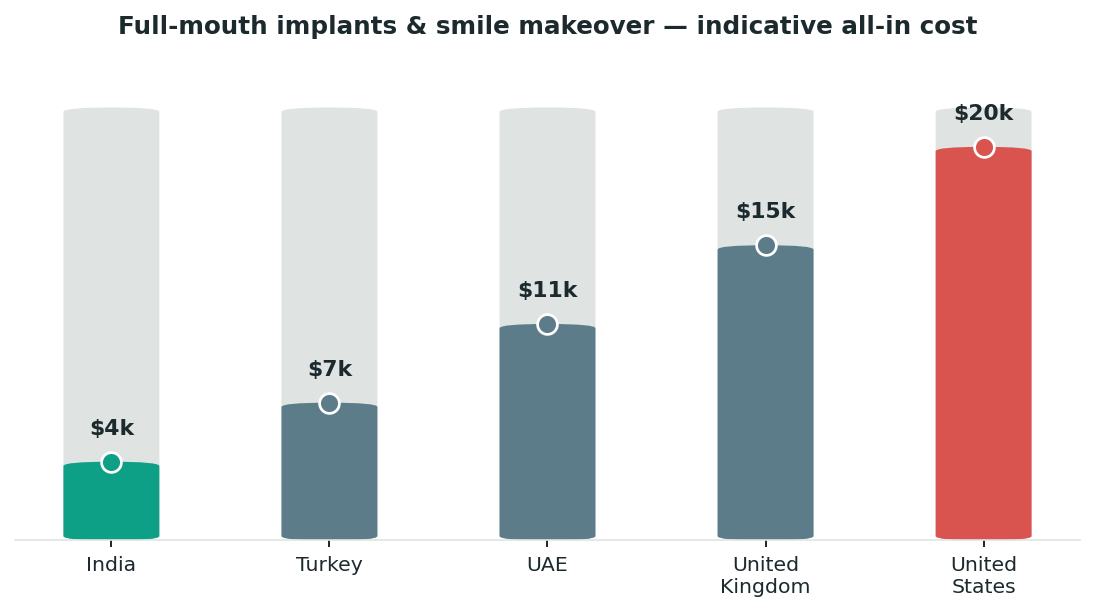
Indicative all-in cost for a full-mouth implant and smile makeover package. India sits far below every common alternative.
A full-mouth implant and smile makeover package in a reputable Indian dental centre typically runs US$4,000 to US$8,000 all-in, covering implants, crowns, any bone grafting needed and cosmetic finishing; a single implant or a smaller cosmetic case costs considerably less. Ask for a written plan itemising each tooth and procedure, not a single lump-sum figure covering an unspecified amount of work.
Why the implant brand and the surgeon's volume both matter
Not all dental implants are the same product. Established, well-researched implant systems have decades of published outcome data behind them; unfamiliar or unbranded systems, sometimes used to cut costs, can be harder to source replacement parts for years later if anything needs adjusting. Ask specifically which implant brand is being used and whether the clinic can provide documentation of it, since this detail matters far more for a decade-long outcome than it might seem at the time of treatment. Equally, ask how many full-mouth implant cases, not just single crowns, the treating dentist completes each year, since sequencing multiple implants around a stable, functional bite is a different skill from a single straightforward replacement.
Four signals that should make you stop and walk away
No X-ray or CBCT scan before a treatment plan. Bone quantity and quality can only be properly assessed through imaging. A plan built without one is a plan built blind.
Every gap treated with the same technique. Implants, bridges and partial dentures each suit different situations. Ask why a specific technique was chosen for each tooth.
No discussion of bone grafting where teeth were lost years ago. Long-missing teeth often mean bone loss. If this isn't assessed, the implant plan may not be realistic.
The price keeps moving. A verbal estimate that shifts each time you ask is not an estimate. Demand an itemised quote in writing.
The practical journey from Somalia — plan it before you fly
There is no direct flight between Somalia and India; patients route through Nairobi, Addis Ababa, Dubai or Djibouti. Because there is no full Indian mission inside Somalia, the medical visa is issued through the Embassy of India in Addis Ababa or the High Commission in Nairobi , against a written invitation letter from the treating clinic. Somali patients may bring up to two medical attendants on attendant visas. Since your route crosses yellow-fever territory, carry a valid yellow-fever vaccination certificate . Above every other instruction: send clear photographs of your teeth and any existing X-rays, not just a description, so the dental team can begin planning before you ever leave home. Full-mouth implant cases typically require two visits several months apart to allow proper healing, so plan your travel around two trips rather than one.
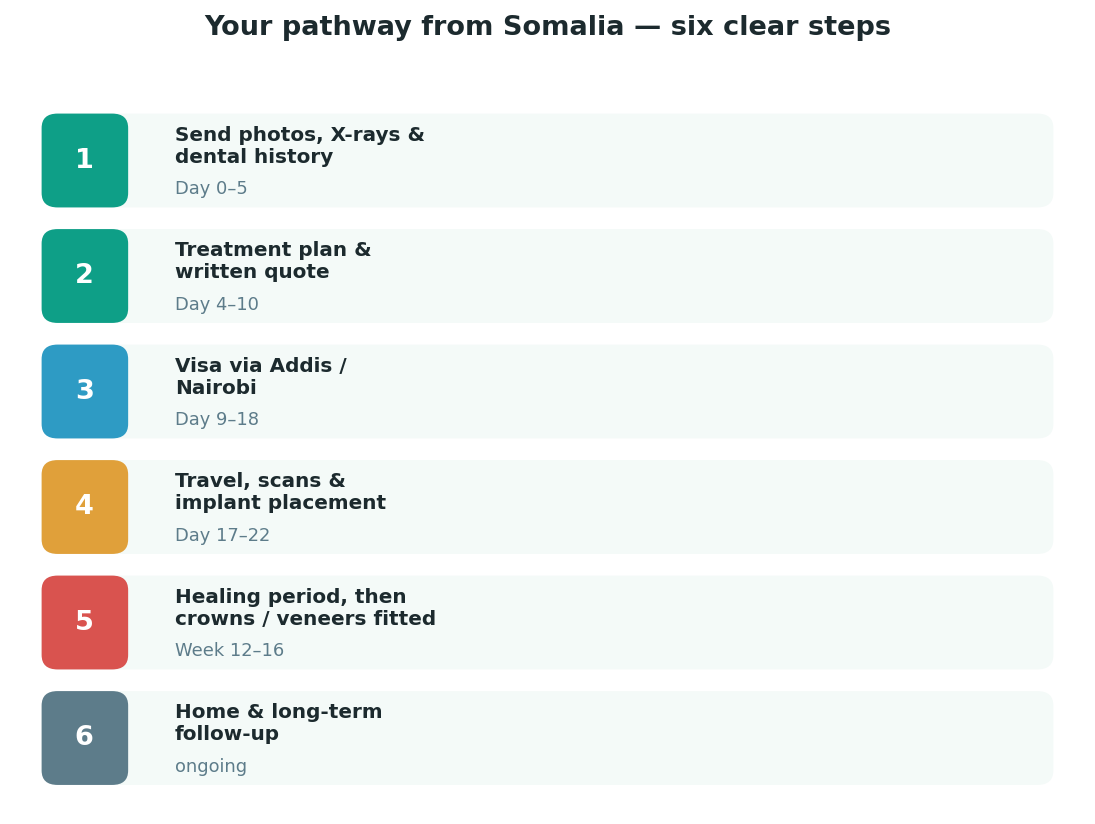
The complete route, start to finish — implants need a healing period before final crowns are fitted.
Rebuilding what years of extraction took away
A smile built back one careful, planned tooth at a time is a genuinely different outcome from the one built by years of "just pull it." Done properly, full-mouth implant and smile makeover work gives patients back not just individual teeth, but the ability to eat, speak and smile without the accumulated gaps of a lifetime standing in the way.
Sources & useful links
- 🌐 Indian medical visa (Somali nationals) — indianvisaonline.gov.in
- 🌐 Embassy of India, Addis Ababa — eoiaddisababa.gov.in
- 🌐 High Commission of India, Nairobi — hcinairobi.gov.in
- 🌐 Yellow-fever requirements — who.int/health-topics/yellow-fever
- 🌐 Hospital accreditation (India) — nabh.co · jointcommissioninternational.org
- 🌐 Verify a dentist's registration — dciindia.gov.in
Do not decide alone, and do not decide blind
If you want your case reviewed properly and an honest written plan — including exactly which teeth need what, and why — that is precisely the independent guidance I provide, without a single hospital's interest attached to my advice. Dr. Dheeraj Bojwani · Independent medical travel advisor
Frequently Asked Questions by Somali Patients about Dental Implants and Smile Makeover in India
Why do some Somali patients need multiple dental implants rather than a single implant?
The guide explains that many patients may have several teeth missing over years, partly because extraction has historically been a common response to dental pain and decay.
Can long-standing missing teeth make dental implant treatment more difficult?
Yes. The guide explains that the jawbone can gradually resorb after tooth loss, while neighbouring and opposing teeth may shift, sometimes making bone grafting or more complex implant planning necessary.
Does every missing tooth require a dental implant?
No. Depending on the condition, bridges, partial dentures or other restorative options may be appropriate. A proper examination should determine which teeth actually need implants.
Can a smile makeover be done without dental implants?
Yes. If the existing teeth are structurally sound but have cosmetic concerns involving colour, shape or alignment, veneers, crowns or professional whitening may address the problem without implant surgery.
How much does a full-mouth dental implant and smile makeover cost in India for Somali patients?
The guide gives an indicative range of US$4,000–US$8,000 all-in, including implants, crowns, required bone grafting and cosmetic finishing.
Is bone grafting necessary for Somali patients who lost teeth many years ago?
It may be necessary where sufficient bone has been lost. The guide recommends X-ray or CBCT assessment before treatment so the dentist can determine whether adequate bone exists for implant placement.
What should Somali patients check about the dental implant system?
Patients should ask for the specific implant brand and documentation and confirm that the system is established and has reliable replacement components available for future maintenance.
How many visits are usually required for full-mouth dental implants?
The guide states that full-mouth implant cases typically require two visits several months apart, allowing time for healing before the final crowns or veneers are fitted.
What should Somali patients send before travelling to India for dental treatment?
They should send clear photographs of their teeth, existing X-rays and dental history so the dental team can begin assessing the case and preparing a treatment plan before travel.
What warning signs should Somali patients watch for when choosing a dental implant centre?
Patients should be cautious if there is no X-ray or CBCT scan, every gap is treated with the same technique, bone grafting is not discussed despite long-term tooth loss, or the treatment price keeps changing.
Page Summary
This guide explains the key considerations for Somali patients exploring dental implants and smile makeover treatment in India, focusing on multiple missing teeth, the consequences of long-standing gaps, appropriate implant planning and the need to distinguish between restorative and cosmetic treatments. It covers bone loss and grafting, implant and restoration options, indicative costs of US$4,000–US$8,000, implant-brand and dentist-experience checks, warning signs when choosing a dental centre, pre-travel records, visa and travel arrangements, and the two-visit treatment pathway required for healing before final crowns or veneers.
Citation Block
| Topic | Information |
|---|---|
| Topic Information | Dental Implants and Smile Makeover in India for Patients from Somalia |
| Treatment | Dental Implants / Smile Makeover |
| Intended Audience | Patients from Somalia |
| Key Specialist | Implant Dentist / Prosthodontic Specialist |
| Primary Assessment | Dental Examination with X-Ray or CBCT |
| Treatment Options | Implants, Bridges, Partial Dentures, Crowns and Veneers |
| Indicative Cost | US$4,000–US$8,000 Full-Mouth Package |
| Bone Grafting | May Be Required After Long-Term Bone Loss |
| Important Checks | Implant Brand, CBCT/X-Ray and Full-Mouth Experience |
| Pre-Travel Records | Dental Photographs, X-Rays and Dental History |
| Patient Journey | Records → treatment plan/quote → visa → travel/implant placement → healing → final crowns/veneers |
| Follow-Up | Healing Period and Final Restoration |


Our Mission Statement
Our mission is to place patients at the centre of every healthcare decision by providing trustworthy, evidence-based, and unbiased medical information. We believe that informed patients make better decisions. Backed by personalised guidance from our experienced advisory team, we help patients understand their treatment options, compare them objectively, and confidently choose the path that best suits their medical needs and personal circumstances.
Patient Testimonials from Somalia




Ready to Take the First Step?
Share your Medical Reports with our Healthcare Managers Today and Get a FREE CONSULTATION, a Personalized Treatment Plan, and Complete Support from Arrival to Recovery.
Get Your Free ConsultationAreas We Serve
This resource has been thoughtfully prepared for patients from Somalia who are considering medical treatment in India. We also welcome patients from the wider region in the countries mentioned below-
We assist patients from:
- Ethiopia
- Djibouti
- Yemen
- Kenya
- Seychelles
- Somalia
- South Sudan
- Tanzania
- Uganda
- Zambia
- Zimbabwe
- Angola
- Cameroon
- Central African Republic
Many of the insights, treatment pathways, hospital recommendations, travel guidance, and patient support services described here are equally relevant and may be used as a reference when planning treatment in India.
From Somalia to India: Your Complete Patient Support Guide
- Best Brain Tumour Surgeons & Hospitals in India for Somali Patients
- Best Cancer Treatment Surgeons & Hospitals in India for Somali Patients
- Best Cardiac Surgeons & Hospitals in India for Somali Patients
- Best CyberKnife Teams & Centres in India for Somali Patients
- Best Heart Valve Replacement Surgeons & Hospitals in India for Somali Patients
- Best Hip Surgeons & Hospitals in India for Somali Patients
- Best Knee Surgeons & Hospitals in India for Somali Patients
- Best Neurosurgeons & Hospitals in India for Somali Patients
- Best Paediatric Cardiac Surgeons & Hospitals in India for Somali Patients
- Best Paediatric Neurosurgeons & Hospitals in India for Somali Patients
- Best Spine Surgeons & Hospitals in India for Somali Patients
- Bariatric Surgery in India for Patients from Somalia
- Brain Tumour Surgery in India for Patients from Somalia
- Cancer Treatment and Surgery in India for Patients from Somalia
- Cardiac Surgery in India for Patients from Somalia
- Cosmetic and Plastic Surgery in India for Patients from Somalia
- CyberKnife Treatment in India for Patients from Somalia
- Dental Surgery in India for Patients from Somalia