

Cornea Transplant and Advanced Eye Surgery in India for Patients from Somalia
In a Mogadishu hospital study, the single most common cause of blindness in one eye was not age or infection — it was trauma.
A clouded, scarred cornea is one of the most treatable causes of blindness in modern medicine — and one of the hardest to actually treat, because fixing it depends on something no amount of surgical skill alone can provide: a healthy donor cornea. For 24 years I have watched patients from across the Horn of Africa reach the point of a correct diagnosis only to discover that the tissue needed to restore their sight simply is not available where they are.
India has built exactly the infrastructure this problem requires: a genuine network of certified eye banks supplying screened donor corneal tissue, combined with high-volume surgical centres performing everything from standard full-thickness transplants to the newer, faster-recovering partial techniques — at a fraction of the cost of the same surgery in the Gulf, Europe or the United States.
Healing Journeys of Somali Patients









Key Takeaways
- The guide highlights trauma as the leading single cause of monocular blindness in the cited Mogadishu tertiary-hospital study, accounting for 23.6% of cases. The study reported an overall blindness rate of 9.8%.
- Corneal transplant depends on access to screened donor tissue and a reliable eye-bank supply chain. The guide notes that Sub-Saharan Africa has very limited functioning eye-bank capacity and a severe global shortage of donor corneas.
- Timing after an eye injury is important. Early specialist treatment aims to prevent infection and control inflammation, while established corneal scarring may later require transplantation to restore useful vision.
- Warning signs include sharp or penetrating eye injuries, flying debris, chemical splashes, persistent redness or discharge, increasing light sensitivity, white or grey corneal patches, and cloudy or distorted vision.
- Not every patient needs a full corneal transplant. Depending on the damaged layer, partial-thickness or deep lamellar techniques may be appropriate, while an artificial corneal device may be considered in selected severely damaged eyes.
- The guide gives an indicative cost of US$2,000–US$4,900 all-in at a reputable private Indian hospital, including surgery, donor tissue and initial follow-up. Advanced partial-thickness procedures may be toward the higher end.
- Patients should confirm which eye bank supplies the donor cornea, whether the tissue meets recognised screening standards, and whether slit-lamp or corneal imaging has been completed before the surgical plan is finalised.
- Somali patients should send clear photographs of the affected eye and existing examination notes before travelling. The guide's six-step pathway covers ophthalmology review, written treatment planning, visa processing, travel, surgery, recovery and ongoing follow-up.
- The guide states that patients may travel through Nairobi, Addis Ababa, Dubai or Djibouti, with medical-visa processing through Addis Ababa or Nairobi. Up to two medical attendants may accompany the patient, and yellow-fever vaccination documentation should be carried where required by the route.
Quick Facts
- Treatment
- Cornea Transplant and Advanced Eye Surgery
- Country
- India
- Patients
- Patients from Somalia
- Key Specialist
- Cornea Specialist / Ophthalmic Surgeon
- Main Cause Highlighted
- Trauma-Related Corneal Damage
- Primary Assessment
- Slit-Lamp Examination and Corneal Imaging
- Donor Requirement
- Screened Donor Corneal Tissue
- Surgical Options
- Full-Thickness, Partial-Thickness and Deep Lamellar Techniques
- Indicative Cost
- US$2,000–US$4,900 All-In
- Important Check
- Certified Eye Bank and Donor-Tissue Screening
- Pre-Travel Records
- Eye Photographs and Examination Notes
- Travel Routes
- Nairobi, Addis Ababa, Dubai or Djibouti
- Follow-Up
- Initial Recovery and Long-Term Monitoring
- Author
- Dr. Dheeraj Bojwani
- Experience
- 24+ Years
In Brief
For Somali patients considering cornea transplant in India, the guide recommends confirming the exact extent and layer of corneal damage through proper ophthalmic examination and imaging before selecting a surgical technique. Depending on the condition, partial-thickness or deep lamellar transplantation may be preferable to a full-thickness graft. Patients should also verify the hospital's eye-bank source and donor-tissue screening process, obtain a written quote for the specific graft type, and send eye photographs and previous examination records before travelling.
First, know why Somalia's eye injuries look different
Most countries researching corneal transplant surgery are dealing with an older population, where infection, degenerative disease or complications from cataract surgery are the usual causes of corneal scarring. A study of 2,605 patients at a tertiary hospital in Mogadishu found something different: trauma, not age-related disease, was the single leading cause of blindness in one eye, ahead of cataract and diabetic retinopathy, attributed directly to the country's security conditions. Corneal scarring from a traumatic injury behaves clinically the same way whether it comes from a fall, a workplace accident, or a fragment of shrapnel — but a population with unusually high rates of trauma-related eye injury is, correspondingly, a population with unusually high need for the specific surgery that treats it.
The Somali difference: the diagnosis is reachable, but the donor tissue is not
Corneal transplant surgery depends entirely on a supply chain most people never think about: a deceased donor, timely consent, careful screening, and transport of the tissue to a surgeon within days. Sub-Saharan Africa has almost no functioning eye banks at all — only two have achieved meaningful scale on the entire continent, in Ethiopia and Kenya — against a global shortage so severe that only one donor cornea is available for roughly every seventy patients who need one. A Somali patient with a correctly diagnosed, genuinely treatable scarred cornea is, in effect, waiting for tissue that the regional supply chain was never built to provide.
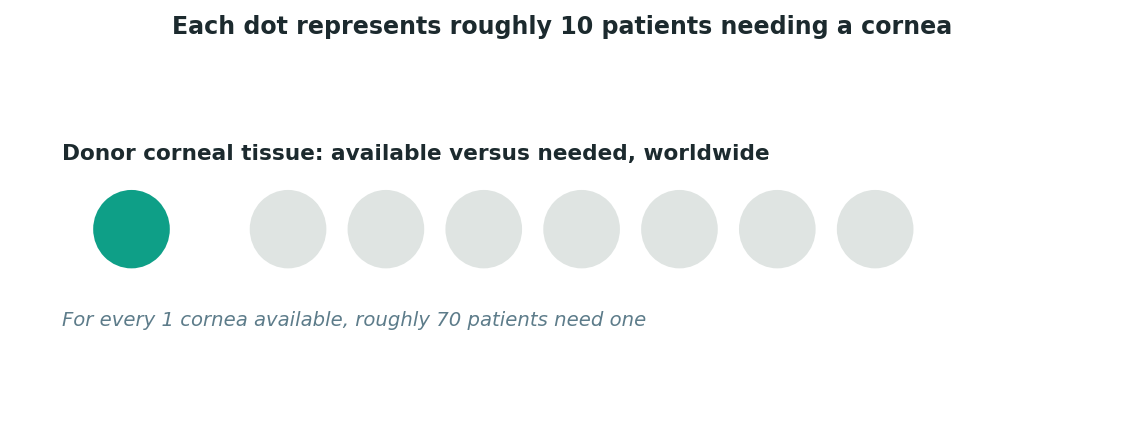
Published estimates of the global gap between donor corneal tissue supply and patient need.
Why timing matters as much as the surgery itself
A fresh corneal injury and an old, already-scarred one are different clinical problems. In the days immediately after trauma, the priority is preventing infection and controlling inflammation; a cornea that becomes infected in this window is far more likely to end up permanently scarred than one treated promptly. Once scarring has set in, a transplant becomes the main route back to useful vision, but it is treating the consequence of a delay that, in many cases, could have been avoided with faster access to specialist care in the first place.
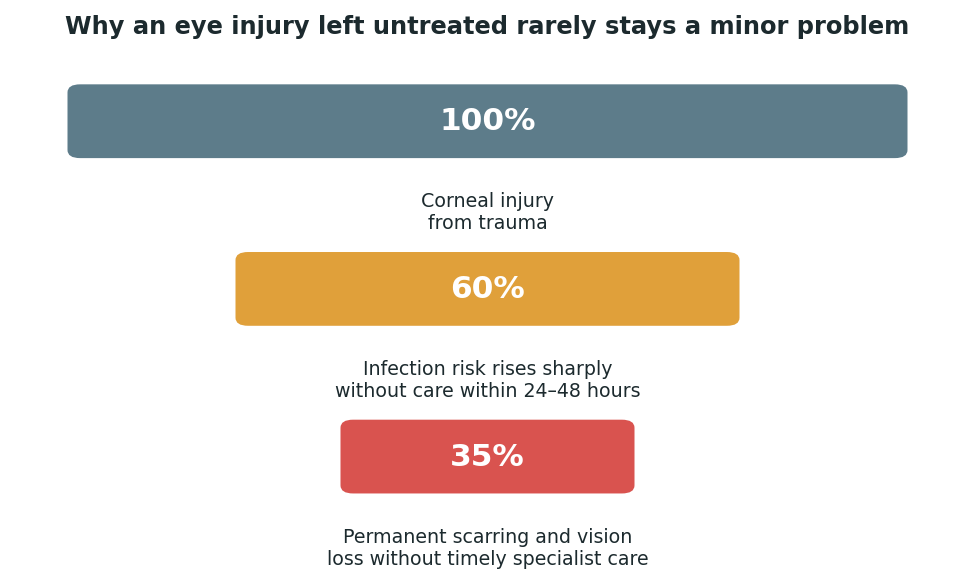
Illustrative progression from corneal trauma to permanent scarring without timely specialist care, based on general ophthalmology literature.
Know the warning signs, and do not wait them out
Any eye injury involving a sharp object, flying debris, a blow, or a chemical splash deserves urgent assessment, even if vision seems only mildly affected at first, since the surface damage that matters most is not always obvious without a proper examination. A white or grey patch developing on the previously clear part of the eye, worsening light sensitivity, persistent redness or discharge after an injury, and vision that is cloudy, hazy or distorted in one eye are all reasons to seek an ophthalmology assessment rather than wait to see whether things improve on their own. For an eye that was injured some time ago and has never fully recovered, it is not too late to ask whether the scarring is now the treatable kind — many patients live for years assuming nothing more can be done for an old injury that is, in fact, a straightforward transplant case.
Not every clouded cornea needs a full transplant
Modern corneal surgery is more targeted than the traditional full-thickness graft most people picture. Where only the innermost layer of the cornea has failed, as is common after complications from other eye surgery, a partial-thickness transplant replacing just that layer offers faster recovery and better outcomes than replacing the whole cornea. Where scarring is confined to the front layers, a deep lamellar technique can preserve the patient's own inner corneal layer entirely. And where a cornea is too severely and repeatedly damaged for any donor graft to survive, an artificial corneal device is sometimes the more realistic option. A surgeon who proposes the same full-thickness procedure for every case, without discussing these alternatives, has not matched the technique to the actual damage.
What it costs
In more than 24 years arranging this kind of care, the disputes I have seen were almost never about the price itself — they were about a diagnosis, or a cost, nobody had bothered to write down before the flight was booked. A quote should specify which type of corneal graft is planned, since this affects both cost and recovery time substantially.
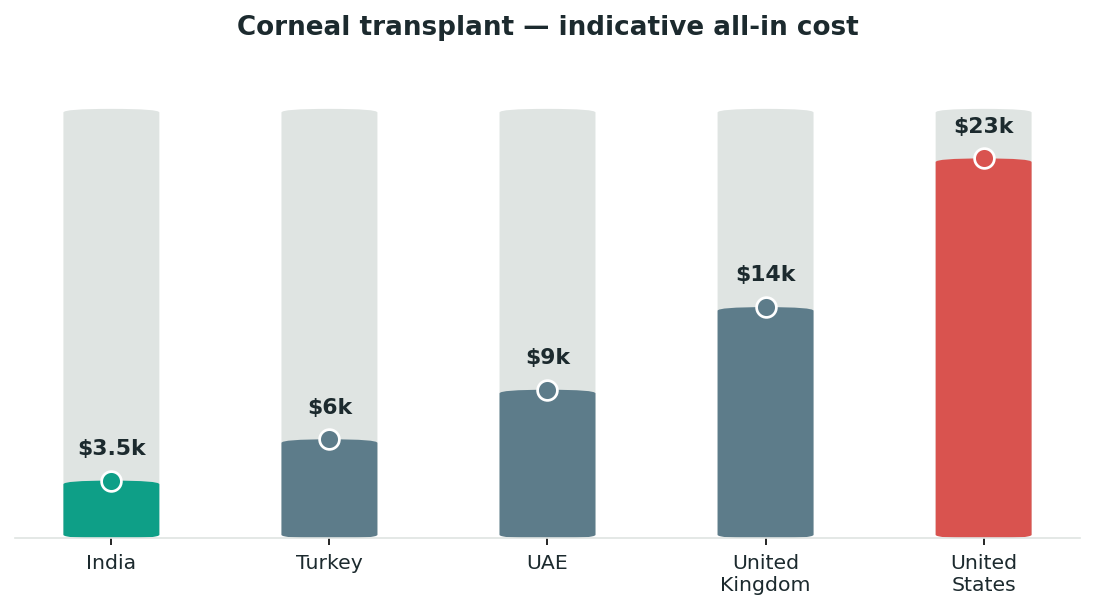
Indicative all-in cost for corneal transplant surgery. India sits far below every common alternative.
A corneal transplant case in a reputable private Indian hospital typically runs US$2,000 to US$4,900 all-in, covering the surgery, donor tissue and initial follow-up; advanced partial-thickness techniques sit toward the top of that range. Ask for the figure specific to the graft type recommended for your eye.
Why the eye bank behind the surgeon matters
The surgery itself is only as reliable as the tissue supply behind it. Ask specifically which eye bank supplies the hospital, whether it holds recognised international quality accreditation, and how donor tissue is screened and tracked before it reaches the operating theatre. A hospital with an established, high-volume relationship to a certified eye bank generally means shorter waiting times and more consistent tissue quality than one sourcing corneas irregularly. This detail rarely comes up unprompted, but it is one of the more meaningful predictors of a smooth, well-timed surgery.
Four signals that should make you stop and walk away
No confirmation of certified donor tissue. Ask specifically which eye bank supplies the hospital's donor corneas and whether it meets international screening standards.
Full-thickness graft proposed without discussing alternatives. Partial-thickness techniques suit many cases better. Ask why a full transplant, specifically, is being recommended.
No slit-lamp or corneal imaging before the plan is set. A proper assessment of exactly which corneal layers are damaged should come before any surgical plan is finalised.
The price keeps moving. A verbal estimate that shifts each time you ask is not an estimate. Demand a fixed figure in writing.
The practical journey from Somalia — plan it before you fly
There is no direct flight between Somalia and India; patients route through Nairobi, Addis Ababa, Dubai or Djibouti. Because there is no full Indian mission inside Somalia, the medical visa is issued through the Embassy of India in Addis Ababa or the High Commission in Nairobi , against a written invitation letter from the treating hospital. Somali patients may bring up to two medical attendants on attendant visas. Since your route crosses yellow-fever territory, carry a valid yellow-fever vaccination certificate . Above every other instruction: send clear photographs of the affected eye and any existing examination notes, not just a description, so the ophthalmology team can begin assessing the damage before you ever leave home. If the injury happened some time ago, note roughly when it occurred and what, if anything, was done at the time, since this shapes what technique is realistic now.
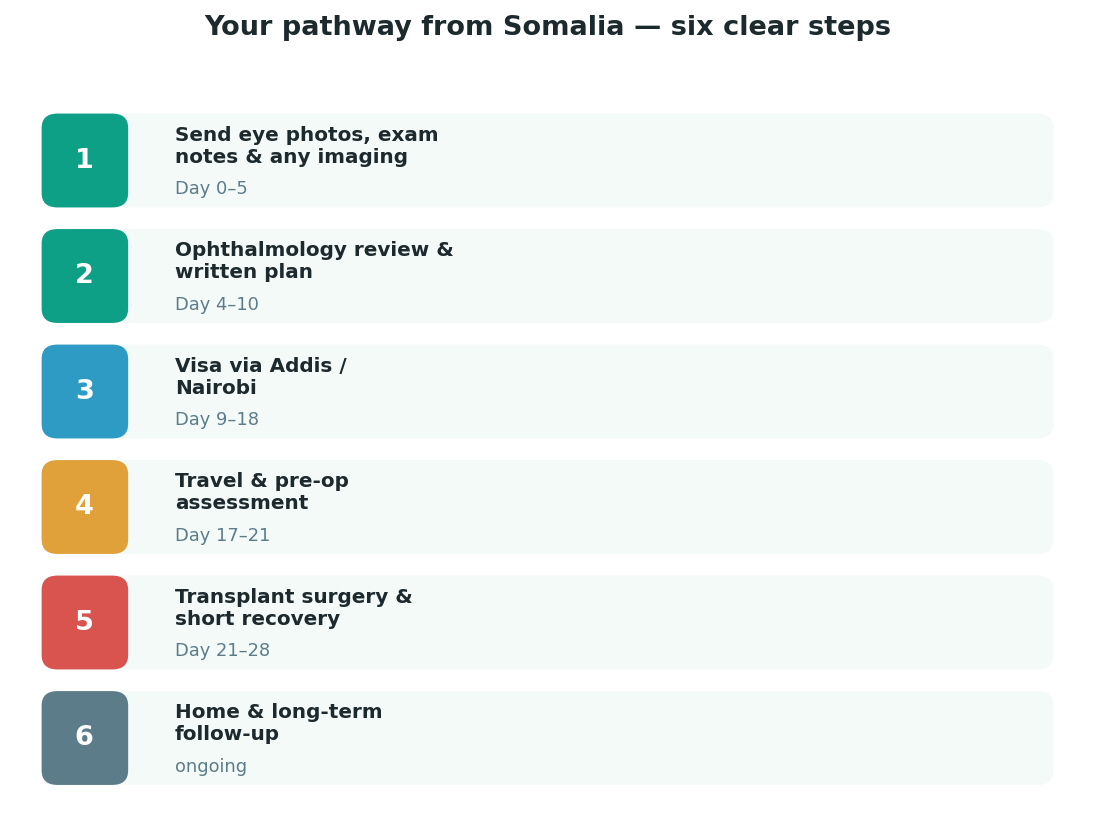
The complete route, start to finish — donor tissue availability at a high-volume centre keeps waiting times short.
A trauma survivor's sight is not a lost cause
An eye injured by trauma, whatever its cause, is not automatically an eye beyond help. Matched to the right technique, with donor tissue that Somalia's own health system cannot yet reliably provide, corneal transplant surgery restores genuinely useful vision to patients who have often been told, incorrectly, that nothing more could be done.
Sources & useful links
- 🌐 Indian medical visa (Somali nationals) — indianvisaonline.gov.in
- 🌐 Embassy of India, Addis Ababa — eoiaddisababa.gov.in
- 🌐 High Commission of India, Nairobi — hcinairobi.gov.in
- 🌐 Yellow-fever requirements — who.int/health-topics/yellow-fever
- 🌐 Hospital accreditation (India) — nabh.co · jointcommissioninternational.org
- 🌐 Verify a surgeon's registration — nmc.org.in
Do not decide alone, and do not decide blind
If you want your case reviewed properly and an honest written plan — including exactly which technique fits your eye — that is precisely the independent guidance I provide, without a single hospital's interest attached to my advice. Dr. Dheeraj Bojwani · Independent medical travel advisor
Frequently Asked Questions by Somali Patients about Cornea Transplant and Advanced Eye Surgery in India
Why is cornea transplant particularly relevant for some Somali patients?
The guide highlights trauma as the leading single cause of monocular blindness in the cited Mogadishu hospital study, making traumatic corneal scarring an important condition requiring specialist eye care.
Can an old eye injury still be treated with a cornea transplant?
Yes. The guide explains that an eye injured some time ago may still have treatable corneal scarring, even when reduced vision has persisted for years.
Does every Somali patient with a cloudy cornea need a full cornea transplant?
No. Depending on which corneal layers are damaged, partial-thickness or deep lamellar transplantation may be considered instead of replacing the entire cornea.
What tests should Somali patients have before cornea transplant surgery in India?
The guide emphasises proper slit-lamp examination and corneal imaging to determine which layers are damaged before selecting the surgical technique.
How much does cornea transplant cost in India for Somali patients?
The guide gives an indicative all-in range of US$2,000–US$4,900, including surgery, donor tissue and initial follow-up. The final cost depends on the graft technique recommended.
Why is the eye bank important for Somali patients travelling to India?
Cornea transplantation depends on safe, screened donor tissue. Patients should ask which eye bank supplies the hospital and how donor tissue is screened and tracked.
What warning signs after an eye injury should Somali patients not ignore?
Sharp-object or chemical injuries, persistent redness or discharge, increasing light sensitivity, a white or grey patch on the cornea, or cloudy and distorted vision should prompt ophthalmology assessment.
What should Somali patients send to an Indian eye specialist before travelling?
The guide recommends sending clear photographs of the affected eye and existing examination notes, together with information about when the injury occurred and what treatment was previously provided.
What travel arrangements are needed for Somali patients coming to India for cornea surgery?
The guide describes travel through Nairobi, Addis Ababa, Dubai or Djibouti, with medical-visa processing through Addis Ababa or Nairobi using a hospital invitation. Up to two medical attendants may accompany the patient.
How long does the cornea transplant journey take from Somalia to India?
The guide's six-step pathway covers initial eye records, ophthalmology review, visa processing, travel and pre-operative assessment, transplant surgery and short recovery, followed by ongoing follow-up.
Page Summary
This guide explains the key considerations for Somali patients exploring cornea transplant and advanced eye surgery in India, with particular emphasis on trauma-related corneal damage, timely specialist assessment and access to screened donor tissue. It covers warning signs, full- and partial-thickness transplant options, eye-bank requirements, indicative costs of US$2,000–US$4,900, pre-travel eye records, visa and travel arrangements, and the six-step treatment pathway from ophthalmology review through surgery and long-term follow-up.
Citation Block
| Topic | Information |
|---|---|
| Topic Information | Cornea Transplant and Advanced Eye Surgery in India for Patients from Somalia |
| Treatment | Cornea Transplant / Advanced Eye Surgery |
| Intended Audience | Patients from Somalia |
| Key Specialist | Cornea Specialist / Ophthalmic Surgeon |
| Primary Assessment | Slit-Lamp Examination and Corneal Imaging |
| Donor Requirement | Screened Donor Corneal Tissue |
| Surgical Options | Full-Thickness, Partial-Thickness and Deep Lamellar Techniques |
| Indicative Cost | US$2,000–US$4,900 All-In |
| Important Check | Certified Eye Bank and Donor-Tissue Screening |
| Pre-Travel Records | Eye Photographs and Examination Notes |
| Patient Journey | Eye review → written plan → visa → travel/pre-op → transplant/recovery → follow-up |
| Follow-Up | Initial Recovery and Long-Term Monitoring |


Our Mission Statement
Our mission is to place patients at the centre of every healthcare decision by providing trustworthy, evidence-based, and unbiased medical information. We believe that informed patients make better decisions. Backed by personalised guidance from our experienced advisory team, we help patients understand their treatment options, compare them objectively, and confidently choose the path that best suits their medical needs and personal circumstances.
Patient Testimonials from Somalia




Ready to Take the First Step?
Share your Medical Reports with our Healthcare Managers Today and Get a FREE CONSULTATION, a Personalized Treatment Plan, and Complete Support from Arrival to Recovery.
Get Your Free ConsultationAreas We Serve
This resource has been thoughtfully prepared for patients from Somalia who are considering medical treatment in India. We also welcome patients from the wider region in the countries mentioned below-
We assist patients from:
- Ethiopia
- Djibouti
- Yemen
- Kenya
- Seychelles
- Somalia
- South Sudan
- Tanzania
- Uganda
- Zambia
- Zimbabwe
- Angola
- Cameroon
- Central African Republic
Many of the insights, treatment pathways, hospital recommendations, travel guidance, and patient support services described here are equally relevant and may be used as a reference when planning treatment in India.
From Somalia to India: Your Complete Patient Support Guide
- Best Brain Tumour Surgeons & Hospitals in India for Somali Patients
- Best Cancer Treatment Surgeons & Hospitals in India for Somali Patients
- Best Cardiac Surgeons & Hospitals in India for Somali Patients
- Best CyberKnife Teams & Centres in India for Somali Patients
- Best Heart Valve Replacement Surgeons & Hospitals in India for Somali Patients
- Best Hip Surgeons & Hospitals in India for Somali Patients
- Best Knee Surgeons & Hospitals in India for Somali Patients
- Best Neurosurgeons & Hospitals in India for Somali Patients
- Best Paediatric Cardiac Surgeons & Hospitals in India for Somali Patients
- Best Paediatric Neurosurgeons & Hospitals in India for Somali Patients
- Best Spine Surgeons & Hospitals in India for Somali Patients
- Bariatric Surgery in India for Patients from Somalia
- Brain Tumour Surgery in India for Patients from Somalia
- Cancer Treatment and Surgery in India for Patients from Somalia
- Cardiac Surgery in India for Patients from Somalia
- Cosmetic and Plastic Surgery in India for Patients from Somalia
- CyberKnife Treatment in India for Patients from Somalia
- Dental Surgery in India for Patients from Somalia