

Complex Orthopaedic and Joint Revision Surgery in India for Patients from Somalia
The hardest cases we see from Somalia are rarely a fracture nobody has treated at all. Far more often, they are a fracture or a joint that was treated once, under impossible conditions, and never treated properly again.
A leg that never fully healed after an old injury. A hip or knee replacement, done years ago, that has loosened or become infected. A limb held together with hardware that was always meant to be temporary. These are not first operations, and for 24 years I have specialised in exactly this harder category of case — the second surgery that has to succeed where the first one, through no fault of the patient, could not.
India is where that second operation is genuinely possible. Its leading revision and reconstruction centres bring together orthopaedic, plastic and infectious disease specialists in one team, with the imaging, microbiology and specialised implant systems that complex revision work demands — at a fraction of the cost of the same reconstruction in the Gulf, Europe or the United States.
Healing Journeys of Somali Patients









Key Takeaways
- The guide explains that complex orthopaedic cases from Somalia are often previously treated fractures or joint problems requiring further reconstruction, rather than first-time operations. Scar tissue, malunion, nonunion, damaged hardware and infection can make revision surgery more difficult.
- A published Mogadishu trauma-hospital study cited in the guide found that 96% of gunshot-related fractures and 81% of blast-related fractures were open fractures, increasing the risk of infection and nonunion. The guide connects this history with patients who may later require definitive reconstruction.
- The illustrative breakdown on page 2 shows complex referrals as 35% infected/failed war-wound fixation, 30% malunion/nonunion, 25% failed primary joint replacement and 10% other complex reconstruction.
- Warning signs requiring assessment include a persistently discharging wound, visibly bent or shortened limb, increasing pain in a previously functioning joint replacement, movement or grinding at an old fracture site, and persistent low-grade fever.
- Complex reconstruction is not a single procedure. Infected nonunion may require staged infection clearance and later reconstruction, malunion may require corrective osteotomy, failed joint replacement may require revision arthroplasty, and major bone loss may require bone transport or vascularised bone grafting.
- The guide stresses that revision surgery requires a multidisciplinary team, potentially including orthopaedic, microbiology, plastic surgery and limb-reconstruction specialists, particularly when infection, soft-tissue defects or significant bone loss are involved.
- A complex revision or reconstruction case in a reputable Indian private hospital typically starts around US$13,000 all-in, with costs increasing according to the number of stages, extent of bone loss and need for infection clearance. A staged, itemised quotation is recommended.
- Patients should be cautious if a multi-stage problem is treated as one operation, previous operative notes or implant records are not reviewed, no microbiology work-up is performed for nonunion, or the quoted price repeatedly changes.
- Somali patients should send all previous operative notes, implant cards, X-rays and other imaging, not only the latest scan. The journey may involve staged surgery and a longer stay, with the guide's six-step pathway extending from initial records through written planning, visa, travel and surgery, extended recovery and long-term follow-up.
Quick Facts
- Treatment
- Complex Orthopaedic and Joint Revision Surgery
- Country
- India
- Patients
- Patients from Somalia
- Key Specialist
- Orthopaedic Revision / Limb Reconstruction Specialist
- Main Problems
- Infected Nonunion, Malunion, Failed Joint Replacement and Bone Loss
- Important Assessment
- Complete Surgical History and Imaging Review
- Indicative Cost
- Starts Around US$13,000 All-In
- Surgical Approach
- May Require Staged Reconstruction
- Team Requirement
- Orthopaedic, Microbiology and Plastic Surgery Support Where Required
- Important Records
- Previous Operative Notes, Implant Cards and X-Rays
- Major Warning
- Do Not Treat a Multi-Stage Problem as a Single Operation
- Travel Routes
- Nairobi, Addis Ababa, Dubai or Djibouti
- Visa
- Hospital Invitation and Indian Mission Processing
- Attendants
- Up to Two Medical Attendants
- Follow-Up
- Extended Recovery and Long-Term Follow-Up
- Author
- Dr. Dheeraj Bojwani
- Experience
- 24+ Years
In Brief
For Somali patients considering complex orthopaedic or joint revision surgery in India, the guide recommends a full review of the previous surgical history, implant records, X-rays and current imaging before deciding on reconstruction. Revision cases may involve infection clearance, correction of malunion, failed joint replacement or significant bone loss and may require more than one operation. Patients should therefore choose a multidisciplinary team with specific revision and reconstruction experience and obtain a staged, itemised written quotation that reflects the actual procedures likely to be required.
First, know why these cases are different from a first-time operation
A fracture treated once, badly, is not the same problem as a fracture never treated at all. It is often a harder one. Scar tissue has formed. The bone may have healed in the wrong position, or not healed at all. Old hardware may be loose, broken, or quietly infected without ever having caused obvious symptoms. None of this reflects poorly on the original care — much of it was almost certainly delivered under genuine emergency conditions with limited resources — but it does mean the second operation has to solve problems the first one never intended to leave behind.
The Somali difference: decades of urgent fixation, without the follow-up reconstruction
A published study of extremity gunshot and blast casualties at a major Mogadishu trauma hospital found that 96% of gunshot-related fractures, and 81% of blast-related fractures, were open fractures — wounds where the bone breaks through the skin and is directly exposed to contamination. Open fractures carry a well-documented, sharply higher risk of infection and nonunion worldwide, particularly when the wound cannot be surgically cleaned within the first 12 to 24 hours, a window that is often simply not achievable during active conflict or in a system with only around 1.2 surgical specialists per 100,000 people nationally. The result, years later, is a population of patients whose fractures were stabilised urgently and often skilfully under the circumstances, but who never received the second-stage reconstruction — bone grafting, definitive fixation, infection clearance — that a fully resourced trauma system would have scheduled as a matter of course.
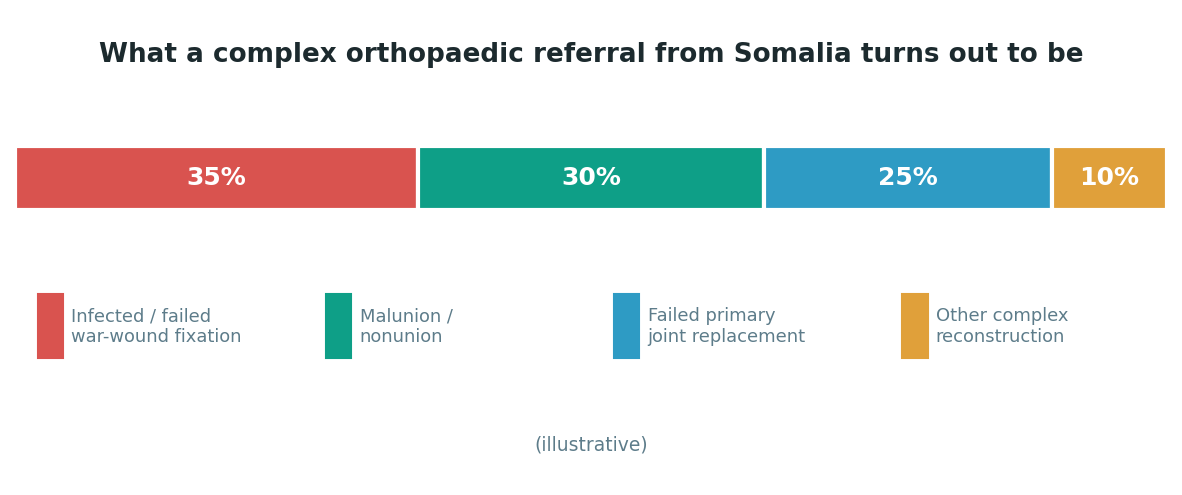
Illustrative breakdown of complex orthopaedic referrals from Somalia, by underlying problem.
Why revision is simply a bigger operation
Removing old, sometimes ingrown hardware, clearing infected or dead bone, correcting a healed- crooked limb, and rebuilding a joint's normal anatomy all take longer and carry more risk than the equivalent first-time procedure. A revision case typically means more operating time, a longer hospital stay, and a meaningfully higher chance that a further procedure will eventually be needed, even when everything is done well. None of this is a reason to avoid the surgery — it is a reason to make sure the team doing it has genuine experience in revision work specifically, not just a strong general orthopaedic record.
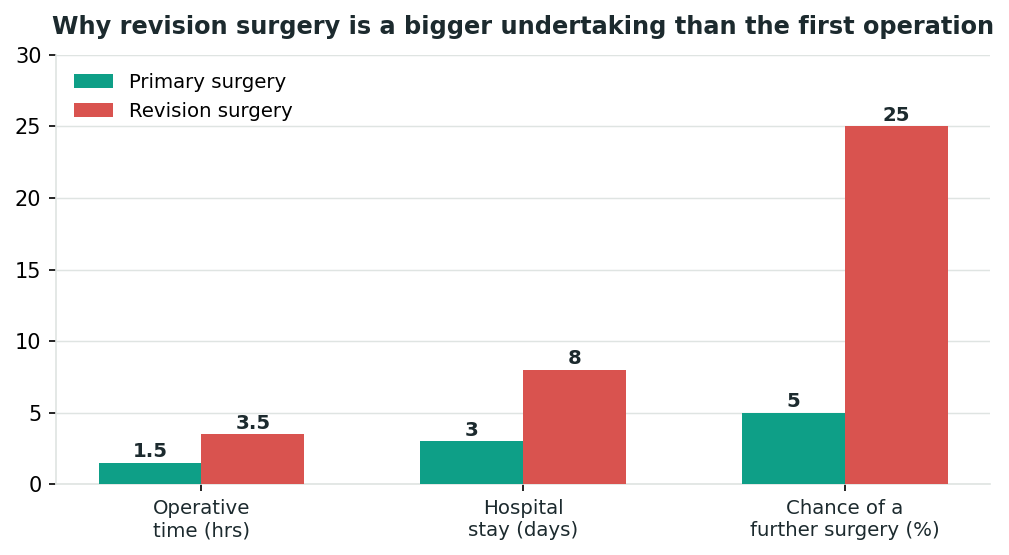
Illustrative comparison of a straightforward primary procedure against the equivalent revision case.
Know the warning signs, and do not wait them out
A wound over an old fracture that keeps discharging fluid, months or years after the original injury, is one of the clearest signs of chronic infection and deserves urgent assessment, not repeated courses of oral antibiotics alone. So is a limb that is visibly bent, shortened, or rotated compared with its uninjured pair, a joint replacement that has become increasingly painful after a period of working well, or a bone that still moves or grates at the fracture site many months after the original injury. Persistent low-grade fever with no other obvious cause, in someone with a history of open fracture or retained hardware, is also worth investigating for occult infection. None of these signs mean the original treatment failed through anyone's fault — they mean the case has reached the point where it needs the second, more definitive look that emergency conditions never allowed for the first time round.
What "complex reconstruction" actually covers
This is not one operation but a family of related techniques, matched to what has actually gone wrong. Infected nonunion typically needs staged surgery: removing infected hardware and dead bone first, treating the infection with targeted antibiotics and often an antibiotic-loaded spacer, and only then rebuilding the bone once the infection is genuinely clear. Malunion, where a fracture has healed in the wrong position, is corrected with a planned osteotomy to re-break and realign the bone under controlled conditions. A failed joint replacement is addressed with revision arthroplasty, using specialised longer- stemmed implants and bone graft to rebuild a socket or shaft that has lost bone stock over years of loosening. Segmental bone loss, common after severe blast injury, may call for bone transport or vascularised bone grafting to regenerate missing length. A surgeon who proposes the same single technique regardless of which of these problems is actually present has not looked closely enough at the imaging.
Why the surgical team matters more than the individual surgeon here
Complex revision work is one of the few areas of orthopaedics where the case genuinely cannot be handled by a single specialist working alone. Infection clearance needs a microbiologist reading the right cultures and choosing antibiotics that will actually reach infected bone. Large soft-tissue defects left after debridement often need a plastic surgeon skilled in flap coverage, working in the same operation as the orthopaedic team rather than as an afterthought. Segmental bone loss may call for a limb-reconstruction specialist experienced specifically in bone transport techniques, a genuinely narrow subspecialty even within orthopaedics. Ask whether these specialists are part of a standing team at the hospital being proposed, or would be assembled ad hoc for your case — the difference shows up in outcomes.
What it costs
In more than 24 years arranging this kind of care, the disputes I have seen were almost never about the price itself — they were about a diagnosis, or a cost, nobody had bothered to write down before the flight was booked. Complex and revision cases are the category where a firm, itemised quote matters most, since the true extent of the problem is often only fully clear once the old hardware is out and the bone and soft tissue can be directly assessed.
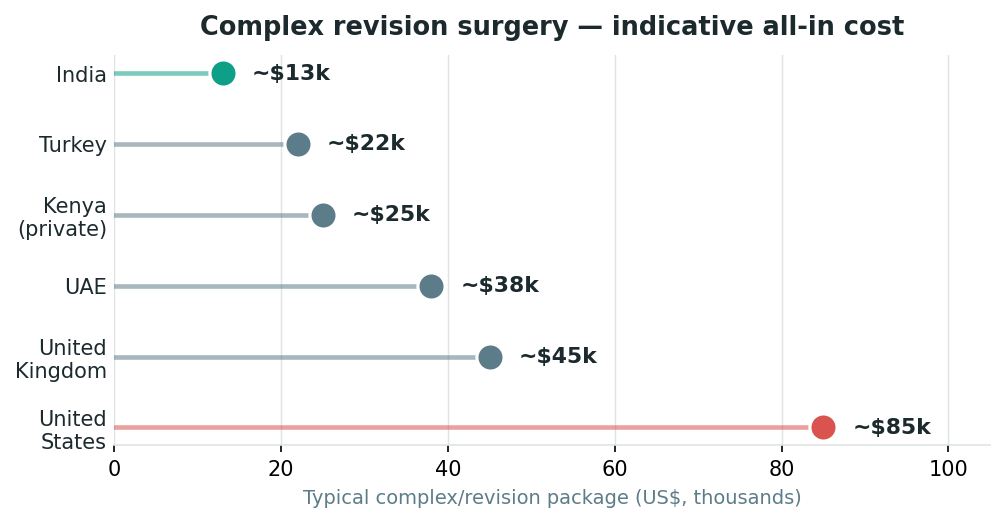
Indicative all-in cost for complex orthopaedic and joint revision surgery. India sits far below every common alternative.
A complex revision or reconstruction case in a reputable private Indian hospital typically starts around US$13,000 all-in, rising with the number of stages required, the extent of bone loss, and whether infection clearance is needed before reconstruction can begin. Ask for a staged quote that names each planned procedure separately, since a genuine multi-stage reconstruction should never be priced as a single flat number.
Four signals that should make you stop and walk away
One operation proposed for a multi-stage problem. Infected nonunion, in particular, is almost never a single-surgery fix. Be wary of a plan that skips infection clearance.
No mention of prior op notes or implant records. A revision plan built without reviewing exactly what was done before, and with what hardware, is working blind.
No microbiology or infection work-up for a nonunion. A fracture that has not healed for months deserves testing for occult infection before any reconstruction is planned.
The price keeps moving. A verbal estimate that shifts each time you ask is not an estimate. Demand a staged, itemised quote in writing.
The practical journey from Somalia — plan it before you fly
There is no direct flight between Somalia and India; patients route through Nairobi, Addis Ababa, Dubai or Djibouti. Because there is no full Indian mission inside Somalia, the medical visa is issued through the Embassy of India in Addis Ababa or the High Commission in Nairobi , against a written invitation letter from the treating hospital. Somali patients may bring up to two medical attendants on attendant visas. Since your route crosses yellow-fever territory, carry a valid yellow-fever vaccination certificate . Above every other instruction for this category of case specifically: bring or send every previous operative note, implant card and X-ray you have, not only the most recent scan, so the surgical team can reconstruct the full history of the limb before proposing a plan. Complex cases are also more likely to need a staged stay, so budget travel time accordingly rather than planning around a single fixed return date.
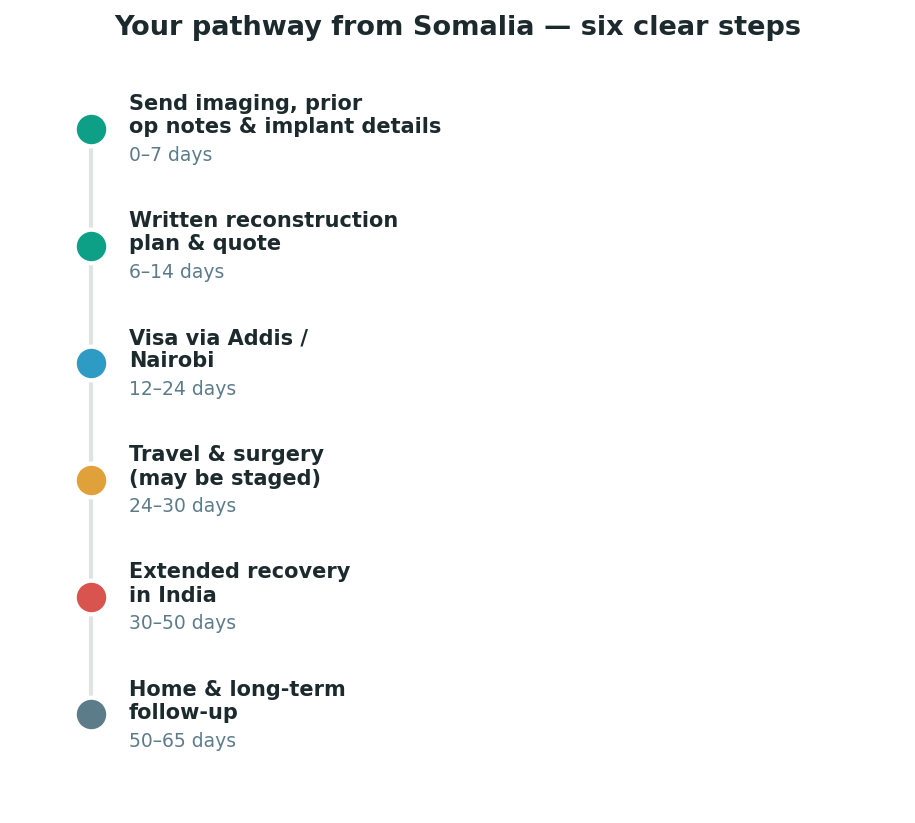
The complete route, start to finish — longer than a first-time procedure, and often staged.
The second surgery is the one that gets to be the last one
A limb stabilised urgently once, under difficult conditions, deserves a proper second look — not indefinitely, but eventually, by a team built specifically for this harder category of reconstruction. Done well, complex and revision surgery genuinely can be the operation that finally closes a chapter a patient has been living with for years.
Sources & useful links
- 🌐 Indian medical visa (Somali nationals) — indianvisaonline.gov.in
- 🌐 Embassy of India, Addis Ababa — eoiaddisababa.gov.in
- 🌐 High Commission of India, Nairobi — hcinairobi.gov.in
- 🌐 Yellow-fever requirements — who.int/health-topics/yellow-fever
- 🌐 Hospital accreditation (India) — nabh.co · jointcommissioninternational.org
- 🌐 Verify a surgeon's registration — nmc.org.in
Do not decide alone, and do not decide blind
If you want your full case history reviewed properly and an honest, staged written plan — including what has genuinely gone wrong and what it will take to fix it — that is precisely the independent guidance I provide, without a single hospital's interest attached to my advice. Dr. Dheeraj Bojwani · Independent medical travel advisor
Frequently Asked Questions by Somali Patients about Complex Orthopaedic and Joint Revision Surgery in India
What types of complex orthopaedic problems can Somali patients have treated in India?
The guide covers infected or failed fracture fixation, malunion, nonunion, failed joint replacements and major bone loss requiring complex reconstruction.
Why can revision orthopaedic surgery be more difficult than the first operation?
Previous surgery may leave scar tissue, damaged bone, old hardware, infection or altered joint anatomy, making the revision procedure longer and more technically demanding.
What are the warning signs of infection after an old fracture or orthopaedic surgery?
A wound that continues to discharge fluid, persistent low-grade fever or problems around retained hardware can indicate chronic or occult infection and require assessment.
Can an infected nonunion be treated in one operation?
The guide explains that infected nonunion typically requires staged treatment, beginning with removal of infected hardware and dead bone and infection management before definitive reconstruction.
What happens if a fracture has healed in the wrong position?
A malunion may be corrected through a planned osteotomy, allowing the bone to be realigned under controlled surgical conditions.
How much does complex revision surgery cost in India for Somali patients?
The guide states that a complex revision or reconstruction case in a reputable private Indian hospital typically starts around US$13,000 all-in, with the final cost depending on the number of stages, bone loss and infection management.
What medical records should Somali patients send before travelling to India?
Patients should provide all previous operative notes, implant cards, X-rays and other relevant imaging, rather than sending only their most recent scan.
What specialists may be needed for complex orthopaedic reconstruction?
Depending on the case, the team may include an orthopaedic revision specialist, microbiologist, plastic surgeon and limb-reconstruction specialist, particularly where infection, soft-tissue defects or major bone loss are involved.
What should Somali patients look for when choosing a revision surgery centre in India?
They should confirm genuine revision and reconstruction experience, multidisciplinary support, infection work-up and a staged written quotation. A centre should be able to explain why each proposed procedure is necessary.
How long should Somali patients plan to stay in India for complex revision surgery?
The guide shows that these cases can require a staged stay and extended recovery. Its six-step pathway extends from initial records and planning through visa processing, surgery, recovery in India and long-term follow-up, so patients should avoid planning around a fixed short return date.
Page Summary
This guide explains the key considerations for Somali patients exploring complex orthopaedic and joint revision surgery in India, focusing on previously treated fractures, infected nonunion, malunion, failed joint replacements and major bone loss that may require specialised reconstruction. It covers warning signs, staged surgical approaches, multidisciplinary team requirements, indicative costs starting around US$13,000, important records to provide before travel, warning signs when selecting a centre, visa and travel arrangements, and the longer treatment pathway from Somalia to India through recovery and long-term follow-up.
Citation Block
| Topic | Information |
|---|---|
| Topic Information | Complex Orthopaedic and Joint Revision Surgery in India for Patients from Somalia |
| Treatment | Complex Orthopaedic / Joint Revision and Reconstruction |
| Intended Audience | Patients from Somalia |
| Key Specialist | Orthopaedic Revision / Limb Reconstruction Specialist |
| Main Problems | Infected Nonunion, Malunion, Failed Joint Replacement and Bone Loss |
| Treatment Approach | May require staged reconstruction |
| Indicative Cost | Starts Around US$13,000 All-In |
| Team Requirement | Orthopaedic, Microbiology and Plastic Surgery Support Where Required |
| Important Records | Operative Notes, Implant Cards and X-Rays |
| Important Check | Infection and microbiology assessment before reconstruction where indicated |
| Travel Planning | Hospital invitation, visa and route arrangements |
| Patient Journey | Records → reconstruction plan → visa → travel/surgery → recovery → long-term follow-up |
| Follow-Up | Extended recovery and long-term monitoring |


Our Mission Statement
Our mission is to place patients at the centre of every healthcare decision by providing trustworthy, evidence-based, and unbiased medical information. We believe that informed patients make better decisions. Backed by personalised guidance from our experienced advisory team, we help patients understand their treatment options, compare them objectively, and confidently choose the path that best suits their medical needs and personal circumstances.
Patient Testimonials from Somalia




Ready to Take the First Step?
Share your Medical Reports with our Healthcare Managers Today and Get a FREE CONSULTATION, a Personalized Treatment Plan, and Complete Support from Arrival to Recovery.
Get Your Free ConsultationAreas We Serve
This resource has been thoughtfully prepared for patients from Somalia who are considering medical treatment in India. We also welcome patients from the wider region in the countries mentioned below-
We assist patients from:
- Ethiopia
- Djibouti
- Yemen
- Kenya
- Seychelles
- Somalia
- South Sudan
- Tanzania
- Uganda
- Zambia
- Zimbabwe
- Angola
- Cameroon
- Central African Republic
Many of the insights, treatment pathways, hospital recommendations, travel guidance, and patient support services described here are equally relevant and may be used as a reference when planning treatment in India.
From Somalia to India: Your Complete Patient Support Guide
- Best Brain Tumour Surgeons & Hospitals in India for Somali Patients
- Best Cancer Treatment Surgeons & Hospitals in India for Somali Patients
- Best Cardiac Surgeons & Hospitals in India for Somali Patients
- Best CyberKnife Teams & Centres in India for Somali Patients
- Best Heart Valve Replacement Surgeons & Hospitals in India for Somali Patients
- Best Hip Surgeons & Hospitals in India for Somali Patients
- Best Knee Surgeons & Hospitals in India for Somali Patients
- Best Neurosurgeons & Hospitals in India for Somali Patients
- Best Paediatric Cardiac Surgeons & Hospitals in India for Somali Patients
- Best Paediatric Neurosurgeons & Hospitals in India for Somali Patients
- Best Spine Surgeons & Hospitals in India for Somali Patients
- Bariatric Surgery in India for Patients from Somalia
- Brain Tumour Surgery in India for Patients from Somalia
- Cancer Treatment and Surgery in India for Patients from Somalia
- Cardiac Surgery in India for Patients from Somalia
- Cosmetic and Plastic Surgery in India for Patients from Somalia
- CyberKnife Treatment in India for Patients from Somalia
- Dental Surgery in India for Patients from Somalia