

Colorectal Cancer Treatment and Surgery in India for Patients from Somalia
Blood in the stool and weeks of diarrhoea mean something different in a country where cholera and dysentery are genuinely common — which is exactly why colorectal cancer so often gets diagnosed as an emergency instead of a plan.
Blood in the stool. Weeks of loose bowels that will not settle. Cramping that comes and goes. Anywhere else, a doctor seeing these symptoms in a patient under 50 might reasonably start with the least alarming explanation. In Somalia, that instinct is entirely reasonable and, increasingly, also the reason colorectal cancer is caught so late: for 24 years I have watched this specific pattern play out, and it is one of the more fixable delays in this entire field.
India treats colorectal cancer with genuinely modern tools: colonoscopy for direct diagnosis, laparoscopic and robotic resection that preserve far more bowel function than open emergency surgery, and, for tumours that have already spread within the abdomen, specialist teams experienced in more advanced combined surgical approaches, delivered by dedicated colorectal surgical oncology units — at a fraction of the cost of the same care in the Gulf, Europe or the United States.
Healing Journeys of Somali Patients









Key Takeaways
- The guide highlights a specific diagnostic challenge for Somali patients: rectal bleeding, diarrhoea and abdominal symptoms may initially be attributed to infections such as cholera or dysentery, potentially delaying investigation when symptoms persist.
- Regional East African research cited in the guide found that more than 41% of colorectal cancer patients were under 50, with approximately 90% presenting at a late stage. This supports greater attention to persistent symptoms even in younger patients.
- The illustrative presentation chart on page 2 shows approximately 65% emergency presentation through obstruction or perforation and 35% planned/elective presentation among referrals, based on regional emergency-presentation data.
- Planned diagnosis through colonoscopy and biopsy can allow a more controlled surgical approach. Emergency obstruction or perforation may require a colostomy initially, with later reconnection considered separately where possible.
- Warning symptoms include persistent rectal bleeding, ongoing change in bowel habits, narrower stools, incomplete bowel emptying, unexplained weight loss, fatigue or pallor suggesting anaemia. Persistence or recurrence after appropriate infection treatment should prompt further assessment.
- A colorectal-specific surgical oncology team can provide laparoscopic or robotic surgery, bowel-reconnection assessment and specialised rectal cancer techniques, depending on the tumour's location and the patient's condition.
- The guide gives an indicative full treatment cost of US$6,000–US$12,500 all-in, including surgery and any required chemotherapy. Stoma-reversal surgery, when needed, should be quoted separately.
- Before surgery, patients should confirm that colonoscopy with biopsy and staging scans of the chest, abdomen and pelvis have been completed. They should also ask whether bowel reconnection can be performed rather than accepting a permanent stoma without discussion.
- Somali patients should send their colonoscopy report, biopsy results and relevant imaging before travelling. The journey includes a written treatment plan and quotation, medical-visa arrangements, travel and surgery, recovery, chemotherapy if required and long-term follow-up.
Quick Facts
- Treatment
- Colorectal Cancer Treatment and Surgery
- Country
- India
- Patients
- Patients from Somalia
- Key Specialist
- Colorectal Surgical Oncology Specialist
- Primary Diagnostic Test
- Colonoscopy with Biopsy
- Important Staging
- Chest, Abdomen and Pelvis Imaging
- Indicative Cost
- US$6,000–US$12,500 All-In
- Surgical Options
- Laparoscopic, Robotic or Open Surgery as Appropriate
- Main Concern
- Delayed Diagnosis After Symptoms Are Initially Attributed to Infection
- Emergency Risk
- Bowel Obstruction or Perforation
- Stoma Consideration
- Ask Whether Bowel Reconnection Is Possible
- Chemotherapy
- May Be Required Depending on Disease and Treatment Plan
- Pre-Travel Records
- Colonoscopy, Biopsy Results and Imaging
- Travel Routes
- Nairobi, Addis Ababa, Dubai or Djibouti
- Attendants
- Up to Two Medical Attendants
- Follow-Up
- Recovery, Chemotherapy if Required and Ongoing Follow-Up
- Author
- Dr. Dheeraj Bojwani
- Experience
- 24+ Years
In Brief
For Somali patients considering colorectal cancer treatment in India, the guide recommends paying particular attention to persistent symptoms that continue despite appropriate treatment for infection, followed by colonoscopy and biopsy rather than repeated empirical treatment. Once cancer is confirmed, staging and review by a colorectal-focused surgical oncology team can help determine whether planned laparoscopic or robotic surgery, chemotherapy or other treatment is appropriate and whether bowel reconnection may be possible. Patients should obtain a staged written quotation covering surgery, chemotherapy and any stoma-reversal procedure separately before travelling.
First, know why this cancer hides so well in Somalia
Colorectal cancer's early symptoms — rectal bleeding, changed bowel habits, cramping abdominal pain — are also the symptoms of some of the most common illnesses in Somalia. Recurrent cholera outbreaks, with more than 18,300 cases recorded in 2023 alone, and endemic bacillary dysentery driven by widespread lack of sanitation, mean that blood in the stool and persistent diarrhoea are, correctly, first assumed to be infectious in origin. That assumption is right far more often than it is wrong. The problem is what happens when it is wrong, and nobody circles back to check.
The Somali difference: a cancer now striking younger, hiding behind an infection that is genuinely common
Research across East Africa has found a striking and consistent pattern: colorectal cancer is increasingly diagnosed in adults under 50, a group not traditionally considered at meaningful risk and rarely offered colonoscopy as a first step. A regional study in northern Tanzania found more than 41% of colorectal cancer patients were under 50, alongside a six-fold rise in cases over a decade and 90% of patients presenting at a late stage. Layer Somalia's genuinely high burden of infectious diarrhoeal disease on top of that younger, unscreened population, and a persistent case of "just dysentery" becomes exactly the case most likely to be treated as one for months longer than it should be.
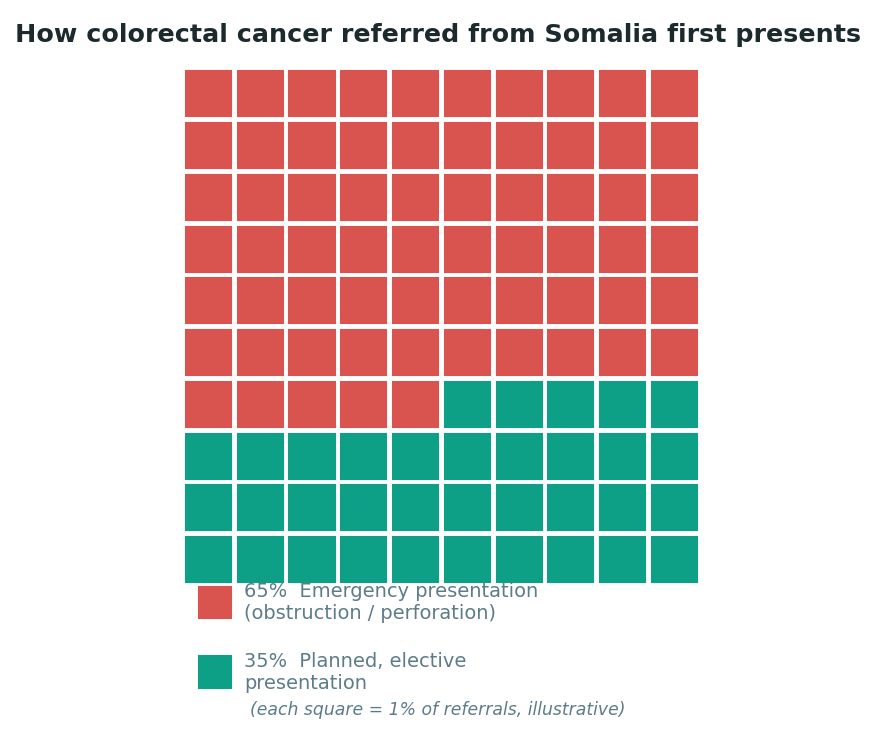
Illustrative breakdown of how colorectal cancer referred from Somalia first presents, informed by regional East African emergency- presentation data.
Why an emergency diagnosis changes the whole operation
A colorectal cancer caught through a planned colonoscopy, before it has grown large enough to block the bowel, is very often removed with a single planned operation, frequently done laparoscopically, that reconnects the bowel in the same procedure. A colorectal cancer that first announces itself as a bowel obstruction or perforation is a surgical emergency: the same regional research found that roughly two- thirds of patients presented this way, and 60% needed a colostomy, an opening of the bowel onto the abdominal wall, as their first operation simply to save their life, with any reconnection left for a second, later surgery if it is possible at all. The cancer has not usually changed between these two scenarios. The circumstances of finding it have, and that difference alone often decides whether a patient ever needs to live with a stoma at all.
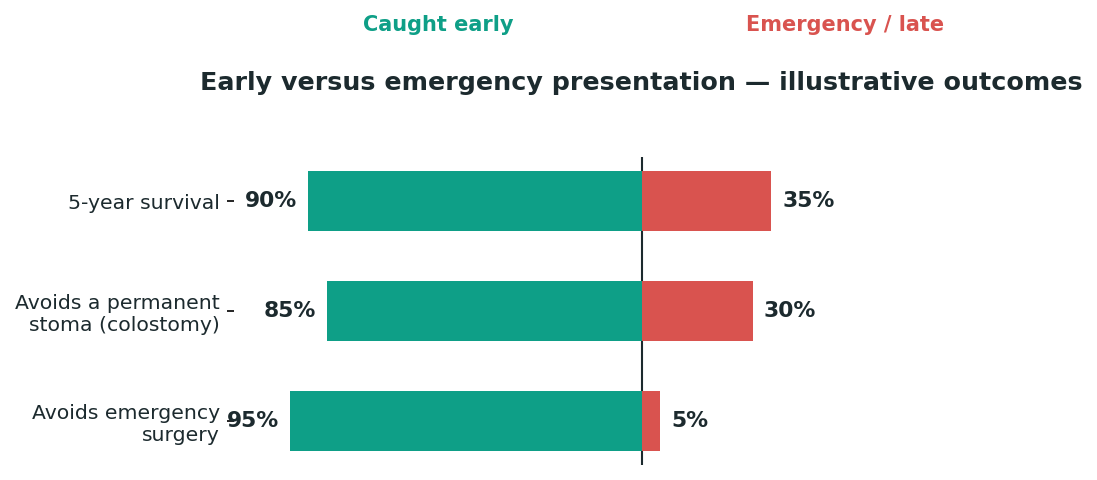
Illustrative outcomes: colorectal cancer caught early through planned diagnosis, versus discovered through an emergency presentation. General oncology and surgical literature, not a Somalia-specific measured outcome.
Know the warning signs, and do not wait them out
Rectal bleeding that continues beyond two to three weeks, a change in bowel habit that persists rather than resolving, stools that become noticeably narrower, a feeling that the bowel has not fully emptied, unexplained weight loss, or new fatigue and pallor suggesting anaemia are all worth a proper look rather than another round of treatment for infection. So is any of these symptoms recurring in a pattern, even if each individual episode seems to settle. None of these signs guarantee cancer, and in a country where infectious diarrhoeal disease is genuinely widespread, the ordinary explanation remains the most likely one most of the time. What should change the response is time: symptoms that keep coming back, or that never fully resolve despite appropriate treatment for infection, have moved past the point where "probably an infection" should be the final answer.
Not every symptom needs a colonoscopy — but persistence changes that
A single episode of diarrhoea or a small amount of blood after straining is, most of the time, exactly what it looks like, and does not need urgent investigation. What changes the picture is persistence and pattern: bleeding that continues beyond a couple of weeks, diarrhoea or altered bowel habit that does not resolve with standard treatment for infection, unexplained weight loss, or a new, persistent change in bowel habit in someone over 40. Any of these, especially in combination, is the specific point at which "probably an infection" should become "confirm it isn't something else" — through a colonoscopy, not a longer course of the same antibiotics.
What it costs
In more than 24 years arranging this kind of care, the disputes I have seen were almost never about the price itself — they were about a diagnosis, or a cost, nobody had bothered to write down before the flight was booked. A quote should specify whether it covers surgery alone or the full course including any chemotherapy, since the two differ substantially.
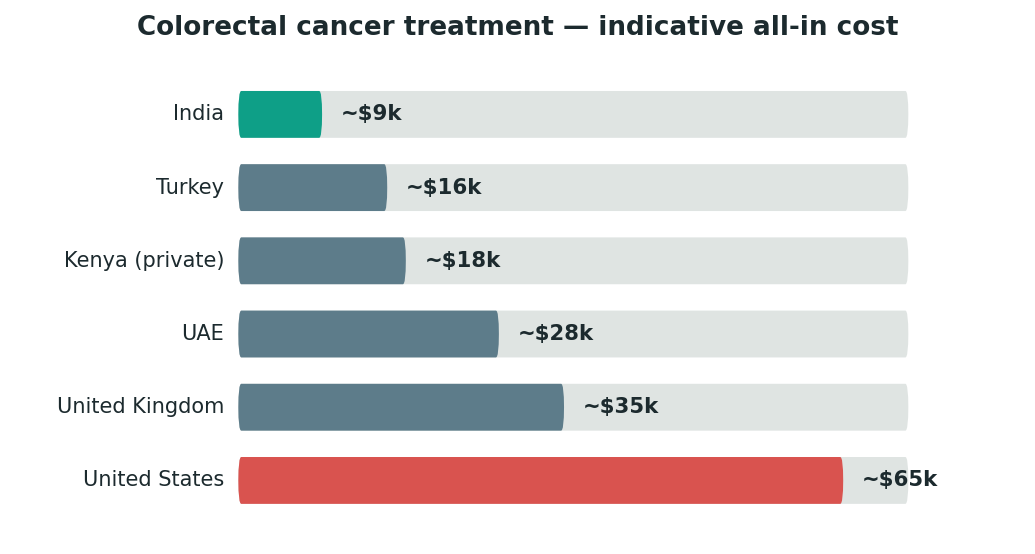
Indicative all-in cost for a full colorectal cancer treatment course. India sits far below every common alternative.
A full colorectal cancer treatment course in a reputable private Indian hospital, from surgery through any needed chemotherapy, typically runs US$6,000 to US$12,500 all-in; surgery alone for an earlier- stage cancer sits toward the lower end. A later stoma-reversal procedure, if one was needed as an emergency measure before travel, is typically quoted and costed separately from the original cancer surgery. Ask for a staged quote naming surgery, chemotherapy and any stoma-reversal procedure separately.
Why a colorectal-specific surgical team matters
General surgeons can and do remove bowel cancers, but a genuinely colorectal-focused surgical oncology unit brings specific advantages: routine use of laparoscopic or robotic technique even for cancers that would be done open elsewhere, meaning smaller incisions and faster recovery; a lower threshold for attempting bowel reconnection rather than defaulting to a permanent stoma; and, for rectal cancers specifically, techniques that preserve the muscles controlling continence wherever the tumour's position allows it. Ask how many colorectal resections the named surgeon performs each year, and specifically what proportion of rectal cancer cases are completed without a permanent stoma.
Four signals that should make you stop and walk away
No colonoscopy before a surgery date is set. Direct visualisation and biopsy, not imaging alone, confirms the diagnosis and exact location. Refuse a plan built without one.
No discussion of whether a stoma can be avoided. For planned, non-emergency cases, ask specifically whether the bowel can be reconnected in the same operation.
No staging scan of the chest, abdomen and pelvis. Confirming whether the cancer has spread beyond the bowel should come before finalising the surgical plan.
The price keeps moving. A verbal estimate that shifts each time you ask is not an estimate. Demand a staged, itemised quote in writing.
The practical journey from Somalia — plan it before you fly
There is no direct flight between Somalia and India; patients route through Nairobi, Addis Ababa, Dubai or Djibouti. Because there is no full Indian mission inside Somalia, the medical visa is issued through the Embassy of India in Addis Ababa or the High Commission in Nairobi , against a written invitation letter from the treating hospital. Somali patients may bring up to two medical attendants on attendant visas. Since your route crosses yellow-fever territory, carry a valid yellow-fever vaccination certificate . Above every other instruction: send your colonoscopy report and biopsy results, not a written description of symptoms, so the surgical team can begin planning before you ever leave home. If a stoma has already been created as an emergency measure elsewhere, send details of that operation too, since it directly shapes what reconnection surgery, if any, is possible later.
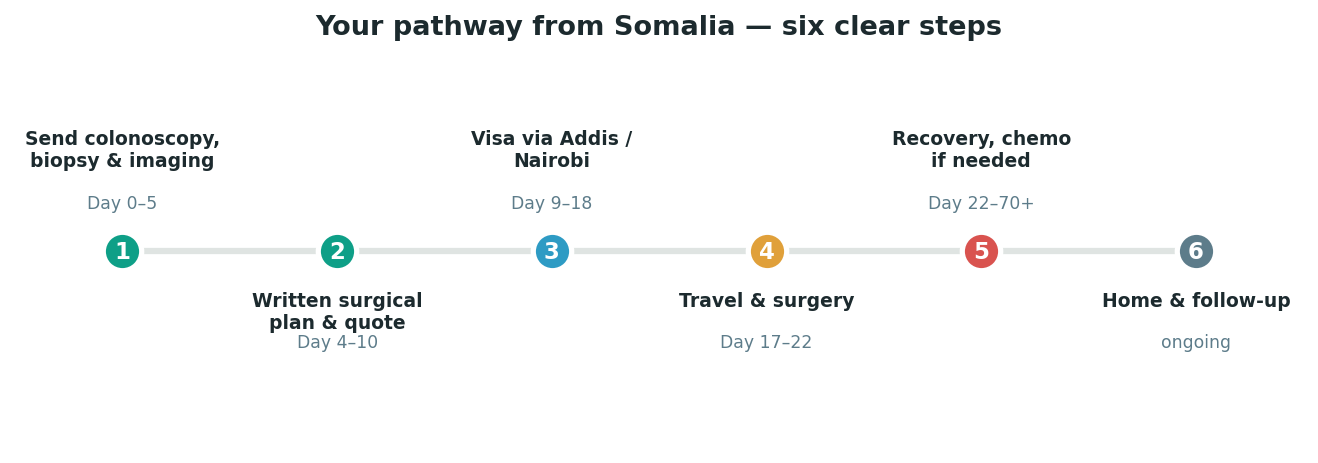
The complete route, start to finish — length varies if chemotherapy follows surgery.
A common infection's symptoms deserve a second look when they do not go away
Nobody is wrong to suspect infection first in a country where dysentery and cholera are genuinely this common. What matters is having a clear point at which "still not better" prompts a colonoscopy rather than another round of the same treatment — because caught while still a local, planned problem, colorectal cancer is, more often than not, a curable one.
Sources & useful links
- 🌐 Indian medical visa (Somali nationals) — indianvisaonline.gov.in
- 🌐 Embassy of India, Addis Ababa — eoiaddisababa.gov.in
- 🌐 High Commission of India, Nairobi — hcinairobi.gov.in
- 🌐 Yellow-fever requirements — who.int/health-topics/yellow-fever
- 🌐 Hospital accreditation (India) — nabh.co · jointcommissioninternational.org
- 🌐 Verify a surgeon's registration — nmc.org.in
Do not decide alone, and do not decide blind
If you want your results reviewed properly and an honest written plan — including whether a stoma can genuinely be avoided — that is precisely the independent guidance I provide, without a single hospital's interest attached to my advice. Dr. Dheeraj Bojwani · Independent medical travel advisor
Frequently Asked Questions by Somali Patients about Colorectal Cancer Treatment and Surgery in India
Why can colorectal cancer be diagnosed late in Somali patients?
The guide explains that symptoms such as blood in the stool, diarrhoea and abdominal cramps can resemble common infections, making it possible for persistent cancer symptoms to be treated as infection for too long.
When should a Somali patient consider a colonoscopy?
Persistent rectal bleeding, ongoing changes in bowel habits, unexplained weight loss, fatigue or symptoms that repeatedly return despite appropriate infection treatment should prompt further investigation with colonoscopy.
Can colorectal cancer affect younger Somali patients?
Yes. The guide cites regional East African research in which more than 41% of colorectal cancer patients were under 50, highlighting the importance of considering persistent symptoms even in younger adults.
Why is early planned diagnosis important before colorectal cancer surgery?
A planned diagnosis may allow the cancer to be treated with a controlled operation and possible bowel reconnection. Emergency obstruction or perforation can require a colostomy to manage the immediate situation.
What tests should Somali patients complete before colorectal cancer surgery in India?
The guide recommends colonoscopy with biopsy for diagnosis and staging scans of the chest, abdomen and pelvis before finalising the surgical plan.
How much does colorectal cancer treatment cost in India for Somali patients?
The guide gives an indicative full treatment range of US$6,000–US$12,500, including surgery and any required chemotherapy. Stoma-reversal surgery may be priced separately.
Should Somali patients ask whether a permanent stoma can be avoided?
Yes. For planned cases, patients should specifically ask whether the bowel can be reconnected during the same operation and what factors determine whether a temporary or permanent stoma is necessary.
Why should Somali patients choose a colorectal-specific surgical team?
The guide highlights the value of teams experienced in laparoscopic and robotic colorectal surgery, bowel reconnection and specialised rectal cancer techniques, depending on the tumour and patient's condition.
What medical records should Somali patients send before travelling to India?
Patients should send their colonoscopy report, biopsy results and relevant imaging. If a stoma was already created during emergency surgery, details of that operation should also be provided.
What is the treatment journey for Somali patients coming to India for colorectal cancer care?
The guide outlines the pathway as colonoscopy, biopsy and imaging → written surgical plan and quotation → visa → travel and surgery → recovery and chemotherapy if needed → home and ongoing follow-up.
Page Summary
This guide explains the key considerations for Somali patients exploring colorectal cancer treatment and surgery in India, with particular emphasis on persistent symptoms being investigated through colonoscopy and biopsy rather than repeatedly attributed to infection. It covers younger-onset colorectal cancer, emergency versus planned presentation, laparoscopic and robotic surgery, stoma avoidance and reversal, chemotherapy, indicative treatment costs, warning signs when selecting a centre, pre-travel medical records, visa arrangements and the treatment pathway from Somalia to India and subsequent follow-up.
Citation Block
| Topic | Information |
|---|---|
| Topic Information | Colorectal Cancer Treatment and Surgery in India for Patients from Somalia |
| Treatment | Colorectal Cancer Treatment and Surgery |
| Intended Audience | Patients from Somalia |
| Key Specialist | Colorectal Surgical Oncology Specialist |
| Primary Diagnosis | Colonoscopy and Biopsy |
| Staging | Chest, Abdomen and Pelvis Imaging |
| Indicative Cost | US$6,000–US$12,500 All-In |
| Surgical Options | Laparoscopic, Robotic or Open Surgery |
| Important Check | Assess whether bowel reconnection can be performed |
| Emergency Concern | Obstruction or perforation may require initial colostomy |
| Treatment Components | Surgery and chemotherapy where required |
| Pre-Travel Records | Colonoscopy, biopsy results and imaging |
| Patient Journey | Diagnosis → staging → treatment plan → visa → travel/surgery → recovery/chemotherapy → follow-up |
| Follow-Up | Ongoing monitoring after treatment |


Our Mission Statement
Our mission is to place patients at the centre of every healthcare decision by providing trustworthy, evidence-based, and unbiased medical information. We believe that informed patients make better decisions. Backed by personalised guidance from our experienced advisory team, we help patients understand their treatment options, compare them objectively, and confidently choose the path that best suits their medical needs and personal circumstances.
Patient Testimonials from Somalia




Ready to Take the First Step?
Share your Medical Reports with our Healthcare Managers Today and Get a FREE CONSULTATION, a Personalized Treatment Plan, and Complete Support from Arrival to Recovery.
Get Your Free ConsultationAreas We Serve
This resource has been thoughtfully prepared for patients from Somalia who are considering medical treatment in India. We also welcome patients from the wider region in the countries mentioned below-
We assist patients from:
- Ethiopia
- Djibouti
- Yemen
- Kenya
- Seychelles
- Somalia
- South Sudan
- Tanzania
- Uganda
- Zambia
- Zimbabwe
- Angola
- Cameroon
- Central African Republic
Many of the insights, treatment pathways, hospital recommendations, travel guidance, and patient support services described here are equally relevant and may be used as a reference when planning treatment in India.
From Somalia to India: Your Complete Patient Support Guide
- Best Brain Tumour Surgeons & Hospitals in India for Somali Patients
- Best Cancer Treatment Surgeons & Hospitals in India for Somali Patients
- Best Cardiac Surgeons & Hospitals in India for Somali Patients
- Best CyberKnife Teams & Centres in India for Somali Patients
- Best Heart Valve Replacement Surgeons & Hospitals in India for Somali Patients
- Best Hip Surgeons & Hospitals in India for Somali Patients
- Best Knee Surgeons & Hospitals in India for Somali Patients
- Best Neurosurgeons & Hospitals in India for Somali Patients
- Best Paediatric Cardiac Surgeons & Hospitals in India for Somali Patients
- Best Paediatric Neurosurgeons & Hospitals in India for Somali Patients
- Best Spine Surgeons & Hospitals in India for Somali Patients
- Bariatric Surgery in India for Patients from Somalia
- Brain Tumour Surgery in India for Patients from Somalia
- Cancer Treatment and Surgery in India for Patients from Somalia
- Cardiac Surgery in India for Patients from Somalia
- Cosmetic and Plastic Surgery in India for Patients from Somalia
- CyberKnife Treatment in India for Patients from Somalia
- Dental Surgery in India for Patients from Somalia