

Cervical and Lumbar Disc Replacement Surgery in India for Patients from Somalia
The patients we see from Somalia with a worn-out disc are, more often than not, in their twenties and thirties — which changes not just how the pain started, but which operation actually makes sense.
Neck pain that radiates down an arm. A lower back that locks up after a long drive or a day spent bent over a well. A tingling in the fingers that will not go away. These are the everyday complaints that, on an MRI, turn out to be a worn or herniated disc — and for 24 years I have helped patients work out which of the two real surgical answers, fusion or disc replacement, actually fits their spine and their life ahead of them.
India is where that second question gets answered properly. It performs over 50,000 spinal procedures a year across its leading centres, giving surgeons there the case volume to offer genuine motion-preserving disc replacement — not just the fusion that is often the only option quoted closer to home — at a fraction of what the equivalent surgery costs in the Gulf, Europe or the United States.
Healing Journeys of Somali Patients









Key Takeaways
- The guide highlights that Somali patients referred for disc problems are often younger, commonly in their twenties and thirties, compared with the typical worldwide disc-replacement patient shown as approximately 45–60 years.
- It identifies chronic axial loading and road-traffic trauma as important factors discussed in relation to younger-onset disc problems in Somalia. The illustrative chart on page 2 attributes 34% to chronic axial loading, 29% to road-traffic trauma, 27% to age-related degeneration and 10% to occupational/other causes.
- Age and the number of affected spinal levels can influence the choice between disc replacement and fusion. Disc replacement preserves movement at the treated level, while fusion remains a proven and widely used option.
- Warning symptoms include neck pain with arm numbness or weakness, lower-back pain radiating below the knee, new hand or foot weakness, bladder or bowel changes, and pain that wakes the patient from sleep. Early assessment can help preserve treatment options.
- Disc replacement generally suits selected patients with one- or two-level disease, preserved facet joints, adequate bone density and no major instability or deformity. The guide states that conditions such as significant stenosis, spondylolisthesis, scoliosis, osteoporosis or previous major surgery at the same level may favour other approaches.
- The guide recommends approximately six months of genuine non-surgical treatment before surgery is considered in non-emergency cases. Actual MRI or CT imaging should be reviewed before deciding between replacement and fusion.
- An artificial disc should be selected according to the specific spinal level and patient's condition. The guide notes that modern implants are designed to preserve controlled movement and that replacement may offer advantages in maintaining motion and reducing some adjacent-level surgery compared with fusion, while fusion remains appropriate for many patients.
- Indicative cost for cervical or lumbar disc replacement in a reputable private Indian hospital is US$7,000–US$13,000 all-in for a single level. Lumbar and multi-level cases generally sit toward the higher end, while single-level cervical replacement may be toward the lower end.
- Somali patients should send their actual MRI or CT films rather than only a written radiology summary before travelling. The practical pathway includes imaging review, written surgical plan and quotation, visa arrangements, travel and surgery, recovery in India and home follow-up.
Quick Facts
- Treatment
- Cervical and Lumbar Disc Replacement Surgery
- Country
- India
- Patients
- Patients from Somalia
- Key Specialist
- Spine Surgeon / Spine Specialist
- Main Assessment
- MRI or CT Imaging
- Typical Referred Age
- 22–38 Years
- Worldwide Comparison
- Approximately 45–60 Years
- Main Surgical Options
- Disc Replacement or Fusion
- Typical Candidate
- One- or Two-Level Disease with Suitable Spinal Anatomy
- Non-Surgical Trial
- Approximately 6 Months in Non-Emergency Cases
- Indicative Cost
- US$7,000–US$13,000 for Single-Level Surgery
- Important Check
- Actual MRI/CT Review Before Surgery
- Travel Routes
- Nairobi, Addis Ababa, Dubai or Djibouti
- Visa Planning
- Hospital Invitation and Relevant Indian Mission
- Attendants
- Up to Two Medical Attendants
- Follow-Up
- Home and Long-Term Follow-Up
- Author
- Dr. Dheeraj Bojwani
- Experience
- 24+ Years
In Brief
For Somali patients considering cervical or lumbar disc replacement in India, the guide recommends making the surgical decision only after reviewing the patient's actual MRI or CT imaging, age, affected levels and response to non-surgical treatment. Disc replacement may be suitable for selected younger patients with limited-level disease and preserved spinal structures, while fusion or non-surgical treatment may be more appropriate in other cases. Patients should obtain a written plan specifying the procedure and number of levels, confirm the implant being proposed, and arrange visa, travel and follow-up planning before leaving Somalia.
First, know why Somalia's disc patients look different on paper
Almost everywhere else, degenerative disc disease is a condition of later middle age — a slow wear process that shows up from the mid-40s onward. The patients referred to us from Somalia are, strikingly often, in their twenties and thirties. That is not a coincidence; it reflects two specific, well- documented pressures on the Somali spine that most disc-replacement marketing, written for an older Western patient, never mentions.
The Somali difference: two young-onset pathways, not one slow one
Only around 52% of Somalia's population has access to even a basic water supply, and fetching what water there is falls overwhelmingly to women and girls, often carried for long distances balanced on the head. Research on head-loading across sub-Saharan Africa has found spinal pain in as many as 69% of women who carry loads this way, with the pattern of pain most consistent with sustained axial compression through the cervical spine — a genuine, physical mechanism for early disc wear, not just a symptom of hard work. Alongside this, Somalia's roads carry an average of roughly 4,157 deaths a year and, unusually, no general speed limit at all on the open highway. Road traffic injury is one of the most common causes of acute traumatic disc herniation worldwide, and it lands disproportionately on drivers and passengers in their twenties and thirties. Between the two, a Somali disc patient is often decades younger than the patient a fusion-focused clinic elsewhere is used to seeing.
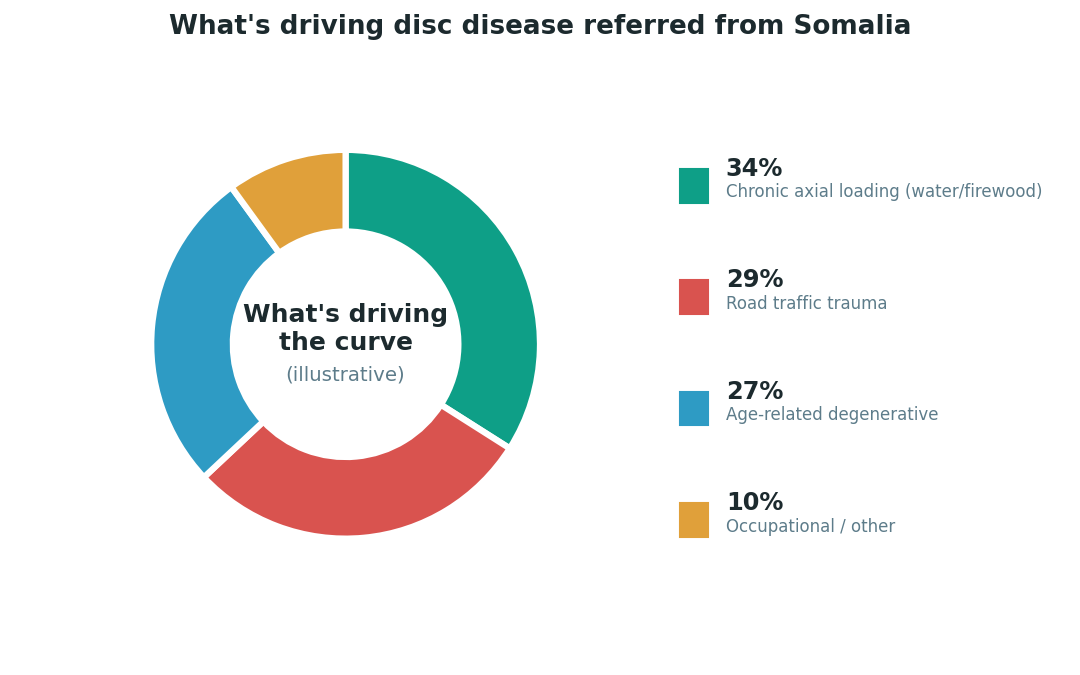
Illustrative breakdown of disc disease referrals from Somalia, by underlying cause.
Why age changes which operation is actually right
This is the detail that gets skipped when a clinic quotes "spine surgery" as a single line item. Spinal fusion permanently stops motion at the treated level, which is a proven, durable fix — but it also transfers extra stress onto the disc levels above and below, and over several decades that stress measurably raises the chance of needing surgery again at an adjacent level. Disc replacement keeps the segment moving much the way a natural disc does, which is exactly why it was developed in the first place: to give younger, otherwise healthy patients a fix that does not quietly wear out the rest of their spine while they still have forty or fifty years of use ahead of them. A Somali patient in their late twenties with a single-level herniation is, on paper, close to the textbook candidate this technology was designed for — yet is often the patient least likely to be offered it, simply because it is not the first thing discussed closer to home.
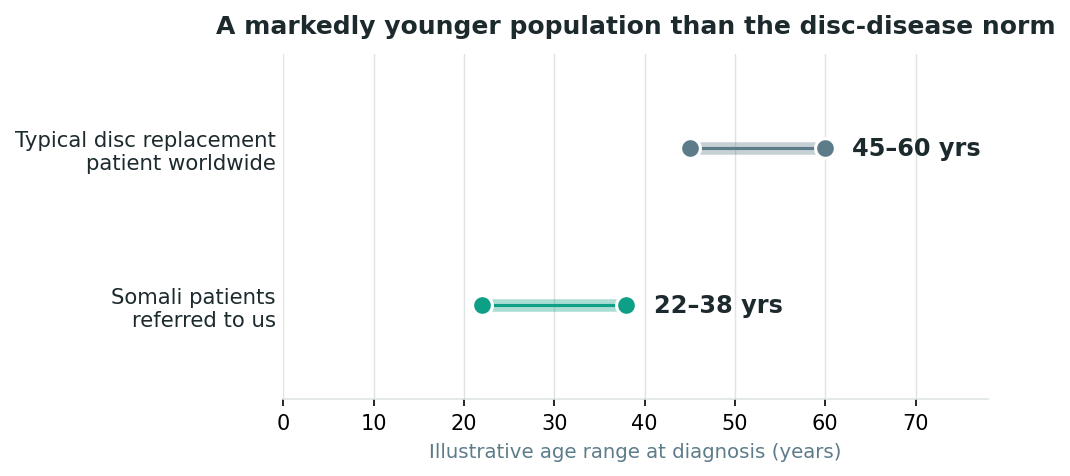
Illustrative age range at diagnosis: the typical disc-replacement patient worldwide, versus Somali patients referred to us.
Know the warning signs, and do not wait them out
Neck pain paired with numbness or weakness radiating into an arm, or lower back pain radiating down a leg past the knee, is different from ordinary muscular strain and deserves imaging, not painkillers alone. So is any new weakness in the hand or foot, a change in bladder or bowel control, or pain that wakes a person from sleep. Because MRI access is still limited outside Somalia's largest cities, many patients live with these symptoms for months or years before anyone confirms a disc is the cause — time during which a straightforward single-level problem can, in a minority of cases, progress to multi- level disease or nerve damage that is harder to fully reverse. Flagging the symptoms early, even without immediate access to a scan, is what keeps the eventual treatment options widest.
Who is, and is not, a genuine candidate
Disc replacement is not the right answer for every worn disc, and an honest surgeon will say so before ever discussing a date. It generally suits one or two-level disease with reasonably preserved facet joints, adequate bone density, and no significant spinal instability or deformity. It is usually not offered where there is spinal stenosis, spondylolisthesis, scoliosis, osteoporosis, or prior major spine surgery at the same level — fusion, or in milder cases physiotherapy and injections, remain the right tools for those patients. Six months of genuine non-surgical treatment that has not worked is the usual threshold before either operation is even considered. A clinic that skips straight to booking either procedure without this conversation, or without reviewing your actual MRI first, has skipped the step that decides whether you get the right operation at all.
Why the artificial disc itself matters
Not all artificial discs are the same device, and it is reasonable to ask which one is being proposed and why. Modern cervical and lumbar implants are built from combinations of medical-grade metal and a polymer core designed to allow controlled flexion, extension and rotation at the treated level, closely mimicking a healthy disc's range of motion. Manufacturers' data suggest well-placed implants can be expected to function for decades, and published outcome studies comparing cervical disc replacement to fusion have found broadly similar complication rates between the two, with replacement showing an edge in preserving neck motion and in the rate of further surgery needed at neighbouring levels over the following years. None of this makes replacement automatically superior — fusion remains the more proven, more widely available option for many patients — but a surgeon who cannot explain which implant is being used, and why it suits your specific levels, has not finished the conversation.
What it costs
In more than 24 years arranging this kind of care, the disputes I have seen were almost never about the price itself — they were about a diagnosis, or a cost, nobody had bothered to write down before the flight was booked. A written quote should say plainly whether you are being offered fusion or replacement, at how many levels, and why.
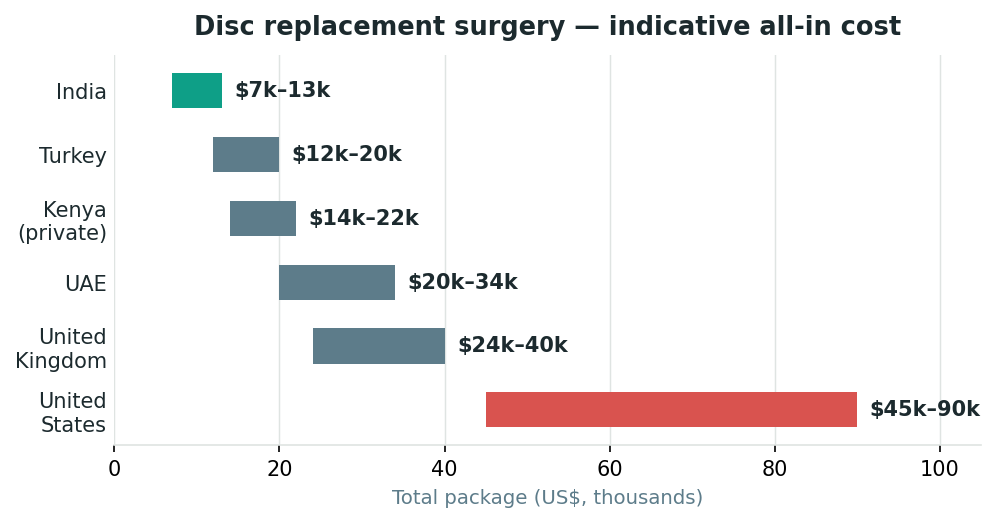
Indicative all-in cost for cervical or lumbar disc replacement surgery. India sits far below every common alternative.
A surgical disc replacement case in a reputable private Indian hospital typically runs US$7,000 to US$13,000 all-in for a single level, covering diagnosis, the implant, surgery, hospital stay and initial recovery. Lumbar cases and multi-level procedures sit toward the top of that range; a single-level cervical replacement is often toward the bottom. Ask for the figure specific to your levels and your actual MRI before committing to anything.
Four signals that should make you stop and walk away
Surgery quoted before your MRI is reviewed. Fusion or replacement decided from a written summary, not your actual imaging, is a plan made blind. Refuse it.
Only fusion is ever mentioned. If you are a plausible replacement candidate and it is never raised as an option, ask directly why not.
No six-month non-surgical trial discussed. For anything short of a true emergency, physiotherapy and injections should be tried and documented first.
The price keeps moving. A verbal estimate that shifts each time you ask is not an estimate. Demand a fixed figure in writing, tied to your levels.
The practical journey from Somalia — plan it before you fly
There is no direct flight between Somalia and India; patients route through Nairobi, Addis Ababa, Dubai or Djibouti. Because there is no full Indian mission inside Somalia, the medical visa is issued through the Embassy of India in Addis Ababa or the High Commission in Nairobi , against a written invitation letter from the treating hospital. Somali patients may bring up to two medical attendants on attendant visas. Since your route crosses yellow-fever territory, carry a valid yellow-fever vaccination certificate . Above every other instruction: send your actual MRI or CT films, not a written radiology summary, so the surgical team can confirm which levels are involved and which operation genuinely fits before you ever leave home.
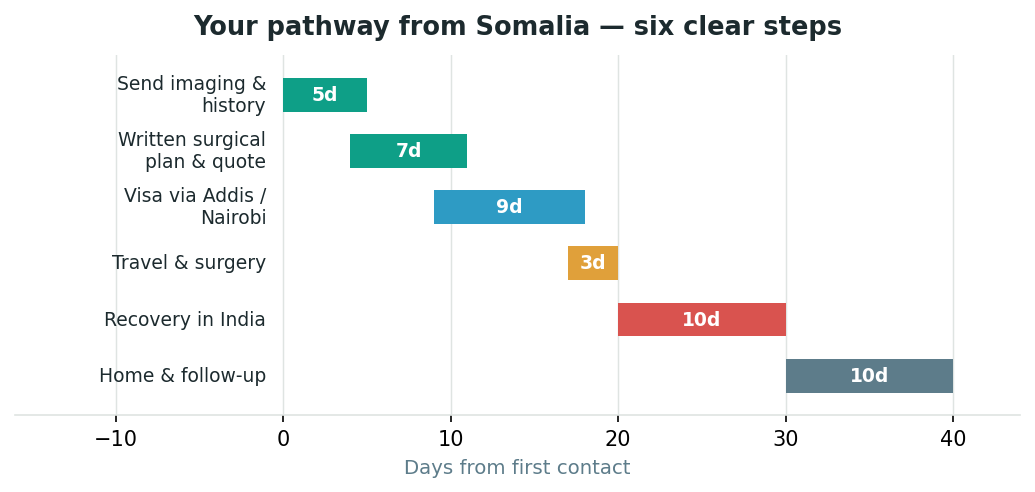
The complete route, start to finish — most of it arranged before you ever leave Somalia.
The right operation is the one that fits the decades ahead, not just the pain today
A disc that has failed at 28 is not the same problem as a disc that fails at 58, and it should not automatically get the same operation. Matched correctly to the patient's age, the level involved, and the years of spine still ahead of them, both fusion and disc replacement deliver excellent, lasting relief — the work is simply in getting that match right before the operating date is ever set.
Sources & useful links
- 🌐 Indian medical visa (Somali nationals) — indianvisaonline.gov.in
- 🌐 Embassy of India, Addis Ababa — eoiaddisababa.gov.in
- 🌐 High Commission of India, Nairobi — hcinairobi.gov.in
- 🌐 Yellow-fever requirements — who.int/health-topics/yellow-fever
- 🌐 Hospital accreditation (India) — nabh.co · jointcommissioninternational.org
- 🌐 Verify a surgeon's registration — nmc.org.in
Do not decide alone, and do not decide blind
If you want your MRI reviewed properly and an honest written plan — including whether disc replacement is genuinely an option for you — that is precisely the independent guidance I provide, without a single hospital's interest attached to my advice. Dr. Dheeraj Bojwani · Independent medical travel advisor
Frequently Asked Questions by Somali Patients about Cervical and Lumbar Disc Replacement Surgery in India
Are Somali patients often younger when considering disc replacement surgery?
The guide states that Somali patients referred for worn or herniated discs are often in their twenties and thirties, with the illustrative referred age range shown as 22–38 years.
What is the difference between disc replacement and spinal fusion for Somali patients?
Disc replacement preserves movement at the treated spinal level, while fusion permanently stops movement there. The guide stresses that the appropriate option depends on the patient's age, spinal levels and anatomy.
Who may be a candidate for disc replacement surgery in India?
The guide describes suitable candidates as generally having one- or two-level disease, reasonably preserved facet joints, adequate bone density and no significant instability or deformity.
Who may not be suitable for disc replacement?
The guide states that patients with conditions such as spinal stenosis, spondylolisthesis, scoliosis, osteoporosis or major previous surgery at the same level may require fusion or other treatment instead.
Should Somali patients try non-surgical treatment before disc replacement?
Yes. For non-emergency cases, the guide describes approximately six months of genuine non-surgical treatment, including options such as physiotherapy and injections, before surgery is considered.
How much does disc replacement surgery cost in India for Somali patients?
The guide gives an indicative all-in cost of US$7,000–US$13,000 for single-level surgery. Lumbar and multi-level procedures may be toward the higher end of this range.
Should Somali patients send their MRI before travelling to India?
Yes. The guide specifically recommends sending the actual MRI or CT films rather than only a written radiology report, so the surgical team can determine the affected levels and appropriate procedure.
What warning signs should Somali patients watch for before choosing spine surgery?
Patients should be cautious if surgery is recommended before reviewing their actual MRI, only fusion is discussed without explanation, no non-surgical treatment trial is considered, or the treatment price repeatedly changes.
What travel arrangements are required for Somali patients coming to India for spine surgery?
The guide states that patients may travel through Nairobi, Addis Ababa, Dubai or Djibouti, with medical-visa arrangements through the relevant Indian mission using a hospital invitation. Yellow-fever documentation may also be required based on the route.
How long does the treatment journey from Somalia to India take?
The pathway shown on page 5 covers imaging and history, a written surgical plan, visa processing, travel and surgery, recovery in India and home follow-up, with the illustrated timeline extending to approximately 40 days from first contact.
Page Summary
This guide explains the major considerations for Somali patients exploring cervical or lumbar disc replacement surgery in India, with particular emphasis on the younger age of many referred patients, accurate MRI-based assessment and choosing between disc replacement and fusion according to the patient's anatomy and long-term needs. It also covers warning symptoms, eligibility criteria, non-surgical treatment, artificial disc selection, indicative costs of US$7,000–US$13,000, warning signs when selecting a surgeon, visa and travel arrangements, and the treatment pathway from Somalia to India and subsequent follow-up.
Citation Block
| Topic | Information |
|---|---|
| Topic Information | Cervical and Lumbar Disc Replacement Surgery in India for Patients from Somalia |
| Treatment | Cervical / Lumbar Disc Replacement Surgery |
| Intended Audience | Patients from Somalia |
| Key Specialist | Spine Surgeon / Spine Specialist |
| Primary Assessment | Actual MRI or CT Imaging |
| Typical Referred Age | 22–38 Years |
| Main Options | Disc Replacement or Fusion |
| Candidate Profile | One- or two-level disease with suitable anatomy |
| Non-Surgical Trial | Approximately 6 months in non-emergency cases |
| Indicative Cost | US$7,000–US$13,000 for single-level surgery |
| Important Checks | MRI review, implant selection, number of levels and written quotation |
| Travel Planning | Hospital invitation, visa and route arrangements |
| Patient Journey | Imaging review → surgical plan → visa → travel/surgery → recovery → follow-up |
| Follow-Up | Home and long-term follow-up |


Our Mission Statement
Our mission is to place patients at the centre of every healthcare decision by providing trustworthy, evidence-based, and unbiased medical information. We believe that informed patients make better decisions. Backed by personalised guidance from our experienced advisory team, we help patients understand their treatment options, compare them objectively, and confidently choose the path that best suits their medical needs and personal circumstances.
Patient Testimonials from Somalia




Ready to Take the First Step?
Share your Medical Reports with our Healthcare Managers Today and Get a FREE CONSULTATION, a Personalized Treatment Plan, and Complete Support from Arrival to Recovery.
Get Your Free ConsultationAreas We Serve
This resource has been thoughtfully prepared for patients from Somalia who are considering medical treatment in India. We also welcome patients from the wider region in the countries mentioned below-
We assist patients from:
- Ethiopia
- Djibouti
- Yemen
- Kenya
- Seychelles
- Somalia
- South Sudan
- Tanzania
- Uganda
- Zambia
- Zimbabwe
- Angola
- Cameroon
- Central African Republic
Many of the insights, treatment pathways, hospital recommendations, travel guidance, and patient support services described here are equally relevant and may be used as a reference when planning treatment in India.
From Somalia to India: Your Complete Patient Support Guide
- Best Brain Tumour Surgeons & Hospitals in India for Somali Patients
- Best Cancer Treatment Surgeons & Hospitals in India for Somali Patients
- Best Cardiac Surgeons & Hospitals in India for Somali Patients
- Best CyberKnife Teams & Centres in India for Somali Patients
- Best Heart Valve Replacement Surgeons & Hospitals in India for Somali Patients
- Best Hip Surgeons & Hospitals in India for Somali Patients
- Best Knee Surgeons & Hospitals in India for Somali Patients
- Best Neurosurgeons & Hospitals in India for Somali Patients
- Best Paediatric Cardiac Surgeons & Hospitals in India for Somali Patients
- Best Paediatric Neurosurgeons & Hospitals in India for Somali Patients
- Best Spine Surgeons & Hospitals in India for Somali Patients
- Bariatric Surgery in India for Patients from Somalia
- Brain Tumour Surgery in India for Patients from Somalia
- Cancer Treatment and Surgery in India for Patients from Somalia
- Cardiac Surgery in India for Patients from Somalia
- Cosmetic and Plastic Surgery in India for Patients from Somalia
- CyberKnife Treatment in India for Patients from Somalia
- Dental Surgery in India for Patients from Somalia