

Cardiac Pacemaker Treatments in India for Patients from Somalia
A fainting spell that ends in a brief convulsion looks exactly like a seizure — right up until an ECG shows that the heart, not the brain, stopped for a few seconds.
A sudden collapse. A few seconds of jerking or stiffening. Confusion on waking, with no memory of falling. To anyone watching, this looks exactly like a seizure, and it is very often treated as one. In a genuine minority of cases, the actual cause is the heart stopping and starting again, not the brain misfiring — and for 24 years I have watched how much difference a correct diagnosis, and a small implanted device, can make to a life that had been organised around a diagnosis of epilepsy that was never quite right.
India implants pacemakers at genuinely high volume, with cardiac electrophysiologists experienced in exactly the kind of complete heart block that produces these dramatic, seizure-like collapses — delivered with modern leadless and MRI-compatible devices, at a fraction of the cost of the same procedure in the Gulf, Europe or the United States.
Healing Journeys of Somali Patients









Key Takeaways
- The guide highlights that some fainting or seizure-like episodes may have a cardiac cause, particularly complete heart block, where the heart can pause for several seconds. An ECG can help distinguish a cardiac collapse from a neurological seizure.
- The PDF cites a pacemaker implantation rate of approximately 2.66 per million people per year across 31 African countries, compared with a global average of around 50 per million. It notes that eight of the surveyed countries had never performed a pacemaker implant.
- Somali patients with sudden unexplained collapse, fainting during exertion, unusually slow pulse, recurrent episodes despite anti-seizure medication, palpitations or a relevant family history are advised to undergo appropriate cardiac assessment rather than assuming epilepsy.
- A pacemaker is not required for every fainting episode or slow heartbeat. The guide identifies confirmed complete or high-grade heart block, symptomatic sick sinus syndrome and symptomatic bradycardia as situations where pacemaker treatment may be indicated, supported by ECG and sometimes Holter monitoring.
- The guide gives an indicative Indian private-hospital cost of US$4,000–US$7,500 all-in. Single-chamber devices are generally toward the lower end, while dual-chamber or leadless devices may be toward the higher end.
- Device selection matters because single-chamber, dual-chamber and leadless pacemakers differ in cost, longevity and suitability. The guide recommends asking which device is being proposed and why.
- Long-term follow-up is essential because pacemakers require periodic checks, generally every 6–12 months, and eventual pulse-generator replacement when the battery becomes depleted. The guide recommends establishing a remote-monitoring or long-distance follow-up plan for Somali patients.
- Patients should be cautious if a pacemaker is proposed without ECG evidence, seizure-like episodes have never received a cardiac work-up, device type and battery life are not discussed, or the treatment quotation repeatedly changes.
- The Somalia-to-India pathway includes sending ECG, symptom history and Holter results → cardiology review → visa arrangements → travel and pre-implant assessment → pacemaker implantation and short hospital stay → long-term device checks. The guide also highlights medical-visa arrangements through Addis Ababa or Nairobi and yellow-fever requirements based on the travel route.
Quick Facts
- Treatment
- Cardiac Pacemaker Implantation
- Country
- India
- Patients
- Patients from Somalia
- Main Indications
- Complete Heart Block, High-Grade Heart Block, Symptomatic Sick Sinus Syndrome and Symptomatic Bradycardia
- Key Specialist
- Cardiac Electrophysiologist / Cardiologist
- Primary Test
- ECG
- Additional Test
- 24-Hour Holter Monitoring where required
- Indicative Cost
- US$4,000–US$7,500
- Device Options
- Single-Chamber, Dual-Chamber and Leadless Pacemakers
- Important Technology
- MRI-Compatible Pacemaker Options
- Hospital Requirement
- Experienced Cardiac Electrophysiology Team
- Follow-Up
- Device Checks Every 6–12 Months
- Long-Term Requirement
- Battery and Pulse-Generator Monitoring
- Important Check
- Confirm Device Type, Suitability and Battery Life
- Pre-Travel Records
- ECG, Holter Results and Symptom History
- Travel Consideration
- Routes may include Nairobi, Addis Ababa, Dubai or Djibouti
- Visa Planning
- Hospital Invitation and Relevant Indian Mission
- Author
- Dr. Dheeraj Bojwani
- Experience
- 24+ Years
In Brief
For Somali patients considering pacemaker treatment in India, the guide recommends establishing the actual cardiac rhythm problem before arranging implantation, particularly when fainting or convulsive episodes have previously been treated as epilepsy. ECG and, where necessary, longer rhythm monitoring can help identify conditions such as complete heart block or symptomatic bradycardia. Patients should also compare the proposed pacemaker type, hospital expertise, cost and follow-up arrangements, with particular attention to long-term device checks and remote monitoring because ongoing in-person pacemaker services may be limited after returning to Somalia.
First, know why a heart problem can look exactly like a brain one
When the heart's electrical signal is blocked between its upper and lower chambers — complete heart block — the heart can pause for several seconds at a time. The brain, starved of blood even briefly, responds the same way it does to many other causes of oxygen deprivation: the person collapses, and the muscles can jerk or stiffen in a way that looks identical to an epileptic seizure. This pattern, known medically as a Stokes-Adams attack, has a long history of being mistaken for epilepsy, and published research estimates that around one in five patients on long-term anti-seizure medication in epilepsy clinics do not actually have epilepsy at all — with unrecognised cardiac causes, including complete heart block, a documented factor behind these misdiagnoses.
The Somali difference: the test that would catch this is not the barrier — the device that would fix it is
An ECG, the test that actually distinguishes a cardiac collapse from a seizure, is simple, fast and inexpensive by the standards of modern medicine. The harder barrier is what comes after a correct diagnosis: treating complete heart block requires a pacemaker, and pacemaker implantation across Africa runs at a fraction of the rate seen elsewhere in the world. A continent-wide survey of 31 African countries found a median implant rate of roughly 2.66 pacemakers per million people per year, against a global average near 50 per million — and eight of those 31 countries, more than a quarter, had never performed a single pacemaker implant. For a patient in Somalia whose collapses are actually cardiac in origin, the diagnosis is reachable. The treatment, until now, generally has not been.
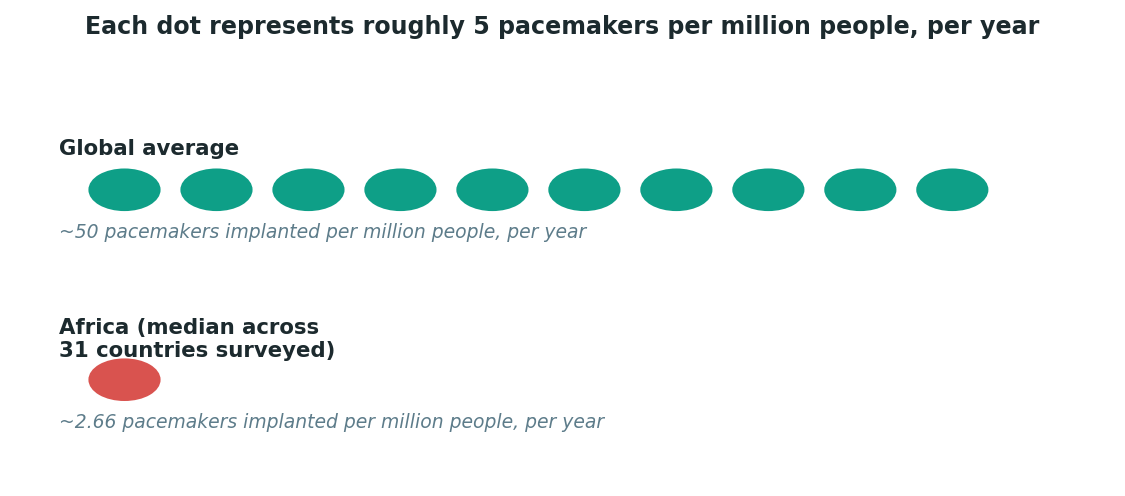
Published data on pacemaker implant rates: the global average versus the median across 31 African countries surveyed by the Pan- African Society of Cardiology.
Why this misdiagnosis carries real risk, not just inconvenience
Anti-seizure medication does nothing for complete heart block, so a patient misdiagnosed with epilepsy continues to have unpredictable cardiac pauses while taking a drug that cannot prevent them. Each Stokes-Adams attack carries a real, if usually brief, risk that the heart's pause will not resolve on its own. This is precisely why the distinction matters clinically, not just diagnostically: catching the cardiac cause and treating it with a pacemaker removes the underlying risk entirely, in a way that no amount of adjusting seizure medication ever could.
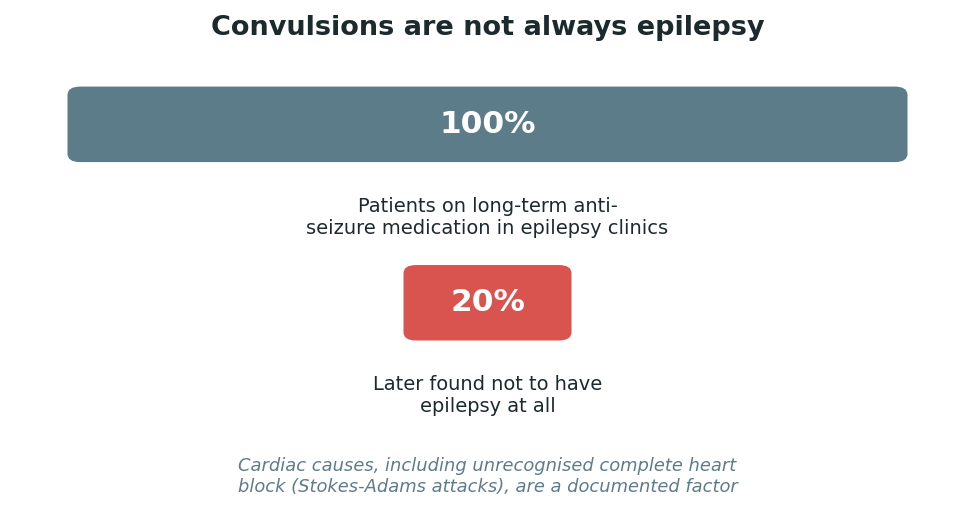
Published research on long-term epilepsy clinic patients, showing the proportion later found not to have epilepsy at all.
Know the warning signs, and do not wait them out
A sudden collapse with no warning, especially one that recovers within a minute or two on its own, deserves an ECG before it is treated as a seizure disorder. So does light-headedness or fainting that comes on during exertion, a pulse that feels unusually slow when checked at rest, or fainting episodes that keep happening despite anti-seizure medication being taken correctly and consistently. Palpitations or a fluttering sensation before a collapse, and a family history of unexplained sudden collapse or early cardiac death, are also worth mentioning specifically to whoever is assessing the case. None of these signs mean the cause is cardiac rather than neurological, but an ECG is quick, widely available even where specialist care is scarce, and is the one test that can settle the question either way before months or years pass on the wrong treatment.
Not every collapse, and not every slow heartbeat, needs a pacemaker
Fainting has many possible causes, and most of them, including simple vasovagal fainting from standing too long or emotional stress, need no cardiac device at all. A pacemaker is specifically indicated for confirmed complete or high-grade heart block, sick sinus syndrome causing symptoms, or a heart rate that is both genuinely too slow and directly linked to symptoms like dizziness, fainting or extreme fatigue. Confirming this requires an ECG, and often a longer recording, such as a 24-hour Holter monitor, to catch the abnormal rhythm in the act, since it may not be present at the exact moment of an examination. A pacemaker proposed without this documentation is a pacemaker proposed on assumption, not evidence.
What it costs
In more than 24 years arranging this kind of care, the disputes I have seen were almost never about the price itself — they were about a diagnosis, or a cost, nobody had bothered to write down before the flight was booked. Pacemaker pricing covers the device and the implant procedure, with periodic checks and an eventual battery replacement, typically after five to fifteen years, to plan for separately.
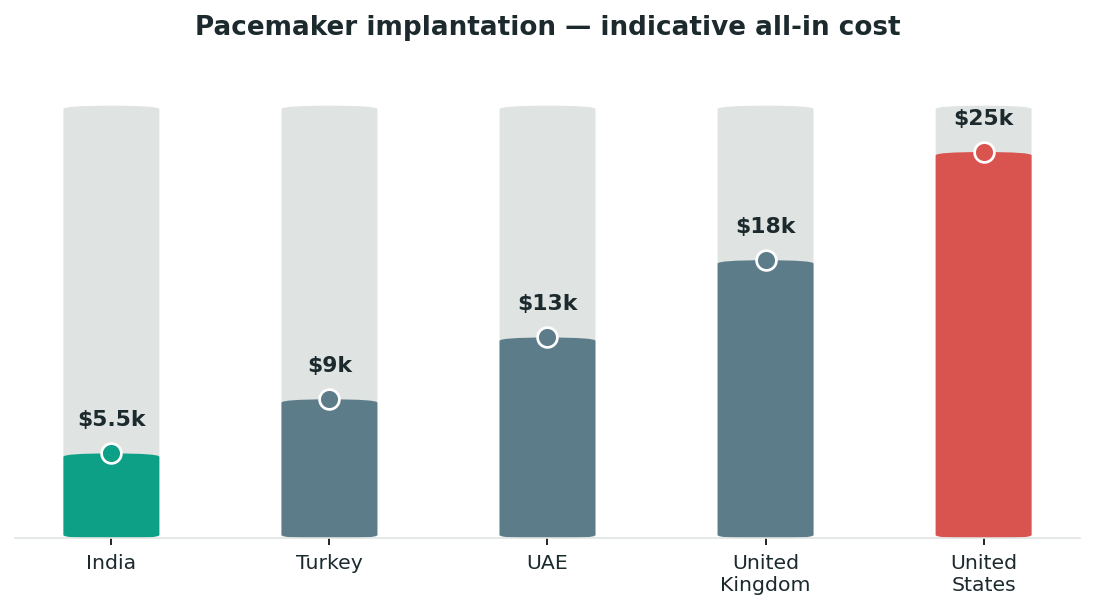
Indicative all-in cost for pacemaker implantation. India sits far below every common alternative.
A pacemaker implantation case in a reputable private Indian hospital typically runs US$4,000 to US$7,500 all-in, covering the device, the procedure and initial hospital stay; single-chamber devices sit toward the lower end and dual-chamber or leadless devices toward the top. Ask for the figure specific to the device type recommended for your condition.
Why the follow-up plan matters as much as the implant itself
A pacemaker is not a one-time fix and forget device. It needs periodic checks, typically every six to twelve months, to confirm the battery and leads are working correctly and the settings still suit the patient, and eventually a further short procedure to replace the pulse generator once the battery runs low. Since Somalia currently has no local team able to check a pacemaker in person, ask specifically how the hospital supports long-distance follow-up: many modern devices can transmit data remotely for review, and a clear plan for this, agreed before the original implant, is what actually protects the investment over the years the device is expected to last.
Four signals that should make you stop and walk away
Pacemaker proposed without an ECG showing the actual rhythm problem. Confirmed heart block or sick sinus syndrome on ECG, not symptoms alone, should justify the device.
Ongoing "seizures" never checked with an ECG. If convulsive episodes have only ever been investigated as epilepsy, ask for a cardiac work-up before assuming the diagnosis is settled.
No discussion of device type or battery life. Single-chamber, dual-chamber and leadless devices differ meaningfully in cost, longevity and suitability. Ask which is planned and why.
The price keeps moving. A verbal estimate that shifts each time you ask is not an estimate. Demand a fixed figure in writing.
The practical journey from Somalia — plan it before you fly
There is no direct flight between Somalia and India; patients route through Nairobi, Addis Ababa, Dubai or Djibouti. Because there is no full Indian mission inside Somalia, the medical visa is issued through the Embassy of India in Addis Ababa or the High Commission in Nairobi, against a written invitation letter from the treating hospital. Somali patients may bring up to two medical attendants on attendant visas. Since your route crosses yellow-fever territory, carry a valid yellow-fever vaccination certificate. Above every other instruction: send any ECG already performed and a clear description of the collapses themselves — what happens before, during and after — not just a diagnosis someone else has already assigned, so the cardiology team can assess the actual cause before you ever leave home.
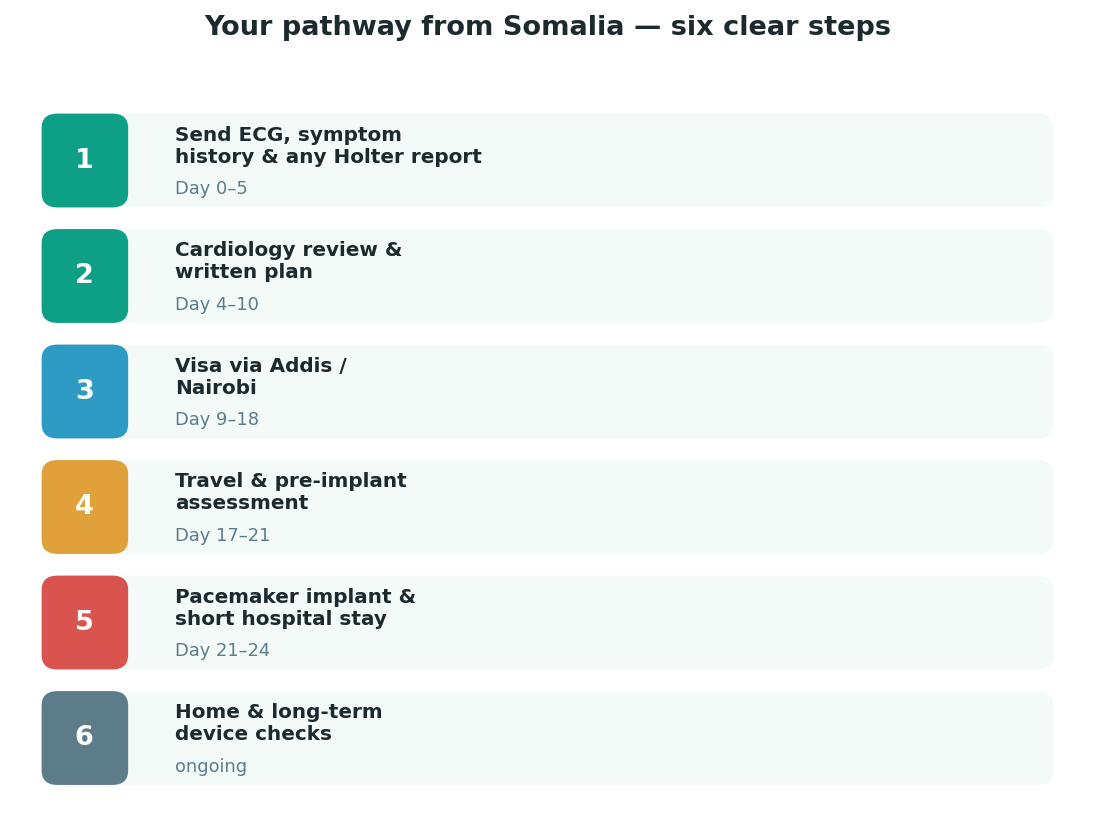
The complete route, start to finish — pacemaker implantation itself is typically a short procedure with a brief hospital stay.
The heart that stops for a moment can be taught not to
A pacemaker does something genuinely simple and genuinely permanent: it takes over the timing the heart's own electrical system can no longer reliably provide. For a patient whose collapses have been the heart's doing all along, that is not a lifelong condition to manage around — it is a problem with a fix.
Sources & useful links
- 🌐 Indian medical visa (Somali nationals) — indianvisaonline.gov.in
- 🌐 Embassy of India, Addis Ababa — eoiaddisababa.gov.in
- 🌐 High Commission of India, Nairobi — hcinairobi.gov.in
- 🌐 Yellow-fever requirements — who.int/health-topics/yellow-fever
- 🌐 Hospital accreditation (India) — nabh.co · jointcommissioninternational.org
- 🌐 Verify a surgeon's registration — nmc.org.in
Do not decide alone, and do not decide blind
If you want your case reviewed properly and an honest written answer — including whether the real cause is cardiac at all — that is precisely the independent guidance I provide, without a single hospital's interest attached to my advice. Dr. Dheeraj Bojwani · Independent medical travel advisor
Frequently Asked Questions by Somali Patients about Cardiac Pacemaker Treatments in India
Should Somali patients with fainting or seizure-like episodes have an ECG?
Yes. The guide recommends an ECG when sudden collapse or seizure-like episodes could have a cardiac cause, particularly when the episodes have not been adequately explained.
Can complete heart block cause symptoms that look like epilepsy?
Yes. The guide explains that a temporary pause in the heartbeat can reduce blood flow to the brain and cause collapse, jerking or stiffening that may resemble a seizure.
When may a Somali patient need a pacemaker?
The guide identifies confirmed complete or high-grade heart block, symptomatic sick sinus syndrome and symptomatic bradycardia as situations where pacemaker treatment may be appropriate after cardiac assessment.
What tests should Somali patients complete before pacemaker treatment in India?
An ECG is the key initial test. A 24-hour Holter monitor or longer rhythm recording may also be used when the abnormal rhythm is not captured during a routine examination.
How much does pacemaker implantation cost in India for Somali patients?
The guide gives an indicative all-in cost of US$4,000–US$7,500, depending partly on the pacemaker type and the treatment requirements.
What types of pacemakers can Somali patients receive in India?
The guide discusses single-chamber, dual-chamber and leadless pacemakers. Patients should ask which device is appropriate for their condition and why it has been recommended.
How often does a pacemaker need to be checked after returning to Somalia?
The guide states that pacemakers generally require checks every 6–12 months. Patients should establish how these checks and remote monitoring will be managed after returning home.
What should Somali patients check before choosing a pacemaker hospital in India?
They should verify the experience of the cardiac electrophysiology team, the recommended device type, supporting cardiac facilities, follow-up arrangements and a written treatment quotation.
What should Somali patients send to an Indian cardiology team before travelling?
They should send any available ECG, Holter results and a clear description of the collapse episodes, including what happens before, during and after an episode, rather than relying only on a previous diagnosis.
What is the treatment journey for Somali patients receiving a pacemaker in India?
The guide outlines a six-step pathway: send ECG and medical history → cardiology review → visa arrangements → travel and pre-implant assessment → pacemaker implantation and short hospital stay → home and long-term device checks.
Page Summary
This guide explains the key considerations for Somali patients exploring pacemaker evaluation and treatment in India, with particular emphasis on correctly identifying a cardiac cause of fainting or seizure-like episodes through ECG and appropriate rhythm monitoring. It covers pacemaker indications, device options, indicative costs, warning signs when selecting a treatment centre, long-term device monitoring and the Somalia-to-India treatment pathway, including visa, travel, implantation and ongoing follow-up.
Citation Block
| Topic | Information |
|---|---|
| Topic Information | Cardiac Pacemaker Treatments in India for Patients from Somalia |
| Treatment | Cardiac Pacemaker Implantation |
| Intended Audience | Patients from Somalia |
| Main Indications | Complete/high-grade heart block, symptomatic sick sinus syndrome and symptomatic bradycardia |
| Key Specialist | Cardiac Electrophysiologist / Cardiologist |
| Primary Diagnosis | ECG; Holter monitoring may be required |
| Indicative Cost | US$4,000–US$7,500 |
| Device Options | Single-chamber, dual-chamber and leadless pacemakers |
| Hospital Requirement | Experienced cardiac electrophysiology team |
| Important Checks | ECG evidence, device type, battery life and treatment quotation |
| Follow-Up | Device checks every 6–12 months and eventual battery replacement |
| Travel Planning | Hospital invitation, visa arrangements and travel route |
| Patient Journey | ECG/records → cardiology review → visa → travel/work-up → implantation → long-term checks |


Our Mission Statement
Our mission is to place patients at the centre of every healthcare decision by providing trustworthy, evidence-based, and unbiased medical information. We believe that informed patients make better decisions. Backed by personalised guidance from our experienced advisory team, we help patients understand their treatment options, compare them objectively, and confidently choose the path that best suits their medical needs and personal circumstances.
Patient Testimonials from Somalia




Ready to Take the First Step?
Share your Medical Reports with our Healthcare Managers Today and Get a FREE CONSULTATION, a Personalized Treatment Plan, and Complete Support from Arrival to Recovery.
Get Your Free ConsultationAreas We Serve
This resource has been thoughtfully prepared for patients from Somalia who are considering medical treatment in India. We also welcome patients from the wider region in the countries mentioned below-
We assist patients from:
- Ethiopia
- Djibouti
- Yemen
- Kenya
- Seychelles
- Somalia
- South Sudan
- Tanzania
- Uganda
- Zambia
- Zimbabwe
- Angola
- Cameroon
- Central African Republic
Many of the insights, treatment pathways, hospital recommendations, travel guidance, and patient support services described here are equally relevant and may be used as a reference when planning treatment in India.
From Somalia to India: Your Complete Patient Support Guide
- Best Brain Tumour Surgeons & Hospitals in India for Somali Patients
- Best Cancer Treatment Surgeons & Hospitals in India for Somali Patients
- Best Cardiac Surgeons & Hospitals in India for Somali Patients
- Best CyberKnife Teams & Centres in India for Somali Patients
- Best Heart Valve Replacement Surgeons & Hospitals in India for Somali Patients
- Best Hip Surgeons & Hospitals in India for Somali Patients
- Best Knee Surgeons & Hospitals in India for Somali Patients
- Best Neurosurgeons & Hospitals in India for Somali Patients
- Best Paediatric Cardiac Surgeons & Hospitals in India for Somali Patients
- Best Paediatric Neurosurgeons & Hospitals in India for Somali Patients
- Best Spine Surgeons & Hospitals in India for Somali Patients
- Bariatric Surgery in India for Patients from Somalia
- Brain Tumour Surgery in India for Patients from Somalia
- Cancer Treatment and Surgery in India for Patients from Somalia
- Cardiac Surgery in India for Patients from Somalia
- Cosmetic and Plastic Surgery in India for Patients from Somalia
- CyberKnife Treatment in India for Patients from Somalia
- Dental Surgery in India for Patients from Somalia