

Breast Cancer Treatment and Surgery in India for Patients from Somalia
Nearly half of the breast cancer patients seen at one Somali hospital were already at Stage III or IV by the time anyone confirmed the diagnosis — not because the disease moved fast, but because nothing in the system was built to catch it early.
A lump found while bathing. A change in the shape or skin of the breast that a woman notices but is not quite sure means anything. Breast cancer is, more than most cancers, a disease a patient can genuinely catch early herself — if she knows what to look for, and if a proper diagnosis is actually within reach once she does. For 24 years I have watched how often both of those conditions quietly fail Somali women, and how much difference it makes when they do not.
India treats breast cancer with the full range of modern options: breast-conserving surgery wherever the tumour allows it, oncoplastic and reconstructive techniques, and genetic and hormone-receptor testing that determines exactly which chemotherapy or targeted therapy will actually work — delivered by dedicated breast surgical oncology units, at a fraction of the cost of the same care in the Gulf, Europe or the United States.
Healing Journeys of Somali Patients









Key Takeaways
- The guide highlights a significant breast cancer diagnosis challenge in Somalia. At one Somali tertiary hospital, 47% of breast cancer patients presented at Stage III or IV, while 51% of biopsied breast masses were found to be cancer. Somalia also has no mammography screening programme, with ultrasound used as the primary imaging tool where mammography is unavailable.
- The guide explains that stage at diagnosis can substantially change the treatment pathway. Earlier-stage disease may allow breast-conserving surgery, while Stage III or IV disease more often requires mastectomy and more extensive systemic treatment. The page 3 chart illustrates how survival and the possibility of breast conservation decline as stage increases.
- Patients should not assume that every breast lump is cancer. The guide notes that approximately half of the biopsied masses in the cited Somali hospital study were benign, but any persistent lump or breast change should still be properly investigated. Cancer must be confirmed through biopsy and pathology, followed by hormone-receptor and HER2 testing to guide treatment selection.
- The guide strongly recommends choosing a dedicated breast oncology unit rather than relying on a general surgeon. Patients should ask about the named surgeon's annual breast cancer case volume, oncoplastic surgery, sentinel lymph node biopsy, reconstruction and coordination with medical and radiation oncologists.
- The page 4 cost chart shows an indicative full-treatment cost of around US$3,000–11,000 in India, compared with approximately US$13,000 in Turkey, US$15,000 in private Kenya, US$24,000 in the UAE, US$30,000 in the UK and US$55,000 in the US. The guide stresses that the actual amount depends on stage and treatment combination.
- For Somali patients, the guide recommends sending actual ultrasound images and pathology reports, not written summaries, before travelling. Patients should request a staged, itemised quotation covering surgery, chemotherapy, radiation and reconstruction where required, and ask what can realistically be completed during the same trip.
- Travel from Somalia requires planning because there is no direct flight to India and no full Indian mission inside Somalia. The guide states that medical visas are handled through the Indian mission in Nairobi or Addis Ababa, with up to two medical attendants permitted, and advises carrying a valid yellow-fever vaccination certificate.
Quick Facts
- Author
- Dr. Dheeraj Bojwani
- Experience
- 24+ Years
- Treatment
- Breast Cancer Treatment & Surgery
- Patients
- Somali Patients
- Stage III–IV Presentation
- 47% in the cited Somali tertiary-hospital study
- Biopsied Masses Cancerous
- 51%
- First Assessment
- Imaging, biopsy and pathology
- Key Specialist
- Breast Surgical Oncologist
- Main Testing
- Hormone-receptor and HER2 testing
- Surgical Check
- Breast conservation vs mastectomy
- Specialist Check
- Named surgeon's annual breast cancer case volume
- Team Check
- Medical and radiation oncology coordination
- Surgical Expertise
- Sentinel node biopsy and oncoplastic/reconstructive surgery
- India Cost
- US$3,000–11,000 indicative full treatment
- Cost Check
- Staged, itemised quotation
- Medical Records
- Actual ultrasound images and pathology report
- Visa
- Indian medical visa through Nairobi or Addis Ababa
- Travel
- Connecting flights required
- Attendants
- Up to two medical attendants
- Entry Requirement
- Valid yellow-fever vaccination certificate
- Follow-Up
- Home-country/remote follow-up plan
- Key Warning
- Surgery proposed before biopsy confirmation
- Decision Principle
- Verify diagnosis, stage, tumour biology and dedicated breast oncology expertise.
In Brief
For Somali patients seeking breast cancer treatment in India, the most important checks are biopsy-confirmed diagnosis, complete staging, hormone-receptor/HER2 testing, a dedicated breast oncology team, discussion of breast-conserving surgery where appropriate and a complete treatment quotation. Patients should send their actual imaging and pathology before travelling so treatment planning can begin in advance.
First, know why breast cancer is caught so late in Somalia
Two separate gaps compound each other here. The first is straightforwardly infrastructural: Somalia has no mammography screening programme, and a published study from a Somali tertiary hospital confirms that ultrasound, not mammography, is used as the primary imaging tool simply because mammography equipment is not available. Ultrasound is a genuinely useful tool once a lump is already found, but it is not the same as a population screening programme that catches cancers before they can be felt at all.
The Somali difference: a documented belief that the test itself is the danger
The second gap is about awareness, and it is more specific than simple unfamiliarity. Research among Somali women, including diaspora focus groups, has documented a recurring and specific misconception: that mammograms themselves can cause breast cancer, rather than detect it. Combined with limited general awareness of breast self-examination and low community visibility of survivors, this helps explain why the same tertiary-hospital study found 39.8% of patients already at Stage III and a further 7.3% at Stage IV by the time of diagnosis — nearly half the entire patient group. This is not a reflection of denial or neglect. It is what happens when a genuine, specific, correctable piece of misinformation meets a healthcare system with very little screening infrastructure to catch the cancer anyway.
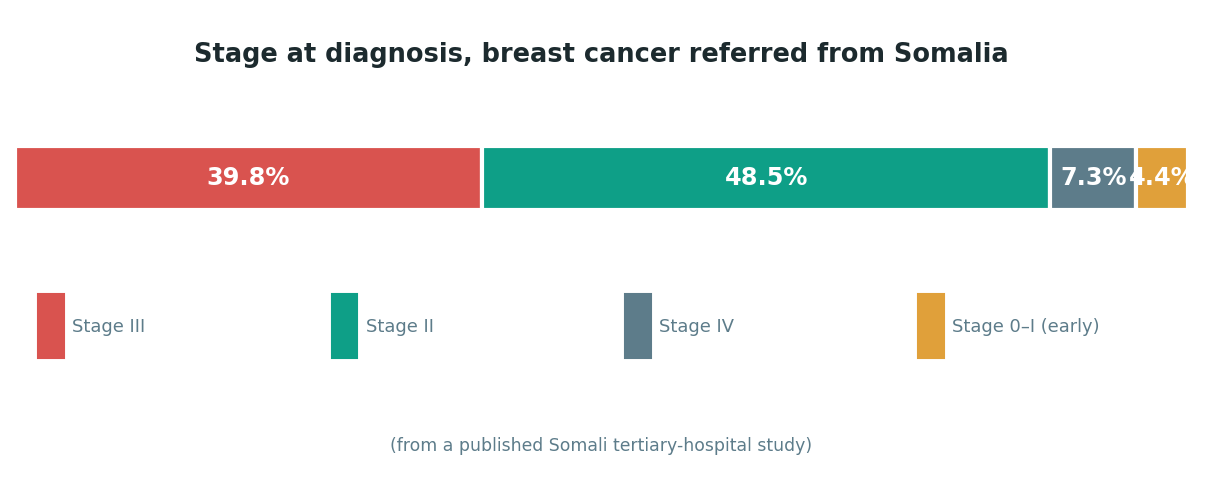
Stage at diagnosis, from a published study of breast cancer patients at a Somali tertiary hospital.
Why the stage at diagnosis changes almost everything about treatment
A cancer caught at Stage II, while still confined to the breast and nearby lymph nodes, is very often treatable with breast-conserving surgery — removing the tumour with a margin of healthy tissue, rather than the whole breast — followed by radiation. The same cancer caught at Stage III or IV, having grown larger or spread further, much more often requires a full mastectomy, more extensive chemotherapy, and carries a meaningfully lower chance of long-term survival. None of this is unique to Somalia; it is true everywhere breast cancer is treated. What is specific to Somalia is how large a share of women are currently being diagnosed on the wrong side of that line.
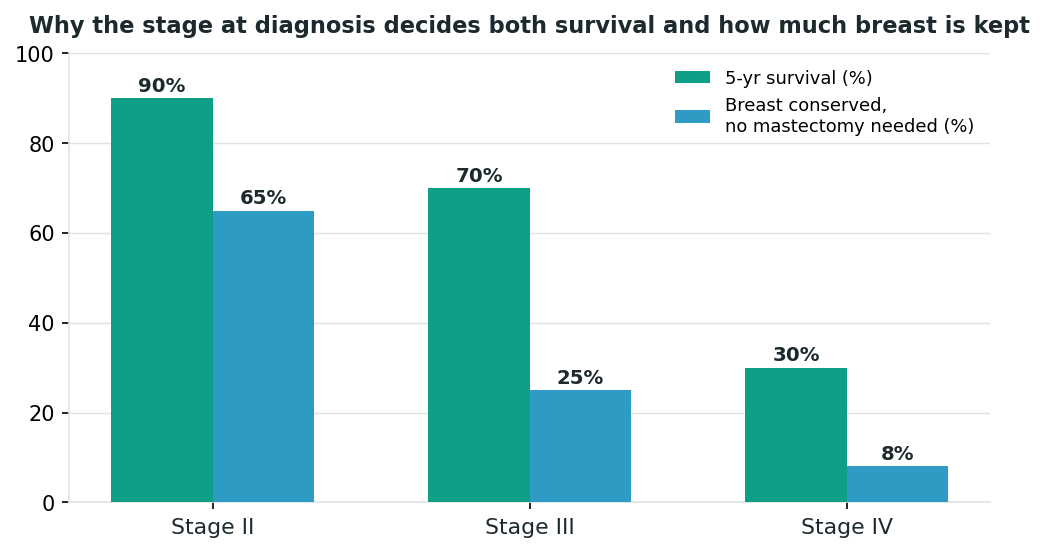
Illustrative five-year survival and likelihood of breast-conserving surgery by stage at diagnosis, based on general oncology literature.
Know the warning signs, and do not wait them out
A new lump or thickening in the breast or underarm, a change in breast size or shape, skin that dimples like an orange peel, a nipple that turns inward when it did not before, unusual discharge, or persistent redness and warmth are all signs that deserve an ultrasound and, if anything is found, a biopsy — not reassurance alone. Monthly self-examination, simply pressing gently across the breast and underarm to notice anything new, remains one of the most effective early-detection tools available anywhere mammography is not, precisely because it costs nothing and needs no equipment. Any change that persists for more than two to three weeks, particularly after a menstrual cycle has passed, is worth a proper look rather than watching to see if it resolves on its own.
Not every lump, and not every diagnosis, is the same
Most breast lumps found by young women are not cancer at all; fibroadenomas, benign and non- cancerous, are especially common before menopause and typically need nothing more than monitoring. Even the Somali hospital study cited above found that roughly half of biopsied masses were benign. This cuts both ways: a lump should always be checked rather than dismissed, but a diagnosis of cancer should always be confirmed by biopsy and pathology, not assumed from how a lump feels on examination alone. Once cancer is confirmed, hormone-receptor and HER2 testing on the biopsy sample determines which of several very different treatment pathways — hormone therapy, targeted therapy, standard chemotherapy, or a combination — will actually work for that specific tumour. Treatment planned without this testing is, in a meaningful sense, treatment planned blind.
What it costs
In more than 24 years arranging this kind of care, the disputes I have seen were almost never about the price itself — they were about a diagnosis, or a cost, nobody had bothered to write down before the flight was booked. A full breast cancer treatment course can include surgery, chemotherapy, radiation and, for some patients, reconstruction, each of which should be quoted and understood separately.
Why a dedicated breast unit, not a general surgeon, is what to look for
Breast cancer surgery today is genuinely subspecialised. Oncoplastic techniques that combine cancer removal with reshaping the breast for a better cosmetic result, sentinel lymph node biopsy to check for spread without removing every lymph node under the arm, and immediate or delayed reconstruction all depend on a surgeon who does this specific work regularly, working alongside a medical oncologist and radiation oncologist as a standing team. Ask how many breast cancer cases the named surgeon manages each year, whether sentinel node biopsy is routinely offered rather than automatic full lymph node clearance, and whether reconstruction, if wanted, can be planned as part of the same team's care rather than referred elsewhere afterward.
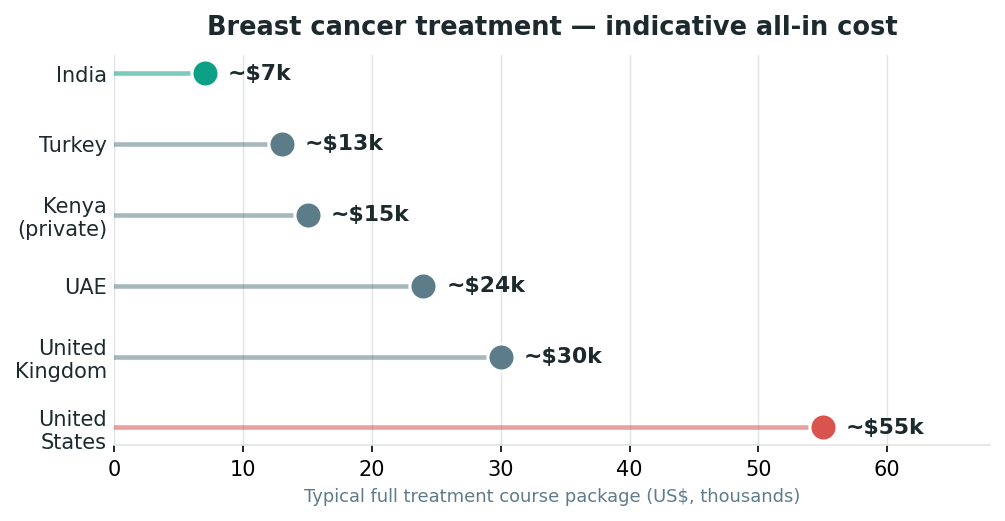
Indicative all-in cost for a full breast cancer treatment course. India sits far below every common alternative.
A full treatment course in a reputable private Indian hospital, from surgery through any needed chemotherapy and radiation, typically runs US$3,000 to US$11,000 all-in depending on stage and the combination of treatments required; surgery alone, for an early-stage cancer needing no further therapy, sits toward the lower end. Ask for a staged quote naming each phase of treatment separately.
Four signals that should make you stop and walk away
1. Surgery quoted before biopsy results. A lump's appearance on ultrasound cannot substitute for a tissue diagnosis. Surgery should never be scheduled before pathology confirms what it actually is.
2. No hormone-receptor or HER2 testing mentioned. This testing determines the entire treatment pathway. Its absence from the plan is a significant gap, not a detail.
3. Mastectomy proposed without discussing conservation. For many Stage I–II tumours, breast-conserving surgery is an option. Ask specifically why it was or was not offered.
4. The price keeps moving. A verbal estimate that shifts each time you ask is not an estimate. Demand a staged, itemised quote in writing.
The practical journey from Somalia — plan it before you fly
There is no direct flight between Somalia and India; patients route through Nairobi, Addis Ababa, Dubai or Djibouti. Because there is no full Indian mission inside Somalia, the medical visa is issued through the Embassy of India in Addis Ababa or the High Commission in Nairobi, against a written invitation letter from the treating hospital. Somali patients may bring up to two medical attendants on attendant visas. Since your route crosses yellow-fever territory, carry a valid yellow-fever vaccination certificate. Above every other instruction: send the actual ultrasound images and, if a biopsy has already been done, the pathology report itself, not a written summary, so the surgical team can begin planning treatment before you ever leave home. If chemotherapy or radiation is likely to follow surgery, ask early how much of that course can realistically be planned during the same trip versus completed after returning home under remote guidance.
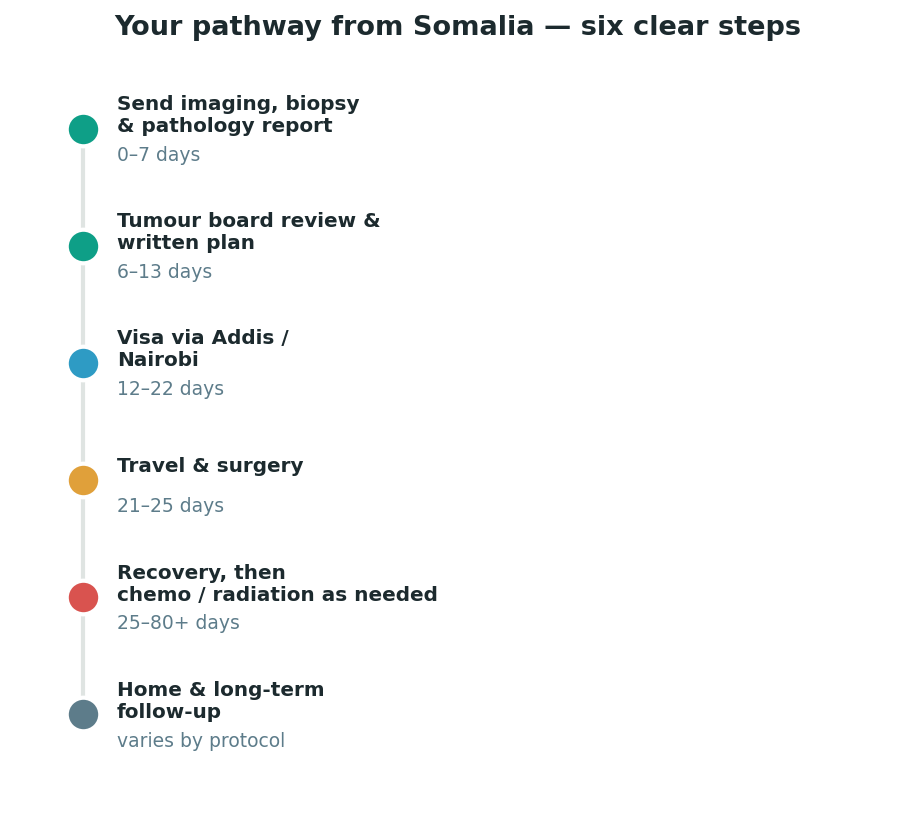
The complete route, start to finish — length varies depending on whether chemotherapy or radiation follows surgery.
A disease a woman can catch herself, in a system built to actually confirm it
Breast cancer is unusual among cancers in that many patients find it themselves, simply by noticing a change. Paired with a genuine diagnostic and treatment system — not a myth to unlearn and not a missing scanner — that early awareness is exactly what turns a frightening finding into a cancer caught in time.
Sources & useful links
- 🌐 Indian medical visa (Somali nationals) — indianvisaonline.gov.in
- 🌐 Embassy of India, Addis Ababa — eoiaddisababa.gov.in
- 🌐 High Commission of India, Nairobi — hcinairobi.gov.in
- 🌐 Yellow-fever requirements — who.int/health-topics/yellow-fever
- 🌐 Hospital accreditation (India) — nabh.co · jointcommissioninternational.org
- 🌐 Verify a surgeon's registration — nmc.org.in
Do not decide alone, and do not decide blind
If you want your scans and biopsy results reviewed properly and an honest written plan — including whether breast-conserving surgery is genuinely an option — that is precisely the independent guidance I provide.
Dr. Dheeraj Bojwani · Independent medical travel advisor
Frequently Asked Questions by Somali Patients about Breast Cancer Treatment and Surgery in India
Why is early breast cancer diagnosis particularly important for Somali patients?
The guide reports that 47% of breast cancer patients at the cited Somali tertiary hospital presented at Stage III or IV. Earlier diagnosis can expand treatment options, including the possibility of breast-conserving surgery in suitable cases.
Why should Somali patients not assume that every breast lump is cancer?
The cited Somali hospital study found that roughly half of biopsied breast masses were benign. However, a persistent lump or breast change should still undergo proper imaging and biopsy rather than being dismissed or assumed to be cancer.
What should a Somali patient do if mammography is not easily available at home?
The guide notes that Somalia has no mammography screening programme and that ultrasound is used as the primary imaging tool at the cited hospital. Patients with a suspicious finding should obtain appropriate imaging and biopsy rather than relying on reassurance alone.
Why are hormone-receptor and HER2 tests important before a Somali patient starts treatment in India?
These tests help determine whether hormone therapy, targeted therapy, chemotherapy or combinations are appropriate for the individual tumour. The guide considers treatment without this testing an important gap in planning.
Why should Somali patients choose a dedicated breast cancer unit rather than a general surgeon?
Breast cancer surgery can involve breast conservation, sentinel lymph node biopsy, oncoplastic surgery and reconstruction, alongside medical and radiation oncology. The guide therefore recommends a dedicated team with regular breast cancer experience.
Can a Somali patient with breast cancer avoid mastectomy?
Possibly, depending on the stage, tumour characteristics and individual clinical assessment. The guide recommends specifically asking whether breast-conserving surgery is genuinely appropriate before accepting a mastectomy recommendation.
What should a Somali patient send to an Indian breast cancer centre before travelling?
Send the actual ultrasound images and pathology report, if a biopsy has already been performed. The guide specifically recommends original diagnostic material rather than a written summary so the Indian team can begin planning before travel.
How much can complete breast cancer treatment cost in India for a Somali patient?
The guide gives an indicative US$3,000–11,000 for a full treatment course, depending on stage and the combination of surgery, chemotherapy, radiation and reconstruction required.
How should Somali patients plan travel if chemotherapy or radiation is needed after surgery?
Ask the Indian oncology team which parts of treatment can realistically be completed during the same trip and what can safely be continued after returning to Somalia. The guide's pathway shows that treatment duration varies substantially depending on whether additional therapy follows surgery.
What are the biggest warning signs when choosing breast cancer treatment in India?
The guide identifies four major warning signs: surgery quoted before biopsy results, no hormone-receptor or HER2 testing, mastectomy proposed without discussing conservation, and a treatment price that keeps changing without a staged written quotation.
Page Summary
This six-page guide explains why breast cancer is frequently diagnosed late in Somalia, how staging and tumour biology influence treatment, what treatment in India may cost and how Somali patients should plan their journey. Page 1 highlights the Somali diagnosis gap and the 47% Stage III–IV figure. Page 2 explains stage-related treatment differences. Page 3 covers warning signs, biopsy and receptor testing. Page 4 focuses on dedicated breast units, treatment costs and warning signs. Page 5 provides the Somalia-to-India pathway, while page 6 reinforces the need for proper pathology review and independent treatment planning.
Citation Block
| Topic | Information |
|---|---|
| Topic | Breast Cancer Treatment and Surgery in India for Somali Patients |
| Treatment | Breast Cancer Treatment & Surgery |
| Patients | Somali Patients |
| First Assessment | Imaging, biopsy and pathology |
| Key Specialist | Breast Surgical Oncologist |
| Stage Check | Complete cancer staging |
| Biology Check | Hormone-receptor and HER2 testing |
| Surgical Check | Breast conservation vs mastectomy |
| Team Check | Breast surgeon, medical oncologist and radiation oncologist |
| Case Volume | Named surgeon's annual breast cancer cases |
| Surgical Expertise | Sentinel node biopsy and oncoplastic/reconstructive surgery |
| India Cost | US$3,000–11,000 indicative full course |
| Cost Check | Staged, itemised quotation |
| Medical Records | Actual ultrasound images and pathology report |
| Visa | Nairobi or Addis Ababa |
| Travel | Connecting flights from Somalia |
| Attendants | Up to two medical attendants |
| Entry Requirement | Valid yellow-fever vaccination certificate |
| Specialist Question | How many breast cancer cases do you personally manage each year? |
| Diagnosis Question | Has my diagnosis been confirmed by biopsy and pathology? |
| Biology Question | What are my hormone-receptor and HER2 results? |
| Surgery Question | Is breast-conserving surgery genuinely suitable for my stage? |
| Team Question | Will my case be reviewed by a multidisciplinary breast cancer team? |
| Cost Question | Does the quotation separately cover surgery, chemotherapy, radiation and reconstruction? |
| Travel Question | How much treatment can realistically be completed during one trip? |
| Warning Signs | Surgery quoted before biopsy results |
| Payment Warning | Moving or incomplete quotation |
| Key Decision | Verify diagnosis, stage, tumour biology and dedicated breast oncology care |


Our Mission Statement
Our mission is to place patients at the centre of every healthcare decision by providing trustworthy, evidence-based, and unbiased medical information. We believe that informed patients make better decisions. Backed by personalised guidance from our experienced advisory team, we help patients understand their treatment options, compare them objectively, and confidently choose the path that best suits their medical needs and personal circumstances.
Patient Testimonials from Somalia




Ready to Take the First Step?
Share your Medical Reports with our Healthcare Managers Today and Get a FREE CONSULTATION, a Personalized Treatment Plan, and Complete Support from Arrival to Recovery.
Get Your Free ConsultationAreas We Serve
This resource has been thoughtfully prepared for patients from Somalia who are considering medical treatment in India. We also welcome patients from the wider region in the countries mentioned below-
We assist patients from:
- Ethiopia
- Djibouti
- Yemen
- Kenya
- Seychelles
- Somalia
- South Sudan
- Tanzania
- Uganda
- Zambia
- Zimbabwe
- Angola
- Cameroon
- Central African Republic
Many of the insights, treatment pathways, hospital recommendations, travel guidance, and patient support services described here are equally relevant and may be used as a reference when planning treatment in India.
From Somalia to India: Your Complete Patient Support Guide
- Best Brain Tumour Surgeons & Hospitals in India for Somali Patients
- Best Cancer Treatment Surgeons & Hospitals in India for Somali Patients
- Best Cardiac Surgeons & Hospitals in India for Somali Patients
- Best CyberKnife Teams & Centres in India for Somali Patients
- Best Heart Valve Replacement Surgeons & Hospitals in India for Somali Patients
- Best Hip Surgeons & Hospitals in India for Somali Patients
- Best Knee Surgeons & Hospitals in India for Somali Patients
- Best Neurosurgeons & Hospitals in India for Somali Patients
- Best Paediatric Cardiac Surgeons & Hospitals in India for Somali Patients
- Best Paediatric Neurosurgeons & Hospitals in India for Somali Patients
- Best Spine Surgeons & Hospitals in India for Somali Patients
- Bariatric Surgery in India for Patients from Somalia
- Brain Tumour Surgery in India for Patients from Somalia
- Cancer Treatment and Surgery in India for Patients from Somalia
- Cardiac Surgery in India for Patients from Somalia
- Cosmetic and Plastic Surgery in India for Patients from Somalia
- CyberKnife Treatment in India for Patients from Somalia
- Dental Surgery in India for Patients from Somalia