

Bone Marrow Transplant Treatment in India for Patients from Somalia
International donor registries give patients of African ancestry roughly a 29% chance of finding a match. A full sibling gives a 25% chance on their own — and every additional sibling tested meaningfully improves the odds.
Bone marrow transplant replaces damaged or diseased marrow with healthy stem cells from a donor, and for many blood cancers and severe blood disorders, it remains the only genuinely curative option once other treatments have been exhausted. The entire process depends on one specific, often underappreciated step: finding a donor whose tissue type is close enough to the patient's own that the new marrow can take hold without the body rejecting it. For 24 years I have watched this single step decide, more than almost any other factor, how quickly a family can move from diagnosis to treatment.
India performs both matched-sibling and unrelated-donor transplants at genuine scale, with haematology teams experienced in typing entire families quickly and, where a related donor cannot be found, searching international registries and using half-matched (haploidentical) family donors as an established alternative — at a fraction of the cost of the same treatment in the Gulf, Europe or the United States.
Healing Journeys of Somali Patients









Key Takeaways
- The guide explains that donor identification is one of the most important early steps in bone marrow transplant planning. A full sibling has a 25% chance of being a complete HLA match, making early family testing particularly important for Somali patients.
- For patients of African ancestry, the guide cites approximately a 29% chance of finding a fully matched available donor through international registries, compared with approximately 77–79% for patients of European ancestry. This makes the family donor search especially important.
- Testing more siblings can significantly improve the cumulative chance of finding a match. The guide cites approximately 43.7% with two siblings, 57.8% with three and 68.4% with four siblings tested, rather than stopping after the first unsuitable result.
- Transplant may be considered for conditions including leukaemia, certain lymphomas, aplastic anaemia and severe inherited blood or immune disorders. The guide recommends beginning family HLA typing alongside initial treatment when transplant may eventually be required.
- A fully matched donor is not always necessary. Haploidentical transplantation using a half-matched parent, child or sibling is presented as an established option at experienced centres, while autologous transplantation may be appropriate for selected conditions.
- The guide gives an indicative Indian private-hospital cost of US$15,000–US$35,000 all-in, with the final amount depending on the diagnosis and donor type. Patients are advised to obtain a written quotation specific to their case.
- Hospital selection should include a dedicated transplant unit, protected rooms, reliable blood-bank support and graft-versus-host disease management, while patients should be cautious if siblings have not been tested, haploidentical options are not discussed, no dedicated transplant specialist is identified or the quoted price keeps changing.
- The practical journey from Somalia requires advance planning, including HLA testing, medical-visa arrangements, hospital invitation documentation and travel routing through Nairobi, Addis Ababa, Dubai or Djibouti. The guide also highlights attendant visas and yellow-fever vaccination requirements where applicable.
- The six-stage pathway covers medical-record submission → haematology review → family HLA typing and visa arrangements → travel and conditioning → transplant and extended recovery → home and long-term follow-up. The guide's overall message is that an unsuccessful registry search does not necessarily mean that no donor option exists.
Quick Facts
- Treatment
- Bone Marrow / Stem Cell Transplantation
- Country
- India
- Patients
- Patients from Somalia
- Main Indications
- Leukaemia, certain lymphomas, aplastic anaemia and severe inherited blood or immune disorders
- Key Specialist
- Haematology / Bone Marrow Transplant Specialist
- Primary Donor Search
- Full Sibling HLA Matching
- Sibling Match Probability
- 25% for one full sibling
- Registry Match
- Approximately 29% cited for patients of African ancestry
- Alternative Donor
- Haploidentical Family Donor
- Indicative Cost
- US$15,000–US$35,000
- Important Testing
- HLA Typing
- Hospital Requirement
- Dedicated Transplant Unit
- Important Infrastructure
- Protected Rooms and 24-hour Blood-Bank Support
- Complication Management
- Graft-versus-Host Disease Management
- Pre-Travel Requirement
- Medical Records, Hospital Invitation and Visa Planning
- Travel Consideration
- Routes may include Nairobi, Addis Ababa, Dubai or Djibouti
- Follow-Up
- Extended Inpatient Recovery and Long-Term Monitoring
- Important Check
- Written Quote Based on Diagnosis and Donor Type
- Author
- Dr. Dheeraj Bojwani
- Experience
- 24+ Years
In Brief
For Somali patients considering bone marrow transplant in India, the guide recommends beginning with family HLA typing and a proper haematology assessment, as the lower likelihood of finding a fully matched unrelated donor makes early family testing especially important. Haploidentical transplantation may provide an alternative when a full match is unavailable. Patients should also assess the transplant centre's haematology expertise, dedicated transplant facilities, blood-bank support, infection control and graft-versus-host disease management, while obtaining a diagnosis- and donor-specific written quotation and planning visa arrangements, travel, extended recovery and long-term follow-up in advance.
First, know why the donor search itself is the real starting point
Every person inherits one set of tissue markers, called HLA type, from each parent, and a full sibling has a one-in-four chance of having inherited the exact same combination. This is why siblings are always tested first: a matched sibling donor generally means a faster search, a well-established transplant protocol, and typically better outcomes than an unrelated donor. Where no sibling matches, the search moves to international unrelated-donor registries — and this is precisely where the picture changes for patients of African ancestry, including Somali patients.
The Somali difference: the backup plan is far less reliable, which makes the sibling search matter more
International donor registries were built primarily from donors of European ancestry, and the numbers reflect it directly: patients of African ancestry have roughly a 29% chance of finding a fully matched, available donor through these registries, compared with around 77 to 79% for patients of European ancestry. This is not a small gap, and it means that for a Somali patient, the unrelated-donor registry search that works reasonably well for many international patients is, statistically, much less likely to succeed. What this makes disproportionately important is the family search that happens first — and Somalia's larger average family size works genuinely in a patient's favour here, since every additional sibling tested measurably raises the cumulative chance of finding a match within the family itself.
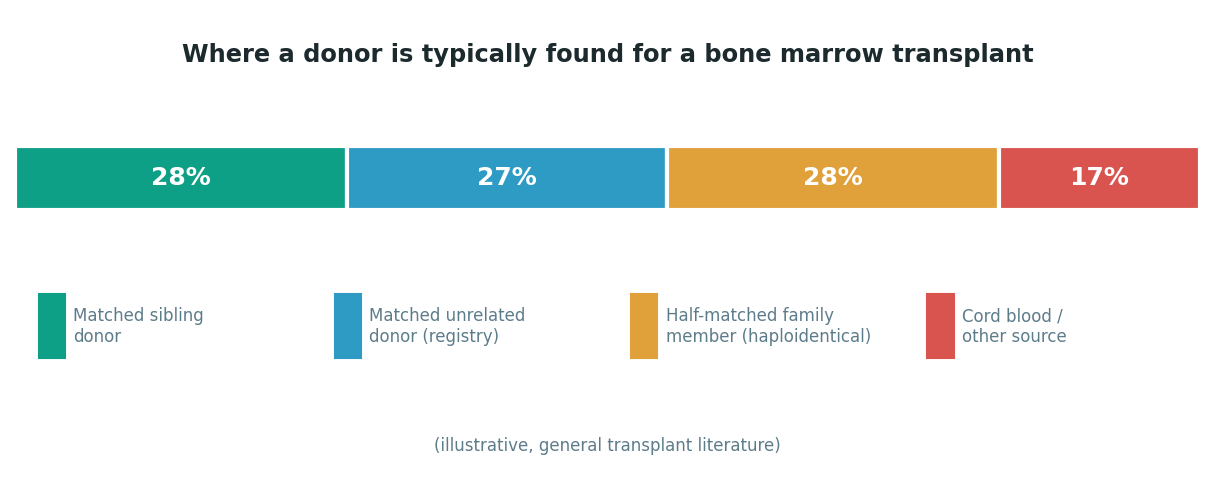
Illustrative breakdown of donor sources for bone marrow transplants, based on general transplant literature.
Why testing every sibling, not just the first one available, matters
A single sibling carries a 25% chance of matching. Test two siblings and the cumulative chance of at least one match rises to roughly 43.7%. With three siblings tested, it climbs to about 57.8%, and with four, to roughly 68.4%. This is simple, well-established genetics, but it is easy to miss in practice: a family that stops testing after one sibling comes back as a partial match may be walking away from a full match sitting in the next child down the line. Every sibling old enough to be tested safely should be tested, not just the first one or two who happen to be nearby.
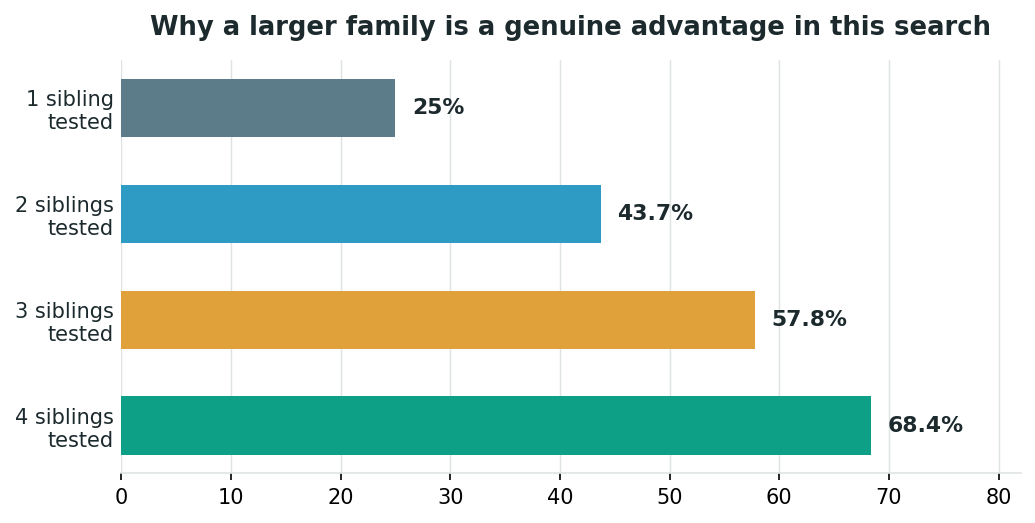
Published probability of finding a matched sibling donor, by number of full siblings tested.
Know when a transplant becomes the right conversation to have
A confirmed diagnosis of leukaemia, certain lymphomas, aplastic anaemia, or a severe inherited blood or immune disorder is the starting point for asking whether transplant is an appropriate option, not a symptom to watch for at home. What matters most once a diagnosis is confirmed is speed: sibling HLA typing can begin immediately, in parallel with initial treatment, rather than waiting until every other option has been tried first. For families who already know a diagnosis is likely to eventually need a transplant, whether from a doctor's assessment or a relapse after initial treatment, starting the family typing conversation early, even before it becomes urgent, is the single most useful thing that can be done while other treatment is underway.
Not every patient needs a fully matched donor
Transplant medicine has moved a long way from requiring a perfect match to proceed at all. Haploidentical transplant, using a half-matched parent, child or sibling, is now an established option with good outcomes at experienced centres, and it means a related donor is available to nearly every patient who has any living, willing family member, since parents and children are always at least a half- match. For some conditions, a patient's own stem cells, collected and stored before treatment, can be used instead of a donor's entirely. The right choice depends on the specific diagnosis, and a good haematology team explains clearly which donor sources are realistic for your case, rather than presenting only one path.
What it costs
In more than 24 years arranging this kind of care, the disputes I have seen were almost never about the price itself — they were about a diagnosis, or a cost, nobody had bothered to write down before the flight was booked. Cost depends heavily on donor type and whether the transplant is autologous, matched sibling, or unrelated/haploidentical, since each involves different levels of donor search, typing and post-transplant monitoring.
Why the supportive care team matters as much as the transplant itself
The weeks immediately after a transplant, while the new marrow establishes itself, are the period where infection control, blood product support and rapid response to complications matter most. Ask specifically whether the hospital has a dedicated transplant unit with laminar-airflow or similarly protected rooms, how quickly the blood bank can supply matched platelets and red cells around the clock, and what the centre's graft-versus-host disease management protocol looks like. A transplant programme is only as strong as the weeks of intensive supportive care that follow the procedure itself.
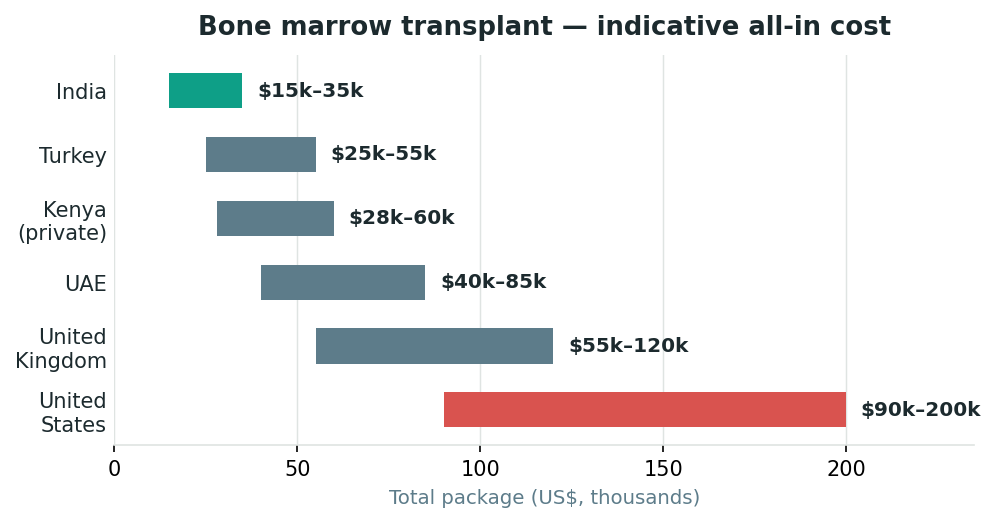
Indicative all-in cost for bone marrow transplant. India sits far below every common alternative.
A bone marrow transplant in a reputable private Indian hospital typically runs US$15,000 to US$35,000 all-in, with matched sibling transplants toward the lower end and complex unrelated-donor or haploidentical cases, which need more extensive typing and monitoring, toward the top. Ask for a quote specific to your donor type and diagnosis.
Four signals that should make you stop and walk away
Not every sibling has been tested. If some siblings were skipped in the initial search, ask specifically why, and whether they can still be tested.
Haploidentical transplant not mentioned as an option. If no matched donor is found, ask whether a half-matched family member has been considered before assuming no donor exists.
No dedicated transplant unit or haematologist named. Ask specifically about the centre's transplant volume and the named haematologist's experience with your donor type.
The price keeps moving. A verbal estimate that shifts each time you ask is not an estimate. Demand a fixed figure in writing, tied to your donor type.
The practical journey from Somalia — plan it before you fly
There is no direct flight between Somalia and India; patients route through Nairobi, Addis Ababa, Dubai or Djibouti. Because there is no full Indian mission inside Somalia, the medical visa is issued through the Embassy of India in Addis Ababa or the High Commission in Nairobi, against a written invitation letter from the treating hospital. Somali patients may bring up to two medical attendants on attendant visas, and a related donor will typically need to travel too. Since your route crosses yellow-fever territory, carry a valid yellow-fever vaccination certificate. Above every other instruction: begin sibling and family HLA typing as early as possible, even before travel is arranged, since this single step often determines the entire timeline that follows.
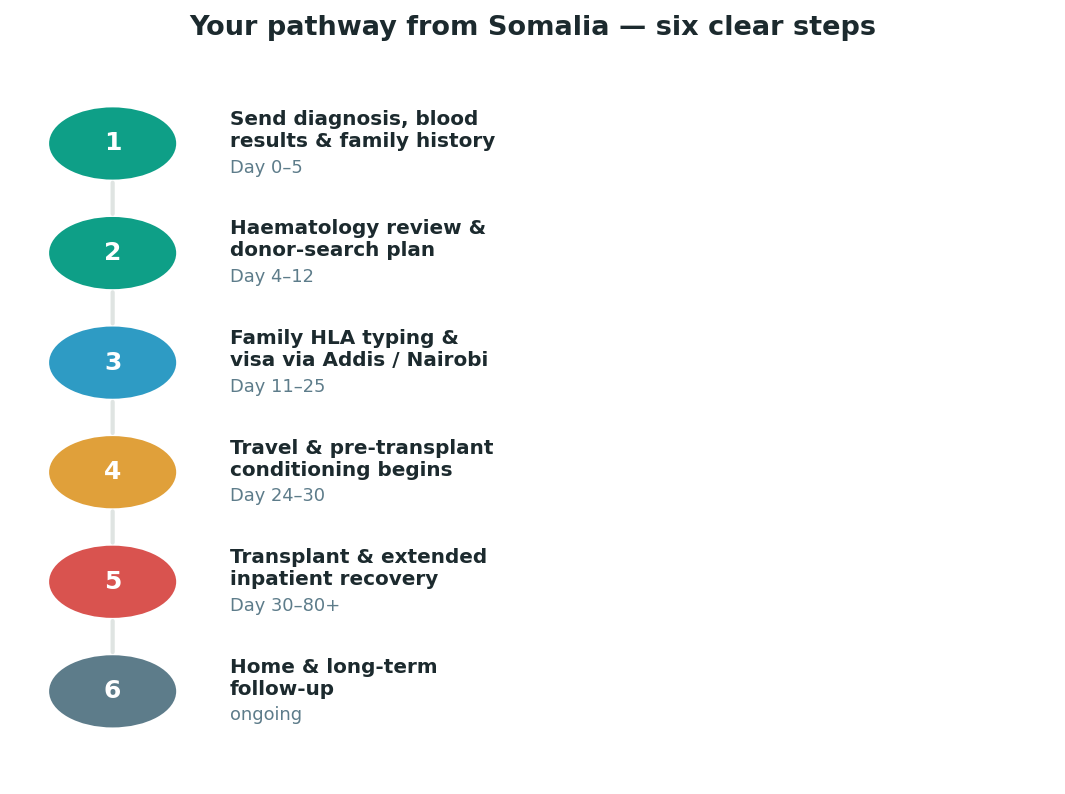
The complete route, start to finish — recovery after transplant is extended and closely monitored.
The search is not as hopeless as the registry numbers suggest
A 29% chance through an international registry is a real and serious gap, not a reason to give up before the family search has even started. Between siblings, parents, children and half-matched relatives, most patients have a realistic donor path available — the work is in finding it properly, not in assuming it does not exist.
Sources & useful links
- 🌐 Indian medical visa (Somali nationals) — indianvisaonline.gov.in
- 🌐 Embassy of India, Addis Ababa — eoiaddisababa.gov.in
- 🌐 High Commission of India, Nairobi — hcinairobi.gov.in
- 🌐 Yellow-fever requirements — who.int/health-topics/yellow-fever
- 🌐 Hospital accreditation (India) — nabh.co · jointcommissioninternational.org
- 🌐 Verify a surgeon's registration — nmc.org.in
Do not decide alone, and do not decide blind
If you want your case reviewed properly and an honest written plan — including a genuine strategy for the donor search itself — that is precisely the independent guidance I provide, without a single hospital's interest attached to my advice. Dr. Dheeraj Bojwani · Independent medical travel advisor
Frequently Asked Questions by Somali Patients about Bone Marrow Transplant Treatment in India
Should Somali patients begin HLA donor testing before travelling to India?
Yes. The guide recommends starting family HLA typing as early as possible, even before travel arrangements, because donor identification can affect the treatment timeline.
What are the chances of finding a matched sibling donor for a Somali patient?
A full sibling has a 25% chance of being a complete HLA match. Testing additional siblings increases the cumulative chance of finding a suitable match.
Why is family donor testing especially important for Somali patients?
The guide cites approximately a 29% chance of finding a fully matched available donor through international registries for patients of African ancestry, making family donor testing particularly important.
What can Somali patients do if no fully matched donor is available?
A haploidentical transplant using a half-matched parent, child or sibling may be considered when medically appropriate.
What is the cost of bone marrow transplant in India for Somali patients?
The guide gives an indicative cost of US$15,000–US$35,000, depending on the diagnosis, donor type, testing and monitoring requirements.
What should Somali patients check before choosing a bone marrow transplant hospital in India?
They should check for a dedicated transplant unit, protected rooms, reliable blood-bank support and graft-versus-host disease management, along with the experience of the transplant team.
Should all available siblings be tested for HLA matching?
The guide recommends testing every sibling who can safely be tested because the likelihood of finding a matched sibling increases as more siblings are evaluated.
What warning signs should Somali patients watch for when selecting a transplant centre?
Patients should be cautious if not all siblings are tested, haploidentical transplantation is not discussed, no dedicated transplant specialist is identified, or the quoted treatment cost keeps changing.
What should Somali patients arrange before travelling to India for treatment?
Patients should arrange medical records, family HLA testing, a hospital invitation, medical visa requirements and travel plans. Yellow-fever vaccination requirements should also be checked according to the travel route.
How should Somali patients plan recovery and follow-up after bone marrow transplant in India?
Recovery can extend well beyond the initial transplant admission. Patients should plan for extended inpatient recovery, long-term monitoring and continued follow-up after returning home.
Page Summary
This guide explains the key considerations for Somali patients exploring bone marrow transplant treatment in India, with particular emphasis on early donor search and HLA testing, given the lower international-registry matching probability cited for patients of African ancestry. It also covers haploidentical transplantation, transplant costs, supportive-care requirements, warning signs when selecting a centre, visa and travel planning, and long-term follow-up, with the six-step patient pathway outlining the process from medical-record submission and donor assessment through travel, transplantation, recovery and ongoing care.
Citation Block
| Topic | Information |
|---|---|
| Topic Information | Bone Marrow Transplant Treatment in India for Patients from Somalia |
| Treatment | Bone Marrow / Stem Cell Transplantation |
| Intended Audience | Patients from Somalia |
| Main Conditions | Leukaemia, certain lymphomas, aplastic anaemia, severe inherited blood or immune disorders |
| Key Specialist | Haematology / Bone Marrow Transplant Specialist |
| Donor Strategy | Full sibling HLA testing; haploidentical donor may be considered |
| Sibling Match | 25% chance with one full sibling |
| Registry Match | Approximately 29% cited for patients of African ancestry |
| Indicative Cost | US$15,000–US$35,000 |
| Hospital Requirement | Dedicated transplant unit with strong supportive-care facilities |
| Important Checks | Blood-bank support, protected rooms and graft-versus-host disease management |
| Travel Planning | Hospital invitation, visa arrangements and route planning |
| Patient Journey | HLA testing → medical review → travel/conditioning → transplant → recovery and follow-up |
| Follow-Up | Extended recovery and long-term monitoring |


Our Mission Statement
Our mission is to place patients at the centre of every healthcare decision by providing trustworthy, evidence-based, and unbiased medical information. We believe that informed patients make better decisions. Backed by personalised guidance from our experienced advisory team, we help patients understand their treatment options, compare them objectively, and confidently choose the path that best suits their medical needs and personal circumstances.
Patient Testimonials from Somalia




Ready to Take the First Step?
Share your Medical Reports with our Healthcare Managers Today and Get a FREE CONSULTATION, a Personalized Treatment Plan, and Complete Support from Arrival to Recovery.
Get Your Free ConsultationAreas We Serve
This resource has been thoughtfully prepared for patients from Somalia who are considering medical treatment in India. We also welcome patients from the wider region in the countries mentioned below-
We assist patients from:
- Ethiopia
- Djibouti
- Yemen
- Kenya
- Seychelles
- Somalia
- South Sudan
- Tanzania
- Uganda
- Zambia
- Zimbabwe
- Angola
- Cameroon
- Central African Republic
Many of the insights, treatment pathways, hospital recommendations, travel guidance, and patient support services described here are equally relevant and may be used as a reference when planning treatment in India.
From Somalia to India: Your Complete Patient Support Guide
- Best Brain Tumour Surgeons & Hospitals in India for Somali Patients
- Best Cancer Treatment Surgeons & Hospitals in India for Somali Patients
- Best Cardiac Surgeons & Hospitals in India for Somali Patients
- Best CyberKnife Teams & Centres in India for Somali Patients
- Best Heart Valve Replacement Surgeons & Hospitals in India for Somali Patients
- Best Hip Surgeons & Hospitals in India for Somali Patients
- Best Knee Surgeons & Hospitals in India for Somali Patients
- Best Neurosurgeons & Hospitals in India for Somali Patients
- Best Paediatric Cardiac Surgeons & Hospitals in India for Somali Patients
- Best Paediatric Neurosurgeons & Hospitals in India for Somali Patients
- Best Spine Surgeons & Hospitals in India for Somali Patients
- Bariatric Surgery in India for Patients from Somalia
- Brain Tumour Surgery in India for Patients from Somalia
- Cancer Treatment and Surgery in India for Patients from Somalia
- Cardiac Surgery in India for Patients from Somalia
- Cosmetic and Plastic Surgery in India for Patients from Somalia
- CyberKnife Treatment in India for Patients from Somalia
- Dental Surgery in India for Patients from Somalia